
ACCT-412 · Lesson 5 of 12 · 23 min
Tangible capital assets, asset retirement obligations and contaminated sites
Tangible capital assets dominate a municipality's statement of financial position: Aspen Ridge's $186 million of tangible capital assets is about 87 per cent of its total assets. Until 2009, Canadian local governments did not record them at all; they expensed capital spending as it occurred, which made it impossible to see the cost of using infrastructure or the condition of the asset base. PS 3150 Tangible Capital Assets changed that. This lesson covers PS 3150, the related obligations to retire assets under PS 3280 Asset Retirement Obligations, the liability for contaminated sites under PS 3260, and related topics such as public private partnerships and intangibles.
Recognizing and measuring tangible capital assets
Tangible capital assets are non-financial assets with physical substance that are held for use in the production or supply of goods and services, for rental to others, for administrative purposes or for the development, construction, maintenance or repair of other tangible capital assets; have useful lives extending beyond an accounting period; are intended to be used on a continuing basis; and are not for sale in the ordinary course of operations. They include land, buildings, engineered structures such as roads, bridges and water mains, machinery and vehicles. They are recorded at cost, which includes amounts directly attributable to acquisition, construction, development or betterment, and contributed assets are recorded at fair value at the date of contribution. Capitalization thresholds, set by each government, keep small items out of the asset register.
Amortization allocates the cost, less residual value, over the asset's useful life in a rational and systematic manner, usually straight-line. Major components with different useful lives, such as a road's base and surface, are often amortized separately. Land is not amortized. PS 3150 requires write-downs when conditions indicate that an asset no longer contributes to the ability to provide services or that the value of future economic benefits is less than net book value; the write-down is an expense and is not reversed. Because there is no market test of the asset's value, write-downs are infrequent, usually following damage, obsolescence or a decision to stop using an asset.
# Tangible capital asset continuity and an asset retirement obligation for the
# invented City of Aspen Ridge, Saskatchewan, 2027 (thousands of dollars).
# class: (opening cost, opening accumulated amortization, additions, useful life)
classes = {
    "Land":                      (22_000,      0,    560, None),
    "Land improvements":         (14_000,  5_600,    900, 20),
    "Buildings":                 (52_000, 18_200,  1_400, 50),
    "Roads, bridges and paths":  (88_000, 30_000,  6_200, 45),
    "Water and sewer networks":  (61_000, 18_700,  3_400, 60),
    "Machinery and equipment":   (21_000, 11_600,  1_000, 15),
    "Vehicles":                  (12_800,  7_100,    840, 10),
}
disposal_nbv = 300                   # a retired grader, net book value
tot = {"cost": 0, "acc": 0, "add": 0, "amort": 0}
print(f"{'Class':26}{'Opening NBV':>12}{'Additions':>10}{'Amort.':>8}{'Closing NBV':>12}")
for c, (cost, acc, add, life) in classes.items():
    amort = 0 if life is None else round(cost / life + add / life / 2)   # half-year rule
    print(f"{c:26}{cost - acc:>12,}{add:>10,}{amort:>8,}{cost - acc + add - amort:>12,}")
    tot["cost"] += cost; tot["acc"] += acc; tot["add"] += add; tot["amort"] += amort
closing = tot["cost"] - tot["acc"] + tot["add"] - tot["amort"] - disposal_nbv
print(f"{'Total (after disposal)':26}{tot['cost'] - tot['acc']:>12,}{tot['add']:>10,}{tot['amort']:>8,}{closing:>12,}")

# Asset retirement obligation: closing and monitoring the landfill, and removing
# asbestos from the old water plant; cash flows expected in 2035, discounted at 4%.
undiscounted, rate, years = 1_916, 0.04, 8
pv = undiscounted / (1 + rate) ** years
print(f"\nARO at 31 Dec 2027: {pv:,.0f}")
for y in range(2028, 2031):
    acc = pv * rate
    print(f"  {y}: accretion expense {acc:,.0f}, closing liability {pv + acc:,.0f}")
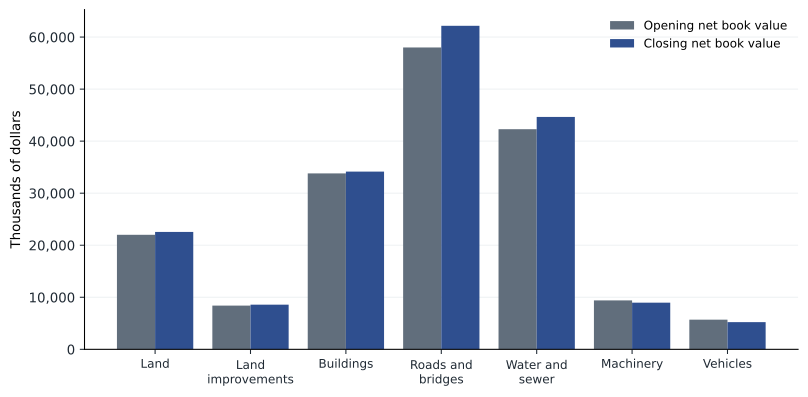
pv += accClass Opening NBV Additions Amort. Closing NBV Land 22,000 560 0 22,560 Land improvements 8,400 900 722 8,578 Buildings 33,800 1,400 1,054 34,146 Roads, bridges and paths 58,000 6,200 2,024 62,176 Water and sewer networks 42,300 3,400 1,045 44,655 Machinery and equipment 9,400 1,000 1,433 8,967 Vehicles 5,700 840 1,322 5,218 Total (after disposal) 179,600 14,300 7,600 186,000 ARO at 31 Dec 2027: 1,400 2028: accretion expense 56, closing liability 1,456 2029: accretion expense 58, closing liability 1,514 2030: accretion expense 61, closing liability 1,575
The program builds Aspen Ridge's 2027 continuity schedule. Opening net book value of $179.6 million plus additions of $14.3 million less amortization of $7.6 million and the $300,000 net book value of a retired grader gives closing net book value of $186.0 million. The city uses the half-year rule for additions. Roads, bridges and paths, the largest class, received $6.2 million of additions as the city continued its pavement program. The second part measures the asset retirement obligation explained below: $1.4 million at the end of 2027, growing by accretion each year.
Asset retirement obligations: PS 3280
PS 3280, effective for fiscal years beginning on or after 1 April 2022, requires a government to recognize a liability for an asset retirement obligation when there is a legal obligation to incur retirement costs for a tangible capital asset, the past transaction or event giving rise to the liability has occurred, it is expected that future economic benefits will be given up, and a reasonable estimate can be made. Legal obligations arise from legislation, contracts and promissory estoppel. Typical examples for municipalities are closure and post-closure care of landfills (PS 3280 replaced the former landfill section, PS 3270), removal of asbestos and other hazardous materials from buildings, and decommissioning of fuel tanks and water and wastewater facilities.
When an ARO is recognized, the estimated cost is added to the carrying amount of the related tangible capital asset and amortized over its remaining useful life; if the asset is no longer in productive use, the cost is expensed. The liability is measured at the best estimate of the expenditures required to retire the asset, and PS 3280 allows discounting when cash flows are expected over extended future periods; a present value technique is often the best method. The liability then increases each year by accretion expense. In the program, Aspen Ridge expects to spend $1.9 million in 2035 to close its landfill cell and remove asbestos from the old water plant; discounted at 4 per cent, the obligation is $1.4 million at the end of 2027, and accretion expense is $56,000 in 2028.
Contaminated sites, P3s and intangibles
PS 3260 Liability for Contaminated Sites requires a liability for remediation of contamination when, at the financial statement date, an environmental standard exists, contamination exceeds it, the government is directly responsible or accepts responsibility, future economic benefits will be given up, and a reasonable estimate can be made. Unlike PS 3280, it covers sites not in productive use, or sites in productive use where an unexpected event caused contamination. A municipality's abandoned works yard with fuel spills, or a tax-sale property it took over, may require a liability. Since PS 3280, contamination associated with retiring an asset in productive use falls under the ARO standard instead.
Two newer PSAS sections also affect capital assets. PS 3160 Public Private Partnerships, effective for fiscal years beginning on or after 1 April 2023, requires a public sector entity to recognize infrastructure procured through a P3 when it controls the purpose and use of the asset, access to it and the price of any products or services, and controls any significant interest in the asset at the end of the term; it also recognizes a liability under a financial liability model or a user-pay model. Public Sector Guideline 8, Purchased Intangibles, effective at the same time, allows recognition of purchased intangibles such as software licences; PSAB issued an exposure draft on a full intangible assets standard in February 2025 and is deliberating, with a second phase on cloud computing arrangements.
Asset management and disclosure
Recording tangible capital assets was meant to support better decisions about infrastructure, and many provinces now encourage or require municipalities to prepare asset management plans. In some provinces, such as Ontario under its asset management planning regulation, plans are mandatory; in others, they are tied to infrastructure funding programs, such as the Canada Community-Building Fund, which encourages asset management. Notes to the statements disclose cost, accumulated amortization, additions and disposals by class, the amortization methods and lives, contributed assets, assets under construction and write-downs. Ratios such as net book value to cost, which lesson 12 uses, give a rough sense of the remaining life of the asset base.
| Topic | Standard | Main requirement |
|---|---|---|
| Tangible capital assets | PS 3150 | Cost, amortized over useful life; write-downs not reversed |
| Asset retirement obligations | PS 3280 | Liability at best estimate, often discounted; cost added to asset |
| Contaminated sites | PS 3260 | Liability for remediation of sites not in productive use |
| Public private partnerships | PS 3160 | Recognize controlled infrastructure and a liability |
| Purchased intangibles | PSG-8 (interim) | May recognize; full standard under development |
Infrastructure deficits and renewal funding
Recording tangible capital assets at historical cost has a limitation: amortization based on decades-old costs understates what it costs to replace the assets today. A water main installed in 1975 for $200,000 might cost $1.5 million to replace, so amortization of the original cost tells council little about the money it must set aside. Many municipalities therefore supplement the statements with asset management information: replacement values, condition ratings and the annual investment needed to maintain service levels. Comparing that investment with actual capital spending reveals an infrastructure gap. For Aspen Ridge, annual amortization of $7.6 million compares with an asset management plan estimate of about $11 million a year needed to sustain current service levels, which is why council is building its reserves and why the ratio of net book value to cost keeps falling.
Funding programs from senior governments respond to these gaps. The Canada Community-Building Fund, formerly the federal Gas Tax Fund, provides predictable federal funding to municipalities through provincial and territorial agreements for eligible infrastructure, and the Canada Housing Infrastructure Fund and provincial programs add targeted support. Because each program has its own stipulations, municipalities track the eligible spending against each agreement, which links the capital asset records to the transfer revenue recognition discussed in lesson 4. Auditors test both together: an addition to tangible capital assets funded by a transfer should match the revenue recognized as stipulations are met.
Disclosure of tangible capital assets by class, as in the program's schedule, is required by PS 3150, along with the amortization methods and useful lives, the amount of contributed assets recognized in the year, the nature and use of assets recognized at nominal value, works of art and historical treasures (which are not recognized as assets but disclosed), and write-downs. These disclosures let users see the scale and composition of the asset base and, combined with asset management information, judge whether it is being maintained.
Worked problem
Recognizing an ARO
Aspen Ridge owns a 1970s arena containing asbestos. Provincial regulations require removal before demolition. Engineers estimate removal will cost $600,000 when the arena is decommissioned in 2034. The arena's net book value is $1.2 million, with seven years of remaining life, and the city's discount rate is 4 per cent. The city had not previously recognized the obligation. How is it recorded at 31 December 2027, and what expenses arise in 2028?
Show solution
- The legal obligation exists from the regulation and the asbestos's presence, so the city recognizes an ARO.
- Present value: $600,000 ÷ 1.04^7 = about $455,950.
- If adopted with retroactive or prospective transition under PS 3280's transitional provisions, the amount is added to the arena's carrying amount and recognized as a liability.
- In 2028, accretion expense is about $455,950 × 4% = $18,240, and the added cost is amortized over the remaining seven years, about $65,140 a year.
- If the arena were no longer in productive use, the cost would be expensed immediately instead.
Answer: ARO about $455,950 added to the arena; 2028 accretion about $18,240 and extra amortization about $65,140.
Common mistakes
MistakeExpensing capital spending as if before 2009.
InsteadPS 3150 requires capitalization and amortization.
MistakeUsing PS 3260 for asbestos in a building in productive use.
InsteadThat is an asset retirement obligation under PS 3280.
MistakeReversing a write-down when conditions improve.
InsteadPS 3150 write-downs are not reversed.
MistakeRecording a P3 asset only when the contract ends.
InsteadPS 3160 requires recognition when control criteria are met, during construction.
MistakeForgetting contributed assets from developers.
InsteadContributed tangible capital assets are recorded at fair value.
Summary and key terms
- PS 3150 requires tangible capital assets at cost, amortized over useful lives.
- Contributed assets are recorded at fair value; land is not amortized.
- Write-downs are recognized when service potential declines and are not reversed.
- PS 3280 requires AROs for legal obligations, measured at best estimate, often discounted.
- PS 3260 covers remediation of sites not in productive use.
- PS 3160 governs P3s; PSG-8 allows purchased intangibles.
- Aspen Ridge: closing net book value $186.0 million; amortization $7.6 million.
- Aspen Ridge ARO $1.4 million; accretion $56,000 in 2028.
- Tangible capital asset
- A non-financial asset with physical substance used to provide services over more than one period.
- Asset retirement obligation
- A legal obligation associated with the retirement of a tangible capital asset.
- Accretion expense
- The increase in a discounted liability due to the passage of time.
- Contaminated site
- A site where contamination exceeds an environmental standard.
- Public private partnership
- An arrangement in which a private partner designs, builds, finances and possibly operates infrastructure for a public sector entity.
- Write-down
- A reduction in the carrying amount of a tangible capital asset when it no longer contributes to service.
- Useful life
- The period over which an asset is expected to be used.
- Capitalization threshold
- The minimum cost for an item to be recorded as a capital asset.
Practice problems
Work each problem on paper first, then reveal the answer to check.
What was the net book value of Aspen Ridge's tangible capital assets at 31 December 2027?
Show answer
$186.0 million.
Name three typical municipal AROs.
Show answer
Landfill closure and post-closure care, asbestos removal and decommissioning of tanks or treatment plants.
Why does the ARO liability grow each year?
Show answer
Accretion: the discount unwinds with the passage of time.
When does PS 3260 apply rather than PS 3280?
Show answer
For contamination of sites not in productive use, or from unexpected events.
What happens to the cost added to an asset for an ARO?
Show answer
It is amortized over the asset's remaining useful life.
What controls must exist for a government to recognize a P3 asset?
Show answer
Control of purpose, use, access and price, and of any significant residual interest at the end of the term.
What is the status of PSAB's intangible assets project?
Show answer
An exposure draft was issued in February 2025 and is under deliberation; a later phase covers cloud computing.
In the program, what amortization did roads, bridges and paths have?
Show answer
$2,024,000.
Lesson quiz · 5 questions
Score 60% or more to complete this lesson.
Create a free account to save your progress, take quizzes and earn a certificate.