
ACCT-412 · Lesson 8 of 12 · 23 min
Employee benefits, debt and financial instruments
After tangible capital assets, a government's largest long-term items are usually its debt and its obligations to employees. Municipal employees in Saskatchewan typically belong to a multi-employer pension plan, accumulate sick leave and may be entitled to retirement allowances; larger governments sponsor their own defined benefit plans. PS 3250 Retirement Benefits and PS 3255 Post-Employment Benefits, Compensated Absences and Termination Benefits govern these obligations; PSAB is replacing both with a new section, PS 3251, and issued a re-exposure draft in October 2024. This lesson also covers long-term debt, including municipal borrowing limits, and PS 3450 Financial Instruments.
Retirement benefits under PS 3250
PS 3250 distinguishes defined contribution plans, where the employer's obligation is limited to its contributions and the expense equals the contributions for the period, from defined benefit plans, where the employer promises a benefit based on salary and service. For a defined benefit plan, the government recognizes a liability (or asset) equal to the accrued benefit obligation, measured by an actuary using the projected benefit method prorated on services and management's best-estimate assumptions, less plan assets at market-related value, adjusted for unamortized actuarial gains and losses. Actuarial gains and losses are amortized over the expected average remaining service life of the employee group, so the statements smooth the effect of market swings and assumption changes. A valuation allowance limits any net asset.
Many municipal employees in Saskatchewan belong to the Municipal Employees' Pension Plan, a multi-employer defined benefit plan. Because the plan does not allocate assets and obligations to individual employers in a way that allows defined benefit accounting, participating municipalities account for it as a defined contribution plan: the expense equals the contributions required for the year, and the note discloses the plan's status. In the program, Aspen Ridge's pension expense is therefore its $2.05 million of employer contributions. The city also has obligations for accumulating sick leave and a retirement allowance, which it accounts for under PS 3255.
# Debt, employee future benefits and portfolio investments for the invented City
# of Aspen Ridge, Saskatchewan, 2027 (thousands of dollars; illustrative).
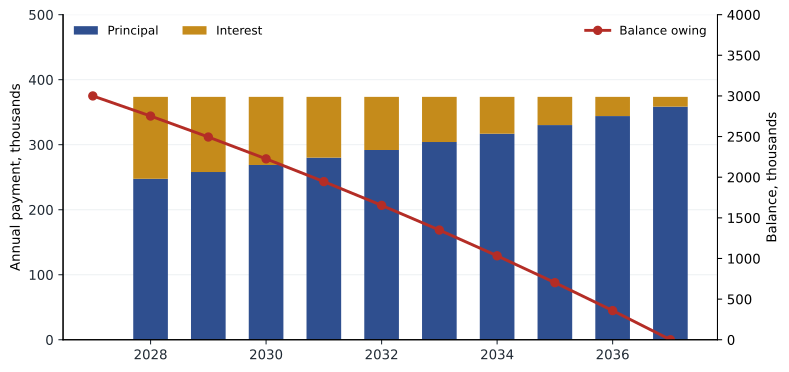
# 1) New 3,000 debenture for the water plant upgrade: 10 years, 4.2%, blended payments
P, r, n = 3_000, 0.042, 10
pmt = P * r / (1 - (1 + r) ** -n)
print(f"Annual blended payment {pmt:,.1f}")
bal = P
for year in range(2028, 2031):
    interest = bal * r
    bal -= pmt - interest
    print(f"  {year}: interest {interest:,.1f}, principal {pmt - interest:,.1f}, balance {bal:,.1f}")

# 2) Non-vesting accumulating sick leave and retirement allowances (PS 3255)
opening, current_service, interest_cost, benefits_paid, actuarial_loss = 1_816, 160, 70, -150, 40
amortized_loss = actuarial_loss / 10       # over expected average remaining service life
closing_obligation = opening + current_service + interest_cost + benefits_paid + actuarial_loss
unamortized_loss = actuarial_loss - amortized_loss
liability = closing_obligation - unamortized_loss
print(f"\nAccrued benefit obligation {closing_obligation:,.0f}; unamortized actuarial loss {unamortized_loss:,.0f}")
print(f"Liability reported {liability:,.0f}; expense {current_service + interest_cost + amortized_loss:,.0f}")

# 3) The multi-employer pension plan is accounted for as a defined contribution plan
print("Pension expense = employer contributions to the multi-employer plan: 2,050")

# 4) Portfolio investments in equities measured at fair value (PS 3450)
fair_value_open, fair_value_close = 5_250, 5_400
print(f"\nUnrealized gain for 2027 to accumulated remeasurements: {fair_value_close - fair_value_open:,}")Annual blended payment 373.6 2028: interest 126.0, principal 247.6, balance 2,752.4 2029: interest 115.6, principal 258.0, balance 2,494.5 2030: interest 104.8, principal 268.8, balance 2,225.7 Accrued benefit obligation 1,936; unamortized actuarial loss 36 Liability reported 1,900; expense 234 Pension expense = employer contributions to the multi-employer plan: 2,050 Unrealized gain for 2027 to accumulated remeasurements: 150
The program shows four items. The new $3.0 million debenture for the water plant upgrade, at 4.2 per cent for 10 years, requires blended annual payments of about $373,600, of which $126,000 is interest in 2028. The sick leave and retirement allowance obligation is $1.94 million, but because $36,000 of a 2027 actuarial loss remains unamortized, the liability reported is $1.9 million and the expense $234,000. Pension expense equals contributions to the multi-employer plan. Finally, the city's equity investments rose by $150,000 in fair value, a remeasurement gain reported in accumulated remeasurements, as lesson 3 showed.
Post-employment benefits and compensated absences
PS 3255 covers benefits other than pensions: post-employment benefits such as retiree health and dental care, compensated absences such as vesting and accumulating non-vesting sick leave, and termination benefits. For benefits that accumulate with service, such as sick leave that can be carried forward and used later, the obligation is measured actuarially, reflecting the expected use of accumulated days; benefits that do not accumulate, such as parental leave, are recognized when the event occurs. Retirement allowances, lump-sum payments at retirement based on years of service, are accrued over service. In 2027 Aspen Ridge recognized a $40,000 actuarial loss from a change in the expected use of sick leave; under PS 3255, it amortizes the loss over 10 years.
PSAB's employee benefits project would change much of this. Its October 2024 re-exposure draft of PS 3251 proposes to replace PS 3250 and PS 3255, and among other changes would end the deferral and amortization of actuarial gains and losses, requiring remeasurements to be recognized in net assets, and would revise the discount rate guidance. Because the board is still deliberating, the timing and final content are uncertain. Students should know the current model and recognize that the smoothing it allows is likely to be removed.
Long-term debt and borrowing limits
Municipal borrowing is closely controlled by provincial law. In Saskatchewan, a city may borrow within a debt limit and generally requires approval of the Saskatchewan Municipal Board for borrowing that exceeds it, and long-term borrowing usually requires a bylaw. Debt is recorded at amortized cost; debentures are often issued with blended payments of principal and interest, as in the program, or as serial debentures with a portion maturing each year. Some provinces provide financing through central agencies; in Ontario, for example, Infrastructure Ontario lends to municipalities. The notes disclose the terms, interest rates, maturities and principal repayments for the next five years, and many municipalities also disclose the debt limit and the amount used.
PS 3450 Financial Instruments, effective for fiscal years beginning on or after 1 April 2022, together with PS 2601 Foreign Currency Translation and PS 3041 Portfolio Investments, governs financial instruments. Derivatives and portfolio investments in equity instruments quoted in an active market must be measured at fair value; other financial instruments are measured at cost or amortized cost unless the government elects fair value for a group managed on a fair value basis. Unrealized gains and losses go to the statement of remeasurement gains and losses, which under PS 1202 becomes a component of the statement of changes in net assets, and are reclassified to the statement of operations when realized. Impairments that are other than temporary are recognized in the annual surplus.
| Obligation | Standard | Measurement | Aspen Ridge 2027 |
|---|---|---|---|
| Multi-employer defined benefit pension | PS 3250 | Defined contribution accounting: contributions | Expense $2.05 million |
| Sick leave and retirement allowances | PS 3255 | Actuarial obligation less unamortized losses | Liability $1.9 million |
| Long-term debt | PS 3450, debt notes | Amortized cost | $18.2 million including new $3.0 million debenture |
| Equity investments | PS 3450 | Fair value; gains to remeasurements | Gain $150,000 |
| Asset retirement obligations | PS 3280 | Best estimate, discounted | $1.4 million |
Debt management and credit ratings
Municipalities borrow to spread the cost of long-lived assets over the taxpayers who use them, but borrowing creates fixed charges that reduce future flexibility. Debt management policies typically limit debt charges to a percentage of own-source revenue, set maximum terms no longer than the life of the asset financed and prefer borrowing for renewal or growth projects with identified repayment sources, such as development levies or utility rates. Larger cities obtain credit ratings from agencies such as S&P Global and Moody's, which consider the economy and tax base, financial management, budgetary performance, liquidity, debt and contingent liabilities, and the institutional framework, including provincial oversight. Smaller municipalities often borrow from banks or provincial financing agencies without a rating. Aspen Ridge's debt charges of 3.7 per cent of revenue, which lesson 12 computes, are modest.
Employee benefit obligations are part of the same analysis. Rating agencies add unfunded pension and other benefit liabilities to debt when assessing a government's long-term obligations, so a government with modest debt but large benefit liabilities may be rated lower than its debt suggests. For Aspen Ridge, membership in a multi-employer plan limits its direct exposure, although the plan's funded status still matters: if the plan's sponsors raised contribution rates to address a deficit, the city's pension expense would rise. The note on the multi-employer plan therefore discloses the plan's most recent funded status and the city's contributions, helping readers judge that risk.
The proposed PS 3251 would make benefit obligations more visible in the statements by removing deferral of actuarial gains and losses. Governments that currently carry large unamortized losses would see their liabilities and net financial liabilities increase on adoption, and their net assets fall, although the economic position would be unchanged. Analysts already adjust for unamortized amounts using the note disclosures, so the change would improve transparency without altering the underlying risk.
Finally, debt and benefits interact with intergenerational equity. Borrowing for a 40-year asset spreads its cost over the taxpayers who use it, which many regard as fair; borrowing to fund operating deficits, or underfunding pension and benefit obligations, shifts current costs to future taxpayers. The statements, by reporting liabilities and expenses on an accrual basis, make such shifts visible, which is a central purpose of public sector accounting.
Disclosures about debt and benefits are extensive. Notes show the debt by type, interest rates and maturities, principal payments for each of the next five years, the debt limit and the amount used, the nature of employee future benefits, the actuarial assumptions such as discount rate and salary growth, the date of the most recent valuation, and the components of benefit expense. For multi-employer plans, they show contributions and the plan's funded status. Readers can use these disclosures to judge whether obligations are growing faster than the city's capacity to pay them.
Worked problem
Accounting for a defined benefit plan
A province's capital region transit commission sponsors a single-employer defined benefit plan. At 31 December 2027, the accrued benefit obligation is $84 million; plan assets at market-related value are $79 million; unamortized net actuarial losses are $6 million. What liability or asset is reported, and how would the proposed PS 3251 change the picture?
Show solution
- Funded status: obligation $84 million − assets $79 million = $5 million deficit.
- Under PS 3250, unamortized actuarial losses of $6 million are not yet recognized, so the balance sheet amount is $5 million − $6 million = a net asset of $1 million, subject to a valuation allowance if the commission cannot obtain future benefits from the surplus.
- The losses will be amortized into expense over the expected average remaining service life.
- Under the proposed PS 3251, remeasurements would be recognized immediately in net assets, so the commission would report the $5 million deficit as a liability.
- This illustrates why the proposal matters for governments with large unrecognized losses.
Answer: A net asset of $1 million under PS 3250 (subject to a valuation allowance); a $5 million liability under the PS 3251 proposal.
Common mistakes
MistakeApplying defined benefit accounting to a multi-employer plan that cannot allocate assets.
InsteadAccount for it as a defined contribution plan with disclosure.
MistakeRecognizing all actuarial losses immediately under PS 3250.
InsteadThey are amortized over the expected average remaining service life, for now.
MistakeMeasuring portfolio equities quoted in an active market at cost.
InsteadPS 3450 requires fair value with gains in remeasurements.
MistakeBorrowing beyond the debt limit without approval.
InsteadSaskatchewan cities generally need Saskatchewan Municipal Board approval above the limit.
MistakeAssuming PS 3251 is already in force.
InsteadIt is a re-exposure draft under deliberation.
Summary and key terms
- PS 3250 and PS 3255 govern employee benefits; PS 3251 is proposed to replace them.
- Defined benefit liabilities use the accrued benefit obligation less plan assets, with actuarial gains and losses amortized.
- Multi-employer plans that cannot allocate assets use defined contribution accounting.
- Accumulating sick leave and retirement allowances are measured actuarially.
- Debt is at amortized cost; Saskatchewan cities borrow within debt limits.
- PS 3450 requires fair value for derivatives and quoted equities; gains go to remeasurements.
- Aspen Ridge: pension expense $2.05 million; benefit liability $1.9 million.
- Aspen Ridge: new $3.0 million debenture, payments about $373,600 a year.
- Accrued benefit obligation
- The actuarial present value of benefits attributed to service to date.
- Expected average remaining service life
- The period over which actuarial gains and losses are amortized.
- Multi-employer plan
- A plan in which several employers participate, often without allocation of assets to each.
- Debenture
- A long-term debt instrument issued by a municipality under a bylaw.
- Debt limit
- The maximum debt a municipality may incur without further approval.
- Defined benefit plan
- A plan promising a benefit based on factors such as salary and service.
- Defined contribution plan
- A plan in which the employer's obligation is limited to specified contributions.
- Actuarial gain or loss
- A change in the value of an obligation or assets from experience differing from assumptions or from changes in assumptions.
Practice problems
Work each problem on paper first, then reveal the answer to check.
How does Aspen Ridge account for its multi-employer pension plan?
Show answer
As a defined contribution plan: expense equals contributions of $2.05 million.
Over what period are actuarial gains and losses amortized under PS 3255?
Show answer
The expected average remaining service life of the employee group.
In the program, what is the annual payment on the new debenture?
Show answer
About $373,600.
What would the PS 3251 proposal change?
Show answer
Among other things, it would end deferral of actuarial gains and losses, recognizing remeasurements in net assets.
Where do unrealized gains on quoted equities go?
Show answer
To remeasurement gains and losses, now part of the statement of changes in net assets.
Who approves Saskatchewan city borrowing above the debt limit?
Show answer
The Saskatchewan Municipal Board.
Is the PS 3450 fair value election available?
Show answer
Yes, for groups of financial instruments managed and evaluated on a fair value basis.
What is the reported sick leave and retirement allowance liability?
Show answer
$1.9 million.
Lesson quiz · 5 questions
Score 60% or more to complete this lesson.
Create a free account to save your progress, take quizzes and earn a certificate.