
ACCT-412 · Lesson 10 of 12 · 23 min
Not-for-profit organizations II: financial statements and special topics
Lesson 9 dealt with contributions. This lesson completes the picture of not-for-profit reporting under ASNPO: the statements an organization presents, how it reports net assets, how it accounts for capital assets and allocated expenses, and how it deals with controlled and related entities, combinations and related parties. We finish Riverbend Community Pantry's 2027 statements, prepared under the deferral method, and look at the measures donors and funders use to judge a charity, along with their limitations.
The statements under ASNPO
Section 4400 Financial Statement Presentation by Not-for-Profit Organizations requires a statement of financial position, a statement of operations, a statement of changes in net assets and a statement of cash flows, with notes. The statement of financial position shows assets, liabilities and net assets, with net assets divided into amounts invested in capital assets (if the organization chooses to show them), restricted for endowment purposes, other externally restricted amounts (under the restricted fund method), internally restricted amounts and unrestricted net assets. The statement of operations reports revenues and expenses, normally by object or function. The statement of changes in net assets reconciles each class. Under the restricted fund method, the statements present each fund in columns.
Two features of ASNPO statements reflect the deferral method. First, deferred contributions appear as liabilities: amounts restricted for future expenses and deferred capital contributions, which are amortized into revenue as the related assets are amortized. Second, net assets invested in capital assets are often shown separately: capital assets less related debt and less unamortized deferred capital contributions. For Riverbend, the refrigerated truck's $161,000 net book value at 31 December 2027 is exactly matched by $161,000 of deferred capital contributions, so the truck adds nothing to net assets.
Capital assets and allocated expenses
Sections 4433 Tangible Capital Assets Held by Not-for-Profit Organizations and 4434 Intangible Assets Held by Not-for-Profit Organizations require capital assets to be recorded at cost, or at fair value when contributed, and amortized over their useful lives; they require partial write-downs when an asset's fair value or replacement cost is less than its net carrying amount, and organizations with average annual revenues below a threshold may use simpler expensing. Collections, such as artworks held by a museum, are covered by Section 4441 and may be recorded at cost or nominal value. Section 4470 Disclosure of Allocated Expenses by Not-for-Profit Organizations applies when an organization classifies expenses by function and allocates fundraising and general support costs to other functions: it must disclose its allocation policies, the nature of the allocated expenses, the basis of allocation and the amounts allocated.
# Riverbend Community Pantry (invented registered charity), 2027: allocating
# shared costs to functions and disclosing them (ASNPO Section 4470), and the
# statement of financial position under the deferral method (thousands).
direct = {"Food distribution": 2_400 + 605, "School breakfast": 197,
          "Fundraising": 135, "Administration": 73}
shared = {"Executive director": 140, "Rent and utilities": 96, "Information systems": 24}
time_or_space = {   # allocation basis for each shared cost, by function
    "Executive director":  {"Food distribution": .35, "School breakfast": .05, "Fundraising": .25, "Administration": .35},
    "Rent and utilities":  {"Food distribution": .80, "School breakfast": .05, "Fundraising": .05, "Administration": .10},
    "Information systems": {"Food distribution": .40, "School breakfast": .05, "Fundraising": .20, "Administration": .35},
}
alloc = {f: 0.0 for f in direct}
for cost, amount in shared.items():
    for f, share in time_or_space[cost].items():
        alloc[f] += amount * share
print(f"{'Function':20}{'Direct':>8}{'Allocated':>11}{'Total':>8}")
for f in direct:
    print(f"{f:20}{direct[f]:>8,}{alloc[f]:>11,.0f}{direct[f] + alloc[f]:>8,.0f}")
total = sum(direct.values()) + sum(shared.values())
print(f"{'Total (before amortization 23)':20}{total:>27,}")
fund = direct["Fundraising"] + alloc["Fundraising"]
print(f"Fundraising cost per dollar of cash donations: {fund / 1_200:.3f}")
print()
assets = {"Cash": 310, "Investments": 1_480, "Receivables": 45, "Food inventory": 210, "Truck, net": 161}
liabilities = {"Payables": 90, "Deferred contributions (expenses of future periods)": 44,
               "Deferred capital contributions": 161}
net_assets = {"Endowment": 100, "Internally restricted (reserve)": 600,
              "Unrestricted": sum(assets.values()) - sum(liabilities.values()) - 700}
print(f"Total assets {sum(assets.values()):,}; liabilities {sum(liabilities.values()):,}")
for k, v in net_assets.items():
print(f" Net assets, {k.lower()}: {v:,}")Function Direct Allocated Total Food distribution 3,005 135 3,140 School breakfast 197 13 210 Fundraising 135 45 180 Administration 73 67 140 Total (before amortization 23) 3,670 Fundraising cost per dollar of cash donations: 0.150 Total assets 2,206; liabilities 295 Net assets, endowment: 100 Net assets, internally restricted (reserve): 600 Net assets, unrestricted: 1,211
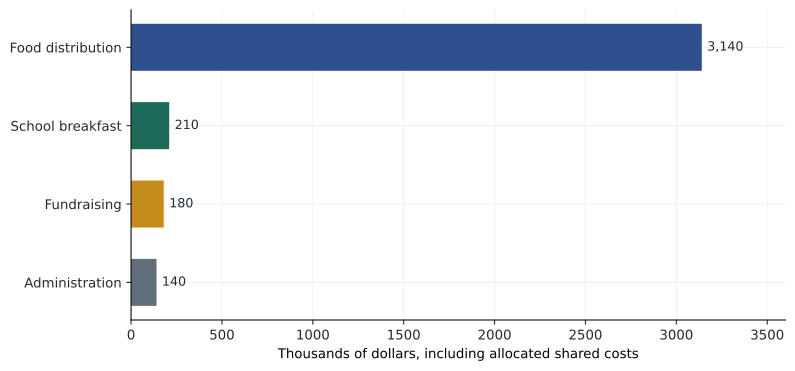
The first part of the program allocates Riverbend's $260,000 of shared costs, the executive director, rent and utilities, and information systems, using time and space studies. After allocation, food distribution costs $3.14 million including donated food, the school breakfast program $210,000, fundraising $180,000 and administration $140,000; with $23,000 of truck amortization in food distribution, total expenses are $3.693 million, matching lesson 9. Section 4470 requires Riverbend to disclose these allocations. The fundraising cost per dollar of cash donations is 15 cents. The second part summarizes the statement of financial position: total assets of $2.206 million, liabilities of $295,000 including $205,000 of deferred contributions, and net assets of $1.911 million, of which $100,000 is endowment, $600,000 internally restricted for an operating reserve and $1.211 million unrestricted.
Controlled entities, combinations and related parties
Many not-for-profits control other organizations: a foundation that raises money for a hospital, a separately incorporated thrift store or a charity's for-profit subsidiary. Section 4450 Reporting Controlled and Related Entities by Not-for-Profit Organizations allows an organization to consolidate controlled not-for-profit organizations, or to disclose information about them instead, including summarized financial information; controlled profit-oriented enterprises may be consolidated or accounted for by the equity method. The AcSB is gathering information on whether to revise Section 4450. Section 4449 Combinations by Not-for-Profit Organizations distinguishes mergers, accounted for by combining carrying amounts from the date of the merger, from acquisitions, accounted for by the acquisition method. Section 4460 Disclosure of Related Party Transactions by Not-for-Profit Organizations requires disclosure of transactions with related parties such as board members and controlled entities.
Related party questions arise often in small organizations. If Riverbend's treasurer owns the warehouse it rents, the rental must be disclosed with its terms, even if the rent is below market. Board members who donate cannot receive benefits that would be private benefit under charity law, a point lesson 11 discusses. Organizations also disclose commitments, contingencies such as grant repayment obligations, and economic dependence: Riverbend depends on one supermarket chain for 40 per cent of its donated food, a fact users need to understand its risks.
Judging a charity by its statements
Donors and watchdog organizations often judge charities by ratios: the share of spending on programs, fundraising cost per dollar raised and months of operating reserves. These are useful but easily misread. Program ratios depend on allocation choices; recognizing donated food makes Riverbend's program share look very high, because $2.4 million of food goes entirely to programs. A charity that invests in good administration, such as financial controls and staff training, may deliver better programs at a higher overhead cost. Reserves that seem large may be restricted or needed for a planned truck replacement. The CRA's guidance on fundraising, discussed in lesson 11, also warns against relying on ratios alone.
Ratios are also affected by the method chosen for restricted contributions and by how capital assets are financed. Under the restricted fund method, Riverbend's excess would be $445,000 rather than $140,000, giving a much stronger impression of results. Users should read the notes on restrictions, allocated expenses and contributed materials before drawing conclusions, and should compare organizations of similar type and size.
| Measure | Riverbend 2027 | Caution |
|---|---|---|
| Program expenses ÷ total expenses | 91 per cent | Inflated by donated food; depends on allocations |
| Fundraising cost per dollar of cash donations | $0.15 | Ignores multi-year campaigns and in-kind support |
| Months of cash expenses held in cash and investments | About 17 | Includes endowment and internally restricted reserve |
| Deferred contributions | $205,000 | Show unspent restricted funds, not free cash |
| Economic dependence | One donor supplies 40 per cent of food | Disclosure required if significant |
Riverbend's statement of operations
Pulling lessons 9 and 10 together, Riverbend's 2027 statement of operations under the deferral method reports revenue of $3,833,000: donations of $1,200,000, contributed food of $2,400,000, the provincial breakfast grant of $210,000 recognized as expenses were incurred, and amortization of deferred capital contributions of $23,000. Expenses of $3,693,000 are presented by function, with the Section 4470 note explaining the allocation of $260,000 of shared costs. The excess of revenue over expenses is $140,000. The statement of changes in net assets shows that excess added to unrestricted net assets, the $100,000 endowment gift added directly to endowment net assets, and a board transfer of $100,000 from unrestricted to internally restricted net assets to build the operating reserve toward its $600,000 target.
The cash flow statement completes the set. Riverbend's operating activities generated cash, because its cash donations and grants exceeded the cash it spent; donated food affects neither receipts nor payments. Investing activities show the $184,000 truck purchase and net purchases of investments. Under ASNPO, restricted contributions for capital assets and endowment contributions may be presented as financing activities, so the $184,000 capital grant and the $100,000 endowment gift appear there. Non-cash contributions, such as donated food and the shelving, are excluded from the cash flow statement and described in the notes.
Finally, the notes tie the statements to the organization's governance. They describe the purpose and tax status of the organization, its accounting policies including the deferral method and the treatment of contributed materials, restrictions on net assets, commitments such as the truck's maintenance contract, the economic dependence on the supermarket chain and the provincial grant, related party transactions, and financial instrument risks such as interest rate risk on the investment portfolio. A reader who works through the notes can see not only what Riverbend did in 2027 but also how dependent it is on a few sources and how it is preparing for the future.
Smaller organizations have simpler options. ASNPO permit organizations with average annual revenues below $500,000 to expense capital assets rather than capitalize and amortize them, provided they disclose the policy and the amounts, and many small charities use review engagements rather than audits. These choices reduce cost while preserving the core information about restrictions and expenses that donors need.
Comparing Riverbend with a similar food bank in another city illustrates the difficulty of benchmarking. If the other organization does not recognize donated food, its program ratio may be closer to 70 per cent, and its revenue far smaller, even if it distributes as much food. Only the notes reveal the difference, which is why careful readers start there.
Worked problem
Allocating shared costs and presenting net assets
A youth charity has $400,000 of direct program costs, $60,000 of direct fundraising costs and $40,000 of direct administration costs. Shared costs are the executive director ($120,000; time: 50 per cent program, 20 per cent fundraising, 30 per cent administration) and rent ($48,000; space: 80 per cent program, 10 per cent fundraising, 10 per cent administration). Compute expenses by function and the disclosure required by Section 4470.
Show solution
- Program: $400,000 + 50% × $120,000 + 80% × $48,000 = $498,400.
- Fundraising: $60,000 + 20% × $120,000 + 10% × $48,000 = $88,800.
- Administration: $40,000 + 30% × $120,000 + 10% × $48,000 = $80,800.
- Total $668,000, which equals the direct and shared costs.
- Section 4470 requires disclosure of the allocation policy (time and space), the nature of the allocated costs and the amounts allocated to each function: $98,400 to programs, $28,800 to fundraising.
Answer: Program $498,400; fundraising $88,800; administration $80,800, with Section 4470 disclosures.
Common mistakes
MistakeShowing a capital asset funded by a capital grant as an increase in net assets under the deferral method.
InsteadDeferred capital contributions offset its net book value.
MistakeAllocating costs without disclosure.
InsteadSection 4470 requires disclosure of policies, bases and amounts.
MistakeForgetting to disclose a controlled foundation that is not consolidated.
InsteadSection 4450 requires disclosure if not consolidated.
MistakeJudging a charity by its program ratio alone.
InsteadAllocations, gifts in kind and restricted contributions all affect ratios; read the notes.
MistakeIgnoring economic dependence on a single donor.
InsteadSignificant dependence must be disclosed.
Summary and key terms
- Section 4400 requires a statement of financial position, operations, changes in net assets and cash flows.
- Net assets are shown as invested in capital assets, endowment, restricted, internally restricted and unrestricted.
- Deferred capital contributions offset assets funded by capital grants.
- Sections 4433 and 4434 govern capital assets; 4441 collections.
- Section 4470 requires disclosure of allocated expenses.
- Section 4450 allows consolidation or disclosure of controlled not-for-profits; 4449 covers combinations.
- Riverbend: net assets $1.911 million; expenses $3.693 million.
- Ratios are useful but depend on allocations, gifts in kind and the treatment of restrictions.
- Deferred capital contributions
- Contributions for capital assets deferred and amortized into revenue at the assets' amortization rate.
- Invested in capital assets
- A category of net assets equal to capital assets less related debt and deferred capital contributions.
- Allocated expenses
- Fundraising and general support costs allocated to other functions.
- Controlled entity
- An entity whose strategic policies the organization can determine without others' cooperation.
- Economic dependence
- Reliance on a particular source of revenue that, if lost, would threaten continued operations.
- Collection
- Works of art, historical treasures or similar assets held for public exhibition or research.
- Program services
- Activities that fulfil the organization's mission.
- Supporting activities
- Management and general, and fundraising activities.
Practice problems
Work each problem on paper first, then reveal the answer to check.
Name the statements required by Section 4400.
Show answer
Statement of financial position, statement of operations, statement of changes in net assets and statement of cash flows.
Why does the truck add nothing to Riverbend's net assets?
Show answer
Its $161,000 net book value is offset by $161,000 of deferred capital contributions.
In the program, what does administration cost after allocation?
Show answer
$140,000.
What does Section 4470 require?
Show answer
Disclosure of allocation policies, nature of costs, bases and amounts allocated.
How can a not-for-profit report a controlled foundation?
Show answer
By consolidating it or by disclosing information about it.
Name two categories of related party disclosure.
Show answer
Transactions with board members and with controlled or related entities.
Why does donated food raise Riverbend's program ratio?
Show answer
All $2.4 million is a program expense, dwarfing administrative and fundraising costs; ASU 2020-07 requires separate presentation and disclosure of such gifts.
What is Riverbend's internally restricted net asset balance?
Show answer
$600,000, for an operating reserve.
Lesson quiz · 5 questions
Score 60% or more to complete this lesson.
Create a free account to save your progress, take quizzes and earn a certificate.