
ACCT-412 · Lesson 2 of 12 · 23 min
The revised PSAS conceptual framework
A conceptual framework is the set of ideas from which a standard setter derives its standards and to which preparers turn when no standard addresses a transaction. For more than three decades the Canadian public sector relied on two short sections, PS 1000 Financial Statement Concepts and PS 1100 Financial Statement Objectives. PSAB replaced them with a revised Conceptual Framework for Financial Reporting in the Public Sector, which applies, together with PS 1202, to fiscal years beginning on or after 1 April 2026, prospectively, with earlier adoption permitted. This lesson explains the framework's main ideas, the elements of the financial statements, and the distinction between financial and non-financial items that gives public sector statements their distinctive shape.
Objectives and users
The framework states that the objective of public sector financial reporting is to provide information useful to users for accountability and decision making. The users are the public and their elected representatives, as well as lenders, other governments and oversight bodies. Unlike the business frameworks of IFRS and ASPE, which focus on providers of capital, the public sector framework puts the public first and emphasizes accountability for the stewardship of public resources. It asks financial statements to help users assess the entity's financial position and its changes, the cost of services and how they were financed, the entity's performance against its budget, and whether it can continue to meet its service commitments and obligations.
Qualitative characteristics in the framework are familiar from business reporting: relevance, faithful representation, understandability, comparability, verifiability and timeliness, constrained by the cost of providing the information. Two public sector themes stand out. The first is the importance of the budget as a basis for accountability. The second is the long-term perspective: governments exist indefinitely and provide services that must be financed across generations, so information about the sustainability of services and the burden passed to future taxpayers is relevant.
Elements of the financial statements
The revised framework defines the elements of the financial statements. An asset is an economic resource controlled by the entity as a result of past events from which future economic benefits are expected; for a government, benefits include service potential, not only cash flows. A liability is a present obligation of the entity to others arising from past events whose settlement is expected to result in an outflow of economic resources. Revenue and expenses are increases and decreases in economic resources, other than those arising from transactions that affect net assets directly. Net assets are the residual of assets minus liabilities. Under PS 1202, net assets have three components: accumulated surplus or deficit, accumulated remeasurement gains and losses, and a new component called accumulated other, which holds amounts that other standards require to be recognized directly in net assets.
The framework also explains recognition and measurement. An item is recognized when it meets the definition of an element and can be measured in a way that achieves faithful representation. Measurement bases include historical cost, which remains the basis for tangible capital assets, and fair value or current value where standards require, such as for portfolio investments in equities and derivatives under PS 3450. Changes in fair value of such items are remeasurement gains and losses that go to accumulated remeasurements, not to the annual surplus, until the item is derecognized.
Financial and non-financial items
Public sector statements divide assets into financial and non-financial. A financial asset is an asset that could be used to discharge existing liabilities or finance future operations and is not for consumption in the normal course of operations: cash, receivables, portfolio investments and loans. A non-financial asset is held to provide future services: tangible capital assets, inventories of supplies and prepaid expenses. PS 1202 extends the idea to liabilities, distinguishing financial liabilities, which will be settled with financial assets, from non-financial liabilities, which will be settled by providing goods or services, such as some deferred revenue. Classifying a liability may require judgment, and PSAB's guidance on the distinction is new, so expect practice to develop.
Why does the distinction matter? Because net financial assets or liabilities, the difference between financial assets and financial liabilities, measure the extent to which past transactions will be paid for by future revenue. A government can have large net assets, because it owns roads and buildings, and still be in a weak financial position, because roads cannot be sold to pay its debts. Before PS 1202, the indicator was called net debt and used all liabilities. PS 1202 renames it, computes it from financial liabilities only and presents it in a new statement of net financial assets or net financial liabilities.
# Classifying items for the invented City of Aspen Ridge, Saskatchewan (thousands).
# PS 1202 measures net financial assets (liabilities) from financial assets and
# financial liabilities only. Classifying a liability requires judgment; here the
# deferred revenue is assumed to be settled by providing services.
items = [
    ("Cash and short-term deposits",        8_400,  "financial asset"),
    ("Portfolio investments",              14_000,  "financial asset"),
    ("Property taxes receivable",           1_600,  "financial asset"),
    ("Grants and other receivables",        3_000,  "financial asset"),
    ("Tangible capital assets, net",      186_000,  "non-financial asset"),
    ("Inventories of supplies",               600,  "non-financial asset"),
    ("Prepaid insurance",                     400,  "non-financial asset"),
    ("Accounts payable and accrued",        6_200,  "financial liability"),
    ("Employee benefit obligations",        1_900,  "financial liability"),
    ("Asset retirement obligations",        1_400,  "financial liability"),
    ("Long-term debt",                     18_200,  "financial liability"),
    ("Deferred revenue (services owed)",    2_300,  "non-financial liability"),
]
t = {}
for name, amount, kind in items:
    t[kind] = t.get(kind, 0) + amount
fa, nfa = t["financial asset"], t["non-financial asset"]
fl, nfl = t["financial liability"], t["non-financial liability"]
print(f"Financial assets            {fa:>9,}")
print(f"Financial liabilities       {fl:>9,}")
print(f"Net financial liabilities (PS 1202)   {fl - fa:>6,}")
print(f"Old net debt (all liabilities)        {fl + nfl - fa:>6,}")
print(f"Net assets                  {fa + nfa - fl - nfl:>9,}")
print()
# Effect of selling 5,000 of investments to buy a new snow-removal fleet
fa2, nfa2 = fa - 5_000, nfa + 5_000
print("After buying 5,000 of equipment with investments:")
print(f"Net financial liabilities {fl - fa2:,}; net assets {fa2 + nfa2 - fl - nfl:,} (unchanged)")Financial assets 27,000 Financial liabilities 27,700 Net financial liabilities (PS 1202) 700 Old net debt (all liabilities) 3,000 Net assets 184,000 After buying 5,000 of equipment with investments: Net financial liabilities 5,700; net assets 184,000 (unchanged)
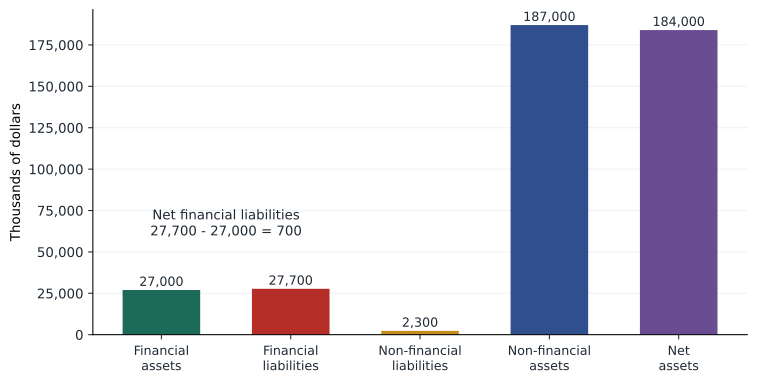
The program classifies Aspen Ridge's balance sheet items. Financial assets of $27.0 million and financial liabilities of $27.7 million give net financial liabilities of $700,000. The $2.3 million of deferred revenue is assumed to be a non-financial liability because the city will settle it by providing services, such as recreation programs already paid for and transfer-funded projects to be delivered; if it were classified as financial, the indicator would equal the old net debt of $3.0 million. The last lines show a key property of the indicator: when the city spends $5.0 million of investments on a snow-removal fleet, net financial liabilities rise by $5.0 million but net assets do not change, because one asset replaced another.
How the framework changes practice
For most governments the revised framework changes concepts more than numbers. Its practical effects come mainly through PS 1202: the new component accumulated other, the new statement of changes in net assets, the financial and non-financial liability distinction, and stricter rules on budgets. The framework also gives preparers clearer ground for judgments, for example in deciding whether a government controls an asset, whether a stipulation on a transfer creates a liability, or how to classify an obligation. PSAB applied it prospectively, so prior periods are not restated for changes in concepts, although PS 1202's presentation changes require restated comparatives.
The financial and non-financial distinction also shapes how capital spending is presented. Buying a tangible capital asset is not an expense, but it consumes financial assets, so it worsens net financial assets. In the old statement of change in net debt, users saw exactly how much of the year's financial capacity went into new assets. That statement is removed under PS 1202, but its information remains important for analysis, and lesson 3 shows how to rebuild the reconciliation.
| Feature | PSAS (revised framework and PS 1202) | ASPE or IFRS |
|---|---|---|
| Residual | Net assets: accumulated surplus, remeasurements, accumulated other | Equity |
| Key subtotal on financial position | Net financial assets or liabilities | Working capital |
| Tangible capital assets | Non-financial assets at cost, amortized | Property, plant and equipment |
| Fair value changes on equities | Remeasurement gains and losses, outside surplus | Net income (ASPE) or profit/OCI (IFRS) |
| Budget comparison | Required on the statement of operations | Not required |
Judgment where no standard applies
The framework matters most when a transaction falls between standards. Suppose Aspen Ridge receives title to a heritage building from a provincial agency at no cost, on condition that it be used as a museum for 20 years. No section deals with every aspect: PS 3150 covers contributed tangible capital assets, PS 3410 covers transfers between governments, and the condition may or may not create a liability. The preparer reasons from the framework's definitions: does the city control an economic resource with future service potential (yes, it controls access to and use of the building); does the condition create a present obligation that would require an outflow of resources if breached (only if the agreement requires repayment or return); and can the building be measured reliably (fair value at the date of transfer, or a nominal amount if fair value cannot be estimated). The framework does not give the answer mechanically, but it frames the questions in a consistent way and helps auditors evaluate the preparer's judgment.
A second practical use of the framework is in deciding how much information to present. Public sector statements are read by people with very different expertise, from residents to bond analysts, so the qualitative characteristic of understandability pulls toward simple, aggregated presentation, while relevance for analysts pulls toward detail. PSAB's answer, visible in PS 1202, is to keep the face of the statements focused on a few key indicators, such as the annual surplus, net financial assets or liabilities and net assets by component, and to move detail into notes and schedules. Preparers should resist adding lines to the statements that do not help users assess accountability, and should explain significant judgments, such as the classification of liabilities, clearly in the notes.
Worked problem
Classifying items
Classify each item for Aspen Ridge at 31 December 2027: (a) $300,000 of land held by the city for a future fire hall; (b) a $1.6 million receivable for property taxes; (c) $500,000 of unspent capital transfer received with stipulations requiring it to be spent on eligible projects; (d) a $400,000 prepaid insurance premium; (e) a $250,000 deposit received from a developer, refundable if the project is cancelled.
Show solution
- (a) Land held for a future service facility is a tangible capital asset: a non-financial asset.
- (b) Taxes receivable are a financial asset.
- (c) Unspent transfers with stipulations are deferred revenue; whether a financial or non-financial liability depends on whether the city would refund cash or satisfy the obligation by delivering the projects. The city's policy, consistent with the program, treats it as non-financial.
- (d) Prepaid insurance will be consumed in providing services: a non-financial asset.
- (e) A refundable deposit will be settled in cash if the project is cancelled, so it is a financial liability.
Answer: Non-financial: (a), (d); financial assets: (b); financial liability: (e); (c) deferred revenue classified by judgment.
Common mistakes
MistakeCalling the net financial liabilities indicator net debt and computing it with all liabilities.
InsteadUnder PS 1202 the indicator uses financial liabilities only.
MistakeReporting unrealized gains on equities in the annual surplus.
InsteadThey are remeasurement gains in accumulated remeasurements until derecognized.
MistakeThinking a large net assets balance means the government can pay its debts.
InsteadNet assets are mostly tangible capital assets; look at net financial assets or liabilities.
MistakeRestating prior periods for the revised framework.
InsteadThe framework is applied prospectively; PS 1202's presentation changes need restated comparatives.
MistakeAssuming all deferred revenue is a financial liability.
InsteadDeferred revenue settled by providing services may be a non-financial liability.
Summary and key terms
- The revised framework replaces PS 1000 and PS 1100 for fiscal years beginning on or after 1 April 2026.
- Users are the public, their representatives, lenders and oversight bodies; accountability is central.
- Net assets have three components: accumulated surplus, accumulated remeasurements and accumulated other.
- Financial assets can settle liabilities; non-financial assets provide services.
- PS 1202 distinguishes financial and non-financial liabilities.
- Net financial assets or liabilities measure future revenue needed for past transactions.
- Buying capital assets worsens net financial assets but leaves net assets unchanged.
- Aspen Ridge: net financial liabilities $700,000 under PS 1202; old net debt $3.0 million.
- Financial asset
- An asset that could be used to discharge existing liabilities or finance future operations and is not for consumption in normal operations.
- Non-financial asset
- An asset held to provide future services, such as a tangible capital asset, inventory of supplies or prepaid expense.
- Financial liability
- A liability that will be settled with financial assets.
- Non-financial liability
- A liability that will be settled by providing goods or services rather than financial assets.
- Accumulated remeasurements
- The component of net assets holding unrealized remeasurement gains and losses, such as on portfolio investments at fair value.
- Accumulated other
- A component of net assets under PS 1202 for amounts other standards require to be recognized directly in net assets.
- Conceptual framework
- The objectives, characteristics, elements and recognition and measurement concepts from which standards are derived.
- Historical cost
- Measurement at the amount paid or received when an item was acquired or incurred.
Practice problems
Work each problem on paper first, then reveal the answer to check.
What sections does the revised framework replace?
Show answer
PS 1000 Financial Statement Concepts and PS 1100 Financial Statement Objectives.
Name the three components of net assets under PS 1202.
Show answer
Accumulated surplus or deficit, accumulated remeasurement gains and losses, and accumulated other.
Is an inventory of road salt a financial asset?
Show answer
No; it will be consumed in providing services, so it is a non-financial asset.
How does buying a $2 million fire truck with cash affect net financial liabilities and net assets?
Show answer
Net financial liabilities rise by $2 million; net assets are unchanged until amortization is recognized.
Where do unrealized gains on equity investments go?
Show answer
To accumulated remeasurements, reported in the statement of changes in net assets.
In the program, what would the indicator be if deferred revenue were a financial liability?
Show answer
Net financial liabilities of $3.0 million.
Why does PSAB emphasize the budget?
Show answer
Because the approved budget is the basis of public accountability, so users need to compare actual results with it.
Is the revised framework applied retrospectively?
Show answer
No; prospectively, although PS 1202 comparatives must be restated.
Lesson quiz · 5 questions
Score 60% or more to complete this lesson.
Create a free account to save your progress, take quizzes and earn a certificate.