
ACCT-412 · Lesson 7 of 12 · 23 min
Reserves, reserve funds and segment reporting
Canadian governments once kept their accounts in funds, much as American governments still do: an operating fund, a capital fund and reserve funds, each with its own balance sheet. Since PSAS moved governments to consolidated, accrual-based summary statements, funds no longer appear on the face of the statements. They survive in two forms. First, municipalities still set aside resources in reserves and reserve funds, whose balances are disclosed as part of accumulated surplus. Second, segment disclosures under PS 2700 show revenues and expenses by major activity. This lesson covers both, and then the government reporting entity and consolidation under PS 1300, which determine what the summary statements include.
Reserves and reserve funds
A reserve is an appropriation of accumulated surplus by council for a future purpose, such as equipment replacement or tax rate stabilization; it is not a separate pool of assets and does not change the statements' totals. A reserve fund, in contrast, is set aside under legislation or agreement and segregated from the municipality's other resources, with its own investments and interest. Some reserve funds are obligatory, such as those for development charges in Ontario or certain levies in other provinces, and the inflows to them are deferred revenue rather than surplus until spent, as lesson 4 explained. Discretionary reserves and reserve funds are council decisions and form part of accumulated surplus.
Notes to municipal statements disclose accumulated surplus by component, typically showing the amount invested in tangible capital assets (net book value less related debt), the reserves and reserve funds, and the unappropriated surplus or deficit. The breakdown helps readers see that most accumulated surplus is not available to spend: it is invested in roads and buildings. Under PS 1202, accumulated surplus is one of three components of net assets, so this note sits alongside the new statement of changes in net assets.
# Reserves and the composition of accumulated surplus for the invented City of
# Aspen Ridge, Saskatchewan, 2027 (thousands of dollars).
reserves = {  # name: (opening, from operating, interest, used for capital)
    "Equipment replacement": (3_600,   400,  60, -1_100),
    "Water and sewer capital": (7_900,  600, 150, -2_000),
    "Roads and bridges":      (4_200,    0,  70, -1_200),
    "Stabilization":          (1_400,    0,  20,      0),
}
close = 0
print(f"{'Reserve':24}{'Opening':>8}{'In':>6}{'Int.':>6}{'Used':>8}{'Closing':>9}")
for k, (o, i, n, u) in reserves.items():
    c = o + i + n + u; close += c
    print(f"{k:24}{o:>8,}{i:>6,}{n:>6,}{u:>8,}{c:>9,}")
print(f"{'Total reserves':24}{'':>28}{close:>9,}")
tca, debt, accumulated_surplus = 186_000, 18_200, 183_600
invested = tca - debt
print(f"\nInvested in tangible capital assets (TCA less related debt) {invested:,}")
print(f"Reserves (appropriated surplus)                             {close:,}")
print(f"Unappropriated surplus                                       {accumulated_surplus - invested - close:,}")
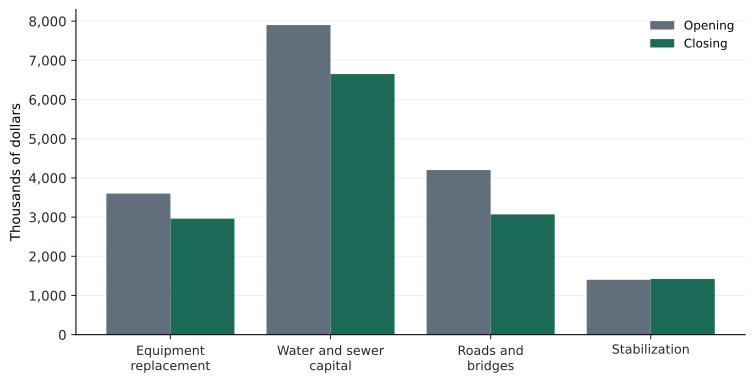
print(f"Accumulated surplus {accumulated_surplus:,}")Reserve Opening In Int. Used Closing Equipment replacement 3,600 400 60 -1,100 2,960 Water and sewer capital 7,900 600 150 -2,000 6,650 Roads and bridges 4,200 0 70 -1,200 3,070 Stabilization 1,400 0 20 0 1,420 Total reserves 14,100 Invested in tangible capital assets (TCA less related debt) 167,800 Reserves (appropriated surplus) 14,100 Unappropriated surplus 1,700 Accumulated surplus 183,600
The program builds Aspen Ridge's reserve continuity schedule and the accumulated surplus note. The four reserves started 2027 with $17.1 million. Council transferred $1.0 million from operations, as budgeted, interest of $300,000 was allocated, and $4.3 million was used to fund capital projects, leaving $14.1 million. Of the $183.6 million of accumulated surplus, $167.8 million is invested in tangible capital assets, $14.1 million is in reserves and only $1.7 million is unappropriated surplus. That last figure, not the $183.6 million total, is closest to what a reader might think of as uncommitted resources, and even it is not cash.
Segment disclosures
PS 2700 Segment Disclosures requires a government to define segments that are relevant to users, such as major services or programs, and to disclose for each the revenues and expenses, with a description of the segment and its accounting policies. Many municipalities use the same functions as in the statement of operations: general government, protective services, transportation, environmental and utility services, recreation and culture, and planning and development. A schedule shows, for each segment, revenues such as user fees and transfers, expenses by object, and the net surplus or deficit funded by taxation. Segment information lets residents see, for example, whether the water utility is self-funding, a question the fund structure answers directly in the United States.
Segments also underpin the analysis of the water and wastewater utility. Saskatchewan requires municipal waterworks to have rates that cover the cost of the service, including capital, and many provinces have similar policies; the segment schedule and a separate waterworks financial overview, filed with the provincial regulator, show whether rates are sufficient. In Aspen Ridge, the environmental and utility segment earned $7.9 million of water and sewer rates against $9.9 million of expenses including amortization; capital transfers for the water plant upgrade cover part of the gap, but rates alone did not cover full cost in 2027, and council plans a rate increase.
The government reporting entity
PS 1300 Government Reporting Entity defines what the summary statements include: all organizations controlled by the government. Control is the power to govern the financial and operating policies of another organization with expected benefits or risk of loss. Controlled organizations, such as a municipal library board or a utility corporation, are consolidated line by line, except government business enterprises, which use the modified equity method: the government reports its share of the enterprise's net assets as an investment and its share of the enterprise's net income as revenue, without adjusting the enterprise's IFRS policies. Government partnerships are proportionately consolidated, or accounted for by modified equity for business partnerships. For Aspen Ridge, the public library board is consolidated and the city's 50 per cent interest in a regional landfill authority is proportionately consolidated.
Consolidation eliminates transactions between the city and its controlled organizations. A grant from the city to the library board, for example, is an expense of the city and revenue of the library, so it is removed on consolidation. Where controlled organizations use different accounting frameworks, such as a not-for-profit using ASNPO, their statements are adjusted to PSAS before consolidation, except for government business enterprises. The notes list the organizations included and the basis of accounting for each.
| Component | Purpose | Aspen Ridge 31 Dec 2027 (thousands) |
|---|---|---|
| Invested in tangible capital assets | TCA less related debt | 167,800 |
| Reserves: equipment replacement | Fleet and equipment renewal | 2,960 |
| Reserves: water and sewer capital | Utility infrastructure renewal | 6,650 |
| Reserves: roads and bridges | Pavement and bridge program | 3,070 |
| Reserves: stabilization | Tax rate and emergency stabilization | 1,420 |
| Unappropriated surplus | Not designated by council | 1,700 |
Reserve policies
Councils adopt reserve policies that set targets and rules for each reserve. A typical policy sets a stabilization reserve at a percentage of operating expenditure, such as 5 to 10 per cent, to absorb revenue shortfalls and emergencies; sets capital reserves by reference to the asset management plan, so that annual contributions approach the long-run cost of renewing assets; and requires council approval for withdrawals. Aspen Ridge's policy targets a stabilization reserve of 5 per cent of operating expenditure, about $2.1 million, so its $1.42 million balance is below target, and it targets capital reserve contributions equal to annual amortization, which it does not yet meet: $1.0 million transferred in 2027 against $7.6 million of amortization. Rating agencies and provincial oversight bodies review these policies, and the reserve continuity schedule shows whether the city follows them.
Reserves raise a governance question: should a government accumulate resources for future needs or keep taxes as low as possible today? Intergenerational equity, discussed in lesson 1, supports saving for asset renewal so that future taxpayers do not inherit a backlog, while residents facing high costs may prefer lower taxes now. The financial statements cannot answer that question, but by showing reserves, their purposes and their use, they make the trade-off visible. Under PS 1202 the accumulated surplus note remains the main place to see reserves, and users should read it with the statement of net financial assets or liabilities, because reserves that are invested in financial assets support the indicator, while reserves already spent on capital do not.
Segment schedule for Aspen Ridge
Aspen Ridge's segment schedule for 2027 shows, for each function, its revenues, its expenses and the net amount funded by taxation. Protective services cost $11.4 million and earn $1.0 million of fines and contract revenue, so taxes fund $10.4 million; transportation costs $12.8 million and receives $3.9 million of capital and operating transfers, leaving $8.9 million; recreation and culture costs $6.5 million and earns $1.4 million of fees. The environmental and utility segment recovers about four-fifths of its $9.9 million of costs from $7.9 million of water and sewer rates. Presenting the schedule this way echoes the US statement of activities discussed in comparative courses and answers the resident's question of what each service costs in taxes.
Segment information also supports intermunicipal agreements. Aspen Ridge provides fire protection to the surrounding rural municipality under a contract priced at the full cost of the service, including amortization of fire trucks and the fire hall; the segment schedule and its supporting cost allocation give both councils confidence in the price. Similar agreements cover regional water supply, landfills and recreation facilities used by residents of several municipalities.
Changes to the reporting entity also deserve attention. When a municipality creates a new corporation, such as a housing corporation or an economic development agency, it must assess whether it controls the organization and, if so, consolidate it or account for it as a government business enterprise. Control can exist even without ownership, for example through the power to appoint the majority of the board and to direct its policies. The notes describe the entities included and any changes, so readers can understand why the statements' scope may differ from year to year.
Segment and reserve information also helps users understand how the city pays for growth. Development levies flow into deferred revenue and then into revenue as growth projects are built; contributed infrastructure from developers increases tangible capital assets and revenue; and reserves fund the city's share of growth-related projects. Reading these together shows whether growth is paying for itself or adding to future costs, a common concern in growing prairie cities.
A last observation: the move from fund statements to consolidated summary statements in Canada and the retention of fund statements in the United States reflect different views of accountability. Canadian standard setters concluded that users need a single picture of the whole government; American standard setters concluded that users also need to see compliance with legal fund restrictions. Each approach has its supporters, and students who work in both countries need to read both kinds of statements comfortably.
Worked problem
Consolidating a library board
Aspen Ridge Public Library Board, controlled by the city, reports under ASNPO using the deferral method. In 2027 the city granted it $1.4 million; the library also received $180,000 of provincial grants and spent $1.55 million. The library holds $300,000 of investments. How do these affect the city's consolidated statements?
Show solution
- The city's $1.4 million grant to the library is eliminated: it is an expense of the city and revenue of the library, an internal transaction.
- The library's provincial grants of $180,000 are revenue of the consolidated city, recognized under PS 3410 after adjusting from the deferral method if needed.
- The library's $1.55 million of expenses are included in the recreation and culture function, by object.
- The library's investments of $300,000 are financial assets of the consolidated city.
- If the library prepared ASNPO statements, its policies are adjusted to PSAS before consolidation.
Answer: Eliminate the $1.4 million grant; include the library's grants, expenses and investments.
Common mistakes
MistakeTreating reserves as separate pools of cash.
InsteadA reserve is an appropriation of accumulated surplus; only reserve funds are segregated.
MistakeRecognizing obligatory reserve fund inflows as revenue when received.
InsteadThey are deferred until used for the specified purpose.
MistakeConsolidating a government business enterprise line by line.
InsteadGBEs use the modified equity method.
MistakeReading the total accumulated surplus as available money.
InsteadMost is invested in TCA; only unappropriated surplus is uncommitted.
MistakeForgetting to eliminate grants to controlled organizations.
InsteadInternal transactions are eliminated on consolidation.
Summary and key terms
- Funds no longer appear on PSAS statements; reserves are disclosed within accumulated surplus.
- A reserve appropriates surplus; a reserve fund is segregated by legislation or agreement.
- Obligatory reserve fund inflows are deferred revenue until spent.
- PS 2700 requires segment disclosures of revenues and expenses.
- PS 1300 consolidates controlled organizations; GBEs use modified equity.
- Partnerships are proportionately consolidated.
- Aspen Ridge: reserves $14.1 million; unappropriated surplus $1.7 million.
- Aspen Ridge's water segment did not fully recover costs in 2027.
- Reserve
- An appropriation of accumulated surplus by council for a future purpose.
- Reserve fund
- Resources segregated under legislation or agreement for a specified purpose.
- Segment
- A distinguishable activity for which separate financial information is useful.
- Modified equity method
- The method for government business enterprises: the government reports its share of the enterprise's net assets and income without adjusting its policies.
- Control
- The power to govern another organization's financial and operating policies with expected benefits or risk of loss.
- Unappropriated surplus
- Accumulated surplus not invested in TCA or allocated to reserves.
- Consolidation
- Combining the financial statements of related organizations as if they were one entity, eliminating internal transactions.
Practice problems
Work each problem on paper first, then reveal the answer to check.
What is the difference between a reserve and a reserve fund?
Show answer
A reserve appropriates accumulated surplus; a reserve fund is a segregated pool of resources required by legislation or agreement.
In the program, how much was used from reserves for capital?
Show answer
$4.3 million.
Why is most accumulated surplus not available to spend?
Show answer
It is invested in tangible capital assets net of related debt.
How does a government account for a government business enterprise?
Show answer
By the modified equity method.
What does PS 2700 require?
Show answer
Disclosure of revenues and expenses by segment, with descriptions and policies.
Was Aspen Ridge's water and sewer segment self-funding in 2027?
Show answer
No: $7.9 million of rates against $9.9 million of expenses, with capital transfers covering part of the gap.
How is a 50 per cent interest in a regional landfill authority reported?
Show answer
By proportionate consolidation, as a government partnership.
What happens to the city's grant to its library board on consolidation?
Show answer
It is eliminated.
Lesson quiz · 5 questions
Score 60% or more to complete this lesson.
Create a free account to save your progress, take quizzes and earn a certificate.