
ACCT-412 · Lesson 6 of 12 · 23 min
Budgets, budgetary control and budget reporting
In business, a budget is an internal management tool. In government it is a legal instrument: council's approval of the budget authorizes the administration to raise and spend money, and the property tax rate is set to balance it. Saskatchewan's municipal legislation, like that of other provinces, requires councils to adopt an annual operating and capital budget and, in general, prohibits budgeting for an operating deficit. Because the budget is the foundation of public accountability, PSAS require the original budget to be presented in the financial statements. This lesson explains how municipal budgets are prepared, why they usually differ in basis from PSAS statements, how to convert one to the other, and how to analyse variances.
How municipal budgets are built
A typical Canadian municipality prepares an operating budget and a capital budget, often with a multi-year capital plan. The operating budget is prepared on a funding basis that resembles modified cash: it includes revenues and the expenditures needed to run services, plus debt principal repayments and transfers to reserves, and excludes amortization. It must balance, meaning planned revenues equal planned expenditures, transfers and debt payments. The capital budget lists projects and how each will be funded: capital transfers, development levies, reserves and borrowing. The property tax levy is the balancing figure: council sets the mill rate needed to raise the revenue the operating budget requires after other sources.
This funding basis differs from PSAS in four main ways. Amortization is an expense under PSAS but is not budgeted. Capital spending is budgeted as an expenditure but is not a PSAS expense. Debt principal repayments and transfers to and from reserves are budgeted, but they are not revenues or expenses. And capital transfers and levies are budgeted in the capital budget but are revenue under PSAS. As a result, a municipality that adopts a balanced funding budget usually shows a budgeted surplus in its PSAS statements, because capital revenue appears but capital spending does not.
Presenting the budget under PSAS
PS 1201 required, and PS 1202 continues to require, the original budget for the year to be presented on the statement of operations, prepared on a basis consistent with the actual results, with the same scope and classifications. Many municipalities therefore convert their funding budget to the PSAS basis for the statements, adding amortization, removing capital spending, debt principal and reserve transfers, and adding capital revenue. PS 1202 adds new budget requirements: entities must disclose when a budget was not prepared or approved, and amended budgets may be used in place of the original only in limited circumstances, such as a change in governance. Users then compare the annual surplus with the budgeted surplus and each revenue and expense line with its budget.
# From a funding-basis budget to a PSAS budget, and variances, for the invented
# City of Aspen Ridge, Saskatchewan, 2027 (thousands of dollars).
operating = {"revenue": 45_100, "expenditure (no amortization)": 42_500,
             "debt principal": 1_600, "transfers to reserves": 1_000}
capital = {"spending": 15_000, "capital transfers": 6_500, "development levies": 1_200,
           "from reserves": 4_300, "new borrowing": 3_000}
amortization = 7_700

assert operating["revenue"] == (operating["expenditure (no amortization)"]
                                + operating["debt principal"] + operating["transfers to reserves"])
assert capital["spending"] == sum(v for k, v in capital.items() if k != "spending")
psas_revenue = operating["revenue"] + capital["capital transfers"] + capital["development levies"]
psas_expense = operating["expenditure (no amortization)"] + amortization
print(f"Budgeted PSAS revenue  {psas_revenue:,}")
print(f"Budgeted PSAS expenses {psas_expense:,}")
print(f"Budgeted annual surplus {psas_revenue - psas_expense:,}  (the funding budget was 'balanced')")
print()
budget = {"Property taxes": 31_000, "User fees": 9_500, "Operating transfers": 4_000,
          "Capital transfers": 6_500, "Development levies": 1_200, "Investment income": 600, "Other": 0}
actual = {"Property taxes": 31_200, "User fees": 9_600, "Operating transfers": 4_100,
          "Capital transfers": 6_000, "Development levies": 1_200, "Investment income": 900, "Other": 1_000}
print(f"{'Revenue':22}{'Budget':>8}{'Actual':>8}{'Variance':>10}")
for k in budget:
    print(f"{k:22}{budget[k]:>8,}{actual[k]:>8,}{actual[k] - budget[k]:>+10,}")
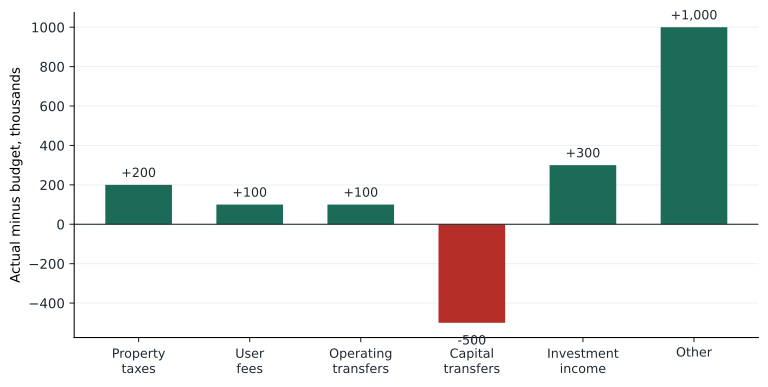
print(f"{'Total':22}{sum(budget.values()):>8,}{sum(actual.values()):>8,}{sum(actual.values()) - sum(budget.values()):>+10,}")Budgeted PSAS revenue 52,800 Budgeted PSAS expenses 50,200 Budgeted annual surplus 2,600 (the funding budget was 'balanced') Revenue Budget Actual Variance Property taxes 31,000 31,200 +200 User fees 9,500 9,600 +100 Operating transfers 4,000 4,100 +100 Capital transfers 6,500 6,000 -500 Development levies 1,200 1,200 +0 Investment income 600 900 +300 Other 0 1,000 +1,000 Total 52,800 54,000 +1,200
The first part of the program converts Aspen Ridge's 2027 funding budget. The balanced operating budget has revenue of $45.1 million, covering operating expenditure of $42.5 million, debt principal of $1.6 million and transfers to reserves of $1.0 million. The capital budget has $15.0 million of projects, funded by $6.5 million of capital transfers, $1.2 million of development levies, $4.3 million from reserves and $3.0 million of new borrowing. On the PSAS basis, budgeted revenue is $52.8 million and budgeted expenses, including $7.7 million of budgeted amortization, are $50.2 million, a budgeted surplus of $2.6 million. The second part compares actual revenue with that budget.
Explaining variances
Variances need explanation, not just calculation. Aspen Ridge's revenue exceeded budget by $1.2 million. Most of the difference comes from $1.0 million of other revenue that was not budgeted: an insurance recovery on a flood-damaged lift station. Investment income was $300,000 above budget because interest rates stayed higher than assumed. Capital transfers were $500,000 below budget, but that is a timing difference: projects were delayed, so less spending met transfer stipulations, and the unspent amount remains deferred. On the expense side, the city spent $1.3 million less than budgeted, mainly in transportation, where a mild winter cut snow-removal costs by $700,000. A good analysis separates permanent variances, which affect future budgets, from timing variances, which reverse.
Budget comparisons also inform the next budget. Council will ask whether the $1.0 million of unbudgeted revenue is likely to recur (it is not) and whether the snow-removal savings justify a lower budget (probably not, since winters vary). Rating agencies look at the history of budget variances as a measure of budgetary discipline. And the public uses the comparison to hold council to account for the tax rate it set. Under PS 1202, the budget must be comparable with the actual figures, so a municipality cannot simply present its funding budget beside PSAS results; it must convert it as the program does, or adopt its budget on the PSAS basis directly, as some larger cities now do.
| Item | Funding budget | PSAS statement of operations |
|---|---|---|
| Amortization | Not budgeted | Expense |
| Capital spending | Expenditure in capital budget | Addition to non-financial assets |
| Debt principal repayment | Expenditure in operating budget | Reduction of liability |
| Transfers to or from reserves | Budgeted transfers | Within accumulated surplus; not revenue or expense |
| Capital transfers and levies | Funding in capital budget | Revenue |
Budgets in not-for-profit organizations
ASNPO do not require a budget comparison, and few charities present one in their statements, though boards and funders rely heavily on budgets. Riverbend Community Pantry's board approves an annual budget, and its provincial school breakfast grant requires a program budget and a final report comparing spending with it. Many funders also require that grant revenue be spent within the grant period, which links budgeting with the deferral of restricted contributions discussed in lesson 9.
Budget processes and participation
The budget process in a Canadian city usually runs from late summer to the following spring. Administration prepares service-level options and a draft operating budget in the fall, presenting the tax rate needed to fund them; council reviews departmental budgets in public sessions, often with public consultation or surveys; and council adopts the operating and capital budgets, usually before year-end or early in the new year, followed by the property tax bylaw setting mill rates once assessment rolls are final. Many cities now adopt multi-year operating budgets, approving rates for two to four years with annual adjustments, which improves planning but requires care when presenting the original budget under PSAS: the budget presented must be the one approved for the year, and PS 1202's limits on amended budgets apply to mid-cycle changes.
Public participation has become more common. Some cities use participatory budgeting for part of the capital budget, letting residents propose and vote on projects; others publish budget simulators that let residents see the tax effect of service choices. These practices do not change the accounting, but they increase the importance of clear budget documents and of financial statements that relate clearly to the budget. Rating agencies and the Government Finance Officers Association's budget award program in both Canada and the United States encourage budgets that explain policies, operations and financial plans in plain language.
Performance budgeting and service costs
Budgets increasingly link money to results. A performance-based budget sets targets for each service, such as kilometres of road resurfaced, fire response times or recreation visits, and reports actual performance alongside spending. Activity-based costing, introduced in management accounting courses, helps a city find the full cost of a service, including overhead and amortization, so that user fees can be set rationally and council can compare the cost of delivering a service in-house with contracting it out. Aspen Ridge's 2027 budget documents report the cost per lane-kilometre of snow clearing and the recovery ratio of recreation fees, which the variance analysis uses to explain the snow-removal saving.
Cost recovery is a policy choice. Water and wastewater rates in most Canadian provinces are expected to recover full costs; recreation fees typically recover a third to a half of costs, with taxes paying the rest because recreation has broad community benefits; and planning fees may be set to recover the cost of processing applications. When a city sets fees, it should know both the cash cost and the full accrual cost of the service, including amortization of facilities. The budget comparison then shows whether fees and costs behaved as planned, and the segment disclosure in lesson 7 shows the results by service.
Finally, budgets connect to long-term financial planning. Many cities now prepare ten-year financial plans that project operating costs, capital needs, reserves and debt, and test the tax rate increases required under different scenarios. The annual budget is then one year of the plan, and the financial statements show how the year turned out. For Aspen Ridge, the long-term plan shows that sustaining the asset base requires increasing capital reserve contributions by about $500,000 a year for the next decade, a message the 2027 budget variance analysis and the statements reinforce.
Budgets also matter for accountability within the administration. Department heads are responsible for staying within their budgets, and monthly or quarterly variance reports to council allow early action when costs or revenues depart from plan. The year-end comparison in the statements is the final step in a cycle that runs throughout the year, and its explanations should be consistent with what council heard during the year.
When results depart sharply from the budget, councils may need to act during the year. A provincial government or municipal regulator may require a municipality that incurs an unplanned deficit to recover it in the next budget, and lenders watch for repeated shortfalls. The statements report what happened; the budget process decides how to respond.
Worked problem
Converting a funding budget
A town adopts a balanced 2027 operating budget: revenue $8.0 million; operating expenditure $7.1 million; debt principal $400,000; transfer to reserves $500,000. Its capital budget includes $2.0 million of projects funded by a $1.2 million provincial capital transfer and $800,000 from reserves. Budgeted amortization is $1.5 million. What budgeted surplus or deficit appears in the PSAS statement of operations?
Show solution
- PSAS revenue: $8.0 million + capital transfer $1.2 million = $9.2 million.
- PSAS expenses: operating expenditure $7.1 million + amortization $1.5 million = $8.6 million.
- Debt principal, transfers to and from reserves and capital spending are excluded.
- Budgeted annual surplus: $9.2 million − $8.6 million = $600,000.
- The town's balanced budget therefore appears as a $600,000 PSAS surplus.
Answer: A budgeted surplus of $600,000.
Common mistakes
MistakePresenting the funding budget beside PSAS actuals.
InsteadThe budget must be on a basis consistent with actual results.
MistakeUsing an amended budget in the statements without limited-circumstance justification.
InsteadPS 1202 permits amended budgets only in limited circumstances.
MistakeExplaining a variance by restating the numbers.
InsteadIdentify causes: estimation, performance or timing, and whether they recur.
MistakeThinking a balanced budget means a nil PSAS surplus.
InsteadCapital revenue and amortization make PSAS results differ from the funding budget.
MistakeTreating transfers to reserves as expenses.
InsteadThey are allocations within accumulated surplus.
Summary and key terms
- A municipal budget is a legal authority; councils generally may not budget an operating deficit.
- Operating budgets are on a funding basis, excluding amortization and including debt principal and reserve transfers.
- PSAS require the original budget on the statement of operations on a consistent basis.
- PS 1202 restricts amended budgets and requires disclosure when no budget is approved.
- Converting adds amortization and capital revenue and removes capital spending, principal and reserve transfers.
- Aspen Ridge: budgeted PSAS surplus $2.6 million from a balanced funding budget.
- Revenue was $1.2 million over budget, mainly an unbudgeted insurance recovery.
- Variance analysis separates permanent, timing and estimation causes.
- Funding basis
- A budgeting basis that includes capital spending, debt principal and reserve transfers and excludes amortization.
- Capital budget
- The plan for capital projects and their funding sources.
- Original budget
- The budget first approved for the year.
- Mill rate factor
- A multiplier that varies the uniform mill rate among property classes.
- Reserve transfer
- An allocation of accumulated surplus to or from a reserve.
- Variance
- The difference between budgeted and actual amounts.
- Balanced budget
- A budget in which planned revenues equal planned spending.
Practice problems
Work each problem on paper first, then reveal the answer to check.
Why do municipalities budget on a funding basis?
Show answer
Because the tax levy must fund cash needs, including debt principal and reserves, and legislation requires a balanced budget.
Name four differences between the funding budget and PSAS.
Show answer
Amortization, capital spending, debt principal and reserve transfers, plus capital revenue.
In the program, what is the budgeted PSAS surplus?
Show answer
$2.6 million.
What new budget disclosure does PS 1202 require?
Show answer
Disclosure when a budget is not prepared or approved, and limits on using amended budgets.
Why were capital transfers below budget?
Show answer
Projects were delayed, so less spending met stipulations; the unspent amount stays deferred.
Is the $1.0 million insurance recovery a permanent variance?
Show answer
No; it is non-recurring.
Do ASNPO require a budget comparison?
Show answer
No, although boards and funders use budgets extensively.
What was the snow-removal saving?
Show answer
About $700,000.
Lesson quiz · 5 questions
Score 60% or more to complete this lesson.
Create a free account to save your progress, take quizzes and earn a certificate.