
ACCT-412 · Lesson 8 of 12 · 23 min
Pensions, OPEB, compensated absences and long-term debt
After capital assets, a government's largest long-term items are usually its debt and its obligations to employees. Police and firefighters in many cities belong to defined benefit plans; other employees may be in state-wide cost-sharing plans or defined contribution plans; and most employees accumulate vacation and sick leave. GASB Statements No. 67 and 68 govern pension plans and employers' pension reporting, Nos. 74 and 75 do the same for other postemployment benefits (OPEB) such as retiree health care, and No. 101, effective for fiscal years beginning after 15 December 2023, governs compensated absences. This lesson covers these standards and long-term debt, from general obligation bonds to revenue bonds and their disclosure.
Pensions under GASB 68
GASB 68 requires an employer that sponsors a single-employer or agent multiple-employer defined benefit plan to report a net pension liability equal to the total pension liability, measured by the entry age actuarial cost method, minus the plan's fiduciary net position. The total pension liability is discounted at the long-term expected rate of return on plan assets to the extent the plan's projected fiduciary net position is sufficient to pay benefits, and at a high-quality municipal bond index rate after that. Changes in the net pension liability are recognized as pension expense, except for certain items deferred: differences between expected and actual experience and changes of assumptions, recognized over the average remaining service lives of all members; and differences between projected and actual investment earnings, recognized over five years. Contributions made after the measurement date are deferred outflows.
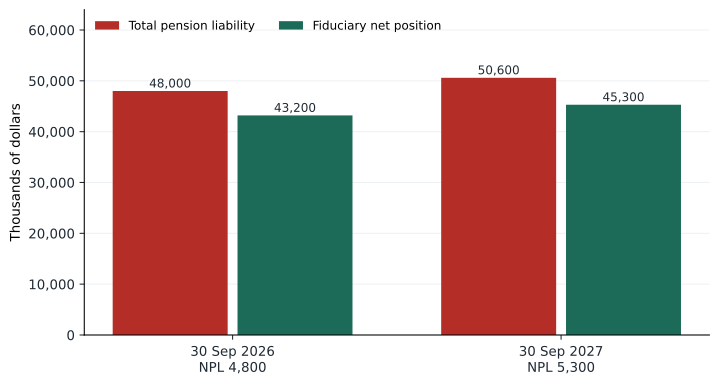
Employers in cost-sharing multiple-employer plans, such as many state-wide plans, report their proportionate share of the collective net pension liability, deferrals and expense, based on their share of contributions. Defined contribution plans produce expense equal to required contributions. In the program, Aspen Ridge's single-employer police and fire plan (invented for this course) has a total pension liability of $50.6 million and fiduciary net position of $45.3 million at the 30 September 2027 measurement date, so the net pension liability is $5.3 million and the funded ratio 89.5 percent. Investment earnings of $2.4 million fell short of the $2.98 million projected at 6.9 percent; the $580,000 difference is deferred and recognized over five years.
# Pensions and compensated absences for the invented City of Aspen Ridge,
# Nebraska, measurement date 30 September 2027 (thousands; illustrative).
r = 0.069                                   # long-term expected rate of return / discount rate
tpl_open, service_cost, experience_loss, benefits = 48_000, 1_500, 400, -2_600
interest = round(tpl_open * r, -2)          # simplified: on the opening balance
tpl = tpl_open + service_cost + interest + experience_loss + benefits
fnp_open, er, ee, actual_earnings, admin = 43_200, 1_800, 600, 2_400, -100
projected = round(fnp_open * r, -1)
fnp = fnp_open + er + ee + actual_earnings + benefits + admin
print(f"Total pension liability {tpl:,.0f}; fiduciary net position {fnp:,.0f}")
print(f"Net pension liability {tpl - fnp:,.0f}  (funded ratio {fnp / tpl:.1%})")
earn_diff = projected - actual_earnings     # deferred, recognized over 5 years
earlier_deferrals = 784                     # amortization of deferrals from earlier years
expense = (service_cost + interest - projected - admin - ee
           + experience_loss / 5 + earn_diff / 5 + earlier_deferrals)
print(f"Projected earnings {projected:,.0f}; actual {actual_earnings:,}; difference {earn_diff:,.0f}")
print(f"Pension expense {expense:,.0f} versus employer contributions {er:,}")

# GASB 101: leave that is more likely than not to be used or paid
vacation, sick_hours_value, share_expected_used = 1_006, 1_200, 0.40
ss_medicare = 0.0765
liability = (vacation + sick_hours_value * share_expected_used) * (1 + ss_medicare)
print(f"\nCompensated absences liability {liability:,.0f}")Total pension liability 50,600; fiduciary net position 45,300 Net pension liability 5,300 (funded ratio 89.5%) Projected earnings 2,980; actual 2,400; difference 580 Pension expense 2,300 versus employer contributions 1,800 Compensated absences liability 1,600
The program rolls forward the plan's liability and computes pension expense of $2.3 million: service cost and interest, less projected earnings and employee contributions, plus administrative expense and the current-year recognition of the deferred items, including $784,000 of amortization of deferrals from earlier years. Pension expense exceeds the employer's $1.8 million of contributions, which is why lesson 2 showed a larger outflow government-wide than in the general fund. The last line applies GASB 101 to leave balances, explained below: a liability of $1.6 million.
OPEB and compensated absences
GASB 75 applies the same model as GASB 68 to OPEB, mainly retiree health insurance. Many OPEB plans are unfunded, with no trust, so the total OPEB liability is discounted entirely at a municipal bond rate, and the liability can be large. Implicit rate subsidies, which arise when retirees pay the same premium as active employees in a blended plan although their expected claims are higher, are OPEB that must be measured. GASB 101 replaced the old compensated absences rules with a single model: a liability is recognized for leave that has not been used if it is attributable to services already rendered, accumulates and is more likely than not to be used for time off or otherwise paid or settled. Leave expected to be used is measured at the employee's pay rate at the reporting date, plus salary-related payments such as the employer's share of Social Security and Medicare.
In the program, Aspen Ridge's unused vacation of about $1.0 million is more likely than not to be used or paid. Its employees also have $1.2 million of accumulated sick leave that is never paid out on separation, but experience shows that about 40 percent will be used for time off, so that portion is included. Adding 7.65 percent for Social Security and Medicare gives a liability of $1.6 million. In the general fund, only leave due and payable, for example to employees who have left, is an expenditure; the rest is a reconciling item between fund balance and net position, as lesson 7 showed.
Long-term debt
Governments issue several types of debt. General obligation bonds are backed by the full faith and credit and taxing power of the issuer, often requiring voter approval; revenue bonds are secured by the revenues of a specific enterprise, such as the water utility, and require rate covenants, such as net revenues of at least 1.25 times annual debt service; special assessment bonds are repaid from charges on benefiting property owners. In the government-wide statements, bonds are liabilities at amortized cost, with premiums and discounts amortized and issuance costs (other than insurance) expensed. In governmental funds, proceeds are other financing sources and debt service expenditures are recognized when due, usually in a debt service fund. Conduit debt, issued by a government for a third party that is responsible for repayment, is generally not a liability of the issuer under GASB Statement No. 91.
Disclosures about debt are extensive. Governments disclose the details of debt by type, debt service requirements to maturity for each of the next five years and in five-year increments thereafter, changes in long-term liabilities during the year, and, under GASB Statement No. 88, information about direct borrowings and direct placements, unused lines of credit, assets pledged as collateral and terms with finance-related consequences such as acceleration on default. GASB Statement No. 102, Certain Risk Disclosures, effective for fiscal years beginning after 15 June 2024, requires disclosure of concentrations and constraints, such as dependence on a single large taxpayer or a legal limit on revenue, that make a government vulnerable to a substantial impact in the next 12 months.
| Obligation | Standard | Measurement | Aspen Ridge fiscal 2027 |
|---|---|---|---|
| Single-employer police and fire pension | GASB 68 | Total pension liability less fiduciary net position | NPL $5.3 million |
| Retiree health (OPEB) | GASB 75 | Total OPEB liability, municipal bond rate if unfunded | Disclosed in notes |
| Compensated absences | GASB 101 | Leave more likely than not used or paid, plus related payments | $1.6 million |
| General obligation bonds | GASB 34, 88 | Amortized cost; issuance costs expensed | $21.8 million |
| Utility revenue bonds | GASB 34, 88 | Amortized cost in the enterprise fund | $12.9 million |
Debt management and credit ratings
Governments borrow to spread the cost of long-lived assets over the taxpayers who use them, but debt creates fixed charges that reduce future flexibility. Debt management policies typically limit debt service to a percentage of expenditures, set maximum maturities no longer than the life of the asset financed and require coverage ratios for revenue bonds. Most municipal bonds are rated by agencies such as S&P Global, Moody's and Fitch, which consider the economy, financial performance and reserves, management, debt and long-term liabilities including pensions and OPEB, and the institutional framework. Issuers must provide continuing disclosure under SEC Rule 15c2-12, filing annual financial information and notices of specified events on the Municipal Securities Rulemaking Board's EMMA system.
Pension and OPEB liabilities are part of the same analysis. Rating agencies add net pension and OPEB liabilities to debt when assessing long-term obligations, and some adjust reported liabilities to a common discount rate, because a high assumed return reduces the reported liability. Aspen Ridge's plan uses a 6.9 percent rate; RSI shows a ten-year schedule of changes in the net pension liability and of employer contributions compared with the actuarially determined contribution, and the notes show the sensitivity of the liability to a one-percentage-point change in the discount rate, which for a plan like this one could change the net pension liability by several million dollars.
Debt disclosures connect to the reconciliation in lesson 7: bonds, leases, compensated absences and net pension liabilities are the largest items that separate fund balance from net position. GASB requires a schedule of changes in long-term liabilities showing beginning balances, additions, reductions and ending balances, with amounts due within one year. For Aspen Ridge, the schedule shows the $5.0 million bond issue as an addition and $1.2 million of principal repaid, a pattern that explains why governmental debt rose even as the general fund paid its scheduled debt service.
Finally, debt and benefits interact with interperiod equity. Borrowing for a 40-year asset spreads its cost over the taxpayers who use it; borrowing to fund operating deficits, or contributing less than the actuarially determined amount to pension plans, shifts current costs to future taxpayers. The government-wide statements, by reporting these liabilities and the related expenses on the accrual basis, make such shifts visible, which is a central purpose of the reporting model.
Readers should also look at the actuarially determined contribution schedule in RSI. If a government consistently contributes less than the actuarially determined amount, its net pension liability will tend to grow regardless of investment returns. Aspen Ridge contributed $1.8 million in fiscal 2027, equal to its actuarially determined contribution, so the growth in its net pension liability came from investment returns below the assumed rate and an experience loss, not from underfunding.
Worked problem
Measuring compensated absences under GASB 101
A city's employees have $900,000 of unused vacation (all expected to be used or paid), $2.0 million of accumulated sick leave that is not paid on separation (historically 30 percent is used), and $150,000 of leave for employees who have resigned and will be paid in October. The employer's FICA rate is 7.65 percent. What liability is reported government-wide and what expenditure in the general fund?
Show solution
- Vacation: $900,000, all included.
- Sick leave: 30 percent × $2.0 million = $600,000 more likely than not to be used.
- Terminated employees: $150,000.
- Subtotal $1.65 million; plus FICA at 7.65 percent = $1,776,225 government-wide.
- In the general fund, only the $150,000 due to terminated employees (plus related FICA, about $11,500) is an expenditure and liability, because it is due and payable.
Answer: About $1.78 million government-wide; about $161,500 in the general fund.
Common mistakes
MistakeDiscounting an unfunded OPEB liability at the expected return on assets.
InsteadUnfunded plans use a high-quality municipal bond rate.
MistakeRecognizing investment earnings differences immediately in pension expense.
InsteadThey are deferred and recognized over five years.
MistakeIgnoring sick leave that is never paid out.
InsteadUnder GASB 101, leave more likely than not to be used for time off is included.
MistakeReporting bond proceeds as a liability in the general fund.
InsteadIn governmental funds, proceeds are other financing sources.
MistakeCapitalizing bond issuance costs.
InsteadIssuance costs other than prepaid insurance are expensed.
Summary and key terms
- GASB 68 and 75 govern pensions and OPEB; GASB 101 governs compensated absences.
- The net pension liability equals total pension liability minus fiduciary net position.
- Experience and assumption changes are deferred over service lives; earnings differences over five years.
- Leave more likely than not to be used or paid is a liability, with salary-related payments.
- General obligation, revenue and special assessment bonds differ in security.
- GASB 88 and 102 require detailed debt and risk disclosures.
- Aspen Ridge: NPL $5.3 million; pension expense $2.3 million; contributions $1.8 million.
- Aspen Ridge: compensated absences liability $1.6 million.
- Net pension liability
- Total pension liability minus the plan's fiduciary net position.
- OPEB
- Other postemployment benefits, such as retiree health insurance.
- Compensated absences
- Leave for which employees may be paid, such as vacation and sick leave.
- General obligation bond
- A bond backed by the full faith, credit and taxing power of the issuer.
- Revenue bond
- A bond repaid from the revenues of a specific enterprise or project.
- Measurement date
- The date as of which the pension or OPEB liability is measured.
- Defined benefit plan
- A plan promising a benefit based on factors such as salary and service.
- Defined contribution plan
- A plan in which the employer's obligation is limited to specified contributions.
- Actuarial gain or loss
- A change in the value of an obligation or assets from experience differing from assumptions or from changes in assumptions.
Practice problems
Work each problem on paper first, then reveal the answer to check.
What is Aspen Ridge's funded ratio?
Show answer
89.5 percent.
Over what period are differences between projected and actual earnings recognized?
Show answer
Five years.
In the program, what is pension expense?
Show answer
$2.3 million.
What is an implicit rate subsidy?
Show answer
The excess of retirees' expected claims over the blended premium they pay in a plan shared with active employees; it is OPEB.
What liability does GASB 101 require for sick leave not paid on separation?
Show answer
The portion more likely than not to be used for time off.
What is a rate covenant?
Show answer
A bond covenant requiring rates set so net revenues cover debt service by a stated multiple.
What does GASB 102 require?
Show answer
Disclosure of concentrations and constraints that make a government vulnerable to a substantial impact within 12 months.
Is conduit debt a liability of the issuing government?
Show answer
Generally not, under GASB 91, though some commitments must be disclosed or recognized.
Lesson quiz · 5 questions
Score 60% or more to complete this lesson.
Create a free account to save your progress, take quizzes and earn a certificate.