
ACCT-412 · Lesson 7 of 12 · 24 min
Fund accounting: governmental, proprietary and fiduciary funds
A fund is a fiscal and accounting entity with a self-balancing set of accounts, recording resources and the related liabilities and residual balances that are segregated for specific activities or objectives. Fund accounting is the oldest feature of governmental reporting and remains central to it: every government uses a general fund, and many use dozens of others. GASB recognizes three categories and eleven fund types. This lesson explains each, the GASB Statement No. 54 classifications of fund balance, interfund activity, and the reconciliation that links the governmental funds to governmental activities in the government-wide statements.
Governmental funds
Governmental funds account for activities financed mainly by taxes and intergovernmental revenue. The general fund accounts for all financial resources not required to be reported in another fund. Special revenue funds account for proceeds of specific revenue sources restricted or committed to purposes other than debt service or capital projects, such as a library tax or state street aid. Capital projects funds account for resources restricted, committed or assigned to capital outlays. Debt service funds account for resources for principal and interest on long-term debt. Permanent funds account for resources legally restricted so that only earnings may be used for the government's programs, such as a cemetery perpetual care fund.
Each governmental fund reports a balance sheet and a statement of revenues, expenditures and changes in fund balance on the modified accrual basis. Fund balance is classified under GASB 54 by the extent to which the government is bound to honor constraints: nonspendable (not in spendable form, such as inventories and prepaids, or legally required to be kept intact); restricted (constrained by external parties, constitutional provisions or enabling legislation); committed (constrained by the government's highest decision-making authority through formal action, such as an ordinance); assigned (intended for a specific purpose by the governing body or an official it delegates); and unassigned (the residual of the general fund, or deficits in other funds).
# Governmental funds and the reconciliation to governmental activities for the
# invented City of Aspen Ridge, Nebraska, at 30 September 2027 (thousands).
fund_balance = {   # fund: {GASB 54 classification: amount}
    "General":          {"nonspendable": 300, "committed": 1_200, "assigned": 420, "unassigned": 12_880},
    "Capital projects": {"restricted": 8_900},
    "Debt service":     {"restricted": 1_240},
    "Nonmajor":         {"restricted": 1_100, "committed": 500},
}
total = 0
for f, parts in fund_balance.items():
    s = sum(parts.values()); total += s
    print(f"{f:18}{s:>8,}  " + ", ".join(f"{k} {v:,}" for k, v in parts.items()))
print(f"{'Total fund balances':18}{total:>8,}")
recon = [("Capital assets, net (not financial resources)", 121_000),
         ("Unavailable revenue is revenue in full accrual", 450),
         ("Deferred outflows related to pensions", 2_600),
         ("Deferred inflows related to pensions", -4_100),
         ("Bonds payable", -21_800),
         ("Compensated absences", -1_600),
         ("Net pension liability", -5_300),
         ("Accrued interest payable", -90)]
print()
net = total
for k, v in recon:
    net += v
    print(f"{k:48}{v:>9,}")
print(f"{'Net position of governmental activities':48}{net:>9,}")General 14,800 nonspendable 300, committed 1,200, assigned 420, unassigned 12,880 Capital projects 8,900 restricted 8,900 Debt service 1,240 restricted 1,240 Nonmajor 1,600 restricted 1,100, committed 500 Total fund balances 26,540 Capital assets, net (not financial resources) 121,000 Unavailable revenue is revenue in full accrual 450 Deferred outflows related to pensions 2,600 Deferred inflows related to pensions -4,100 Bonds payable -21,800 Compensated absences -1,600 Net pension liability -5,300 Accrued interest payable -90 Net position of governmental activities 117,700
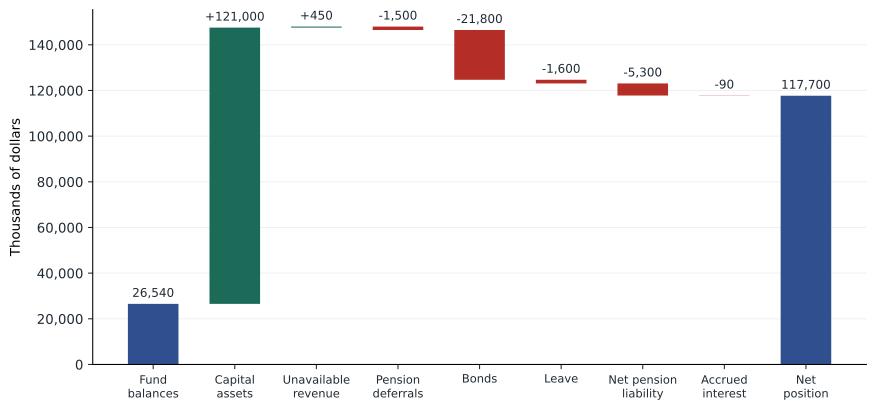
The program lists Aspen Ridge's governmental fund balances and reconciles them to the net position of governmental activities. The general fund's $14.8 million includes $300,000 nonspendable for inventories and prepaids, $1.2 million committed by ordinance to a budget stabilization account, $420,000 assigned for encumbrances and $12.88 million unassigned. The capital projects fund holds $8.9 million of unspent bond proceeds, restricted by the bond covenants, and the debt service fund $1.24 million restricted for debt service. Total fund balances of $26.54 million become net position of $117.7 million after adding capital assets and unavailable revenue and subtracting long-term liabilities and pension deferrals.
Proprietary and fiduciary funds
Proprietary funds use the economic resources focus and accrual basis. Enterprise funds account for activities for which fees are charged to external users, and must be used when the activity is financed by debt secured solely by fees, when laws require costs to be recovered by fees, or when pricing policies set fees to recover costs including capital costs; Aspen Ridge's water and sewer utility is an enterprise fund. Internal service funds account for goods and services provided to other departments on a cost-reimbursement basis, such as fleet maintenance or self-insurance. Fiduciary funds hold resources for others and cannot be used for the government's programs: pension and other employee benefit trust funds, investment trust funds, private-purpose trust funds and custodial funds, as defined by GASB Statement No. 84.
Interfund activity is reported in two ways. Reciprocal interfund activity, the internal counterpart of exchange transactions, includes interfund loans (receivables and payables) and interfund services provided and used, such as the general fund paying the utility for water, which are revenues and expenditures. Nonreciprocal activity includes interfund transfers, reported as other financing sources and uses in governmental funds and as transfers in proprietary funds, and interfund reimbursements, which are repayments of costs initially paid by another fund and are not reported as revenues. In the government-wide statements, activity within governmental activities is eliminated, but transfers between governmental and business-type activities, such as the utility's $500,000 payment in lieu of taxes, are shown.
The reconciliation
Because governmental funds and governmental activities use different focuses, GASB requires a reconciliation of total governmental fund balances to the net position of governmental activities, and of the net change in fund balances to the change in net position. The usual reconciling items are: capital assets, which are not financial resources; long-term liabilities, such as bonds, leases, compensated absences and net pension liabilities, which are not due currently; deferred outflows and inflows related to pensions and OPEB; revenues that are unavailable in the funds but earned government-wide; accrued interest; and the assets and liabilities of internal service funds included in governmental activities. The reconciliation is presented on the face of the fund statements or in an accompanying schedule.
The governmental reporting entity is defined by GASB Statements No. 14, 39, 61 and 80. A primary government includes component units for which it is financially accountable, normally because it appoints a voting majority of the governing body and can impose its will or receives a financial benefit or burden, and organizations whose exclusion would be misleading. Component units are blended (reported as if part of the primary government) when, for example, the governing bodies are substantively the same or the unit serves the primary government exclusively; otherwise they are discretely presented in a separate column. GASB 103 adds that major component units that cannot be shown in separate columns are presented in combining statements in the basic statements.
| Fund category | Fund types | Basis |
|---|---|---|
| Governmental | General, special revenue, capital projects, debt service, permanent | Current financial resources, modified accrual |
| Proprietary | Enterprise, internal service | Economic resources, accrual |
| Fiduciary | Pension and OPEB trust, investment trust, private-purpose trust, custodial | Economic resources, accrual |
| Government-wide | Governmental and business-type activities | Economic resources, accrual |
| Component units | Blended or discretely presented | Depends on the unit |
Fund balance policies
Governments adopt fund balance policies that set targets for unassigned general fund balance and rules for using it. The GFOA recommends that general-purpose governments maintain unrestricted budgetary fund balance in the general fund of no less than two months of regular operating revenues or expenditures, adjusted for the government's circumstances. Aspen Ridge's policy targets unassigned general fund balance of 25 percent of general fund expenditures, about $7.1 million; its $12.88 million balance exceeds the target, so the council has committed $1.2 million to a budget stabilization account and is considering using some of the excess for capital projects. Governments must also disclose their policy on the order in which restricted, committed, assigned and unassigned amounts are used when more than one is available.
Fund balance raises a governance question: should a government accumulate resources for future needs or keep taxes as low as possible today? Interperiod equity supports saving for known future costs, while residents may prefer lower taxes now. The fund statements cannot answer the question, but by classifying fund balance by constraint, they make the trade-off visible. Users should be careful not to confuse fund balance with cash: the general fund's balance may include receivables, and a large capital projects fund balance usually reflects unspent bond proceeds that will be spent on a specific project.
Combining and individual fund statements
Governments that publish an ACFR include combining statements for nonmajor funds and individual fund statements and schedules in the supplementary information. A combining statement shows each nonmajor governmental fund, such as Aspen Ridge's library special revenue fund and its cemetery permanent fund, in its own column, with totals that agree with the nonmajor funds column of the basic statements. Budgetary comparisons for nonmajor funds with legally adopted budgets also appear there. These schedules are supplementary information, covered by the auditor's opinion only in relation to the basic statements as a whole.
Fund information also supports intergovernmental agreements. Aspen Ridge provides fire protection to a neighboring rural fire district under an interlocal agreement priced at the full cost of the service; its cost allocation plan and the public safety function's expenses support the price. Similar agreements under Nebraska's Interlocal Cooperation Act cover regional water supply, landfills and emergency dispatch.
Changes to the reporting entity also deserve attention. When a city creates a new organization, such as a housing authority, a development corporation or a joint public safety agency, it must assess whether it is financially accountable and whether the organization is a blended or discretely presented component unit, or a joint venture accounted for by the equity method. The notes describe the entities included and any changes, so readers understand why the statements' scope may differ from year to year.
Fund information also shows how the city pays for growth. Special assessments on benefiting properties, impact fees where state law allows them, and developer contributions of infrastructure fund new streets and utilities, while the capital projects fund tracks bond-financed projects. Reading these together shows whether growth is paying for itself or adding to future costs.
A last observation: the United States kept fund statements while Canada moved to consolidated summary statements, reflecting different views of accountability. GASB concluded that users need to see compliance with legal fund restrictions as well as a whole-of-government picture; Canadian standard setters concluded that a single consolidated picture serves users best, with segment and reserve disclosures in the notes. Students who work in both countries need to read both kinds of statements comfortably.
Worked problem
Interfund transactions
In fiscal 2027 Aspen Ridge: (a) the general fund lends $300,000 to the utility, repayable in two years; (b) the general fund pays the utility $85,000 for water used in parks; (c) the utility transfers $500,000 to the general fund as a payment in lieu of taxes; (d) the general fund pays $40,000 of the utility's legal costs, and the utility repays it. How is each reported?
Show solution
- (a) An interfund loan: the general fund reports a receivable (advance to other funds) and the utility a payable; a long-term advance is offset by nonspendable fund balance in the general fund.
- (b) Interfund services provided and used: an expenditure of the general fund and revenue of the utility, because the price approximates an external exchange.
- (c) A transfer: an other financing source in the general fund and a transfer out in the utility; government-wide, it appears as a transfer between governmental and business-type activities.
- (d) A reimbursement: the utility's expense is recorded in the utility; the general fund records no expenditure or revenue.
- Within governmental activities, the government-wide statements eliminate interfund balances and transfers.
Answer: (a) loan; (b) revenue and expenditure; (c) transfer; (d) reimbursement, no revenue.
Common mistakes
MistakeClassifying a council's budget intention as committed fund balance.
InsteadCommitted requires formal action by the highest decision-making authority; intentions are assigned.
MistakeReporting interfund reimbursements as revenue.
InsteadReimbursements reduce the expenditure of the fund that first paid.
MistakeIncluding fiduciary funds in governmental activities.
InsteadFiduciary activities are excluded from government-wide statements.
MistakeUsing an enterprise fund for a heavily tax-subsidized service with no fee-recovery requirement.
InsteadEnterprise funds are required when debt is fee-secured or fees must recover costs.
MistakeOmitting the reconciliation to government-wide statements.
InsteadGASB requires it on the face of the fund statements or in a schedule.
Summary and key terms
- Funds are self-balancing sets of accounts; GASB has three categories.
- Governmental funds: general, special revenue, capital projects, debt service and permanent.
- Fund balance: nonspendable, restricted, committed, assigned and unassigned.
- Proprietary funds: enterprise and internal service; fiduciary funds hold resources for others.
- Interfund loans, services, transfers and reimbursements are reported differently.
- Fund balances are reconciled to net position.
- Aspen Ridge: fund balances $26.54 million; net position $117.7 million.
- Component units are blended or discretely presented.
- Fund
- A fiscal and accounting entity with a self-balancing set of accounts.
- General fund
- The fund for all resources not required to be reported elsewhere.
- Enterprise fund
- A proprietary fund for activities charging external users fees.
- Committed fund balance
- Amounts constrained by formal action of the highest decision-making authority.
- Interfund transfer
- A flow of assets between funds without equivalent flows back and without a requirement to repay.
- Component unit
- A legally separate organization for which the primary government is financially accountable.
- Consolidation
- Combining the financial statements of related organizations as if they were one entity, eliminating internal transactions.
Practice problems
Work each problem on paper first, then reveal the answer to check.
List the five governmental fund types.
Show answer
General, special revenue, capital projects, debt service and permanent.
In the program, what is the general fund's unassigned balance?
Show answer
$12.88 million.
What makes a fund balance committed?
Show answer
A formal action, such as an ordinance, by the highest decision-making authority.
When must an enterprise fund be used?
Show answer
When debt is secured solely by fees, when law requires cost recovery by fees, or when pricing policies set fees to recover costs including capital.
How is a payment in lieu of taxes from the utility to the general fund reported?
Show answer
As a transfer: other financing source in the general fund, transfer out in the utility, and a transfer between activities government-wide.
What are the reconciling items between fund balances and net position?
Show answer
Capital assets, long-term liabilities, pension deferrals, unavailable revenue, accrued interest and internal service funds.
When is a component unit blended?
Show answer
When, for example, its governing body is substantively the same as the primary government's, or it serves the primary government almost exclusively.
What fund type holds a cemetery perpetual care endowment?
Show answer
A permanent fund.
Lesson quiz · 5 questions
Score 60% or more to complete this lesson.
Create a free account to save your progress, take quizzes and earn a certificate.