
ACCT-412 · Lesson 6 of 12 · 23 min
Budgets, budgetary control and budget reporting
In business, a budget is an internal management tool. In government it is a legal instrument: the council's appropriation ordinance authorizes spending, and the property tax levy is set to fund it. Nebraska law, like that of other states, prescribes a budget process for cities, including publication, a public hearing, filing with the state auditor and limits on levies and on growth in restricted funds. Spending beyond appropriations is generally unlawful. Because the budget is central to accountability, GASB requires budgetary comparison information for the general fund and each major special revenue fund with a legally adopted annual budget. This lesson explains budget preparation, budgetary accounting with encumbrances, the budgetary comparison schedule and variance analysis.
Budgetary accounting
Many governments integrate the budget into the accounting records. Budgetary accounts record estimated revenues, appropriations and encumbrances so that managers can see at any time how much of each appropriation remains available. An encumbrance is a commitment, such as a purchase order or contract, that will become an expenditure when goods or services are received. Recording encumbrances prevents overspending: available appropriation equals appropriation minus expenditures minus outstanding encumbrances. Encumbrances are not GAAP expenditures or liabilities; at year-end, outstanding encumbrances may lapse, or be carried forward by re-appropriation, and are reported as restricted, committed or assigned fund balance if they relate to resources so constrained.
The budgetary basis may differ from GAAP. Common differences are: basis differences, such as charging encumbrances as expenditures or budgeting on a cash basis; timing differences, such as biennial budgets or continuing appropriations for capital projects; perspective differences, where the budget is organized differently from the fund structure; and entity differences, where the budget includes or excludes organizations differently from the reporting entity. Governments must reconcile budgetary basis results to GAAP, either in the RSI schedule or in a note, so users can connect the budgetary comparison with the fund statements.
The budgetary comparison schedule
GASB 103 requires the budgetary comparison for the general fund and major special revenue funds with legally adopted budgets to be presented as required supplementary information. It shows the original budget, the final appropriated budget and actual results on the budgetary basis, with variances between the final budget and actual results and between the original and final budgets. Before Statement 103, governments could present the comparison as a basic statement, but most presented it as RSI; the change ends that choice. Governments must also disclose significant budgetary policies, such as the legal level of budgetary control, which is the level at which spending above appropriations requires council action, and any excess of expenditures over appropriations at that level.
# Budgetary comparison for the general fund of the invented City of Aspen Ridge,
# Nebraska, FY2027 (thousands). The budgetary basis charges encumbrances as
# expenditures; GAAP does not.
rows = [  # line, original, final, actual (budgetary basis)
    ("Property taxes",            15_100, 15_100, 15_220),
    ("Sales taxes",                7_400,  7_700,  7_900),
    ("Intergovernmental",          2_300,  2_600,  2_610),
    ("Charges for services",       2_900,  2_900,  3_040),
    ("Other revenue",                700,    600,    580),
    ("General government",        -4_500, -4_700, -4_610),
    ("Public safety",            -12_100,-12_500,-12_380),
    ("Highways and streets",      -5_600, -6_000, -5_890),
    ("Culture and recreation",    -3_900, -4_000, -3_970),
    ("Community development",     -1_500, -1_500, -1_350),
    ("Transfers in (utility PILOT)",  500,    500,    500),
    ("Transfers out (debt service)",-1_400, -1_400, -1_400),
]
o = f = a = 0
print(f"{'':30}{'Original':>9}{'Final':>8}{'Actual':>8}{'Var. final':>11}")
for k, x, y, z in rows:
    o += x; f += y; a += z
    print(f"{k:30}{x:>9,}{y:>8,}{z:>8,}{z - y:>+11,}")
print(f"{'Net change in fund balance':30}{o:>9,}{f:>8,}{a:>8,}{a - f:>+11,}")
encumbrances = 420          # purchase orders outstanding at 30 September 2027
print(f"\nBudgetary basis net change {a:,} + encumbrances {encumbrances:,} = GAAP basis {a + encumbrances:,}")Original Final Actual Var. final Property taxes 15,100 15,100 15,220 +120 Sales taxes 7,400 7,700 7,900 +200 Intergovernmental 2,300 2,600 2,610 +10 Charges for services 2,900 2,900 3,040 +140 Other revenue 700 600 580 -20 General government -4,500 -4,700 -4,610 +90 Public safety -12,100 -12,500 -12,380 +120 Highways and streets -5,600 -6,000 -5,890 +110 Culture and recreation -3,900 -4,000 -3,970 +30 Community development -1,500 -1,500 -1,350 +150 Transfers in (utility PILOT) 500 500 500 +0 Transfers out (debt service) -1,400 -1,400 -1,400 +0 Net change in fund balance -100 -700 250 +950 Budgetary basis net change 250 + encumbrances 420 = GAAP basis 670
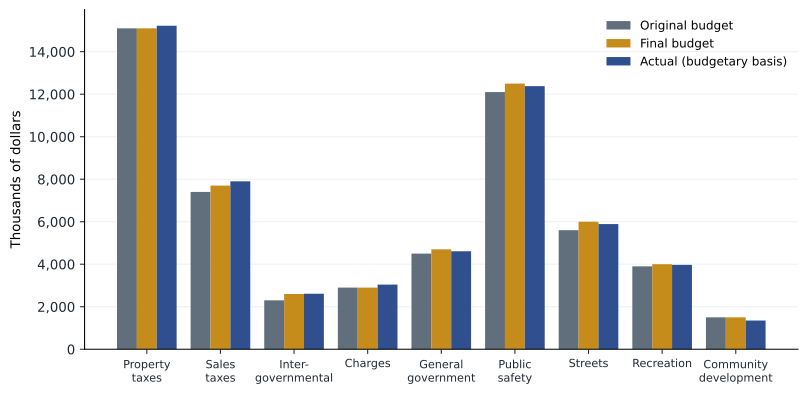
The program prepares Aspen Ridge's budgetary comparison schedule for the general fund. The original budget planned a $100,000 decrease in fund balance. During the year, council amended it, increasing estimated sales tax and intergovernmental revenue and adding $1.0 million of appropriations, mostly for public safety and streets, so the final budget planned a $700,000 decrease. Actual results on the budgetary basis show a $250,000 increase, a favorable variance of $950,000 from the final budget. Because the budgetary basis charges the $420,000 of outstanding encumbrances as expenditures, the GAAP-basis increase in general fund balance is $670,000.
Explaining variances
Variances need explanation, not just calculation. Aspen Ridge's general fund revenue exceeded the final budget by $450,000, led by sales tax, which grew faster than the amended estimate, and by ambulance and recreation charges. Expenditures were $500,000 under the final budget on the budgetary basis, with savings in every function, especially community development, where a planning position stayed vacant for most of the year. A useful analysis distinguishes estimation variances, where the budget was unrealistic, from performance variances, where managers controlled costs, and timing variances, where spending simply moved to the next year. Amendments during the year also deserve scrutiny: frequent large amendments can weaken budgetary control even if the final variance looks favorable.
Budget comparisons also inform the next budget. Council will ask whether sales tax growth will continue and whether savings in public safety came from vacancies that will be filled. The budget also interacts with Nebraska's levy and spending limits, which restrict increases in property tax requests and in restricted funds, so a government that underspends may find its future authority constrained. Rating agencies look at the history of budget variances, and the public uses the schedule to hold the council to account for the levy it set.
| Budgetary practice | Effect on comparison | Where reported |
|---|---|---|
| Encumbrances | Charged as expenditures on the budgetary basis | Reconciling item to GAAP |
| Original and final budget | Both presented, with variance | RSI schedule |
| Legal level of control | Council approval needed to exceed | Notes to RSI |
| Excess of expenditures over appropriations | Indicates noncompliance | Disclosed |
| Major special revenue funds | Comparison required if budget adopted | RSI schedule |
Budgets in not-for-profit organizations
ASC 958 does not require a budget comparison, and few charities present one, though boards and funders rely heavily on budgets. Riverbend Community Pantry's board approves an annual budget, and its state school breakfast grant requires a program budget and periodic reimbursement requests comparing spending with it. Federal awards impose budget rules too: the Uniform Guidance requires prior approval for some budget revisions and restricts unallowable costs, which lesson 12 discusses.
The budget calendar
The budget process in a Nebraska city follows a statutory calendar tied to its 1 October fiscal year. Departments prepare requests in spring; the city manager or mayor presents a proposed budget in summer; the council holds a public hearing after published notice and adopts the budget and the property tax request; and the city files the adopted budget with the state auditor, typically by 20 September. Separate hearings may be required when the property tax request grows beyond limits set by state law. Many cities also prepare capital improvement plans covering five or more years, adopted separately and linked to the capital projects funds.
Public participation has become more common. Some cities use participatory budgeting for part of the capital budget, letting residents propose and vote on projects; others publish budget simulators that let residents see the tax effect of service choices. These practices do not change the accounting, but they increase the importance of clear budget documents and of financial statements that relate clearly to the budget. The Government Finance Officers Association's Distinguished Budget Presentation Award program encourages budgets that explain policies, operations and financial plans in plain language.
Performance budgeting and service costs
Budgets increasingly link money to results. A performance-based budget sets targets for each service, such as lane-miles of street resurfaced, fire response times or library visits, and reports actual performance alongside spending; GASB's service efforts and accomplishments concepts (Concepts Statements No. 2 and 5) encourage such reporting outside the financial statements. Activity-based costing helps a city find the full cost of a service, including overhead and depreciation, so that fees can be set rationally and the council can compare in-house delivery with contracting out. Aspen Ridge's budget reports the cost per lane-mile of street maintenance and the recovery ratio of recreation fees.
Cost recovery is a policy choice. Enterprise funds such as water and sewer are expected to recover full costs, including depreciation and debt service; recreation fees typically recover a third to a half of costs, with taxes paying the rest because recreation has broad community benefits; and permit fees may be set by state law or to recover processing costs. When a city sets fees, it should know both the cash cost and the full accrual cost of the service. The budgetary comparison shows whether fees and costs behaved as planned, and the statement of activities shows the net cost of each function.
Finally, budgets connect to long-term financial planning. Many cities now prepare multi-year financial forecasts that project operating costs, capital needs, fund balances and debt, and test the levy changes required under different scenarios, as GFOA's best practices recommend. The annual budget is then one year of the plan, and the financial statements show how the year turned out. For Aspen Ridge, the forecast shows that maintaining streets at the target condition level will require increasing preservation spending by about $300,000 a year, a message the budgetary comparison and the RSI on infrastructure condition reinforce.
Budgets also matter for accountability within the administration. Department heads are responsible for staying within their appropriations, and monthly or quarterly budget reports to the council allow early action through amendments when costs or revenues depart from plan. The year-end comparison in RSI is the final step in a cycle that runs throughout the year, and its explanations should be consistent with what the council heard during the year.
When results depart sharply from the budget, councils may need to act during the year. Spending above appropriations at the legal level of control is unlawful in most states, so governments amend the budget before overspending, using contingency appropriations or transfers between budget lines where the law allows. Nebraska also permits a city to adopt a revised budget during the year after notice and a hearing when unexpected circumstances arise, such as a natural disaster or a new grant. Repeated large amendments, or a pattern of spending above appropriations, are findings auditors and rating agencies watch closely, and the RSI notes must disclose any excess of expenditures over appropriations.
Worked problem
Reconciling budgetary and GAAP results
A village's general fund shows, on the budgetary basis, revenues of $6.1 million and expenditures of $6.0 million, including $150,000 of outstanding encumbrances at year-end. The prior year's encumbrances of $90,000, re-appropriated this year, were expended this year. What is the GAAP-basis net change in fund balance?
Show solution
- Budgetary net change: $6.1 million − $6.0 million = $100,000.
- Add current-year encumbrances charged as expenditures on the budgetary basis but not GAAP expenditures: +$150,000.
- Subtract prior-year encumbrances expended this year, which are GAAP expenditures but were charged to last year's budget: −$90,000.
- GAAP net change: $100,000 + $150,000 − $90,000 = $160,000.
- The reconciliation is presented in the RSI schedule or its notes.
Answer: A GAAP-basis increase of $160,000.
Common mistakes
MistakeTreating encumbrances as GAAP expenditures.
InsteadEncumbrances are commitments, reported as fund balance constraints, not expenditures.
MistakePresenting only the final budget.
InsteadBoth original and final budgets are required, with variances.
MistakeIgnoring the legal level of budgetary control.
InsteadIdentify causes: estimation, performance or timing, and whether they recur.
MistakeAssuming favorable variances always show good management.
InsteadLarge amendments or vacant positions can produce favorable variances without efficiency.
MistakeForgetting to disclose excess expenditures over appropriations.
InsteadNoncompliance at the legal level of control must be disclosed.
Summary and key terms
- The appropriation ordinance is a legal limit on spending.
- Budgetary accounting records estimated revenues, appropriations and encumbrances.
- GASB 103 requires the budgetary comparison as RSI with original, final and actual columns.
- Variances are shown from final to actual and from original to final.
- Budgetary basis results are reconciled to GAAP, including encumbrances.
- Aspen Ridge: favorable variance of $950,000 from the final budget.
- GAAP-basis increase in fund balance $670,000 after $420,000 of encumbrances.
- Variance analysis separates permanent, timing and estimation causes.
- Appropriation
- Legal authorization to spend for specified purposes.
- Encumbrance
- A commitment, such as a purchase order, recorded to control spending.
- Legal level of budgetary control
- The level at which spending over appropriations requires governing body approval.
- Final budget
- The original budget adjusted by all amendments during the year.
- Budgetary basis
- The basis of accounting used in the legally adopted budget.
- Variance
- The difference between budgeted and actual amounts.
- Balanced budget
- A budget in which planned revenues equal planned spending.
Practice problems
Work each problem on paper first, then reveal the answer to check.
What is an encumbrance?
Show answer
A commitment such as a purchase order that will become an expenditure when goods or services are received.
Name four types of budgetary-GAAP differences.
Show answer
Basis, timing, perspective and entity differences.
In the program, what is the favorable variance from the final budget?
Show answer
$950,000.
Which funds need budgetary comparisons?
Show answer
The general fund and major special revenue funds with legally adopted annual budgets.
How are outstanding encumbrances reported at year-end?
Show answer
As restricted, committed or assigned fund balance, depending on the constraint.
Why might large amendments weaken budgetary control?
Show answer
Because the final budget can be adjusted toward actual results, reducing the discipline of the original authorization.
Does ASC 958 require a budget comparison?
Show answer
No, although boards and funders use budgets extensively.
What is the GAAP-basis change in general fund balance?
Show answer
An increase of $670,000.
Lesson quiz · 5 questions
Score 60% or more to complete this lesson.
Create a free account to save your progress, take quizzes and earn a certificate.