
ACCT-412 · Lesson 5 of 12 · 23 min
Capital assets, infrastructure, leases and asset retirement obligations
Capital assets dominate a city's statement of net position: Aspen Ridge's $179 million of capital assets in its governmental and business-type activities is about 82 percent of total assets. Until GASB Statement No. 34, governments did not report infrastructure such as streets and bridges at all; the reporting model required them to capitalize and depreciate it, or to use the modified approach. This lesson covers capital assets and depreciation, the modified approach for infrastructure, leases under GASB Statement No. 87 and subscription-based IT arrangements under Statement No. 96, asset retirement obligations under Statement No. 83, and the new disclosures of Statement No. 104.
Capital assets and depreciation
Capital assets include land, improvements to land, easements, buildings, vehicles, machinery, equipment, works of art, infrastructure and intangible assets used in operations with initial useful lives beyond one reporting period. They are reported at historical cost, including ancillary charges, in the government-wide statements and proprietary funds; donated capital assets, works of art and capital assets received in service concession arrangements are reported at acquisition value, an entry price, under GASB Statement No. 72. Interest during construction is not capitalized: GASB Statement No. 89 requires it to be expensed for periods beginning after 15 December 2020. Capital assets are depreciated over their estimated useful lives unless they are inexhaustible, such as land and many works of art, or infrastructure reported using the modified approach.
Depreciation is reported in the statement of activities as an expense of the function that uses the asset; depreciation of shared assets, such as a city hall, may be allocated or reported in general government, and depreciation of infrastructure may be reported as a separate line or in the related function. Impairment is assessed under GASB Statement No. 42 when events such as physical damage, a change in law, technological obsolescence or a change in the manner or duration of use cause a significant, unexpected decline in service utility. GASB 104 adds a new class: capital assets held for sale, when the government has decided to pursue a sale and sale within a year is probable; measurement does not change, but historical cost and accumulated depreciation must be disclosed.
# Capital asset topics for the invented City of Aspen Ridge, Nebraska, FY2027
# (thousands of dollars).
# 1) Lessee accounting under GASB 87: a street sweeper leased for 5 years,
#    payments of 60 at the end of each year, incremental borrowing rate 4.5%.
pay, n, r = 60, 5, 0.045
liability = sum(pay / (1 + r) ** t for t in range(1, n + 1))
asset = liability
print(f"Lease liability and right-to-use asset at inception: {liability:,.1f}")
print(f"{'Year':>4}{'Payment':>9}{'Interest':>10}{'Principal':>11}{'Balance':>9}{'Amort.':>8}")
bal = liability
for t in range(1, n + 1):
    i = bal * r
    bal = bal + i - pay
    print(f"{t:>4}{pay:>9}{i:>10.1f}{pay - i:>11.1f}{max(bal, 0):>9.1f}{asset / n:>8.1f}")

# 2) Streets: depreciation versus the modified approach (illustrative).
depreciation = 2_900
preservation_spending = 2_200
target_index, assessed_index = 70, 74
print(f"\nDepreciation approach: expense {depreciation:,}; preservation costs capitalized or expensed by type")
print(f"Modified approach: expense preservation {preservation_spending:,}; no depreciation "
      f"(condition {assessed_index} vs target {target_index}: {'met' if assessed_index >= target_index else 'not met'})")

# 3) Asset retirement obligation under GASB 83: current value, no discounting.
current_cost_2026, inflation = 2_000, 0.03
aro = current_cost_2026 * (1 + inflation)
useful_life_left, life_at_start = 24, 25
deferred_outflow = current_cost_2026 * useful_life_left / life_at_start
print(f"\nARO remeasured for inflation: {aro:,.0f}")
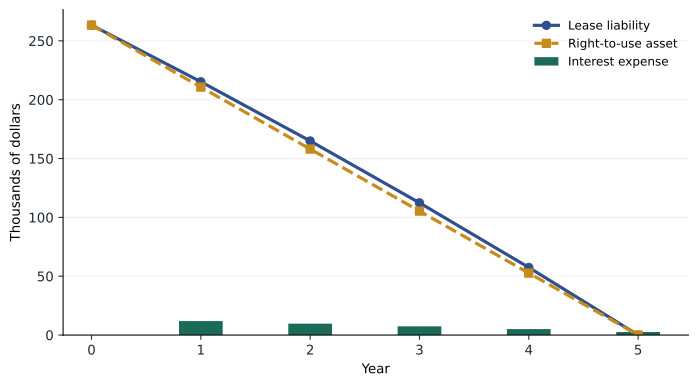
print(f"Deferred outflow of resources remaining: {deferred_outflow:,.0f} (expensed over the plant's life)")Lease liability and right-to-use asset at inception: 263.4 Year Payment Interest Principal Balance Amort. 1 60 11.9 48.1 215.3 52.7 2 60 9.7 50.3 164.9 52.7 3 60 7.4 52.6 112.4 52.7 4 60 5.1 54.9 57.4 52.7 5 60 2.6 57.4 0.0 52.7 Depreciation approach: expense 2,900; preservation costs capitalized or expensed by type Modified approach: expense preservation 2,200; no depreciation (condition 74 vs target 70: met) ARO remeasured for inflation: 2,060 Deferred outflow of resources remaining: 1,920 (expensed over the plant's life)
The program shows three calculations. First, the city leases a street sweeper for five years at $60,000 a year in arrears; at a 4.5 percent incremental borrowing rate, the lease liability and the intangible right-to-use asset are $263,400 at inception. Each payment covers interest and principal, and the asset is amortized straight-line at $52,700 a year. Second, it compares the depreciation and modified approaches for streets. Third, it remeasures an asset retirement obligation for inflation, explained below.
Infrastructure: depreciation or the modified approach
Under the modified approach, a government may choose not to depreciate an eligible infrastructure network, such as streets, if it manages the assets with an asset management system that keeps an up-to-date inventory, performs condition assessments at least every three years, summarizes results using a measurement scale and estimates each year the amount needed to maintain the assets at a condition level established and disclosed by the government. It must document that the assets are being preserved at or above that level. All expenditures to preserve the assets are then expensed, while additions and improvements that increase capacity or efficiency are capitalized. Required supplementary information reports the assessed condition and the estimated and actual preservation spending for five years.
In the program, Aspen Ridge's streets would have $2.9 million of depreciation under the depreciation approach. Under the modified approach the city instead expenses its $2.2 million of preservation spending and reports no depreciation, because its assessed pavement condition index of 74 is above its target of 70. GASB's infrastructure project may change this: its Preliminary Views, issued in September 2024, proposed eliminating the disclosure that describes the modified approach and requiring disclosure of assets that have exceeded 80 percent of their estimated useful lives, and an exposure draft was scheduled for consideration in 2026. Few governments use the modified approach, partly because of its documentation burden.
Leases and subscriptions
GASB Statement No. 87 requires lessees to recognize a lease liability, measured at the present value of payments expected during the lease term, and an intangible right-to-use lease asset, for all leases longer than 12 months that are not short-term, with limited exceptions such as leases of intangible assets and supply contracts. Lessors recognize a lease receivable and a deferred inflow of resources and continue to report the leased asset. There is no operating and finance lease distinction like the old model's. In governmental funds, a lessee reports an expenditure and an other financing source equal to the liability at inception. GASB Statement No. 96 applies the same approach to subscription-based information technology arrangements (SBITAs), such as cloud software subscriptions, which produce a subscription asset and liability.
GASB 104, effective with GASB 103, requires capital asset notes to disclose separately, by major class, lease assets, intangible right-to-use assets recognized by operators in public-private partnerships, subscription assets and other intangible assets, and it requires that right-to-use assets not be combined with owned assets of the same type. In the program, Aspen Ridge's sweeper lease therefore appears in a separate class of lease assets. Public-private and public-public partnerships and availability payment arrangements are accounted for under GASB Statement No. 94.
Asset retirement obligations: GASB 83
GASB Statement No. 83 requires a liability for legally enforceable obligations to perform future asset retirement activities, such as decommissioning a wastewater treatment plant or a power plant, when the liability is incurred and reasonably estimable. Unlike PSAS, the liability is measured at the current value of outlays expected, without discounting, and remeasured at least annually for inflation or deflation and when relevant factors change. A deferred outflow of resources of the same amount is recognized initially and reduced as outflows (expenses) over the asset's useful life. In the program, the city's $2.0 million obligation is remeasured to $2.06 million for 3 percent inflation; the deferred outflow remaining is simplified to the share of the asset's life still ahead.
| Topic | Standard | Main requirement |
|---|---|---|
| Capital assets | GASB 34, 42, 72, 89 | Historical cost; depreciate; interest during construction expensed |
| Modified approach | GASB 34 | No depreciation if condition maintained and documented |
| Leases and SBITAs | GASB 87 and 96 | Liability at present value and right-to-use asset |
| Asset retirement obligations | GASB 83 | Current value, remeasured; deferred outflow |
| Capital asset disclosures | GASB 104 | Separate classes for right-to-use and intangible assets; held for sale |
Infrastructure gaps and renewal funding
Recording capital assets at historical cost has a limitation: depreciation based on decades-old costs understates what it costs to replace the assets today. A water main installed in 1975 for $200,000 might cost $1.5 million to replace, so depreciation of the original cost tells the council little about what it must set aside. Many governments supplement the statements with asset management information: replacement values, condition ratings and the annual investment needed to maintain service levels; the modified approach puts some of this information in RSI. Comparing that investment with actual capital spending reveals an infrastructure gap. For Aspen Ridge, annual depreciation of governmental capital assets compares with an engineering estimate of about 40 percent more spending needed to sustain current service levels, and the utility's rate study includes a replacement component for the same reason.
Funding programs from higher levels of government respond to these gaps. Federal highway funds flow through the state department of transportation, the Clean Water and Drinking Water State Revolving Funds provide low-interest loans and some forgivable principal, and state programs add targeted support. Because each program has its own requirements, governments track eligible spending against each award, which links capital asset records to the grant revenue recognition discussed in lesson 4 and to the Single Audit discussed in lesson 12. Auditors test both together: a capital asset addition funded by a reimbursement grant should match the revenue recognized as costs were incurred.
Disclosure of capital assets by major class, with beginning and ending balances, additions, disposals and depreciation, is required by GASB 34, along with depreciation expense by function and, under GASB 104, separate classes for right-to-use and intangible assets and information about assets held for sale. These disclosures let users see the scale and composition of the asset base and, combined with asset management information, judge whether it is being maintained.
Worked problem
Lease or not?
Aspen Ridge signs three agreements in fiscal 2027: (a) a 5-year lease of a street sweeper at $60,000 a year; (b) a 9-month rental of a crane for a bridge project; (c) a 3-year subscription to cloud-based permitting software at $40,000 a year. How is each accounted for?
Show solution
- (a) A lease longer than 12 months: recognize a lease liability and right-to-use asset of $263,400 (the present value at 4.5 percent); interest and amortization follow.
- In the general fund, report a capital outlay expenditure and an other financing source of $263,400 at inception; payments are debt service expenditures.
- (b) A short-term lease of 12 months or less: report payments as outflows (expenses) as incurred; no liability or asset.
- (c) A SBITA under GASB 96: recognize a subscription liability at the present value of payments and a subscription asset, amortized over the term; implementation costs may be capitalized.
- GASB 104 requires lease and subscription assets to be disclosed as separate major classes.
Answer: (a) lease liability and asset $263,400; (b) expense as incurred; (c) subscription asset and liability.
Common mistakes
MistakeDepreciating infrastructure reported under the modified approach.
InsteadUnder the modified approach preservation costs are expensed and there is no depreciation.
MistakeDiscounting a GASB 83 asset retirement obligation.
InsteadGASB 83 uses current value without discounting, remeasured for inflation.
MistakeCapitalizing interest during construction.
InsteadGASB 89 requires interest during construction to be expensed.
MistakeTreating a cloud software subscription as an operating expense only.
InsteadSBITAs over 12 months are recognized under GASB 96.
MistakeCombining lease assets with owned equipment in the notes.
InsteadGASB 104 requires separate disclosure.
Summary and key terms
- Capital assets are at historical cost; donated assets at acquisition value.
- Interest during construction is expensed under GASB 89.
- Impairment follows GASB 42; GASB 104 adds capital assets held for sale.
- The modified approach expenses preservation costs if condition levels are maintained.
- GASB 87 and 96 put leases and SBITAs on the statement of net position.
- GASB 83 measures AROs at current value with a deferred outflow.
- Aspen Ridge: sweeper lease liability $263,400 at inception.
- Aspen Ridge streets meet the condition target: 74 against 70.
- Modified approach
- An alternative to depreciation for eligible infrastructure maintained at a disclosed condition level.
- Right-to-use asset
- An intangible asset representing a lessee's right to use a leased asset.
- SBITA
- A subscription-based information technology arrangement accounted for under GASB 96.
- Acquisition value
- The price that would be paid to acquire an asset with equivalent service potential.
- Asset retirement obligation
- A legally enforceable liability associated with retiring a capital asset.
- Infrastructure
- Long-lived capital assets that are stationary and can be preserved longer than most capital assets, such as streets and water systems.
- Useful life
- The period over which an asset is expected to be used.
- Capitalization threshold
- The minimum cost for an item to be recorded as a capital asset.
Practice problems
Work each problem on paper first, then reveal the answer to check.
What is the lease liability at inception in the program?
Show answer
$263,400.
What does an entity need to use the modified approach?
Show answer
An asset management system with inventory, condition assessments at least every three years and annual estimates of preservation costs, plus documentation that the condition level is met.
How does GASB 83 differ from PSAS in measuring AROs?
Show answer
GASB 83 uses current value without discounting; PSAS allow a present value.
How is a 9-month crane rental treated?
Show answer
As a short-term lease: expense as incurred.
In a governmental fund, how is a new lease reported?
Show answer
As a capital outlay expenditure and an other financing source.
Which classes does GASB 104 require separately?
Show answer
Lease assets, intangible right-to-use assets in PPPs, subscription assets and other intangible assets.
What did the 2024 infrastructure Preliminary Views propose?
Show answer
Disclosure of assets past 80 percent of their useful lives and removal of the modified approach description disclosure.
In the program, what is year 1 interest on the lease?
Show answer
About $11,900.
Lesson quiz · 5 questions
Score 60% or more to complete this lesson.
Create a free account to save your progress, take quizzes and earn a certificate.