
ACCT-412 · Lesson 4 of 12 · 23 min
Revenue: nonexchange and exchange transactions
Revenue is where governmental accounting departs most clearly from business accounting. A city's largest revenue, property tax, is imposed by law; its sales tax is collected by the state on its behalf; grants come from other governments that receive nothing in return; and only part of its revenue, such as water charges, comes from exchanges with customers. GASB Statement No. 33, Accounting and Financial Reporting for Nonexchange Transactions (1998), classifies nonexchange revenues into four groups with different recognition rules, while exchange revenues follow accrual principles similar to business accounting. In governmental funds, every revenue must also be available. This lesson applies the rules to Aspen Ridge.
Four classes of nonexchange transactions
Statement 33 defines four classes. Derived tax revenues are taxes on exchange transactions, such as sales and income taxes: recognize them when the underlying exchange occurs. Imposed nonexchange revenues are taxes and fines imposed on non-governmental entities without an underlying transaction, such as property taxes: recognize an asset when there is an enforceable legal claim or when resources are received, and revenue in the period for which the tax is levied. Government-mandated nonexchange transactions occur when a higher level of government requires a lower one to perform a service and provides resources, and voluntary nonexchange transactions result from legislative or contractual agreements, such as most grants and private donations: for both, recognize revenue when all eligibility requirements, including time requirements, are met. Purpose restrictions do not delay recognition; they result in restricted net position.
In Nebraska, as in many states, the county assesses property and collects property taxes for all local governments, including the city, school district and other entities, then remits each government's share. Cities levy a rate per $100 of valuation within limits set by state law. Sales tax is a local option tax collected by the state Department of Revenue along with the state sales tax and remitted to the city monthly, about two months after the sales occur. Because both taxes are collected by others, the city must estimate amounts collected for its benefit but not yet received at year-end.
# Revenue recognition for the invented City of Aspen Ridge, Nebraska, fiscal year
# ended 30 September 2027 (thousands). Availability period for property taxes:
# 60 days; for other revenues the city's policy uses 90 days.
levy = 18_700                       # levied for FY2027 (imposed nonexchange)
allowance = 100                     # estimated uncollectible
collected_in_year = 18_100
collected_within_60_days = 300
later = levy - allowance - collected_in_year - collected_within_60_days

print("PROPERTY TAXES              Government-wide   General fund")
print(f"Revenue                     {levy - allowance:>15,}   {collected_in_year + collected_within_60_days:>12,}")
print(f"Deferred inflow (unavailable){'':>14}   {later:>12,}")

# Sales tax (derived tax revenue): recognized when the underlying sales occur.
remitted_by_state = {"Aug sales, received Oct": 640, "Sep sales, received Nov": 660}
receivable = sum(remitted_by_state.values())
print(f"\nSales tax receivable at year end {receivable:,} (available: received within 90 days)")

# Reimbursement grant (voluntary nonexchange with an eligibility requirement):
eligible_costs = 1_000
reimbursed_within_90_days = 750
print(f"Grant: government-wide revenue {eligible_costs:,}; "
      f"fund revenue {reimbursed_within_90_days:,}; "
      f"deferred inflow {eligible_costs - reimbursed_within_90_days:,}")

# Exchange revenue: water bills for September usage, billed in October
print("Utility fund: September usage billed in October is revenue of FY2027 (accrual).")PROPERTY TAXES Government-wide General fund Revenue 18,600 18,400 Deferred inflow (unavailable) 200 Sales tax receivable at year end 1,300 (available: received within 90 days) Grant: government-wide revenue 1,000; fund revenue 750; deferred inflow 250 Utility fund: September usage billed in October is revenue of FY2027 (accrual).
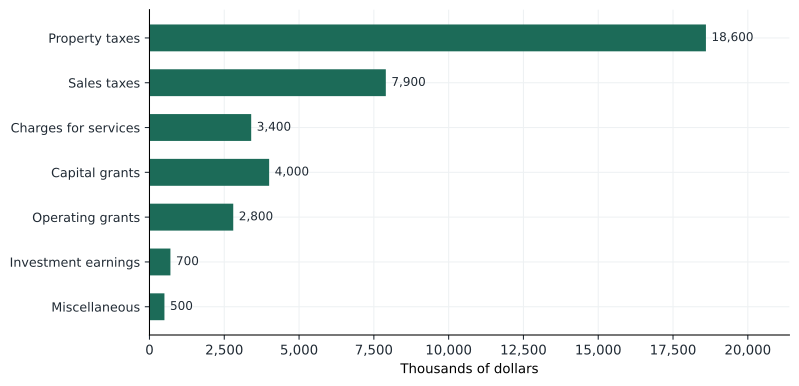
The program applies the rules to three revenues. For property taxes, government-wide revenue is the full fiscal 2027 levy of $18.7 million less the $100,000 estimated to be uncollectible, or $18.6 million; the general fund recognizes only the $18.4 million collected during the year or within 60 days afterward, and reports the $200,000 collected later as a deferred inflow of resources for unavailable revenue. The $1.3 million of sales tax on August and September sales is revenue in both the fund and government-wide, because it will be received within the city's 90-day availability period. The reimbursement grant is recognized government-wide as costs are incurred, $1.0 million, but only $750,000 is available in the fund.
Grants and eligibility requirements
Most grants to local governments are voluntary or government-mandated nonexchange transactions. GASB Statement 33 lists four kinds of eligibility requirements: required characteristics of recipients; time requirements (the period when resources must or may be used); reimbursements (the recipient must incur allowable costs first); and contingencies (for voluntary transactions, such as a requirement to raise matching funds). Revenue is recognized when all are met. Resources received before the requirements are met are liabilities (unearned revenue) except for time requirements, which result in deferred inflows. For reimbursement grants, which are common for federal programs, revenue equals allowable costs incurred. Purpose restrictions, by contrast, do not delay revenue; they restrict net position until the resources are used.
The fund-level difference arises because availability applies to grants as well. The city's policy treats grant revenue as available if collected within 90 days after year-end; the state reimbursed $750,000 of the $1.0 million of costs within that period, so $250,000 is a deferred inflow in the general fund but revenue in governmental activities. Governments disclose their availability periods in the summary of significant accounting policies, and policies of 60, 90 or even 365 days for reimbursement grants are seen in practice.
Exchange transactions
Exchange revenues, such as water and sewer charges, recreation fees and permit fees, are recognized when the exchange takes place, on the accrual basis in the government-wide statements and proprietary funds, and when also available in governmental funds. Water bills for September usage that are sent in October are revenue of fiscal 2027 in the utility fund. GASB's revenue and expense recognition project has proposed a performance obligation model for exchange transactions, influenced by FASB ASC 606, but the proposal is not yet a standard. GASB has also clarified that a transaction is an exchange only if both parties receive value of approximately equal value; a nominal fee for a heavily subsidized service, such as a $5 youth sports registration, may be an exchange-like transaction, still reported as charges for services.
| Class | Example | Government-wide recognition | Governmental fund condition |
|---|---|---|---|
| Derived tax revenues | Sales and income taxes | When the underlying exchange occurs | Available within the availability period |
| Imposed nonexchange revenues | Property taxes, fines | Period for which levied (taxes) or when enforceable (fines) | Collected within 60 days for property taxes |
| Government-mandated nonexchange | State-funded mandates | When all eligibility requirements are met | Available |
| Voluntary nonexchange | Grants and donations | When all eligibility requirements are met | Available |
| Exchange | Charges for services | When the exchange occurs | Available |
Special topics
Several special topics recur. Property taxes levied in fiscal 2027 for fiscal 2028 are deferred inflows of resources in both the fund and government-wide statements, because they relate to a future period. Tax abatements, such as property tax reductions granted to attract a business, are disclosed under GASB Statement No. 77, which applies whether the abatement is the city's own or another government's that reduces the city's revenue. Pass-through grants, which the city receives and passes to subrecipients, are generally revenue and expenditure of the city if it has administrative or direct financial involvement. On-behalf payments, such as a state paying pension contributions for city employees, are recognized as revenue and expenditure by the employer.
Tax refunds, appeals and allowances
Several practical issues affect property tax measurement. Property owners may protest their valuations to the county board of equalization and appeal further; if a protest succeeds, the county refunds part of the tax, reducing every taxing entity's share. Governments estimate refunds for pending protests and reduce revenue and receivables accordingly; Aspen Ridge records an estimated $90,000 of refunds for fiscal 2027 protests outstanding at year-end, within its $100,000 allowance. Tax abatements and tax increment financing (TIF), common in Nebraska, raise their own issues: under TIF, incremental property taxes in a redevelopment area are pledged to repay redevelopment bonds, and the city discloses the abatement and the pledged revenues. Delinquent taxes become liens, and the county may sell tax certificates to investors, which collects the tax for the city even though the property owner has not paid.
Revenue recognition also interacts with the budget. Nebraska limits property tax requests and the growth of restricted funds, so a city whose sales tax grows faster than expected may lower its levy or build fund balance within those limits. The accounting does not change: revenue is recognized when the standards say so, regardless of how the council plans to use it. But the budgetary comparison and MD&A explain the effect, and readers should not assume that a revenue windfall reduces taxes automatically.
| Item | Treatment | Aspen Ridge fiscal 2027 |
|---|---|---|
| Valuation protests outstanding | Reduce revenue and receivable for estimated refunds | Estimate $90,000 |
| Tax increment financing | Disclose abatement; pledged revenue | Downtown TIF district |
| Delinquent taxes | Lien; allowance for uncollectible | Within $100,000 allowance |
| Taxes levied for next year | Deferred inflow | None levied early |
| State aid and on-behalf payments | Revenue when eligibility met | Highway allocation |
A final point concerns disclosure. Governments disclose their revenue recognition and availability policies for each major source, receivables and their collectibility, deferred inflows by type, tax abatements under Statement 77, and pledged revenues that secure debt, such as the water and sewer charges pledged to the utility's revenue bonds. These disclosures help users understand how much of next year's revenue is already committed and how much depends on future decisions. For Aspen Ridge, the notes show $450,000 of unavailable revenue in the general fund, all of which the city expects to collect within the next fiscal year.
Comparing revenue sources shows how mix shapes risk. Property taxes are stable but limited by state law; sales taxes respond to the economy and shift with online sales rules; grants depend on decisions by other governments; and investment earnings depend on interest rates. A city that relies heavily on sales taxes, as many Nebraska cities do, should hold larger reserves against recessions, a point the GASB 102 risk disclosures can highlight.
Worked problem
Recognizing nonexchange revenue
In fiscal 2027, Aspen Ridge (a) receives a $900,000 state grant restricted to police training, with no other requirement; (b) receives on 15 September 2027 a $600,000 grant that may be spent only in fiscal 2028; (c) incurs $400,000 of allowable costs under a federal reimbursement grant, reimbursed in January 2028; (d) issues $85,000 of parking fines, of which $20,000 are uncollectible.
Show solution
- (a) A purpose restriction does not delay recognition: $900,000 is revenue, and unspent amounts are restricted net position.
- (b) A time requirement is an eligibility requirement: the $600,000 is a deferred inflow of resources in both the fund and government-wide statements until fiscal 2028.
- (c) The reimbursement requirement is met when allowable costs are incurred: $400,000 of revenue government-wide; in the fund, revenue only if January falls within the availability period (it does under a 90-day policy).
- (d) Fines are imposed nonexchange revenues: recognize $65,000 of revenue net of the uncollectible estimate when the fines are enforceable; in the fund, only the available portion.
- Purpose restrictions affect net position classification; eligibility requirements affect timing.
Answer: (a) revenue $900,000; (b) deferred inflow $600,000; (c) revenue $400,000; (d) revenue $65,000 net.
Common mistakes
MistakeDelaying revenue for a purpose restriction.
InsteadPurpose restrictions restrict net position; only eligibility requirements delay revenue.
MistakeRecognizing all property taxes in the fund in the levy year.
InsteadOnly amounts collected within 60 days after year-end are available in the fund.
MistakeTreating a time requirement as a liability.
InsteadResources received before a time requirement is met are deferred inflows.
MistakeTreating taxes levied for next year as current revenue.
InsteadThey are deferred inflows until the period for which they are levied.
MistakeNetting tax abatements without disclosure.
InsteadGASB 77 requires disclosure of tax abatements.
Summary and key terms
- GASB 33 defines four classes of nonexchange transactions.
- Derived tax revenues are recognized when the underlying exchange occurs.
- Property taxes are revenue of the period for which they are levied.
- Grants are revenue when all eligibility requirements are met; purpose restrictions do not delay recognition.
- Time requirements produce deferred inflows; reimbursement grants follow costs incurred.
- In funds, revenue must also be available: 60 days for property taxes.
- Aspen Ridge: property taxes $18.6 million government-wide and $18.4 million in the fund.
- Unavailable revenue: $200,000 of taxes and $250,000 of grants.
- Derived tax revenue
- Tax revenue on exchange transactions, such as sales or income taxes.
- Imposed nonexchange revenue
- Revenue imposed on non-governmental entities without an underlying exchange, such as property taxes and fines.
- Eligibility requirement
- A recipient characteristic, time requirement, reimbursement or contingency that must be met before revenue is recognized.
- Purpose restriction
- A limit on how resources may be used; it restricts net position but does not delay revenue.
- Availability period
- The period after year-end within which revenue must be collected to be available in a governmental fund.
- Unavailable revenue
- A deferred inflow in a governmental fund for revenue earned but not available.
- Exchange transaction
- A transaction in which each party receives and gives up essentially equal value.
- Payment in lieu of taxes
- A payment by a government or enterprise exempt from property tax, made instead of the tax.
Practice problems
Work each problem on paper first, then reveal the answer to check.
When is sales tax revenue recognized?
Show answer
When the underlying sales occur, and in the fund when also available.
When is a property tax receivable recognized?
Show answer
When there is an enforceable legal claim, typically the lien or assessment date.
In the program, how much property tax is unavailable in the general fund?
Show answer
$200,000.
How is a grant that may be spent only next year reported?
Show answer
As a deferred inflow of resources until the time requirement is met.
What is the difference between a purpose restriction and an eligibility requirement?
Show answer
A purpose restriction limits use and restricts net position; an eligibility requirement must be met before revenue is recognized.
Which GASB statement requires disclosure of tax abatements?
Show answer
Statement No. 77.
How is a reimbursement grant recognized government-wide?
Show answer
As revenue equal to allowable costs incurred.
What is an on-behalf payment?
Show answer
A payment by another government, such as a state, for the city's employees' benefits, recognized as revenue and expenditure.
Lesson quiz · 5 questions
Score 60% or more to complete this lesson.
Create a free account to save your progress, take quizzes and earn a certificate.