
ACCT-412 · Lesson 3 of 12 · 23 min
The governmental reporting model: GASB 34 and 103
The governmental reporting model was created by GASB Statement No. 34 in 1999 and refined by Statement No. 103, Financial Reporting Model Improvements, effective for fiscal years beginning after 15 June 2025. A government's basic financial statements contain government-wide statements, fund statements and notes, and are accompanied by required supplementary information, starting with management's discussion and analysis (MD&A). Many governments publish them inside an annual comprehensive financial report (ACFR) with introductory and statistical sections. This lesson walks through the model, shows Aspen Ridge's statement of activities, and explains the changes made by Statement 103.
The pieces of the reporting model
The government-wide statements are the statement of net position and the statement of activities. They report the primary government's governmental activities (normally supported by taxes and intergovernmental revenues) and business-type activities (financed in whole or part by user charges) in separate columns, plus discretely presented component units, using the economic resources focus and accrual basis. Fiduciary activities are excluded. The fund statements present governmental funds (balance sheet and statement of revenues, expenditures and changes in fund balances, on the modified accrual basis), proprietary funds (statement of net position, statement of revenues, expenses and changes in fund net position, and statement of cash flows, on the accrual basis) and fiduciary funds (statement of fiduciary net position and statement of changes in fiduciary net position). Major funds are shown individually and nonmajor funds in aggregate.
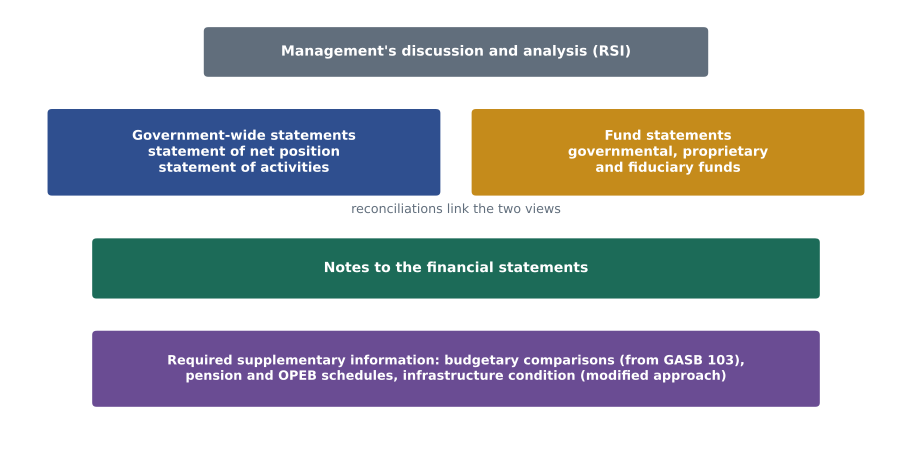
The statement of net position presents assets, deferred outflows of resources, liabilities, deferred inflows of resources and net position, preferably in that order. Net position is divided into three components: net investment in capital assets (capital assets net of depreciation, less related debt and deferred inflows attributable to their acquisition); restricted (constrained by external parties such as creditors, grantors or laws, or by enabling legislation); and unrestricted. Liabilities whose average maturity is more than a year are split between amounts due within one year and amounts due later. Assets and liabilities are generally presented in order of liquidity, or classified as current and noncurrent.
The statement of activities is the most distinctive governmental statement. It reports expenses by function, such as general government, public safety, highways and streets, and culture and recreation, and subtracts the program revenues each function generates: charges for services, operating grants and contributions, and capital grants and contributions. The result is the net (expense) revenue of each function: the part of its cost that must be financed by general revenues, mainly taxes. General revenues, transfers and special items are reported at the bottom, followed by the change in net position. The format answers the question residents ask most often: how much of each service is paid for by taxes?
Aspen Ridge's statement of activities
The program builds Aspen Ridge's statement of activities for fiscal 2027. Each governmental function has net expense, ranging from $700,000 for interest on long-term debt to $9.8 million for public safety; together they are $22.3 million. General revenues of $27.7 million, mostly property and sales taxes, and a $500,000 transfer from the utility cover that net expense and increase net position of governmental activities by $5.9 million. The water and sewer utility generates net revenue of $1.6 million from charges and a capital grant; after the transfer its net position rises by $1.1 million. The primary government's net position rises by $7.0 million.
# Government-wide statement of activities for the invented City of Aspen Ridge,
# Nebraska, fiscal year ended 30 September 2027 (thousands of dollars).
# function: (expenses, charges for services, operating grants, capital grants)
gov = {"General government":     (4_900,   900,   200,     0),
       "Public safety":          (12_600,  1_100, 1_300,   400),
       "Highways and streets":   (8_300,    300,  1_000, 3_600),
       "Culture and recreation": (4_400,  1_100,   100,     0),
       "Community development":  (1_600,      0,   200,     0),
       "Interest on long-term debt": (700,    0,     0,     0)}
bta = {"Water and sewer utility": (8_800, 9_600,     0,   800)}
general = {"Property taxes": 18_600, "Sales taxes": 7_900,
           "Investment earnings": 700, "Miscellaneous": 500}
transfer = 500           # payment in lieu of taxes, utility to general fund

def net(rows):
    return {k: c + o + g - e for k, (e, c, o, g) in rows.items()}

print(f"{'Function':28}{'Net (expense) revenue':>22}")
ng = net(gov)
for k, v in ng.items():
    print(f"{k:28}{v:>22,}")
nb = net(bta)
for k, v in nb.items():
    print(f"{k:28}{v:>22,}")
gtot, btot = sum(ng.values()), sum(nb.values())
G = sum(general.values())
print(f"\nGovernmental: net expense {gtot:,} + general revenues {G:,} + transfers {transfer:,}")
print(f"Change in net position, governmental     {gtot + G + transfer:>7,}")
print(f"Change in net position, business-type    {btot - transfer:>7,}")
print(f"Change in net position, primary government {gtot + G + btot:>5,}")Function Net (expense) revenue General government -3,800 Public safety -9,800 Highways and streets -3,400 Culture and recreation -3,200 Community development -1,400 Interest on long-term debt -700 Water and sewer utility 1,600 Governmental: net expense -22,300 + general revenues 27,700 + transfers 500 Change in net position, governmental 5,900 Change in net position, business-type 1,100 Change in net position, primary government 7,000
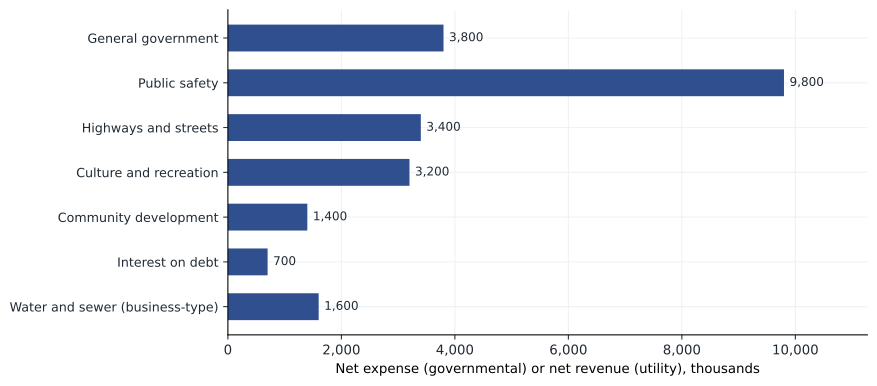
Reading the statement, public safety is by far the most tax-dependent function: its charges and grants cover only $2.8 million of its $12.6 million cost. Highways and streets cost $8.3 million but net expense is only $3.4 million, because capital grants of $3.6 million help pay for street reconstruction. The utility's net revenue does not mean water customers subsidize taxpayers: rates are set to cover operating costs, debt service and replacement, and the $500,000 transfer is a payment in lieu of taxes approved by council.
What GASB 103 changed
GASB's re-examination of Statement 34, which began in 2013, found that the model generally worked but that some features were poorly applied. Statement 103 responds to those findings. Governments apply it as a change in accounting principle under Statement No. 100, Accounting Changes and Error Corrections. The main changes are:
- MD&A must analyze why balances and results changed, not merely restate amounts, must avoid boilerplate, and must focus on the primary government, including significant capital asset and long-term financing activity and currently known facts expected to have a significant effect in the next year.
- Extraordinary and special items are replaced by unusual or infrequent items, presented separately with disclosure of the related programs and whether management controls the events.
- Proprietary fund statements must distinguish operating from nonoperating revenues and expenses using defined criteria, classify subsidies, and show a new subtotal of operating income (loss) and noncapital subsidies.
- Budgetary comparisons are presented only as required supplementary information, with variances between final budget and actual and between original and final budget.
- Major component units are presented in separate columns, or, if that is not practical, in combining statements within the basic statements.
| Statement | Basis | Aspen Ridge fiscal 2027 |
|---|---|---|
| Statement of net position | Economic resources, accrual | Primary government $167.5 million |
| Statement of activities | Economic resources, accrual | Change in net position $7.0 million |
| Governmental funds statements | Current financial resources, modified accrual | Total fund balances $26.5 million |
| Proprietary fund statements | Economic resources, accrual | Utility net position $49.8 million |
| Budgetary comparison (RSI) | Budgetary basis | General fund variance +$950,000 |
Applying the model
Applying the model requires judgment about which funds are major (a fund is major if its assets plus deferred outflows, liabilities plus deferred inflows, revenues or expenditures/expenses are at least 10 percent of its fund type and 5 percent of all governmental and enterprise funds combined, or if the government chooses to present it as major), how to allocate indirect expenses to functions, and how to classify revenues as program or general. Taxes are always general revenues, even if dedicated to a function. Internal service funds, which provide services such as fleet maintenance to other departments, are proprietary funds but are usually folded into governmental activities in the government-wide statements.
Reading the statements together
The statements are designed to be read together, each answering a different question. The statement of activities asks how much of each service is financed by taxes and whether the government's total revenues covered the full cost of services. The statement of net position asks what the government owns and owes, and how much of its net position is unrestricted. The governmental fund statements ask whether current resources were enough for current spending and how much is left in each fund. The proprietary fund statements show whether the utility recovers its costs from rates. For Aspen Ridge, the story is consistent: taxes finance most services; the utility covers its costs; capital assets dominate net position; and the general fund ended the year with a healthy unassigned balance.
Analysts often compute ratios that draw on several statements: unrestricted net position as a share of expenses, general fund unassigned balance as a share of expenditures (many governments target at least two months, following GFOA guidance), debt service as a share of noncapital expenditures and the age of capital assets. Lesson 12 returns to these. MD&A, which GASB 103 strengthened, should help readers make these connections, explaining why balances changed rather than merely restating them. A good MD&A for Aspen Ridge would explain that the capital projects fund balance rose because bonds were issued late in the year and construction will continue into fiscal 2028.
Comparatives also matter. GASB does not require comparative statements, but many governments present prior-year totals in their government-wide statements, and MD&A must compare current-year and prior-year results. When a government adopts a new standard such as Statement 103, Statement 100 governs how the change in accounting principle is reported: generally by restating the beginning balances of the earliest period presented, with disclosure of the nature of the change and its effects. Users comparing a government's history should look for such restatements before computing trends.
Finally, the model asks preparers to think about the order and level of detail from the user's point of view. GASB 34 lets governments present more detailed functions in the statement of activities if useful, and requires governments to report direct expenses by function, with indirect expenses either allocated with a separate column or reported in general government. Statement 103 requires governments to present unusual or infrequent items separately, so that users can separate them from recurring results, and to make MD&A an explanation rather than a repetition of the statements. The aim is that a council member or resident can open the statements and see quickly how much each service costs taxpayers and whether the government's financial position improved, with notes providing the detail analysts need.
Notes under the model include a summary of significant accounting policies, a description of the reporting entity, cash and investment risks, capital assets, long-term liabilities, interfund balances and transfers, pensions and OPEB, commitments and contingencies, tax abatements, and subsequent events, to which GASB 105 adds new requirements for fiscal years beginning after 15 June 2026. For Aspen Ridge, the most important notes for analysts are those on long-term liabilities, pensions and the capital projects funded by the new bonds.
Worked problem
Program or general revenue?
Classify each fiscal 2027 item for Aspen Ridge: (a) $1.1 million of ambulance fees; (b) a $1.0 million state reimbursement grant for police overtime; (c) $3.6 million of federal highway grants for street reconstruction; (d) $7.9 million of local option sales tax dedicated by ordinance to streets; (e) $700,000 of investment earnings.
Show solution
- (a) Ambulance fees are charges for services, a program revenue of public safety.
- (b) The state grant is restricted to police overtime, an operating grant of public safety.
- (c) Grants restricted to capital purposes are capital grants and contributions of highways and streets.
- (d) Taxes are always general revenues, even if dedicated; the sales tax is not a program revenue of streets.
- (e) Unrestricted investment earnings are general revenues.
Answer: Program revenues: (a), (b), (c); general revenues: (d), (e).
Common mistakes
MistakeTreating a dedicated tax as a program revenue.
InsteadTaxes are always general revenues.
MistakeReporting extraordinary items after GASB 103.
InsteadThey are replaced by unusual or infrequent items.
MistakePresenting the budgetary comparison as a basic statement.
InsteadUnder GASB 103 it is required supplementary information.
MistakeIncluding fiduciary activities in the government-wide statements.
InsteadFiduciary activities are excluded; they appear only in fiduciary fund statements.
MistakeWriting boilerplate MD&A.
InsteadGASB 103 requires analysis of why balances and results changed.
Summary and key terms
- The model comprises MD&A, government-wide statements, fund statements, notes and other RSI.
- Government-wide statements show governmental and business-type activities; fiduciary activities are excluded.
- The statement of activities shows net (expense) revenue by function.
- Net position has three components: net investment in capital assets, restricted and unrestricted.
- GASB 103 moves budgetary comparisons to RSI and replaces extraordinary and special items with unusual or infrequent items.
- Proprietary statements show operating income (loss) and noncapital subsidies.
- Aspen Ridge: net expense $22.3 million; general revenues $27.7 million.
- Major fund tests use 10 percent and 5 percent thresholds.
- Statement of activities
- The government-wide operating statement, reporting net (expense) revenue by function.
- Program revenues
- Charges for services and grants and contributions attributable to a specific function.
- General revenues
- Revenues not attributable to a function, including all taxes.
- Net investment in capital assets
- Capital assets net of depreciation, less related debt and deferred inflows.
- ACFR
- Annual comprehensive financial report, with introductory, financial and statistical sections.
- Major fund
- A fund presented in its own column, by size tests or by choice.
- Major program or function
- A significant area of service for which expenses and related revenues are reported.
Practice problems
Work each problem on paper first, then reveal the answer to check.
List the three components of net position.
Show answer
Net investment in capital assets, restricted and unrestricted.
What replaces extraordinary and special items?
Show answer
Unusual or infrequent items, presented separately.
In the program, what is the net expense of public safety?
Show answer
$9.8 million.
How much did the primary government's net position change?
Show answer
An increase of $7.0 million.
Where do budgetary comparisons appear after GASB 103?
Show answer
In required supplementary information.
Why is a dedicated sales tax not a program revenue?
Show answer
All taxes are general revenues under GASB 34.
What new subtotal must proprietary funds show?
Show answer
Operating income (loss) and noncapital subsidies.
When is a fund major by size?
Show answer
When one of its elements is at least 10 percent of its fund type and 5 percent of governmental and enterprise funds combined.
Lesson quiz · 5 questions
Score 60% or more to complete this lesson.
Create a free account to save your progress, take quizzes and earn a certificate.