
ACCT-412 · Lesson 2 of 12 · 23 min
The GASB concepts statements and measurement focus
A conceptual framework is the set of ideas from which a standard setter derives its standards and to which preparers turn when no standard addresses a transaction. GASB's framework is a series of Concepts Statements: No. 1 on the objectives of financial reporting (1987), No. 2 on service efforts and accomplishments reporting, No. 3 on communication methods, No. 4 on the elements of financial statements, No. 5 amending No. 2, No. 6 on measurement (2014) and No. 7 on notes (2022, amending No. 3). GASB has also worked on recognition concepts, which are linked to its long-running revenue and expense recognition project. This lesson explains the objectives, the elements and, above all, the two measurement focuses and bases of accounting that make governmental reporting unlike any other.
Objectives and users
Concepts Statement No. 1 states that financial reporting should help users assess accountability and make economic, social and political decisions. It identifies three primary user groups: citizens, legislative and oversight bodies, and investors and creditors. Its objectives include demonstrating whether resources were obtained and used in accordance with the legally adopted budget, providing information on service efforts, costs and accomplishments, and helping users assess interperiod equity: whether current-year revenues were sufficient to pay for current-year services. It also stresses that governmental reporting should help users assess the level of services that can be provided and the government's ability to meet its obligations as they become due.
The qualitative characteristics in Concepts Statement No. 1 are understandability, reliability, relevance, timeliness, consistency and comparability. Concepts Statement No. 3 classifies how information is communicated: recognition in the statements, disclosure in notes, required supplementary information (RSI), and supplementary information. Concepts Statement No. 7 sets out what belongs in notes: information essential to users' analysis, but not opinions or forward-looking speculation. The communication categories matter in practice because auditors give an opinion on the basic statements and notes, but only apply limited procedures to RSI such as management's discussion and analysis and budgetary comparisons.
Elements of the financial statements
Concepts Statement No. 4 defines seven elements. Assets are resources with present service capacity that the government presently controls. Liabilities are present obligations to sacrifice resources that the government has little or no discretion to avoid. A deferred outflow of resources is a consumption of net assets that applies to a future reporting period, and a deferred inflow of resources is an acquisition of net assets that applies to a future period. Outflows and inflows of resources are consumptions and acquisitions of net assets that apply to the reporting period: expenses or expenditures, and revenues. Net position is the residual of all the other elements. Deferred outflows and inflows are the distinctive feature: they appear only where a GASB standard requires them, such as for pension deferrals, unavailable revenue in governmental funds, and taxes levied for a future period.
Concepts Statement No. 6 identifies two measurement approaches: initial-transaction-date-based measurement (historical cost) and current-financial-statement-date-based measurement (fair value, replacement cost or settlement amount). Capital assets are measured at historical cost; most investments are measured at fair value under GASB Statements 31 and 72, with changes in fair value reported as investment income; and some liabilities, such as asset retirement obligations, are measured at current value. Because GASB has no separate concept of other comprehensive income, fair value changes go directly through the change in net position.
Two measurement focuses
Governmental reporting uses two measurement focuses. The economic resources measurement focus, with the accrual basis of accounting, is the same idea as business accounting: it measures all assets, deferred outflows, liabilities and deferred inflows, and recognizes revenues when earned and expenses when incurred, including depreciation. It is used in the government-wide statements, in proprietary funds and in fiduciary funds. The current financial resources measurement focus, with the modified accrual basis, measures only financial resources available to finance current spending and the claims against them. It is used in governmental funds: the general fund, special revenue funds, capital projects funds, debt service funds and permanent funds.
Under modified accrual, revenues are recognized when they are measurable and available, meaning collected within the period or soon enough afterward to pay liabilities of the period. Governments set an availability period in their accounting policies, and for property taxes GASB guidance limits it to 60 days. Expenditures, not expenses, are recognized when the related liability is incurred, with important exceptions: principal and interest on long-term debt are expenditures when due, and liabilities such as compensated absences, pensions and claims are recognized only to the extent they are normally expected to be paid with expendable available financial resources. Capital outlays are expenditures; there is no depreciation.
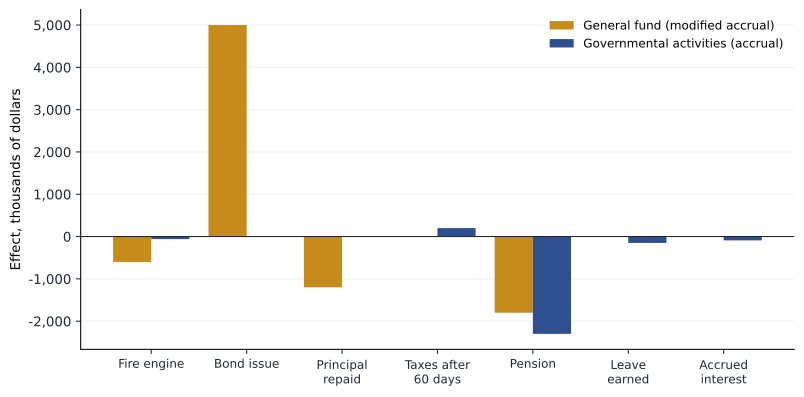
# Same transactions, two measurement focuses: the general fund (current financial
# resources, modified accrual) and governmental activities (economic resources,
# accrual). City of Aspen Ridge, Nebraska, FY2027, thousands of dollars.
tx = [
    # description,                         fund effect,  government-wide effect
    ("Buy a fire engine for cash",             -600,  -60),   # expenditure vs depreciation
    ("Issue general obligation bonds",        5_000,    0),   # other financing source vs liability
    ("Repay bond principal",                 -1_200,    0),   # expenditure vs reduces liability
    ("Property taxes collected or available",18_400, 18_400),
    ("Taxes collected after 60 days",          0,   200),  # unavailable vs revenue
    ("Employer pension contributions",       -1_800, -2_300), # contributions vs pension expense
    ("Unused leave earned, not yet due",          0,  -150),  # compensated absences
    ("Interest accrued, due next year",           0,   -90),
]
f = g = 0
print(f"{'Transaction':40}{'Fund':>8}{'Gov-wide':>10}")
for d, a, b in tx:
    f += a; g += b
    print(f"{d:40}{a:>8,}{b:>10,}")
print(f"{'Net effect':40}{f:>8,}{g:>10,}")
print(f"Difference to reconcile: {g - f:,}")Transaction Fund Gov-wide Buy a fire engine for cash -600 -60 Issue general obligation bonds 5,000 0 Repay bond principal -1,200 0 Property taxes collected or available 18,400 18,400 Taxes collected after 60 days 0 200 Employer pension contributions -1,800 -2,300 Unused leave earned, not yet due 0 -150 Interest accrued, due next year 0 -90 Net effect 19,800 16,000 Difference to reconcile: -3,800
The program applies the two focuses to eight transactions of Aspen Ridge's general government. The general fund reports a net increase of $19.8 million, while governmental activities report $16.0 million. Bond proceeds are an other financing source in the fund but simply a liability in the government-wide statements; repaying principal is an expenditure in the fund but reduces a liability government-wide; the fire engine is an expenditure in the fund but a capital asset government-wide, depreciated by $60,000 a year; taxes collected after the 60-day availability period are deferred in the fund but are revenue government-wide; and pension expense, compensated absences and accrued interest are recognized only government-wide.
Why two focuses survive
Critics have long asked why governments should report two sets of numbers. GASB's answer, set out when it adopted the reporting model in Statement No. 34 in 1999 and reaffirmed in Statement No. 103, is that each focus answers different questions. The fund statements show whether current resources were sufficient for current spending and whether the government complied with budgets and legal restrictions, which matter to legislators and to those who set tax rates. The government-wide statements show the full cost of services and the long-term financial position, which matter to residents and creditors. The reconciliations between them, explained in lesson 7, are where the differences are made visible.
GASB's long-running revenue and expense recognition project, which issued a Preliminary Views document in 2020, has explored replacing the current financial resources focus with a short-term financial resources focus. GASB's current timetable shows a first exposure draft by about September 2027 and a final statement around 2031, and the tentative decisions may change. For now, the modified accrual basis applies exactly as described in this lesson, and students should be cautious about relying on proposals that are years from adoption.
| Feature | Governmental funds | Government-wide statements |
|---|---|---|
| Measurement focus | Current financial resources | Economic resources |
| Basis of accounting | Modified accrual | Accrual |
| Capital assets | Expenditures when acquired; not reported | Capitalized and depreciated |
| Long-term debt | Proceeds are other financing sources; principal is an expenditure when due | Liability |
| Pensions and leave | Only amounts due and payable | Full liability and expense |
Using the framework in practice
The concepts statements matter most when a transaction falls between standards. Suppose Aspen Ridge receives a historic building from the state at no cost, on condition that it be used as a museum for 20 years. Statement 33 covers voluntary nonexchange transactions, Statement 72 requires donated capital assets at acquisition value, and the condition may be an eligibility requirement or a purpose restriction. The preparer reasons from Concepts Statement No. 4's definitions: is there a resource with present service capacity that the city controls (yes); does the condition create a present obligation the city has little or no discretion to avoid (only if a breach would require return); and is any part of the inflow applicable to future periods, which would make it a deferred inflow (only if a time requirement exists). The concepts do not give the answer mechanically, but they frame the questions consistently, which is why GASB cites them in the basis for conclusions of every new statement.
A second practical use is in deciding where information belongs. Concepts Statements No. 3 and No. 7 help a preparer decide whether an item should be recognized, disclosed in notes or presented as RSI. For example, information about the condition of infrastructure under the modified approach is RSI, because it is essential context but relies on engineering assessments rather than accounting measurements, whereas the amount of capital assets by class is a note disclosure. Preparers should avoid filling notes with boilerplate and speculation, which Concepts Statement No. 7 discourages, and should explain significant judgments, such as availability periods and the classification of revenues, clearly in the summary of significant accounting policies.
Worked problem
Applying modified accrual
Explain how the general fund reports each event in fiscal 2027: (a) a $250,000 police car bought on 1 July; (b) $1.3 million of September sales taxes received from the state in October and November; (c) $40,000 of interest on bonds accrued at year-end but due on 1 December; (d) an employee's leave balance of $8,000 that is not due because the employee has not left; (e) a $5.0 million bond issue.
Show solution
- (a) A capital outlay expenditure of $250,000 in the year; no depreciation in the fund.
- (b) Revenue of $1.3 million and a receivable, because the taxes are measurable and available within the city's 90-day period for sales taxes.
- (c) No expenditure: interest on long-term debt is recognized when due, on 1 December.
- (d) No liability or expenditure: compensated absences are reported in the fund only when due, for example on termination.
- (e) An other financing source of $5.0 million, increasing fund balance; no liability in the fund.
Answer: Expenditure (a); revenue (b); nothing for (c) and (d); other financing source (e).
Common mistakes
MistakeApplying accrual accounting in governmental funds.
InsteadGovernmental funds use the current financial resources focus and modified accrual.
MistakeRecording depreciation in the general fund.
InsteadCapital assets are expenditures in governmental funds; depreciation appears only government-wide.
MistakeTreating bond proceeds as revenue.
InsteadThey are other financing sources in the fund and liabilities government-wide.
MistakeUsing a 90-day availability period for property taxes.
InsteadProperty tax availability is limited to 60 days after year-end.
MistakeConfusing deferred inflows with liabilities.
InsteadA deferred inflow is an acquisition of net assets applicable to a future period, not an obligation.
Summary and key terms
- GASB's framework is in Concepts Statements 1 to 7.
- Accountability and interperiod equity are the main objectives.
- There are seven elements, including deferred outflows and inflows of resources.
- The economic resources focus with accrual is used government-wide and in proprietary and fiduciary funds.
- Governmental funds use the current financial resources focus with modified accrual.
- Revenue is recognized when measurable and available; 60 days for property taxes.
- Debt principal and interest are expenditures when due; capital outlays are expenditures.
- Aspen Ridge: general fund effect $19.8 million versus $16.0 million government-wide.
- Measurement focus
- What a statement measures: current financial resources or all economic resources.
- Modified accrual
- The basis of accounting for governmental funds: revenues when measurable and available, expenditures generally when the liability is incurred.
- Available
- Collected within the period or soon enough after it to pay liabilities of the period.
- Deferred outflow of resources
- A consumption of net assets applicable to a future reporting period.
- Deferred inflow of resources
- An acquisition of net assets applicable to a future reporting period.
- Expenditure
- A decrease in net financial resources in a governmental fund, such as salaries, capital outlay or debt service.
- Conceptual framework
- The objectives, characteristics, elements and recognition and measurement concepts from which standards are derived.
- Historical cost
- Measurement at the amount paid or received when an item was acquired or incurred.
Practice problems
Work each problem on paper first, then reveal the answer to check.
List the seven elements in Concepts Statement No. 4.
Show answer
Assets, liabilities, deferred outflows of resources, deferred inflows of resources, outflows of resources, inflows of resources and net position.
Which funds use the economic resources measurement focus?
Show answer
Proprietary and fiduciary funds, and the government-wide statements.
When is revenue available for property taxes?
Show answer
When collected during the year or within 60 days after year-end.
How does buying a $2 million fire truck with cash affect the general fund and governmental activities?
Show answer
The fund reports a $2 million expenditure; government-wide, cash becomes a capital asset and only depreciation is an expense.
When is interest on long-term debt an expenditure in a debt service fund?
Show answer
When it is due, unless resources have been provided in advance for payment early in the next year.
In the program, what is the difference between the fund and government-wide effects?
Show answer
$3.8 million: $19.8 million versus $16.0 million.
What is the purpose of Concepts Statement No. 7?
Show answer
To set out what information should be in notes to the financial statements.
Which GASB project may replace modified accrual, and when?
Show answer
The revenue and expense recognition project; a final statement is not expected before about 2031.
Lesson quiz · 5 questions
Score 60% or more to complete this lesson.
Create a free account to save your progress, take quizzes and earn a certificate.