
ACCT-412 · Lesson 12 of 12 · 24 min
Single Audit, the Yellow Book and capstone
Financial statements are only part of public accountability. Governments and not-for-profits that spend federal money are also subject to the Single Audit, which adds compliance testing of federal programs to the financial statement audit, and to audits under Government Auditing Standards, the Yellow Book issued by the GAO. This lesson outlines those requirements under the 2024 revision of the Uniform Guidance and the 2024 Yellow Book, determines the Single Audit for Aspen Ridge and Riverbend, and closes with a capstone review that brings the course together. ACCT-331 covered audit methodology; here we focus on what is distinctive about governmental and not-for-profit audits.
Government Auditing Standards
Government Auditing Standards, the Yellow Book, apply to audits of government entities and to audits of organizations that receive government awards when laws, regulations or agreements require them, including every Single Audit. The 2024 revision, effective for financial audits, attestation engagements and reviews of financial statements for periods beginning on or after 15 December 2025, and for performance audits beginning on or after that date, replaces quality control with a quality management system: audit organizations had to design and implement the system by 15 December 2025 and complete its first evaluation by 15 December 2026. The revision draws on the AICPA's and IAASB's quality management standards, adds a risk assessment process, makes leadership responsible for proactively managing quality and makes engagement quality reviews optional for GAGAS engagements.
The Yellow Book incorporates the AICPA's auditing standards for financial audits and adds requirements: independence rules that address nonaudit services, such as preparing financial statements, in more detail than the AICPA code; continuing professional education of 80 hours every two years, including 24 hours related to government; reporting on internal control over financial reporting and on compliance with provisions of laws, regulations, contracts and grant agreements; and an external peer review every three years. Performance audits under the Yellow Book assess program effectiveness, economy, efficiency, internal control and compliance, and are the GAO's own main product.
The Single Audit
The Single Audit Act and Subpart F of the Uniform Guidance (2 CFR 200) require a non-federal entity, a state, local government, Indian tribe, institution of higher education or nonprofit organization, that expends $1,000,000 or more of federal awards in its fiscal year to have a Single Audit, for fiscal years beginning on or after 1 October 2024 (the threshold was $750,000 before). The auditor audits the financial statements under the Yellow Book, reports on the Schedule of Expenditures of Federal Awards (SEFA) in relation to the statements, obtains an understanding of and tests internal control over compliance for major programs, and gives an opinion on compliance with the requirements that could have a direct and material effect on each major program. Results go to the Federal Audit Clearinghouse within 30 days after the auditor's reports or nine months after year-end, whichever is earlier.
# Capstone: Single Audit determination for the invented City of Aspen Ridge,
# Nebraska, FY2027, under the 2024 Uniform Guidance (dollars; illustrative).
expended = {   # program (Assistance Listing number): (federal expenditures, low-risk in prior audits?)
    "Highway Planning and Construction (20.205)":     (2_600_000, True),
    "Clean Water State Revolving Fund (66.458)":      (  800_000, False),
    "Community Development Block Grants, state (14.228)": (420_000, True),
    "Assistance to Firefighters Grant (97.044)":      (  310_000, False),
    "Public safety partnership grants (16.710)":      (  140_000, True),
}
total = sum(v for v, _ in expended.values())
print(f"Total federal awards expended {total:,}")
print(f"Single Audit required: {'yes' if total >= 1_000_000 else 'no'} (threshold 1,000,000)")
type_a = 1_000_000 if total <= 34_000_000 else 0.003 * total
print(f"Type A threshold {type_a:,.0f}")
major = []
for p, (v, low_risk) in expended.items():
    kind = "Type A" if v >= type_a else "Type B"
    if kind == "Type A" and not low_risk:
        major.append(p)
    print(f"  {p:48}{v:>11,}  {kind}{'' if kind == 'Type B' else (' low risk' if low_risk else ' not low risk')}")
# Type B programs above 25% of the Type A threshold are risk-assessed; assume the
# auditor judges the firefighters grant high risk.
major.append("Assistance to Firefighters Grant (97.044)")
low_risk_auditee = False            # e.g. a significant deficiency was reported last year
required = 0.20 if low_risk_auditee else 0.40
covered = sum(expended[p][0] for p in major)
print(f"\nAfter risk assessment, coverage {covered / total:.1%}; required {required:.0%}")
for p, (v, _) in sorted(expended.items(), key=lambda kv: -kv[1][0]):
    if covered / total >= required: break
    if p not in major:
        major.append(p); covered += v
        print(f"  add {p.split(' (')[0]} -> coverage {covered / total:.1%}")
print("Major programs: " + "; ".join(m.split(' (')[0] for m in major))
# The pantry: cash grants plus donated commodities from a federal food program
pantry = 650_000                   # donated federal commodities count as awards expended;
                                    # the 210,000 state grant uses state money
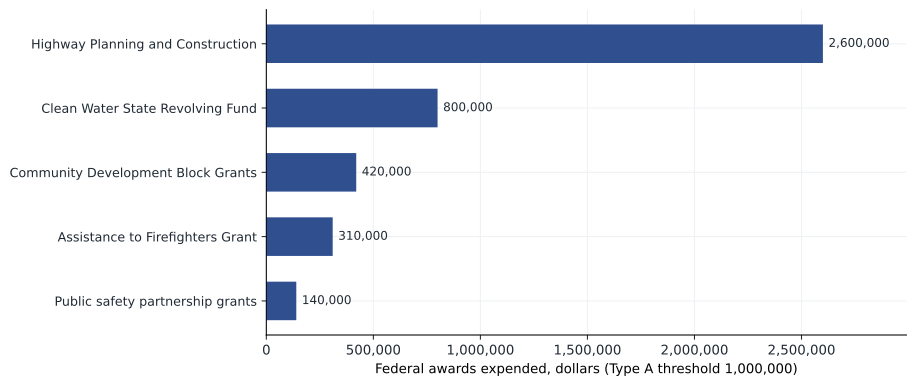
print(f"\nPantry federal expenditures {pantry:,}: Single Audit required? {'yes' if pantry >= 1_000_000 else 'no'}")Total federal awards expended 4,270,000 Single Audit required: yes (threshold 1,000,000) Type A threshold 1,000,000 Highway Planning and Construction (20.205) 2,600,000 Type A low risk Clean Water State Revolving Fund (66.458) 800,000 Type B Community Development Block Grants, state (14.228) 420,000 Type B Assistance to Firefighters Grant (97.044) 310,000 Type B Public safety partnership grants (16.710) 140,000 Type B After risk assessment, coverage 7.3%; required 40% add Highway Planning and Construction -> coverage 68.1% Major programs: Assistance to Firefighters Grant; Highway Planning and Construction Pantry federal expenditures 650,000: Single Audit required? no
The program applies the Single Audit rules to Aspen Ridge. It expended $4.27 million of federal awards, so a Single Audit is required. Because expenditures are under $34 million, the Type A threshold is $1,000,000: the highway program, $2.6 million, is the only Type A program, and it was audited as major in each of the last two years without significant findings, so it is low-risk. Type B programs above 25 percent of the Type A threshold ($250,000) are risk-assessed; the auditor judges the firefighters grant, a new program for the city, high risk, so it is major. Because the city reported a significant deficiency last year, it is not a low-risk auditee, so major programs must cover at least 40 percent of federal expenditures; the auditor adds the highway program, bringing coverage to 68.1 percent. Riverbend expended $650,000 of federal commodities, below the threshold, so it needs no Single Audit.
Compliance requirements and findings
The OMB Compliance Supplement identifies, for each major federal program, the compliance requirements subject to audit, organized in twelve types: activities allowed or unallowed; allowable costs and cost principles; cash management; eligibility; equipment and real property management; matching, level of effort and earmarking; period of performance; procurement, suspension and debarment; program income; reporting; subrecipient monitoring; and special tests and provisions. The 2024 Uniform Guidance changed several thresholds used in testing: equipment is now items costing $10,000 or more (formerly $5,000); the de minimis indirect cost rate rose to 15 percent of modified total direct costs; and the amount of each subaward included in that base rose to $50,000. The auditor reports findings in a schedule of findings and questioned costs, and the auditee prepares a corrective action plan and a summary schedule of prior audit findings.
Findings in a Single Audit include significant deficiencies and material weaknesses in internal control over compliance, material noncompliance, and questioned costs over $25,000 for a type of compliance requirement in a major program. Common findings in local governments involve procurement (failing to follow competitive procedures or verify that contractors are not suspended or debarred), reporting deadlines, subrecipient monitoring, and errors in the SEFA, such as omitting noncash awards or loans. Federal agencies resolve findings through management decisions, and repeated findings can lead to a government being designated high risk, with special award conditions.
A capstone review
Pulling the course together, imagine you are the audit senior on Aspen Ridge. You would check that the statement of activities classifies revenues correctly as program or general (lesson 3); that the general fund recognizes only available property taxes and grants, with $450,000 of unavailable revenue deferred (lesson 4); that the sweeper lease and any SBITAs are recognized and disclosed separately under GASB 104, and that the modified approach for streets is supported by condition assessments (lesson 5); that the budgetary comparison is in RSI with original, final and actual columns and an encumbrance reconciliation (lesson 6); that fund balance classifications and the reconciliation to net position are right (lesson 7); and that the net pension liability, deferrals and GASB 101 leave liability are measured correctly (lesson 8). For Riverbend, you would test the conditional grant and its refundable advance, the release of the truck restriction, the functional expense allocation and liquidity note, the gifts-in-kind disclosure, Form 990 and the UBIT return (lessons 9 to 11), and confirm that its federal expenditures, including commodities on its SEFA, are below the Single Audit threshold.
| Requirement | Threshold or rule | Aspen Ridge fiscal 2027 |
|---|---|---|
| Single Audit | Federal expenditures of $1,000,000 or more | Required: $4.27 million |
| Type A threshold | $1,000,000 for expenditures up to $34 million | $1,000,000 |
| Type B risk assessment | Programs above 25% of the Type A threshold | Firefighters grant high risk |
| Coverage | 40% (20% for a low-risk auditee) | 68.1% after adding highways |
| Submission | 30 days after reports or 9 months after year-end | By 30 June 2028 |
Course synthesis
Looking back over the course, a pattern emerges. Each topic answers the same accountability question from a different angle: what resources did the entity have, where did they come from, how were they used, what obligations does it carry, and can it continue to deliver services? For a government, GASB's model answers with two views: fund statements that show compliance and current resources, and government-wide statements that show the full cost of services and long-term position, linked by reconciliations. For a not-for-profit, ASC 958 answers with contributions recognized in a way that respects donors' conditions and restrictions, expenses by function and nature, and liquidity information. Form 990, the Single Audit and the Yellow Book add the oversight that keeps the system honest.
The standards will keep changing. GASB's projects on revenue and expense recognition, going concern and severe financial stress, and infrastructure assets may reshape governmental reporting over the next several years, and Statement 105 on subsequent events takes effect for fiscal years beginning after 15 June 2026. FASB continues to refine not-for-profit reporting, and the OMB revises the Uniform Guidance and Compliance Supplement regularly. The skills this course has emphasized, reading the standards carefully, reasoning from the concepts when standards are silent, and explaining the numbers to non-specialist users, will remain valuable whatever the next changes bring.
For a student preparing for the CPA Examination, the course also connects to its content. Governmental and not-for-profit accounting is tested in the Financial Accounting and Reporting section, Single Audits and Government Auditing Standards in the Auditing and Attestation section, and exempt organization taxation in the Regulation section and the Tax Compliance and Planning discipline. The capstone exercises in this lesson mirror the task-based simulations that combine these areas.
A final word on judgment. Many of the issues in this course, distinguishing conditions from restrictions, choosing availability periods, classifying fund balance, deciding whether a grant is an exchange, or measuring compensated absences, require professional judgment rather than mechanical application of rules. Good judgment rests on understanding the purpose of each standard, documenting the reasoning, applying policies consistently and disclosing them clearly.
Public trust in governments and charities depends on reliable information about how they use public and donated money. The accountants who prepare, audit and analyze that information play a quiet but essential part in democratic accountability and in the health of the charitable sector. The technical rules covered in this course are the tools; the purpose is trust.
Worked problem
Determining major programs
A county expends $2.4 million of federal awards: program A $1.5 million (audited as major last year with no findings), program B $500,000 (never audited as major), program C $300,000, program D $100,000. The county had no significant deficiencies or material weaknesses in the last two years and unmodified opinions. Which programs are major?
Show solution
- Total $2.4 million, so a Single Audit is required; the Type A threshold is $1,000,000.
- Program A is Type A; it was audited as major in the prior year without findings, so it may be low-risk and need not be major.
- Type B programs above $250,000 (B and C) are risk-assessed; the auditor must identify high-risk Type B programs up to at least one-fourth of the number of low-risk Type A programs, so at least one: suppose B, never audited, is assessed as high risk.
- The county qualifies as a low-risk auditee, so coverage must be at least 20 percent: program B's $500,000 is 20.8 percent of $2.4 million, which meets the requirement.
- Major programs: B (and A only if not low-risk). Program D is below the risk-assessment level.
Answer: Program B is major; coverage 20.8 percent meets the 20 percent minimum for a low-risk auditee.
Common mistakes
MistakeApplying the old $750,000 threshold to a fiscal 2027 audit.
InsteadThe threshold is $1,000,000 for fiscal years beginning on or after 1 October 2024.
MistakeOmitting noncash awards from the SEFA.
InsteadCommodities and loans count as federal awards expended.
MistakeIgnoring the Yellow Book's CPE and independence requirements.
InsteadGAGAS adds 24 hours of government CPE and stricter nonaudit service rules.
MistakeAssuming a low-risk Type A program is always major.
InsteadLow-risk Type A programs need not be major unless needed for coverage.
MistakeUsing the old $5,000 equipment threshold.
InsteadThe 2024 Uniform Guidance raised it to $10,000.
Summary and key terms
- The 2024 Yellow Book applies to periods beginning on or after 15 December 2025, with quality management.
- GAGAS adds independence, CPE, reporting and peer review requirements.
- A Single Audit is required at $1,000,000 of federal awards expended.
- Type A threshold $1,000,000 up to $34 million; Type B risk assessment above 25 percent of it.
- Coverage of 40 percent, or 20 percent for a low-risk auditee.
- Compliance requirements are organized in twelve types; findings go in a schedule with a corrective action plan.
- Aspen Ridge: $4.27 million expended; coverage 68.1 percent; Riverbend needs no Single Audit.
- Statements are one part of accountability; performance and impact reporting complete it.
- Single Audit
- An audit of a non-federal entity's statements and major federal programs under the Uniform Guidance.
- Yellow Book
- Government Auditing Standards issued by the GAO.
- SEFA
- The Schedule of Expenditures of Federal Awards.
- Type A program
- A federal program with expenditures at or above the Type A threshold.
- Major program
- A program selected for compliance testing and opinion in a Single Audit.
- Low-risk auditee
- An auditee meeting criteria such as unmodified opinions and no material weaknesses in the prior two years.
- Performance audit
- An audit of whether programs are managed with economy, efficiency and effectiveness.
- Compliance audit
- An audit of adherence to laws, regulations and agreements.
Practice problems
Work each problem on paper first, then reveal the answer to check.
When must an entity have a Single Audit?
Show answer
When it expends $1,000,000 or more of federal awards in a fiscal year beginning on or after 1 October 2024.
When does the 2024 Yellow Book apply to financial audits?
Show answer
For periods beginning on or after 15 December 2025.
In the program, what is coverage after adding the highway program?
Show answer
68.1 percent.
Which Type B programs are risk-assessed?
Show answer
Those above 25 percent of the Type A threshold, here $250,000.
Name four of the twelve compliance requirement types.
Show answer
For example allowable costs, eligibility, procurement and reporting.
What CPE does the Yellow Book require?
Show answer
80 hours every two years, including 24 hours related to government.
Why does Riverbend not need a Single Audit?
Show answer
Its federal expenditures, $650,000 of commodities, are below $1,000,000.
What changed for the de minimis indirect cost rate in 2024?
Show answer
It rose from 10 percent to 15 percent of modified total direct costs.
Lesson quiz · 5 questions
Score 60% or more to complete this lesson.
Create a free account to save your progress, take quizzes and earn a certificate.