
ACCT-412 · Lesson 10 of 12 · 22 min
Not-for-profit organizations II: functional expenses, liquidity and gifts in kind
Lesson 9 dealt with contributions. This lesson completes the picture of not-for-profit reporting under ASC 958: the statements an organization presents, the analysis of expenses by function and nature that ASU 2016-14 made universal, the liquidity disclosures that the same update introduced, the reporting of contributed nonfinancial assets under ASU 2020-07, and endowments. We finish Riverbend Community Pantry's 2027 statements and look at the measures donors and watchdogs use to judge a charity, along with their limitations.
The statements under ASC 958
ASC 958-205 requires a statement of financial position, a statement of activities, a statement of cash flows, and, since ASU 2016-14, an analysis of expenses by both function and nature, which may be presented in a separate statement of functional expenses, on the face of the statement of activities or in the notes. The statement of financial position reports total assets, liabilities and net assets, with the two classes of net assets. The statement of activities reports the change in each class of net assets: revenues, gains, expenses and losses, and net assets released from restrictions. Organizations may present a measure of operations, such as change in net assets from operating activities, but must describe what it includes if it is not apparent.
The statement of cash flows follows ASC 230, with a few not-for-profit adaptations: cash contributions restricted for long-term purposes, such as acquiring buildings or endowments, are financing activities, and noncash contributions are disclosed. Since ASU 2016-14, an organization may present operating cash flows by either the direct or indirect method without the reconciliation previously required for the direct method. Investment return is reported net of external and direct internal investment expenses, which do not need separate disclosure.
Expenses by function and nature
Every not-for-profit must report expenses by function: program services and supporting activities, which comprise management and general activities, fundraising and membership development. It must also present them by nature (natural classification), such as salaries, rent, depreciation and supplies, in a matrix that shows each natural expense by function. Joint costs of activities that combine fundraising with program or management functions, such as a mailing that both asks for donations and educates the public, can be allocated to program only if the activity meets purpose, audience and content criteria in ASC 958-720; otherwise all joint costs are fundraising. Shared costs, such as rent and the executive director's salary, are allocated using reasonable bases such as time or space.
# Riverbend Community Pantry (invented 501(c)(3)), 2027: statement of functional
# expenses and the liquidity disclosure required by ASU 2016-14 (thousands).
natural = {   # natural expense: {function: amount}
    "Donated food distributed": {"Program": 2_400, "M and G": 0,  "Fundraising": 0},
    "Salaries and benefits":    {"Program": 640,   "M and G": 95, "Fundraising": 105},
    "Rent and utilities":       {"Program": 77,    "M and G": 14, "Fundraising": 5},
    "Food purchases":           {"Program": 150,   "M and G": 0,  "Fundraising": 0},
    "Events and printing":      {"Program": 8,     "M and G": 4,  "Fundraising": 64},
    "Professional fees":        {"Program": 0,     "M and G": 22, "Fundraising": 0},
    "Supplies and other":       {"Program": 75,    "M and G": 5,  "Fundraising": 6},
    "Depreciation":             {"Program": 23,    "M and G": 0,  "Fundraising": 0},
}
cols = ["Program", "M and G", "Fundraising"]
tot = {c: 0 for c in cols}
print(f"{'Natural classification':26}" + "".join(f"{c:>12}" for c in cols) + f"{'Total':>8}")
for k, row in natural.items():
    for c in cols: tot[c] += row[c]
    print(f"{k:26}" + "".join(f"{row[c]:>12,}" for c in cols) + f"{sum(row.values()):>8,}")
grand = sum(tot.values())
print(f"{'Total':26}" + "".join(f"{tot[c]:>12,}" for c in cols) + f"{grand:>8,}")
print(f"Program ratio {tot['Program'] / grand:.1%}")
print()
fin_assets = {"Cash": 310, "Investments": 1_480, "Receivables": 45}
not_available = {"Perpetual endowment": 100, "Board-designated reserve": 600,
                 "Donor-restricted, not yet released": 4}
avail = sum(fin_assets.values()) - sum(not_available.values())
print(f"Financial assets {sum(fin_assets.values()):,}; less unavailable {sum(not_available.values()):,}")
print(f"Available for general expenditure within one year: {avail:,}")
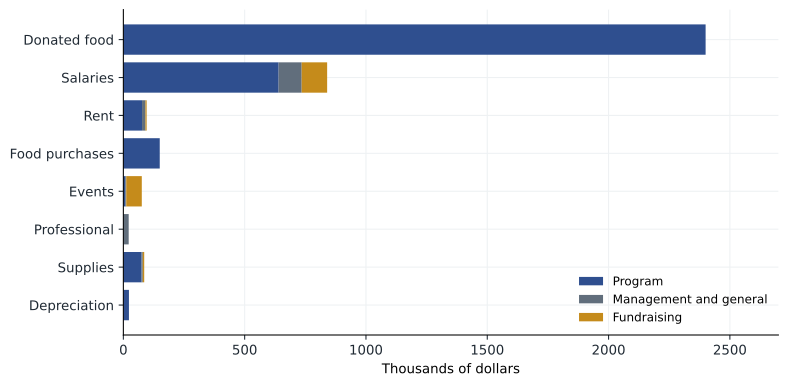
print(f"Months of cash operating expenses covered (excluding donated food): {avail / ((grand - 2_400 - 23) / 12):.1f}")Natural classification Program M and G Fundraising Total Donated food distributed 2,400 0 0 2,400 Salaries and benefits 640 95 105 840 Rent and utilities 77 14 5 96 Food purchases 150 0 0 150 Events and printing 8 4 64 76 Professional fees 0 22 0 22 Supplies and other 75 5 6 86 Depreciation 23 0 0 23 Total 3,373 140 180 3,693 Program ratio 91.3% Financial assets 1,835; less unavailable 704 Available for general expenditure within one year: 1,131 Months of cash operating expenses covered (excluding donated food): 10.7
The program builds Riverbend's statement of functional expenses. Program services, food distribution and the school breakfast program, cost $3.373 million, including $2.4 million of donated food and $23,000 of truck depreciation; management and general cost $140,000; fundraising $180,000. The program ratio is 91.3 percent. The second part prepares the liquidity disclosure explained below: of $1.835 million of financial assets, $704,000 is unavailable within a year because it is perpetual endowment, a board-designated reserve or donor-restricted, leaving $1.131 million available for general expenditure, about 10.7 months of cash operating expenses.
Liquidity and availability
ASU 2016-14 requires two disclosures about liquidity. Qualitative information explains how the organization manages its liquid resources to meet cash needs for general expenditures within one year of the balance sheet date. Quantitative information, on the face of the statements or in the notes, shows the availability of financial assets at the balance sheet date to meet those needs, reducing total financial assets by amounts not available because of donor restrictions, board designations or contractual limits. Riverbend's $600,000 board-designated operating reserve is excluded from available assets, but the note can explain that the board could release it if needed. The disclosure answers a question donors care about: could the organization keep operating if revenue fell?
Endowments receive special disclosure. ASC 958-205 requires organizations to describe their interpretation of UPMIFA, their spending policy and investment objectives, and to reconcile endowment net assets by class, separating donor-restricted from board-designated endowments. An endowment fund is underwater when its fair value falls below the original gift or the amount required to be maintained; the deficiency is reported in net assets with donor restrictions, with disclosure of the fair value, original gift and deficiency. Riverbend's $100,000 endowment, received in 2027, has a spending policy of 4 percent of the average fair value over 12 quarters once it has a sufficient history.
Gifts in kind and judging a charity
ASU 2020-07 responded to concerns that gifts in kind were inflating some charities' program ratios. It requires contributed nonfinancial assets to be presented as a separate line in the statement of activities, apart from cash contributions, and disaggregated in the notes by category, such as food, medical supplies and services, with information on whether each category was used or monetized, the policy for monetizing, any donor restrictions, the valuation techniques and the principal market used. Riverbend's $2.4 million of donated food is valued at estimated wholesale prices for comparable products; the note explains that all donated food was distributed to clients and none was sold.
Watchdogs and donors often use ratios: program expense ratio, fundraising efficiency and months of available reserves. They are useful but easily misread: allocations involve judgment, gifts in kind can raise program ratios, and investment in administration may improve programs. Form 990, discussed in lesson 11, reports expenses in a functional matrix similar to ASC 958 and is publicly available, so the financial statements and the return should tell a consistent story.
| Measure | Riverbend 2027 | Caution |
|---|---|---|
| Program expenses ÷ total expenses | 91.3 percent | Inflated by donated food; depends on allocations |
| Fundraising expenses ÷ contributions | About $0.15 per dollar of cash gifts | Ignores multi-year campaigns |
| Financial assets available within one year | $1.131 million, about 10.7 months | Excludes board-designated reserve |
| Refundable advances | $40,000 | Unearned conditional grants |
| Contributed nonfinancial assets | $2.4 million of food | Separate line under ASU 2020-07 |
Riverbend's statement of activities
Pulling lessons 9 and 10 together, Riverbend's 2027 statement of activities shows, in the without donor restrictions column, contributions of $1,200,000, contributed nonfinancial assets of $2,400,000 on a separate line, grant revenue of $210,000 and $184,000 of net assets released from restrictions, against expenses of $3,693,000 by function, a change of $301,000. The with donor restrictions column shows the truck grant of $184,000, the endowment gift of $100,000 and $4,000 of endowment return, less the $184,000 released, a change of $104,000. The board designated $100,000 more for its operating reserve during the year, but that designation is shown only in the notes and the net asset detail, because designations do not change the class of net assets.
The cash flow statement completes the set. Riverbend's operating activities generated cash, because cash donations and grants exceeded cash spending; donated food affects neither receipts nor payments and is disclosed as a noncash activity. Investing activities show the $184,000 truck purchase and net investment purchases. Cash contributions restricted to acquiring long-lived assets and to endowment, the $184,000 truck grant and the $100,000 endowment gift, are financing activities under ASC 230 and 958.
Finally, the notes tie the statements to the organization's governance. They describe the organization's purpose and tax-exempt status, its accounting policies including the valuation of gifts in kind and its availability and release policies, the nature and amounts of donor restrictions, the board-designated reserve, concentrations of risk such as reliance on one food donor and on the state grant, related party transactions, fair value measurements of investments, and subsequent events. A reader who works through the notes can see not only what Riverbend did in 2027 but also how dependent it is on a few sources and how it is preparing for the future.
Smaller organizations have simpler options. ASC 958 applies to all private not-for-profits regardless of size, but small organizations often present simpler statements, use a review or compilation rather than an audit when no funder or state law requires an audit, and file Form 990-EZ or 990-N. These choices reduce cost while preserving the core information about restrictions, functional expenses and liquidity that donors need.
Comparing Riverbend with a similar pantry in another city illustrates the difficulty of benchmarking. If the other organization receives more cash and buys its food, its program ratio may be lower and its revenue structure very different, even if it distributes as much food. The ASU 2020-07 disclosures help, but careful readers still need to compare like with like.
Worked problem
Preparing the liquidity disclosure
A youth charity has at 30 June 2027: cash $180,000; short-term investments $250,000; pledges receivable within one year $60,000 (of which $20,000 restricted to next year's summer camp); a perpetual endowment of $300,000 invested in long-term securities; and a board-designated building reserve of $100,000 held in the short-term investments. Annual cash expenses are $720,000. Prepare the quantitative liquidity disclosure.
Show solution
- Financial assets: $180,000 + $250,000 + $60,000 + $300,000 = $790,000.
- Less endowment, not available: $300,000.
- Less board-designated reserve: $100,000 (disclose that the board could release it).
- Less donor-restricted pledges for a purpose not met within a year: $20,000 only if the camp is not a general expenditure of the next year; because summer camp is a program in the next year, many organizations treat it as available, with disclosure.
- Available for general expenditure within one year: $390,000 (or $370,000 if the camp pledge is excluded), about 6.5 months of cash expenses.
Answer: About $370,000 to $390,000 available, depending on the treatment of the camp pledge.
Common mistakes
MistakeOmitting the analysis of expenses by nature.
InsteadASU 2016-14 requires expenses by function and nature for all not-for-profits.
MistakeAllocating joint costs to programs without meeting the criteria.
InsteadPurpose, audience and content criteria must be met.
MistakeTreating board-designated amounts as unavailable without explanation.
InsteadExplain that the board can release designations.
MistakeJudging a charity by its program ratio alone.
InsteadAllocations, gifts in kind and restricted contributions all affect ratios; read the notes.
MistakeCombining gifts in kind with cash contributions.
InsteadASU 2020-07 requires a separate line and disaggregated disclosure.
Summary and key terms
- ASC 958 requires a statement of financial position, activities and cash flows, plus expenses by function and nature.
- Two classes of net assets; an operating measure is optional.
- Restricted long-term cash gifts are financing cash flows.
- Joint costs follow purpose, audience and content criteria.
- Liquidity disclosures show financial assets available within one year.
- Endowment disclosures cover UPMIFA, spending policy and underwater funds.
- Riverbend: program ratio 91.3 percent; $1.131 million available.
- Ratios are useful but depend on allocations, gifts in kind and the treatment of restrictions.
- Natural classification
- Classification of expenses by their nature, such as salaries or rent.
- Joint costs
- Costs of activities with fundraising and program or management components.
- Liquidity disclosure
- Information on financial assets available for general expenditure within one year.
- Underwater endowment
- An endowment whose fair value is below the original gift or required amount.
- Gifts in kind
- Contributed nonfinancial assets such as food, supplies or services.
- Board-designated net assets
- Net assets without donor restrictions set aside by the board.
- Program services
- Activities that fulfill the organization's mission.
- Supporting activities
- Management and general, and fundraising activities.
Practice problems
Work each problem on paper first, then reveal the answer to check.
Name the statements required by ASC 958.
Show answer
Statement of financial position, statement of activities and statement of cash flows, plus an analysis of expenses by function and nature.
How are cash gifts restricted to buying a building classified in the cash flow statement?
Show answer
As financing activities.
In the program, what is the program ratio?
Show answer
91.3 percent.
When can joint costs be allocated to programs?
Show answer
When the activity meets the purpose, audience and content criteria.
In the program, how much is available for general expenditure?
Show answer
$1.131 million.
What is an underwater endowment?
Show answer
One whose fair value is below the original gift or the amount required to be maintained.
What does ASU 2020-07 require?
Show answer
All $2.4 million is a program expense, dwarfing administrative and fundraising costs; ASU 2020-07 requires separate presentation and disclosure of such gifts.
What is Riverbend's board-designated reserve?
Show answer
$600,000, for an operating reserve.
Lesson quiz · 5 questions
Score 60% or more to complete this lesson.
Create a free account to save your progress, take quizzes and earn a certificate.