
ACCT-412 · Lesson 1 of 12 · 23 min
Why public sector and not-for-profit accounting is different
Most of the accounting you have studied so far was built for businesses: entities that raise capital from owners and lenders, sell goods and services at prices customers accept, and are judged by the profit they earn and the cash they generate for investors. Governments and not-for-profit organizations do not fit that model. A city levies taxes that residents must pay whether or not they use the services; a food pantry gives food away to people who pay nothing; neither has owners who expect a return. This course explains how accounting adapts to those differences in the United States, under the standards of the Governmental Accounting Standards Board (GASB) for state and local governments and the Financial Accounting Standards Board (FASB) for private not-for-profit organizations, and how tax-exempt organizations and recipients of federal awards meet their reporting and audit obligations.
The course builds on ACCT-211 and ACCT-212, where you learned intermediate financial reporting for businesses, and it refers to ACCT-331 for the audit concepts that lesson 12 applies to the public sector. The standards and dates in this course were checked in October 2026. Governmental standards are changing: GASB Statement No. 103, Financial Reporting Model Improvements, and Statement No. 104, Disclosure of Certain Capital Assets, apply to fiscal years beginning after 15 June 2025, and Statement No. 105, Subsequent Events, applies a year later. The 2024 revision of the Uniform Guidance and the 2024 Yellow Book also change the audit landscape.
Two running examples
Throughout the course we follow two invented organizations. The first is the City of Aspen Ridge, Nebraska, a city of about 24,300 people with a fiscal year ending 30 September. It provides police and fire protection, streets, a water and sewer utility, parks and a library, and community development. Its fiscal 2027 statements apply GASB Statements 103 and 104 for the second year. The second is Riverbend Community Pantry, a section 501(c)(3) public charity in Aspen Ridge that collects donated food, distributes commodities from a federal food program, buys food with cash donations, runs a school breakfast program funded by a state grant and, in 2027, buys a refrigerated truck with a restricted grant. It prepares financial statements under FASB ASC 958 and files Form 990. All names, people and figures are invented; they are chosen to be realistic for organizations of this size and are consistent from lesson to lesson.
What makes these entities different
Four features shape the accounting of governments and not-for-profit organizations. First, there is no profit motive and no owner. The residual interest in a city's assets belongs to no one who can sell it, and the residual interest in a charity's assets must be used for its purposes. The bottom line of the operating statement is therefore not a measure of success: a city that runs a large surplus may simply have taxed more than it needed, and a charity that runs a deficit may have spent reserves on exactly what donors wanted.
Second, many resources arrive in nonexchange transactions. Taxes, government transfers and donations are not payments for services received by the payer, so the matching of revenue with the cost of goods sold that drives business accounting does not apply. Accounting must decide when a tax or a gift is earned, and how to treat conditions and restrictions attached by the giver. Third, the budget matters more. A government's budget is a legal authority to spend, approved by elected officials, and the financial statements are expected to show how actual results compare with it. Fourth, the users differ. Instead of investors and lenders, the main users are citizens, legislators and councils, donors, grantors, rating agencies and oversight bodies, who want to know whether resources were used as intended, whether services can be sustained and whether the entity complied with legal and contractual limits.
| Question | A business | A government (GASB) | A not-for-profit (ASC 958) |
|---|---|---|---|
| Main resource providers | Customers, owners, lenders | Taxpayers, other governments, lenders | Donors, grantors, members |
| Bottom line of operating statement | Net income | Change in net position | Change in net assets |
| Residual interest | Owners' equity | Net position: net investment in capital assets, restricted, unrestricted | Net assets with and without donor restrictions |
| Key indicator besides the bottom line | Cash flow, return on capital | Fund balance, net position, interperiod equity | Liquidity, restrictions, functional expenses |
| Budget in the statements | Rarely | Budgetary comparison as required supplementary information | Not required |
Standard setters and the entities they serve
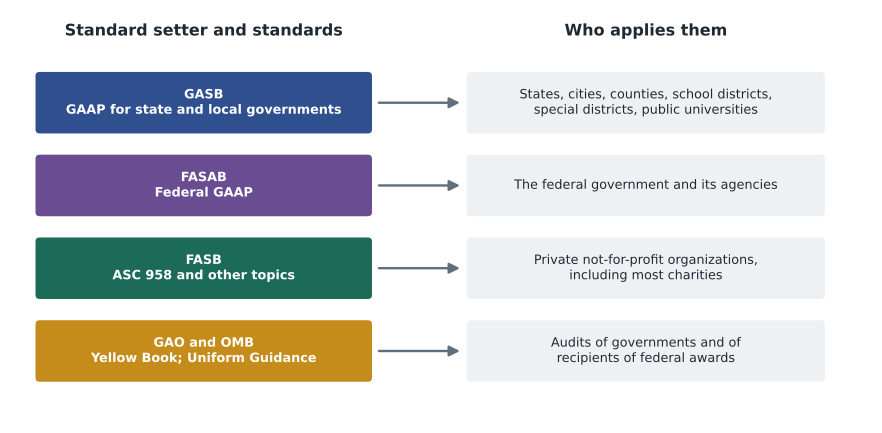
In the United States, GASB sets generally accepted accounting principles (GAAP) for state and local governments: states, counties, cities, school districts, special districts such as transit and water authorities, and public colleges and universities. The Federal Accounting Standards Advisory Board (FASAB) sets standards for the federal government and its agencies. FASB sets GAAP for businesses and for private not-for-profit organizations, mainly in ASC Topic 958, so a private university and a public university in the same state follow different standards. All three boards operate under the oversight of the Financial Accounting Foundation (GASB and FASB) or the federal government (FASAB). State laws often require local governments to follow GAAP, though some states allow regulatory or cash-basis reporting for small governments. Auditing standards come from the AICPA for most engagements, the Government Accountability Office (GAO) for audits under Government Auditing Standards (the Yellow Book), and the OMB for audits of federal awards.
Accountability and interperiod equity
The central idea in governmental reporting is accountability: the government must account to the public for the resources entrusted to it and for how it used them. GASB Concepts Statement No. 1 identifies accountability as the paramount objective of financial reporting and links it to interperiod equity: whether current-year revenues were sufficient to pay for current-year services, or whether the cost was shifted to future taxpayers. It also emphasizes compliance with the budget and with legal limits, and the assessment of service efforts, costs and accomplishments. The two measurement focuses that lesson 2 develops, current financial resources for governmental funds and economic resources for the government-wide statements, give different answers to the interperiod equity question.
Not-for-profit organizations are accountable too, but to a narrower group: donors, grantors, members and the regulators who protect the public interest in charitable assets. Their statements must show what resources they hold, which of those resources are restricted by donors and therefore not available for any purpose the board chooses, what programs they ran and what those programs cost, and whether they can continue. Because donated resources often come with conditions, the accounting for restrictions is the defining technical feature of not-for-profit reporting, and lessons 9 and 10 are devoted to it.
The table below summarizes what each user group of Aspen Ridge's statements wants to know. Few of the questions concern a single bottom line. A council member reviewing the fiscal 2027 statements wants to compare spending with the appropriations the council approved; a state oversight official wants to see whether the city respects its levy and debt limits; a bond analyst wants to see unrestricted net position, the pension liability and debt service coverage for the utility; a resident wants to know what the city spends on streets and whether taxes will rise. The pantry's board and donors want different answers again.
| User | Main questions | Where in the statements |
|---|---|---|
| Council and residents | Did spending follow appropriations? What do services cost? | Budgetary comparison (RSI); statement of activities |
| State oversight bodies | Are levy and debt limits respected? | Notes; statistical section of the ACFR |
| Bondholders and rating agencies | Can the city service its debt and sustain services? | Net position; pension schedules; utility fund statements |
| Donors and grantors (pantry) | Was my gift used as I asked? | Net assets with donor restrictions; releases; notes |
| IRS and the public (pantry) | Does the charity qualify for exemption? | Form 990 and schedules |
A first look at the numbers
The program computes a few headline indicators for Aspen Ridge at 30 September 2027. Read them as a preview: each is explained later in the course. Net position of $167.5 million is dominated by capital assets, which cannot be spent. General revenues, mainly property and sales taxes, provide 73.1 percent of the revenue of governmental activities, while program revenues such as charges and grants provide the rest. Debt per resident of about $1,428 combines governmental bonds and the utility's revenue bonds, which are repaid from water and sewer rates.
# Key financial indicators for the invented City of Aspen Ridge, Nebraska,
# primary government, fiscal year ended 30 September 2027 (thousands of dollars).
population = 24_300
gov = {"current and other assets": 31_500, "capital assets, net": 121_000,
       "deferred outflows": 2_600, "current liabilities": 5_900,
       "long-term liabilities": 27_400, "deferred inflows": 4_100}
bta = {"current and other assets": 7_800, "capital assets, net": 58_000,
       "deferred outflows": 400, "current liabilities": 1_500,
       "long-term liabilities": 14_600, "deferred inflows": 300}

def net_position(a):
    return (a["current and other assets"] + a["capital assets, net"] + a["deferred outflows"]
            - a["current liabilities"] - a["long-term liabilities"] - a["deferred inflows"])

for name, a in (("Governmental activities", gov), ("Business-type activities", bta)):
    print(f"{name:26} net position {net_position(a):>9,}")
total = net_position(gov) + net_position(bta)
print(f"{'Primary government':26} net position {total:>9,}")
print()
debt = 21_800 + 12_900            # bonds and notes: governmental, business-type
print(f"Debt per resident ($)          {debt * 1000 / population:,.0f}")
print(f"Current ratio, governmental    {gov['current and other assets'] / gov['current liabilities']:.2f}")
general_rev, total_rev = 27_700, 37_900   # governmental activities
print(f"Share of revenue from general revenues {general_rev / total_rev:.1%}")Governmental activities net position 117,700 Business-type activities net position 49,800 Primary government net position 167,500 Debt per resident ($) 1,428 Current ratio, governmental 5.34 Share of revenue from general revenues 73.1%
These figures already show why governmental analysis needs its own indicators. Aspen Ridge's governmental activities have a high current ratio of 5.34 because the capital projects fund holds unspent bond proceeds, so liquidity looks stronger than it is. The large share of general revenues means that most services are financed by taxes rather than by the people who use them, which is the defining feature of governmental activities as opposed to business-type activities such as the utility.
Worked problem
Is an increase in net position good news?
Aspen Ridge's governmental activities report an increase in net position of $5.9 million for fiscal 2027. A council member says the city has $5.9 million available for tax relief. Is he right?
Show solution
- The increase is measured on the economic resources basis and includes $4.0 million of capital grants restricted to capital projects.
- It also reflects capital assets acquired with bond proceeds and taxes; those resources are now invested in assets and cannot be spent.
- The general fund's balance, the resources actually available, rose by only $670,000 on a GAAP basis, as lesson 6 shows.
- Much of net position is net investment in capital assets or restricted; unrestricted net position is what matters for flexibility.
- An increase in net position shows that revenues covered the full cost of services, including depreciation; it is not spendable cash.
Answer: No. Most of the increase is invested in capital assets or restricted; the general fund balance rose by only $670,000.
Common mistakes
MistakeJudging a government by its change in net position as if it were profit.
InsteadThe goal is services and accountability, not profit; look at budget comparisons, financial position indicators and service costs.
MistakeAssuming a public university follows ASC 958.
InsteadPublic colleges and universities are governments and follow GASB standards.
MistakeTreating net position as available resources.
InsteadNet investment in capital assets and restricted net position are not available for general use.
MistakeIgnoring restrictions when reading a charity's statements.
InsteadRestricted resources can be used only for the purposes the donor specified; read the notes on restrictions before judging liquidity.
MistakeThinking the budget is irrelevant to GAAP reporting.
InsteadGASB requires budgetary comparisons for the general fund and major special revenue funds as required supplementary information.
Summary and key terms
- Governments and not-for-profits have no owners, and many of their resources come from nonexchange transactions.
- In the United States, GASB sets GAAP for state and local governments, FASAB for the federal government and FASB for private not-for-profits.
- Public colleges and universities follow GASB; private ones follow ASC 958.
- Accountability is the main objective of reporting; budgets and restrictions are central.
- GASB 103 and 104 apply to fiscal years beginning after 15 June 2025; GASB 105 a year later.
- Interperiod equity asks whether current revenues paid for current services.
- Users include councils, citizens, lenders, donors, grantors and regulators.
- Aspen Ridge: net position $167.5 million, debt per resident about $1,428.
- GASB
- The Governmental Accounting Standards Board, which sets GAAP for state and local governments.
- FASAB
- The Federal Accounting Standards Advisory Board, which sets standards for the federal government.
- Interperiod equity
- The idea that current-year revenues should be sufficient to pay for current-year services.
- Net position
- In governmental statements, assets plus deferred outflows minus liabilities and deferred inflows.
- Nonexchange transaction
- A transaction in which an entity receives resources without directly giving equal value in return, such as a tax or a donation.
- Accountability
- The obligation to explain how entrusted resources were obtained and used.
- Not-for-profit organization
- An entity, normally without transferable ownership interests, organized for social, educational, religious, charitable or similar purposes.
Practice problems
Work each problem on paper first, then reveal the answer to check.
Which standard setter governs a private university? A state university?
Show answer
FASB (ASC 958) for the private university; GASB for the state university.
Give two reasons why a not-for-profit's bottom line does not measure success.
Show answer
It has no owners seeking a return, and its goal is to deliver programs; restricted contributions and spending of reserves can make the bottom line move for reasons unrelated to performance.
What does interperiod equity mean?
Show answer
Whether current-year revenues were sufficient to pay for current-year services, or whether costs were shifted to future taxpayers.
When did GASB 103 first apply to a city with a 30 September year-end?
Show answer
To its fiscal year beginning 1 October 2025, ending 30 September 2026.
Why are nonexchange transactions a challenge for revenue recognition?
Show answer
The payer receives no direct goods or services in return, so the timing of revenue must be based on legal claims, eligibility criteria, conditions and restrictions rather than on delivery to a customer.
In the program, what share of governmental revenue comes from general revenues?
Show answer
73.1 percent.
Name three groups that use a charity's financial statements.
Show answer
For example donors, grantors, the board, regulators, beneficiaries and lenders.
Which ASC topic applies to private not-for-profit organizations?
Show answer
ASC 958, Not-for-Profit Entities.
Lesson quiz · 5 questions
Score 60% or more to complete this lesson.
Create a free account to save your progress, take quizzes and earn a certificate.