
ACCT-352 · Lesson 12 of 12 · 24 min
Compliance, administration and a capstone
This final lesson does two things. First, it sets out the compliance calendar of an owner-managed corporation: when the T2 return is due, when tax must be paid, how instalments work, the information slips and payroll obligations that come with paying salaries and dividends, the reassessment and objection rules for corporations, and the personal liability of directors. Second, it assembles Brandt Aerial Inc.'s 2027 corporate tax and Leah's 2027 personal tax from the pieces computed in lessons 2 to 9, reviews the year and identifies planning points for 2028. As throughout, the figures are invented and illustrative, and they apply 2026 rates on the assumption that they continue to 2027.
Filing the T2 return
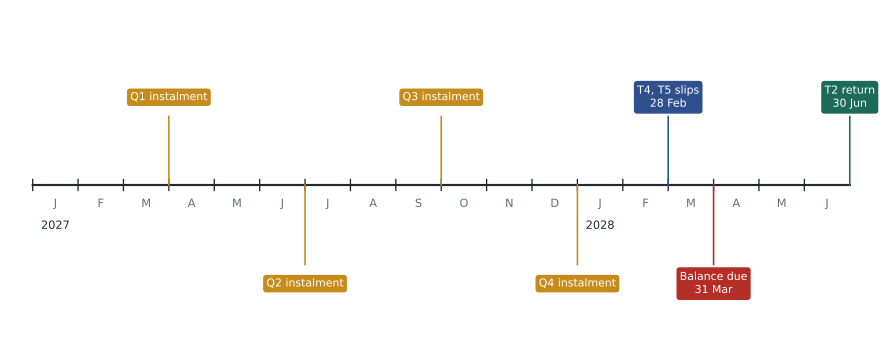
Every corporation resident in Canada, and every non-resident corporation that carried on business in Canada or disposed of taxable Canadian property, must file a T2 return for each taxation year, even if it owes no tax. The return is due six months after the end of the taxation year, so Brandt Aerial Inc.'s 2027 return is due on 30 June 2028. For taxation years beginning after 2023, almost all corporations must file electronically. The return includes the GIFI financial statements and schedules such as Schedule 1 (net income reconciliation), Schedule 8 (CCA), Schedule 7 (aggregate investment income and the small business deduction), Schedule 50 (shareholder information), Schedule 53 (GRIP) and Schedule 23 if the corporation is associated with others. A corporation with permanent establishments in more than one province also files the provincial allocation schedule, and those with permanent establishments in Quebec or Alberta file separate provincial returns. The late-filing penalty is 5 per cent of unpaid tax plus 1 per cent per month up to 12 months, doubled for repeat failures after a demand.
Paying the tax and instalments
A corporation's balance of tax for a year is due two months after its year-end, or three months for a CCPC that claimed the small business deduction in the current or preceding year and whose taxable income for the preceding year, together with that of associated corporations, did not exceed its business limit. Brandt Aerial Inc. qualifies for the three-month date, so its 2027 balance is due on 31 March 2028, three months before the return. Corporations must pay instalments if their tax payable under Parts I, VI, VI.1 and XIII.1 for the current or the preceding year exceeds $3,000. Most corporations pay monthly instalments, each one-twelfth of the estimated current-year tax, the previous year's tax, or a combination based on the second preceding year. A small CCPC, one with taxable income and taxable capital (with associated corporations) of no more than $500,000 and $10 million, that claimed the small business deduction and has a perfect compliance history for 12 months, may pay quarterly instalments instead. Interest on late or deficient instalments is charged at the prescribed rate plus 4 percentage points, and an additional penalty applies when instalment interest exceeds $1,000.
Payroll and information slips
Paying Leah a salary makes Brandt Aerial Inc. an employer. It must deduct income tax and CPP from her pay (but not EI, as a controlling shareholder) and remit the deductions with its own CPP contributions to the CRA by the 15th of the following month, or less often for small remitters, and file a T4 slip and summary by the last day of February: 28 February 2028. Failing to remit source deductions brings penalties of up to 10 per cent, and 20 per cent for repeated failures. Dividends paid in 2027 must be reported on T5 slips by the same date, showing the eligible and non-eligible dividends and their grossed-up amounts; capital dividends are not reported on T5 slips but must have been elected on form T2054. Payments to contractors in some industries must be reported on T5018 slips. The corporation must also file its GST/HST returns on its elected schedule and keep records for six years after the end of the year to which they relate. Directors are jointly and severally liable for unremitted source deductions under section 227.1 and unremitted GST/HST under section 323 of the Excise Tax Act, unless they exercised the care, diligence and skill of a reasonably prudent person, and the CRA must assess them within two years after they cease to be directors.
Assessments, objections and appeals for corporations
The CRA has three years from the date of the original assessment to reassess a CCPC for a taxation year, and four years for other corporations; the periods are extended by three years for reassessments arising from loss carrybacks, transactions with non-arm's length non-residents and certain other items, and there is no limit where the taxpayer made a misrepresentation through carelessness or wilful default, or filed a waiver. A corporation that disagrees with an assessment must file a notice of objection within 90 days after the date of the assessment; unlike individuals, corporations do not get the alternative one-year deadline. A large corporation, one with taxable capital over $10 million, must describe each issue, the relief sought and the facts and reasons relied on, and can be required to pay half of the disputed amount while it objects. Appeals then go to the Tax Court of Canada, the Federal Court of Appeal and, with leave, the Supreme Court of Canada.
| Obligation | Due date for 2027 | Lesson |
|---|---|---|
| Quarterly corporate instalments (small CCPC) | 31 March, 30 June, 30 September, 31 December 2027 | 3, 12 |
| Payroll remittances | 15th of each following month | 12 |
| GST/HST returns (quarterly by election) | One month after each quarter | 9 |
| T4 and T5 slips and summaries | 28 February 2028 | 5, 12 |
| Balance of corporate tax (CCPC eligible for SBD) | 31 March 2028 | 12 |
| SkyGrid Data partners' T1 returns (partnership income) | 15 June 2028 to file; tax due 30 April 2028 | 7 |
| Brandt Family Trust T3 and Schedule 15 | 31 March 2028 (90 days after year-end) | 8 |
| T2 return and schedules | 30 June 2028 | 2, 12 |
Capstone: Brandt Aerial Inc. and Leah in 2027
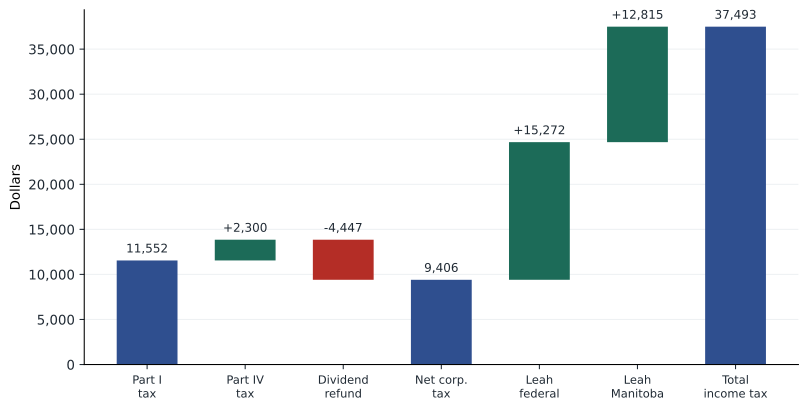
The program brings the year together. The corporation's Part I tax of $11,552.17 comes from lesson 3, its Part IV tax of $2,300 and its dividend refund of $4,446.67 from lesson 4. Leah's income consists of her $70,000 salary, her $23,000 share of SkyGrid Data's income from lesson 7, and the dividends paid in lesson 4: $6,000 eligible, $20,000 non-eligible and a $3,000 capital dividend. Because her partnership income is self-employment income and her salary is below the CPP maximum, she also pays both halves of CPP on the part of her partnership income needed to reach the maximum. Her personal tax is computed with the 2026 federal and Manitoba brackets, the basic personal amounts, CPP credits and deductions, the Canada employment amount and the federal and Manitoba dividend tax credits.
# Capstone: Brandt Aerial Inc.'s 2027 T2 and Leah's 2027 personal tax (2026 rates, illustrative)
FED = [(58_523, 0.14), (117_045, 0.205), (181_440, 0.26), (258_482, 0.29), (float('inf'), 0.33)]
MB = [(47_000, 0.108), (100_000, 0.1275), (float('inf'), 0.174)]
def bracket(x, br):
    tax, lo = 0.0, 0.0
    for hi, r in br:
        if x > lo:
            tax += (min(x, hi) - lo) * r
        lo = hi
    return tax

# Corporation (lessons 2 to 4)
part_i, part_iv = 11_552.17, 2_300.00
refund = 2_300.00 + 2_146.67                     # eligible and non-eligible RDTOH used
corp_net = part_i + part_iv - refund
print(f"{'T2: Part I tax (federal and Manitoba)':<52}{part_i:>11,.2f}")
print(f"{'T2: Part IV tax on portfolio dividends':<52}{part_iv:>11,.2f}")
print(f"{'T2: dividend refund':<52}{-refund:>11,.2f}")
print(f"{'Net corporate tax for 2027':<52}{corp_net:>11,.2f}")
print()
# Leah (lessons 5, 7 and 8 of this course; personal rules from ACCT-351)
salary, elig, nonelig, cap_div, partnership = 70_000, 6_000, 20_000, 3_000, 23_000
g_e, g_n = 1.38 * elig, 1.15 * nonelig
cpp1_emp = 0.0595 * (min(salary, 74_600) - 3_500)
se_room1 = max(0.0, 74_600 - max(salary, 3_500))           # CPP1 room left for self-employment
se_cpp1 = 0.119 * min(partnership, se_room1)
se_cpp2 = 0.08 * max(0.0, min(salary + partnership, 85_000) - 74_600)
# deductible: enhanced part of employee CPP, the employer half of self-employed CPP,
# the enhanced part of the other half, and all CPP2
enhanced_deduction = cpp1_emp / 5.95 + se_cpp1 / 2 + (se_cpp1 / 2) / 5.95 + se_cpp2
base_credit = cpp1_emp * 4.95 / 5.95 + (se_cpp1 / 2) * 4.95 / 5.95
net_income = salary + partnership + g_e + g_n - enhanced_deduction
fed = (bracket(net_income, FED) - 0.14 * (16_452 + base_credit + 1_501)
       - 0.150198 * g_e - 0.090301 * g_n)
mb = (bracket(net_income, MB) - 0.108 * (15_780 + base_credit)
      - 0.08 * g_e - 0.007835 * g_n)
personal = fed + mb
print(f"{'Salary (T4)':<52}{salary:>11,.2f}")
print(f"{'Share of SkyGrid Data partnership income (T5013)':<52}{partnership:>11,.2f}")
print(f"{'Eligible dividends grossed up 38%':<52}{g_e:>11,.2f}")
print(f"{'Non-eligible dividends grossed up 15%':<52}{g_n:>11,.2f}")
print(f"{'Capital dividend (not taxable)':<52}{0:>11,.2f}")
print(f"{'Less deductible CPP (enhanced and self-employed)':<52}{-enhanced_deduction:>11,.2f}")
print(f"{'Net income = taxable income':<52}{net_income:>11,.2f}")
print(f"{'Federal tax after credits and DTC':<52}{fed:>11,.2f}")
print(f"{'Manitoba tax after credits and DTC':<52}{mb:>11,.2f}")
print(f"{'Total personal income tax':<52}{personal:>11,.2f}")
print(f"{'CPP on self-employed partnership income':<52}{se_cpp1 + se_cpp2:>11,.2f}")
print(f"{'Total income tax, corporate and personal':<52}{corp_net + personal:>11,.2f}")T2: Part I tax (federal and Manitoba) 11,552.17 T2: Part IV tax on portfolio dividends 2,300.00 T2: dividend refund -4,446.67 Net corporate tax for 2027 9,405.50 Salary (T4) 70,000.00 Share of SkyGrid Data partnership income (T5013) 23,000.00 Eligible dividends grossed up 38% 8,280.00 Non-eligible dividends grossed up 15% 23,000.00 Capital dividend (not taxable) 0.00 Less deductible CPP (enhanced and self-employed) -1,816.70 Net income = taxable income 122,463.30 Federal tax after credits and DTC 15,272.28 Manitoba tax after credits and DTC 12,815.17 Total personal income tax 28,087.45 CPP on self-employed partnership income 1,379.40 Total income tax, corporate and personal 37,492.95
Brandt Aerial Inc.'s net corporate tax for 2027 is $9,405.50 after the dividend refund. Leah's net income is $122,463.30, putting her in the 26 per cent federal bracket and the 17.4 per cent Manitoba bracket, and her personal income tax is $28,087.45, plus $1,379.40 of CPP on her partnership income. Total income tax on the family's business income, corporate and personal, is $37,492.95. The corporation retains about $80,000 of its accounting income after tax and dividends, taxed so far only at the corporate level, to fund equipment for the second year of the utility contract; that deferral is the main tax benefit of incorporation. Leah received the $3,000 capital dividend tax-free and recovered all of the corporation's refundable tax. Her 2027 balance owing will depend on the tax withheld from her salary, and because her partnership income was not subject to withholding, she should expect to pay personal instalments for 2028 if her net tax owing exceeds $3,000 in 2028 and in 2027 or 2026.
| Item | Amount | Lesson |
|---|---|---|
| Taxable income of Brandt Aerial Inc. | $95,950.00 | 2 |
| Part I tax (federal $10,712.17 + Manitoba $840) | $11,552.17 | 3 |
| Part IV tax on portfolio dividends | $2,300.00 | 4 |
| Dividend refund on $26,000 of taxable dividends | ($4,446.67) | 4 |
| Net corporate tax | $9,405.50 | 12 |
| Leah: salary, partnership income, grossed-up dividends | $124,280.00 | 5, 7, 4 |
| Leah: net income after CPP deductions | $122,463.30 | 12 |
| Leah: federal and Manitoba income tax | $28,087.45 | 12 |
| GST/HST remitted by the corporation | $16,995.00 | 9 |
Reviewing the year and planning for 2028
A review of the year suggests several points for 2028. Leah's salary of $70,000 is below the CPP maximum pensionable earnings; raising it toward $85,000 would increase her RRSP room and CPP pension and, together with a year-end bonus, keep the corporation's active income within the business limit as revenue grows. The corporation's portfolio is small, but if retained earnings are invested in interest-bearing securities, the passive income grind and Manitoba's high rate on investment income make growth investments, debt repayment or an individual pension plan more attractive. The estate freeze and the Brandt Family Trust should be implemented early in 2028, with an independent valuation and a price adjustment clause, before the value of the business grows further, but the family should not expect dividends to Tomás or Nora to escape TOSI. SkyGrid Data must register for GST/HST by early 2028. The corporation must pay quarterly instalments for 2028 and file the trust's T3 and Schedule 15 once the trust exists. Finally, Leah should keep the corporation's minute book, shareholder loan account and capital dividend account up to date, because the reorganizations and dividends that make the structure work depend on them.
Worked problem
Brandt Aerial Inc.'s 2028 instalments
Brandt Aerial Inc. expects 2028 taxable income similar to 2027. Its 2027 tax payable, net of the dividend refund, was about $9,405.50. As a small CCPC with a clean record, how can it pay its 2028 instalments?
Show solution
- Its tax payable exceeded $3,000, so instalments are required for 2028.
- As a small CCPC (taxable income and taxable capital under $500,000 and $10 million, SBD claimed, perfect compliance), it may pay quarterly.
- Using the prior-year option, each quarterly instalment is about one-quarter of $9,405.50, $2,351.38, due on 31 March, 30 June, 30 September and 31 December 2028.
- If it expects lower tax in 2028, it can base instalments on its estimate instead, but it pays interest at the prescribed rate plus 4 per cent if the estimate proves too low.
- The balance for 2028 will be due on 31 March 2029, and the T2 return on 30 June 2029.
Answer: Quarterly instalments of about $2,351 based on 2027, or instalments based on a 2028 estimate.
Common mistakes
MistakeAssuming the balance of corporate tax is due with the T2 return.
InsteadThe balance is due two or three months after year-end; the return is due in six months.
MistakeForgetting the T5 slips for dividends paid to the owner.
InsteadT5 slips are due by the last day of February.
MistakeFiling a corporate objection after 90 days, relying on the individual's one-year rule.
InsteadCorporations must object within 90 days of the assessment.
MistakeThinking directors are never liable for corporate debts.
InsteadDirectors can be personally liable for unremitted source deductions and GST/HST.
MistakeTreating the year-end as the end of the work.
InsteadA review of the return is the start of planning for the next year.
Summary and key terms
- T2 returns are due six months after year-end and must generally be filed electronically.
- The balance is due in two months, or three months for qualifying CCPCs.
- Instalments are required when tax exceeds $3,000; small CCPCs may pay quarterly.
- Employers remit source deductions monthly and file T4s and T5s by the end of February.
- CCPCs can be reassessed for three years, other corporations four; objections are due in 90 days.
- Directors are liable for unremitted source deductions and GST/HST unless duly diligent.
- Brandt Aerial Inc.'s 2027 net tax is $9,405.50; Leah's personal income tax is $28,087.45.
- Reviewing the finished returns is the start of planning for the next year.
- Balance-due day
- The day a corporation's remaining tax for a year must be paid: two or three months after year-end.
- Small-CCPC quarterly instalments
- Quarterly instalments available to CCPCs with taxable income and capital under the limits and a clean compliance record.
- T5 slip
- The slip reporting dividends and certain investment income paid to residents.
- Directors' liability
- Personal liability of directors for unremitted source deductions and GST/HST.
- Large corporation
- For objections, a corporation with taxable capital over $10 million, subject to stricter rules.
- Information return
- A return reporting payments made to others, such as wages, dividends or contractor fees.
Practice problems
Work each problem on paper first, then reveal the answer to check.
When is Brandt Aerial Inc.'s 2027 T2 return due, and when is its balance due?
Show answer
30 June 2028; 31 March 2028.
What conditions allow a CCPC to pay quarterly instalments?
Show answer
Taxable income and taxable capital (with associated corporations) of no more than $500,000 and $10 million, SBD claimed, perfect compliance for 12 months.
What is the reassessment period for a CCPC?
Show answer
Three years from the original assessment.
By when must T4 and T5 slips for 2027 be filed?
Show answer
28 February 2028.
What is the deadline for a corporation's notice of objection?
Show answer
90 days after the date of the assessment.
In the capstone, what is Brandt Aerial Inc.'s net corporate tax?
Show answer
$9,405.50.
In the capstone, how much CPP does Leah pay on her partnership income, and why?
Show answer
$1,379.40, both halves on self-employed earnings up to the CPP maximums not already covered by her salary.
Name two planning points for 2028.
Show answer
For example raising Leah's salary toward $85,000, implementing the estate freeze with a valuation, registering SkyGrid for GST/HST and paying instalments.
Lesson quiz · 5 questions
Score 60% or more to complete this lesson.
Create a free account to save your progress, take quizzes and earn a certificate.