
ACCT-351 · Lesson 8 of 12 · 27 min
Property income: interest, dividends, rent and attribution
Property income is the return on capital that the owner does not actively work to earn: interest on a bond, dividends on a share, rent from a building, royalties from a patent. Subdivision b of Division B governs it, together with business income, so the same general rules on deductions apply. But property income has its own special features, and this lesson covers four of them: the annual accrual of interest, the gross-up and dividend tax credit for dividends from Canadian corporations, the rules for rental properties, and the attribution rules that stop families from shifting investment income to lower-taxed members. Along the way it adds Leah's interest, dividends and rental condominium to her 2026 picture.
Property income or business income?
The line between property income and business income matters for several rules: the attribution rules apply to property income but not business income, CCA on rental buildings cannot create a loss, and, for corporations, the rates differ greatly. Income from property is generally passive: the owner receives it simply by owning the asset. Income becomes business income when the owner provides significant services or carries on activity beyond ownership. A landlord who rents apartments under long leases earns property income; a hotel owner who provides cleaning, meals and front-desk service earns business income. A person who trades securities frequently may be in the business of trading, while a person who holds a portfolio for dividends earns property income.
Interest
Interest is taxed under paragraph 12(1)(c) when received or receivable, depending on the taxpayer's method, but individuals cannot defer interest indefinitely on long-term investments. Subsection 12(4) requires an individual who holds an investment contract, such as a five-year compound-interest GIC or a strip bond, to include interest accrued to each anniversary day of the contract, even though nothing is paid until maturity. Financial institutions report interest on T5 slips. Interest earned in an RRSP, RRIF, TFSA or FHSA is not taxed as it is earned (lesson 11). Interest from foreign sources is fully taxable, with a foreign tax credit for any foreign withholding tax.
Dividends: gross-up and dividend tax credit
Dividends from taxable Canadian corporations get special treatment because the corporation has already paid tax on the profits from which they are paid. To avoid taxing the same income twice, the Act uses a two-step mechanism called integration. First, the individual includes more than the cash dividend in income: the dividend is grossed up to approximate the corporation's pre-tax income. Second, the individual deducts a dividend tax credit that approximates the corporate tax already paid. There are two rates. Eligible dividends, paid mainly by public corporations and by private corporations out of income taxed at the general corporate rate, are grossed up by 38 per cent and carry a federal credit of 15.0198 per cent of the grossed-up amount. Non-eligible dividends, paid mainly by private corporations out of income taxed at the small business rate, are grossed up by 15 per cent with a federal credit of 9.0301 per cent. Provinces add their own dividend tax credits. ACCT-352 explains integration in detail.
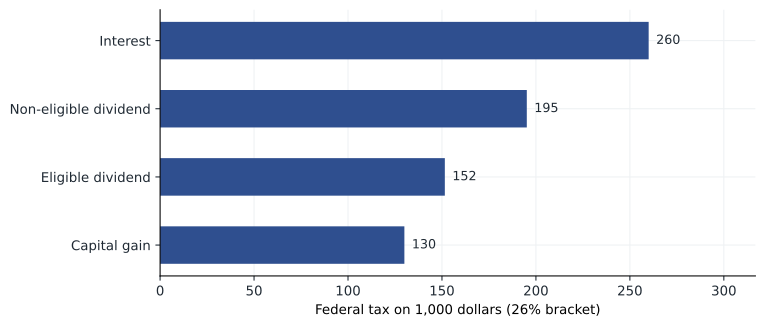
The program compares the federal tax on $1,000 received in four forms by someone in Leah's 26 per cent federal bracket.
# Property income: comparing $1,000 of each kind at Leah's federal bracket (26%), 2026
rate = 0.26
kinds = {
    "Interest":               (1_000, 0.0),
    "Eligible dividend":      (1_000 * 1.38, 0.150198 * 1_000 * 1.38),
    "Non-eligible dividend":  (1_000 * 1.15, 0.090301 * 1_000 * 1.15),
    "Capital gain":           (500, 0.0),
}
print(f"{'$1,000 of':<24}{'taxable':>9}{'tax':>8}{'DTC':>8}{'net federal':>12}")
for k, (taxable, dtc) in kinds.items():
    tax = taxable * rate
    print(f"{k:<24}{taxable:>9,.2f}{tax:>8,.2f}{dtc:>8,.2f}{tax - dtc:>12,.2f}")

# Leah's rental condo: CCA cannot create or increase a rental loss
rent = 21_600
costs = {"Mortgage interest": 7_400, "Property tax": 2_900, "Condo fees": 4_200,
         "Insurance": 650, "Repairs": 1_250}
before_cca = rent - sum(costs.values())
ucc_class1 = 182_000
max_cca = min(round(0.04 * ucc_class1), before_cca)
claimed = 2_000
print()
print(f"Net rent before CCA {before_cca:,}; class 1 CCA available {round(0.04 * ucc_class1):,},"
      f" limited to {max_cca:,}")
print(f"Leah claims {claimed:,}: net rental income {before_cca - claimed:,}")$1,000 of taxable tax DTC net federal Interest 1,000.00 260.00 0.00 260.00 Eligible dividend 1,380.00 358.80 207.27 151.53 Non-eligible dividend 1,150.00 299.00 103.85 195.15 Capital gain 500.00 130.00 0.00 130.00 Net rent before CCA 5,200; class 1 CCA available 7,280, limited to 5,200 Leah claims 2,000: net rental income 3,200
At the federal level, an eligible dividend bears $151.53 of tax per $1,000, far less than the $260 on interest, and a capital gain bears $130. The gross-up has two less obvious effects. Because the grossed-up amount goes into net income, dividends can push up income-tested amounts, such as the Old Age Security recovery tax for seniors, by more than the cash received. And because the dividend tax credit is non-refundable, a person with little other income can find that some of the credit is wasted, although at low incomes eligible dividends can be received with very little or no tax. Leah received $2,000 of eligible dividends in 2026 from her shares of Canadian public companies, so she reports taxable dividends of $2,760 and claims a federal dividend tax credit of $414.55.
Rental income
Rental income is computed like business income: gross rents minus expenses incurred to earn them, such as mortgage interest, property taxes, insurance, condominium fees, utilities paid by the landlord, repairs and property management fees. Two issues dominate in practice. The first is the distinction between current repairs, which are deductible, and capital improvements, which are added to the property's cost and recovered through CCA. The CRA asks whether the expense restores the property to its original condition (current) or improves it beyond that (capital), whether it is a recurring cost, and whether it is for a separate asset. Replacing a broken window is current; adding a deck is capital. The second issue is CCA. Regulation 1100(11) provides that CCA on rental properties cannot be used to create or increase a net rental loss; the claim is limited to the net rental income before CCA from all rental properties combined.
Leah's condominium in downtown Winnipeg earned $21,600 of rent in 2026. Her expenses before CCA were $16,400, leaving $5,200. The condominium's class 1 UCC would allow CCA of $7,280, but the claim is capped at $5,200 because CCA cannot create a rental loss. She chooses to claim only $2,000, reporting net rental income of $3,200 on form T776. Why not claim the full $5,200? Because CCA claimed on a building that later sells for more than its cost will be recaptured in full as ordinary income, and her UCC is better used in a future year if her income or rates rise. Each rental building costing $50,000 or more is placed in its own class, so recapture cannot be deferred by buying another property.
Two further rules deserve mention. Rental losses from renting to family members at below-market rent are not deductible, because the activity is not a source of income. And since 2024, section 67.7 denies all expenses of a short-term rental, a rental of a residential property for fewer than 90 consecutive days, operated in a province or municipality where it is not permitted or not properly registered.
Deducting interest on money borrowed to invest
Paragraph 20(1)(c) allows a deduction for interest on borrowed money used for the purpose of earning income from a business or property. What matters is the current use of the borrowed money, traced to an eligible use, not the collateral. In Bronfman Trust (1987), the Supreme Court denied interest on money borrowed to make a capital distribution to a beneficiary, because the money was not used to earn income, even though it allowed the trust to keep its investments. In Singleton (2001), a lawyer who withdrew capital from his law firm to buy a house and then borrowed to replace the capital could deduct the interest, because the borrowed money was directly used in the business. The lesson is that how a transaction is structured matters: borrowing to invest and paying cash for personal assets gives deductible interest, while the reverse does not. Interest on money borrowed to buy shares is deductible if there was a reasonable expectation of income, such as dividends, at the time; following Ludco (2001), the expectation need not be greater than the interest cost.
Brokerage and investment counsel fees for advice on buying and selling specific shares are deductible under paragraph 20(1)(bb), but fees for RRSP and TFSA accounts are not, and neither are safekeeping fees or commissions, which are added to the cost or deducted from proceeds of the shares instead.
Attribution: keeping investment income in the family
Because Canada taxes individuals separately at progressive rates, a family can save tax if a high earner shifts investment income to a spouse or child in a lower bracket. The attribution rules in sections 74.1 to 74.5 prevent the simplest ways of doing so. If an individual transfers or lends property, directly or indirectly, to a spouse or common-law partner, any income or loss from the property, and any capital gain or loss when it is sold, is attributed back to the transferor. If the property is transferred or lent to a related minor, such as a child, niece or nephew under 18, income and losses are attributed, but capital gains are not. Income earned on attributed income, called second-generation income, is not attributed.
The rules do not apply to transfers for fair market value consideration, to loans made at the prescribed interest rate (3 per cent for the first quarter of 2026) where the interest is actually paid each year by 30 January of the following year, or to income from a business, as opposed to property. They also do not apply to amounts a high earner pays for a spouse's personal expenses while the spouse saves their own income. Separately, the tax on split income, introduced in its current form in 2018, taxes certain dividends and other amounts received by family members from a private business at the top rate; ACCT-352 covers it.
# Attribution: a gift versus a prescribed-rate loan to a spouse (illustrative)
capital, yield_rate, prescribed = 50_000, 0.05, 0.03    # 3% rate set for Q1 2026
income = capital * yield_rate
print("Gift of $50,000 to Tomas, invested at 5%")
print(f"  income {income:,.0f} attributed to Leah (s. 74.1); Tomas reports 0")
interest = capital * prescribed
print("Loan of $50,000 at the prescribed rate, interest paid by 30 January")
print(f"  Tomas reports {income:,.0f} and deducts {interest:,.0f}: net {income - interest:,.0f}")
print(f"  Leah reports the interest received: {interest:,.0f}")
for leah_rate, tomas_rate in [(0.26, 0.14)]:
    saving = (income - interest) * (leah_rate - tomas_rate)
print(f" federal saving at 26% vs 14%: {saving:,.2f} a year")Gift of $50,000 to Tomas, invested at 5% income 2,500 attributed to Leah (s. 74.1); Tomas reports 0 Loan of $50,000 at the prescribed rate, interest paid by 30 January Tomas reports 2,500 and deducts 1,500: net 1,000 Leah reports the interest received: 1,500 federal saving at 26% vs 14%: 120.00 a year
Leah earns far more than Tomás. If she simply gives him $50,000 to invest at 5 per cent, the $2,500 of income is attributed back to her. If she lends him the money at the 3 per cent prescribed rate in effect when the loan is made, and he pays her the $1,500 of interest by 30 January each year, the rules do not apply: Tomás reports the $2,500 and deducts the interest, Leah reports the interest, and the family saves tax on the $1,000 spread at the difference between their rates. The saving is modest, but over many years and larger amounts, a prescribed-rate loan made when rates are low can be valuable, because the rate in effect when the loan is made applies for the life of the loan.
Worked problem
Tracing borrowed money
Leah has $30,000 in savings. She wants to buy a $30,000 car for personal use and $30,000 of dividend-paying shares, and she can borrow $30,000 on a line of credit at 7 per cent. Which way should she arrange the transactions?
Show solution
- If she pays cash for the shares and borrows for the car, the $2,100 of annual interest is personal and not deductible.
- If she pays cash for the car and borrows to buy the shares, the borrowed money is used to earn property income, so the interest is deductible under 20(1)(c).
- At her combined marginal rate of roughly 38 per cent, the deduction saves about $800 a year.
- The CRA follows the direct use of the borrowed money, so keeping the borrowing separate and traceable is essential.
Answer: Pay cash for the car and borrow to invest; the interest becomes deductible.
Common mistakes
MistakeReporting the cash dividend instead of the grossed-up amount.
InsteadInclude the grossed-up amount and claim the dividend tax credit.
MistakeClaiming CCA to create a rental loss.
InsteadRegulation 1100(11) limits CCA to net rental income before CCA.
MistakeDeducting interest on a loan used for a personal purchase because investments were pledged as collateral.
InsteadInterest deductibility follows the use of the borrowed money, not the security.
MistakeGifting money to a spouse to invest and reporting the income on the spouse's return.
InsteadIncome on property transferred to a spouse is attributed back unless a prescribed-rate loan or FMV transfer is used.
MistakeForgetting to accrue interest annually on a compound GIC.
InsteadSubsection 12(4) requires annual accrual to each anniversary day.
Summary and key terms
- Property income is passive return on capital; services beyond ownership can make it business income.
- Interest on investment contracts must be accrued annually to each anniversary day.
- Eligible dividends are grossed up 38 per cent with a federal credit of 15.0198 per cent; non-eligible dividends 15 per cent and 9.0301 per cent.
- Rental income is computed like business income, but CCA cannot create or increase a rental loss.
- Leah reports $640 of interest, $2,760 of taxable dividends and $3,200 of net rental income.
- Interest is deductible when borrowed money is used to earn business or property income; tracing matters.
- Attribution rules send income on property given or lent to a spouse, and income (not gains) on property given to minors, back to the transferor.
- Prescribed-rate loans with interest paid by 30 January avoid attribution.
- Gross-up
- The amount added to a taxable Canadian dividend to approximate the corporation's pre-tax income.
- Dividend tax credit
- A credit that approximates corporate tax already paid on dividend income.
- Eligible dividend
- A dividend designated by the payer, mainly from income taxed at the general corporate rate, with a 38 per cent gross-up.
- Attribution rules
- Sections 74.1 to 74.5, which tax income on property transferred to a spouse or minor back to the transferor.
- Prescribed rate
- The interest rate set quarterly by regulation, used for employee loans and attribution.
- Anniversary day
- Each anniversary of an investment contract's issue date, to which interest must be accrued.
- Property income
- Income from owning property, such as interest, dividends, rent and royalties.
- Current expense
- A cost that maintains property and is deducted in the year incurred, as opposed to a capital improvement.
Practice problems
Work each problem on paper first, then reveal the answer to check.
Compute the federal tax on $1,000 of non-eligible dividends at the 26 per cent bracket.
Show answer
Grossed up to $1,150; tax $299.00; credit $103.85; net $195.15.
In the rental program, change the claimed CCA to the maximum. What is the net rental income?
Show answer
Zero: CCA is limited to $5,200.
Why does Leah claim less CCA than the maximum on her condo?
Show answer
To avoid recapture if the condo sells above its cost and to keep UCC for later years.
Is the gain on property given to a 12-year-old attributed to the parent?
Show answer
No; for minors, only income and losses are attributed, not capital gains.
What must happen for a prescribed-rate loan to avoid attribution?
Show answer
Interest at the prescribed rate in effect when the loan was made must actually be paid by 30 January of the following year, every year.
Is replacing a broken furnace with a similar one a current or capital expense?
Show answer
Generally current, as a repair restoring the property; a much better system or a new addition would be capital.
Which case holds that interest deductibility depends on the direct use of borrowed money?
Show answer
Bronfman Trust (1987), applied in Singleton (2001).
Name one expense section 67.7 can deny.
Show answer
All expenses of a short-term rental operated where it is not permitted or registered.
Why can the dividend gross-up hurt a senior?
Show answer
It raises net income by more than the cash received, increasing the OAS recovery tax.
Are investment counsel fees for an RRSP account deductible?
Show answer
No; 20(1)(bb) applies only to non-registered accounts.
Lesson quiz · 5 questions
Score 60% or more to complete this lesson.
Create a free account to save your progress, take quizzes and earn a certificate.