
ACCT-351 · Lesson 2 of 12 · 27 min
Residency and liability for tax
Before computing anyone's income, you need to know whether, and on what, Canada can tax them. The answer turns on residence, not citizenship. Canada taxes its residents on their income from all sources worldwide and taxes non-residents only on certain income connected with Canada. This lesson explains how residence is determined for individuals, what happens in the year someone arrives in or leaves Canada, how non-residents are taxed and how tax treaties resolve cases where two countries both claim a person as a resident. It ends with a point that surprises students coming from other systems: Canada taxes each individual separately, even within a family.
The basic rule: residents on world income
Subsection 2(1) of the Income Tax Act imposes income tax on the taxable income of every person resident in Canada at any time in the year. Because Division B starts from income "from all sources", a resident's employment income from a contract in Texas, interest from a bank account in Germany and rent from a condominium in Portugal are all taxable in Canada. Double taxation is relieved mainly through the foreign tax credit in section 126, which reduces Canadian tax by foreign income tax paid on the same income, and through tax treaties.
Non-residents are taxed in two ways. Under subsection 2(3) and section 115, a non-resident who was employed in Canada, carried on a business in Canada or disposed of taxable Canadian property, such as Canadian real estate, pays Part I tax on that income and files a Canadian return. Under Part XIII, passive income paid to non-residents, such as dividends, rents, royalties and pensions, is subject to a 25 per cent withholding tax that the Canadian payer deducts and remits; treaties often reduce the rate, for example to 15 per cent on portfolio dividends paid to US residents. Most interest paid to arm's length non-residents is exempt.
Factual residence
The Act does not define "resident". The courts have filled the gap. In Thomson v. Minister of National Revenue (1946), the Supreme Court of Canada described residence as a matter of the degree to which a person, in mind and fact, settles into or maintains a settled routine of life in a place, with its ordinary social relations, interests and conveniences. Residence is a question of fact, decided on all of the circumstances, and a person can be resident in more than one country at once.
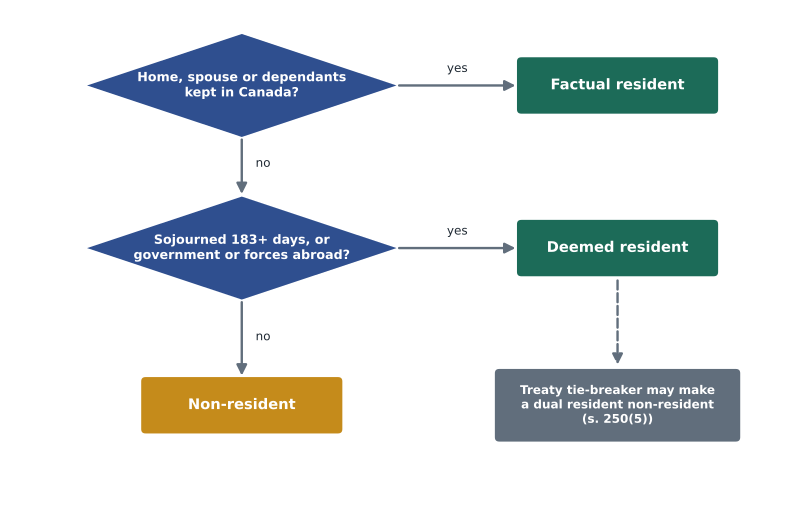
The CRA's Income Tax Folio S5-F1-C1, Determining an Individual's Residence Status, organizes the facts into ties. Significant residential ties are a dwelling place in Canada, a spouse or common-law partner in Canada and dependants in Canada. If a person keeps any of these, the CRA will usually consider them resident. Secondary residential ties include personal property such as a car or furniture, social ties such as memberships, economic ties such as Canadian bank accounts and credit cards, a provincial health card and driver's licence, and a Canadian mailing address. One secondary tie alone rarely decides the question, but together they can. Intention and the length of a stay abroad also matter: a person who leaves for a two-year assignment and keeps a home and family in Canada remains resident.
Deemed residents and the sojourning rule
Section 250 deems certain people to be resident for the whole year even if they are not factually resident. The most important rule for practice is paragraph 250(1)(a): a person who sojourned in Canada for a total of 183 days or more in the year is deemed resident for the entire year. Sojourning means a temporary stay, so the rule catches people who are not factually resident, such as a foreign contract worker or a long-staying visitor; it does not apply to someone who becomes factually resident part-way through the year, who is a part-year resident instead. Other deemed residents include members of the Canadian Forces serving abroad, federal and provincial government employees and diplomats posted abroad who were resident before the posting, and their dependent family members. Deemed residents pay federal tax on world income, but because they are not resident in any province they pay a federal surtax of 48 per cent of basic federal tax in place of provincial tax.
The program below applies the sojourning rule to three invented visitors and then shows how a part-year resident's personal credits are prorated.
# Sojourner test and part-year residency, Canada, 2026 (illustrative)
# Three people present in Canada in 2026; days are invented.
people = {
    "Arjun (contract engineer, no Canadian ties)": 196,
    "Mei (visiting researcher, home in Taipei)": 150,
    "Ola (seasonal guide, family abroad)": 183,
}
for name, days in people.items():
    deemed = days >= 183            # s. 250(1)(a): sojourned 183 days or more
    print(f"{name:<46}{days:>4} days  deemed resident: {'yes' if deemed else 'no'}")

# Part-year resident: Leah's colleague Daniel immigrates on 1 September 2026.
days_resident = 30 + 31 + 30 + 31                 # Sep to Dec
share = days_resident / 365
bpa = 16_452
print()
print(f"Daniel resident {days_resident} of 365 days ({share:.1%})")
print(f"Prorated basic personal amount  {bpa * share:>9,.2f}")
print(f"Federal credit at 14%           {0.14 * bpa * share:>9,.2f}")
print("Taxed in Canada on world income from 1 September only;")
print("before that, only on Canadian employment, business and taxable property.")Arjun (contract engineer, no Canadian ties) 196 days deemed resident: yes Mei (visiting researcher, home in Taipei) 150 days deemed resident: no Ola (seasonal guide, family abroad) 183 days deemed resident: yes Daniel resident 122 of 365 days (33.4%) Prorated basic personal amount 5,499.02 Federal credit at 14% 769.86 Taxed in Canada on world income from 1 September only; before that, only on Canadian employment, business and taxable property.
Arjun, a contract engineer who spent 196 days in Canada without establishing a home or family here, is deemed resident for the whole of 2026 and taxed on his worldwide income for the year, subject to any treaty relief. Mei, at 150 days, is not caught. Ola is caught at exactly 183 days, which is why careful day counts matter. Daniel, who immigrated and became factually resident on 1 September, is not a deemed resident; he is a part-year resident, taxed on world income only for the 122 days after he arrived and on Canadian-source income under section 115 before that. Section 118.91 prorates most personal credits, so his basic personal amount is reduced to about $5,499, unless substantially all of his income for the non-resident period was taxable in Canada.
Arriving in and leaving Canada
A person who becomes or stops being factually resident part-way through a year is a part-year resident. Section 114 computes taxable income as world income for the resident period plus, for the non-resident period, only the Canadian-source items that section 115 would tax. When a person immigrates, subsection 128.1(1) deems them to have acquired most of their property at fair market value on arrival, so gains that accrued before they became resident are never taxed in Canada. When a person emigrates, subsection 128.1(4) deems them to have disposed of most property at fair market value on departure, triggering the so-called departure tax on accrued gains; Canadian real estate, registered plans and certain other property are excluded because Canada can still tax them later. Lesson 10 returns to deemed dispositions. The date residence changes is usually the latest of the dates the person leaves, their spouse and dependants leave, and they establish residence elsewhere.
Worked problem
Leah's brother moves to Seattle
Leah's brother Kai, a Canadian resident, accepts a permanent job in Seattle. He flies out on 1 July 2026; his wife and children follow on 15 August, when their Winnipeg house is sold and they move into a house he bought in Seattle. He keeps a Canadian bank account and RRSP. When does he become a non-resident, and what follows?
Show solution
- Residence usually ends on the latest of: leaving Canada (1 July), the departure of his spouse and dependants (15 August) and establishing residence elsewhere (1 July).
- He becomes a non-resident on 15 August 2026, when his significant ties are severed. A bank account and RRSP are secondary ties and do not keep him resident.
- Before 15 August he is taxed on world income; after it, only on Canadian-source income such as Part XIII withholding on RRSP withdrawals.
- On departure he is deemed to dispose of most property at fair market value; his RRSP and Canadian real estate are excluded.
- Under the Canada–US treaty, the tie-breaker would only matter if both countries considered him resident on the same days.
Answer: A non-resident from 15 August 2026, with a deemed disposition of most property on that date.
| Status | Taxed in Canada on | Return |
|---|---|---|
| Factual resident | World income for the year | T1, federal and provincial tax |
| Deemed resident (s. 250) | World income for the year | T1, federal tax plus 48% surtax instead of provincial tax |
| Part-year resident | World income while resident; Canadian-source income under s. 115 while non-resident | T1 with dates of entry or departure |
| Non-resident | Employment and business in Canada, taxable Canadian property (Part I); passive income through Part XIII withholding | T1 only for Part I income or elections |
The individual as the taxpayer
Canada taxes each individual separately. There is no joint return and no option to pool a couple's income, which is a deliberate policy choice that makes progressive rates bite on each spouse's own income. Family relationships still matter a great deal, however. The spouse or common-law partner amount gives a credit when one partner has little income; the eligible dependant amount gives a single parent a credit equal to the spouse amount; pension income splitting lets retirees allocate up to half of eligible pension income to a spouse; the attribution rules in sections 74.1 to 74.5 stop high earners from shifting investment income to a lower-income spouse or minor children by gift (lesson 8); and income-tested benefits such as the Canada child benefit are based on family net income. A common-law partner is a person who has cohabited with the taxpayer in a conjugal relationship for at least 12 continuous months, or who is the parent of the taxpayer's child and lives with them. Marital status is generally determined at the end of the year.
Because Leah and Tomás file separately by law, decisions about which spouse claims a deduction or credit matter. Child care expenses must generally be claimed by the lower-income spouse; medical expenses and charitable donations may be claimed by either, and pooling them on one return often produces a larger credit; and income earned on money one spouse gives the other is attributed back to the giver. Lesson 11 works through these choices for the Brandt family.
| Relationship | Main tax effects in Canada |
|---|---|
| Spouse or common-law partner | Spouse amount credit; transfers of unused credits; attribution rules; pension splitting; family income for benefits; spousal RRSPs |
| Dependent child | Canada child benefit (tax-free); child care deduction; eligible dependant amount for single parents; attribution on gifts to minors |
| Other dependants | Canada caregiver amount for infirm relatives; transfers of disability and tuition amounts |
Who must file
A resident individual must file a return for a year if they owe tax, if they disposed of capital property or realized a taxable capital gain, if they must repay Old Age Security or Employment Insurance benefits, if they have to contribute to the Canada Pension Plan on self-employment income, if they withdrew from an RRSP under the Home Buyers' Plan or Lifelong Learning Plan without full repayment, or if the CRA sends a demand. In practice, almost everyone should file, because the return is the gateway to refundable credits and benefits such as the Canada child benefit, the GST/HST credit (which the government has announced will be replaced by the Canada Groceries and Essentials Benefit) and the Canada workers benefit. Budget 2025 introduced automatic filing for some low-income individuals, with returns prepared from CRA information starting with the 2025 tax year and expanding in later years.
Spouses must report their marital status and their spouse's net income, because many credits and benefits depend on it. The return for an individual who died in the year is filed by the legal representative, generally by the later of 30 April of the following year and six months after death, and the death triggers deemed dispositions covered in lesson 10.
Common mistakes
MistakeAssuming citizenship decides whether Canada can tax someone.
InsteadCanada taxes on the basis of residence, a question of fact, not citizenship.
MistakeApplying the 183-day sojourning rule to someone who moved to Canada permanently.
InsteadSojourning means a temporary stay; a person who settles here is a part-year resident from the date they became resident.
MistakeTreating a bank account or RRSP as enough to keep an emigrant resident.
InsteadThese are secondary ties; the significant ties are a home, spouse or common-law partner, and dependants.
MistakeFiling a joint return for a married couple.
InsteadCanada has no joint returns; each spouse files and the couple coordinates claims.
MistakeForgetting Part XIII withholding on payments to non-residents.
InsteadThe Canadian payer must withhold 25 per cent, or the treaty rate, and remit it.
Summary and key terms
- Canada taxes residents on world income and non-residents on Canadian-source income.
- Factual residence depends on residential ties, especially a home, spouse and dependants.
- Sojourning in Canada 183 days or more in a year makes a person a deemed resident for the whole year.
- Part-year residents are taxed on world income while resident and get prorated credits.
- Immigrants get a step-up in the cost of property; emigrants face a deemed disposition.
- Non-residents pay Part I tax on Canadian employment and business income and Part XIII tax on passive income.
- Treaty tie-breakers resolve dual residence by looking at a permanent home, centre of vital interests, habitual abode and nationality.
- Canada taxes individuals, not couples, but family relationships shape credits, benefits and attribution.
- Significant residential ties
- A dwelling, a spouse or common-law partner, or dependants in Canada.
- Deemed resident
- A person treated as resident for the whole year under section 250, such as someone who sojourned 183 days or more.
- Part-year resident
- An individual who became or ceased to be resident during the year.
- Part XIII tax
- A 25 per cent withholding tax on passive income paid to non-residents, often reduced by treaty.
- Departure tax
- Tax on gains from the deemed disposition of property when an individual emigrates.
- Common-law partner
- A person who has cohabited conjugally with the taxpayer for 12 months, or who is the parent of their child.
- Factual resident
- A person who has settled into a routine of life in a country, determined from all the facts.
- Tie-breaker rules
- Treaty rules that assign a dual resident to one country based on home, vital interests, habitual abode and nationality.
- Foreign tax credit
- A credit against domestic tax for foreign income tax paid on the same income.
Practice problems
Work each problem on paper first, then reveal the answer to check.
What is the difference between a factual resident and a deemed resident?
Show answer
A factual resident has settled ties to Canada; a deemed resident is treated as resident by section 250 without such ties, for example after sojourning 183 days.
Change Mei's days in the program to 183. What happens?
Show answer
She becomes a deemed resident for the whole year.
Daniel arrives on 1 September. Compute his prorated basic personal amount.
Show answer
122/365 × $16,452 = about $5,499.
Name the three significant residential ties.
Show answer
A dwelling place, a spouse or common-law partner, and dependants in Canada.
What is the Part XIII withholding rate before treaty relief?
Show answer
25 per cent.
Why does an immigrant's property get a deemed acquisition at fair market value?
Show answer
So that gains accrued before the person became resident are not taxed in Canada.
Why might Leah and Tomás claim medical expenses on Tomás's return?
Show answer
The threshold is the lesser of 3 per cent of net income and $2,890, so the lower-income spouse often gets a larger credit.
What federal surtax replaces provincial tax for a deemed resident?
Show answer
48 per cent of basic federal tax.
Under the Canada–US treaty, what is the first tie-breaker test for an individual?
Show answer
Where the individual has a permanent home available to them.
Kai keeps a Canadian bank account after moving. Is he still resident?
Show answer
Not on that basis alone; a bank account is a secondary tie.
Lesson quiz · 5 questions
Score 60% or more to complete this lesson.
Create a free account to save your progress, take quizzes and earn a certificate.