
ACCT-351 · Lesson 11 of 12 · 25 min
Other income, deductions and tax credits
The previous lessons covered the four main sources of income. This lesson gathers the remaining pieces of an individual's return: other kinds of income listed in subdivision d, the registered plans that shelter saving, the deductions in subdivision e, and the non-refundable and refundable credits that do much of the work of adjusting tax for family circumstances. It also covers two clawbacks that raise marginal rates for some taxpayers, the Old Age Security recovery tax and the alternative minimum tax. Along the way it settles the Brandt family's choices about who claims what.
Other sources of income
Subdivision d brings into income several amounts that are not from employment, business, property or capital gains. The main ones are pension benefits, including Old Age Security, CPP and QPP benefits and payments from registered pension plans; Employment Insurance benefits; withdrawals from RRSPs and RRIFs; retiring allowances; spousal support received under a written agreement or court order, if paid periodically; scholarships, bursaries and research grants above the exemption; and social assistance and workers' compensation, which are included and then deducted in Division C (lesson 3). Several amounts are specifically not taxable: Canada child benefit payments, GST/HST credit payments, withdrawals from a TFSA, child support under agreements made after April 1997, lottery winnings, gifts and inheritances, and most scholarships received by full-time students who qualify for the education amount.
Registered plans
Registered plans are the most widely used tax planning tool in Canada. Each combines a deduction or a tax-free withdrawal with tax-free growth inside the plan.
| Plan | Contributions | Growth | Withdrawals | 2026 limit |
|---|---|---|---|---|
| RRSP | Deductible | Tax-free | Taxable | 18% of prior-year earned income, up to $33,810, less pension adjustment, plus unused room |
| TFSA | Not deductible | Tax-free | Tax-free; room restored the following year | $7,000 a year; $109,000 cumulative since 2009 |
| FHSA | Deductible | Tax-free | Tax-free if used to buy a first home | $8,000 a year, $40,000 lifetime |
| RESP | Not deductible; 20% federal grant on first $2,500 a year | Tax-free | Growth and grants taxable to the student | $50,000 lifetime per beneficiary |
| RRIF | Transfers from RRSP by the end of the year the holder turns 71 | Tax-free | Taxable; minimum withdrawals each year | No new contributions |
RRSP contributions made in the first 60 days of a year can be deducted for the previous year, and unused room carries forward indefinitely. Over-contributions above a $2,000 cushion attract a penalty tax of 1 per cent a month. A spousal RRSP, to which one spouse contributes and the other is the annuitant, lets a couple split retirement income, subject to a three-year attribution rule on withdrawals. The Home Buyers' Plan lets first-time buyers withdraw up to $60,000 tax-free to buy a home, repayable over 15 years, and the Lifelong Learning Plan allows withdrawals for full-time education. Whether an RRSP or a TFSA is better depends mostly on the taxpayer's marginal rate now compared with their expected rate on withdrawal: if the rates are the same, the two give the same after-tax result; if the rate in retirement will be lower, the RRSP is better.
Worked problem
RRSP or TFSA?
Leah can set aside $5,000 of pre-tax income. Her combined marginal rate is about 38 per cent now, and she expects it to be about 30 per cent in retirement. The investment will earn 6 per cent a year for 25 years. Compare the after-tax result of an RRSP and a TFSA.
Show solution
- RRSP: the full $5,000 is contributed, because the deduction refunds the tax. After 25 years it grows to $5,000 × 1.06^25 = $21,459.
- Withdrawn and taxed at 30 per cent, it gives $15,022.
- TFSA: only the after-tax amount, $5,000 × (1 − 0.38) = $3,100, can be contributed. After 25 years it grows to $13,305, withdrawn tax-free.
- The RRSP gives about $1,700 more because her rate falls in retirement. If the rates were equal, the results would be identical; if her rate rose, the TFSA would win.
- Withdrawals from an RRSP or RRIF also count in net income for the OAS recovery tax, while TFSA withdrawals do not.
Answer: The RRSP gives $15,022 and the TFSA $13,305 after 25 years.
Deductions in subdivision e
Subdivision e allows a list of deductions in computing net income. Besides RRSP and FHSA contributions and the enhanced CPP deduction, the most common are child care expenses (section 63), moving expenses (section 62), support payments (paragraph 60(b)), the disability supports deduction and carrying charges and interest on investment loans (lesson 8). The child care deduction is generally claimed by the lower-income spouse and is limited to the least of the amount paid, $8,000 for each child under 7, $5,000 for each child aged 7 to 16 and $11,000 for a child eligible for the disability tax credit, and two thirds of the claimant's earned income. Moving expenses are deductible against income at the new location if the move brings the taxpayer at least 40 km closer to a new place of work, business or full-time study. Spousal support paid periodically under a written agreement or court order is deductible by the payer and taxable to the recipient; child support is neither.
Non-refundable credits
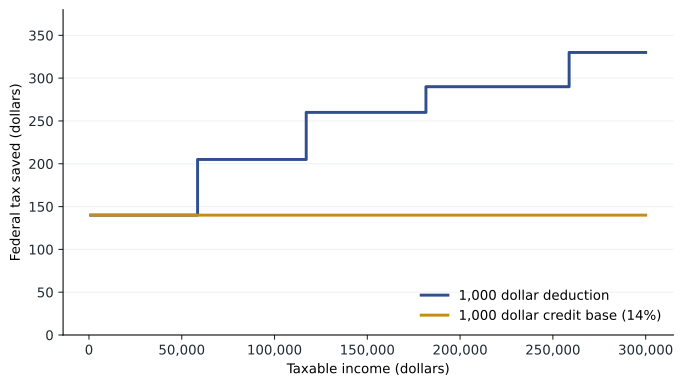
Non-refundable credits are computed by applying the lowest federal rate, 14 per cent for 2026, to a credit base. They reduce federal tax but not below zero. Some can be transferred to a spouse or carried forward; most are simply lost if unused.
| Credit | 2026 base amount | Notes |
|---|---|---|
| Basic personal amount | $16,452 | Reduced to $14,829 between $181,440 and $258,482 of net income |
| Spouse or common-law partner; eligible dependant | $16,452, reduced by the dependant's net income | Eligible dependant is for single parents and others supporting a relative |
| Age amount (65 and over) | $9,208 | Reduced by 15% of net income above $46,432 |
| Pension income amount | Up to $2,000 of eligible pension income | Eligible pension income can also be split with a spouse |
| Canada employment amount | $1,501 | Lesser of this and employment income |
| CPP (base) and EI contributions | Up to $3,519 and $1,123 | Enhanced CPP and CPP2 are deductions instead |
| Disability amount | $10,341 | Requires certification on form T2201; transferable |
| Tuition | Eligible fees paid | Up to $5,000 transferable to a parent or spouse; unused amounts carry forward |
| Medical expenses | Expenses above the lesser of 3% of net income and $2,890 | Any 12-month period ending in the year; either spouse may claim the family's expenses |
| Charitable donations | 14% on the first $200; 29% above (33% to the extent income exceeds $258,482) | Spouses may pool; carry forward five years |
| First-time home buyers' amount | $10,000 | In the year a qualifying home is bought |
Refundable credits and benefits deliver money through the tax system to people with little or no tax to pay. The Canada workers benefit supplements the earnings of low-income workers, and is partly paid in advance. The Canada child benefit, a tax-free monthly payment based on family net income, is worth up to about $8,000 a year for each child under six for the benefit year beginning in July 2026, and less for older children and higher incomes. The GST/HST credit, which the government has announced will be replaced by the Canada Groceries and Essentials Benefit, offsets sales tax for lower-income households. The refundable medical expense supplement helps low-income workers with high medical costs, and a new personal support workers tax credit, refundable at 5 per cent of eligible earnings up to $1,100 a year, applies from 2026 to 2030.
The Brandt family's choices
Because Leah and Tomás file separately, several choices are worth checking each year. The program computes Leah's RRSP limit and then compares claims on each spouse's return.
# Family deductions and credits, 2026 (illustrative)
# 1. Leah's RRSP deduction limit for 2026
earned_2025, pension_adjustment, unused_room = 110_000, 0, 6_400
limit = min(0.18 * earned_2025, 33_810) - pension_adjustment + unused_room
print(f"RRSP deduction limit 2026: {limit:,.0f}; Leah deducts 9,000, room left {limit - 9_000:,.0f}")

# 2. Child care for Nora (age 6): claimed by the lower-income spouse
paid, per_child_limit, tomas_earned = 6_500, 8_000, 38_000
deduction = min(paid, per_child_limit, 2 / 3 * tomas_earned)
print(f"Child care deduction (Tomas, s. 63): {deduction:,.0f}")

# 3. Medical expenses: usually better claimed by the lower-income spouse
expenses = 3_400
for who, net_income in [("Leah", 124_785), ("Tomas", 31_500)]:
    floor = min(0.03 * net_income, 2_890)
    print(f"Medical credit if {who} claims: base {max(0, expenses - floor):,.0f}, "
          f"credit {0.14 * max(0, expenses - floor):,.2f}")

# 4. Donations pooled on one return
gifts = 1_200
credit = 0.14 * min(gifts, 200) + 0.29 * max(0, gifts - 200)
print(f"Donation credit on {gifts:,}: {credit:,.2f} (14% on the first 200, 29% above)")

# 5. OAS recovery tax for Leah's father (net income 118,000; OAS received 8,900)
oas, father_income = 8_900, 118_000
clawback = min(oas, 0.15 * max(0, father_income - 95_323))
print(f"OAS recovery tax: {clawback:,.2f}")RRSP deduction limit 2026: 26,200; Leah deducts 9,000, room left 17,200 Child care deduction (Tomas, s. 63): 6,500 Medical credit if Leah claims: base 510, credit 71.40 Medical credit if Tomas claims: base 2,455, credit 343.70 Donation credit on 1,200: 318.00 (14% on the first 200, 29% above) OAS recovery tax: 3,401.55
Leah's RRSP deduction limit for 2026 is $26,200: 18 per cent of her 2025 earned income of $110,000, which is below the $33,810 dollar limit, plus $6,400 of unused room from earlier years. She contributes and deducts $9,000, leaving $17,200 of room. The child care deduction must be claimed by Tomás, as the lower-income spouse, and he can deduct the full $6,500 because it is below both the $8,000 limit for a child under seven and two thirds of his earned income. Medical expenses of $3,400 produce a much larger credit on Tomás's return, because his net income of $31,500 sets the threshold at $945 rather than the $2,890 maximum that applies to Leah. The family's donations of $1,200 are pooled on Leah's return, where the 29 per cent rate on the amount above $200 gives a credit of $318 regardless of which spouse claims, but pooling ensures the first $200 is counted only once. Finally, the program computes the OAS recovery tax on Leah's father, whose net income of $118,000 exceeds the $95,323 threshold: he repays 15 per cent of the excess, $3,401.55 of his $8,900 OAS.
Clawbacks and the alternative minimum tax
Several income-tested benefits are recovered as income rises, which creates high effective marginal rates in particular ranges. The OAS recovery tax takes back 15 per cent of net income above $95,323 for 2026 until the full pension is repaid. Employment Insurance regular benefits are partly repaid by higher-income recipients who have received benefits in previous years. The Canada child benefit is reduced as family net income rises. These clawbacks are why net income, rather than taxable income, is the measure that matters for many families, and why deductions such as RRSP contributions, which reduce net income, are often worth more than they appear.
The alternative minimum tax ensures that individuals with large deductions and preferential income pay at least a minimum amount. It was substantially reformed for 2024 and later years. Adjusted taxable income for AMT includes 100 per cent of capital gains (30 per cent for gains on publicly listed securities donated to charity), disallows half of many deductions such as interest and carrying charges, and allows only half of most non-refundable credits. An exemption equal to the start of the fourth federal bracket, $181,440 for 2026, is deducted, and the balance is taxed at 20.5 per cent. The taxpayer pays the higher of regular tax and minimum tax, and AMT paid can be recovered over the next seven years when regular tax exceeds minimum tax. The 2024 changes made AMT a real risk for people who realize very large capital gains in a single year, for example on selling a business or a cottage, especially when the lifetime capital gains exemption applies.
Common mistakes
MistakeHaving the higher-income spouse claim child care.
InsteadThe lower-income spouse must generally claim it.
MistakeTreating TFSA withdrawals as income.
InsteadTFSA withdrawals are tax-free and do not affect income-tested benefits.
MistakeClaiming medical expenses on the higher earner's return by default.
InsteadThe 3 per cent threshold is lower for the lower-income spouse.
MistakeForgetting the OAS recovery tax when planning RRIF withdrawals.
InsteadRRIF income increases net income and may trigger the 15 per cent clawback.
MistakeIgnoring AMT on a large capital gain.
InsteadSince 2024, AMT includes 100 per cent of capital gains above a $181,440 exemption (2026).
Summary and key terms
- Subdivision d includes pensions, EI, RRSP withdrawals and spousal support; CCB, TFSA withdrawals and child support are not taxable.
- RRSPs give a deduction now and tax later; TFSAs give no deduction but tax-free withdrawals; FHSAs give both for a first home.
- Leah's 2026 RRSP limit is $26,200; she deducts $9,000.
- Child care is claimed by the lower-income spouse, up to $8,000 for a child under seven.
- Non-refundable credits are worth 14 per cent of their base; donations above $200 get 29 per cent.
- Refundable credits and benefits, such as the Canada workers benefit and the CCB, reach people with no tax to pay.
- The OAS recovery tax takes 15 per cent of net income above $95,323 for 2026.
- The reformed AMT taxes 100 per cent of capital gains at 20.5 per cent above a $181,440 exemption for 2026.
- RRSP deduction limit
- 18 per cent of prior-year earned income up to the annual dollar limit, less the pension adjustment, plus unused room.
- TFSA
- A tax-free savings account: no deduction for contributions, tax-free growth and withdrawals.
- FHSA
- A first home savings account: deductible contributions and tax-free qualifying withdrawals.
- Earned income
- For RRSP purposes, mainly employment, business and net rental income, less certain deductions.
- OAS recovery tax
- The 15 per cent clawback of Old Age Security above a net income threshold.
- Canada child benefit
- A tax-free monthly payment for children based on family net income.
- Refundable credit
- A credit paid even if it exceeds tax owed.
- Alternative minimum tax
- A parallel tax computation that sets a floor on tax for taxpayers with large preferences.
Practice problems
Work each problem on paper first, then reveal the answer to check.
Compute an RRSP limit for someone with 2025 earned income of $200,000, no pension and no unused room.
Show answer
18% × $200,000 = $36,000, capped at $33,810.
In the program, change Tomás's earned income to $9,000. What is the child care deduction?
Show answer
Two thirds of $9,000 = $6,000.
Why does the RRSP beat the TFSA in the example?
Show answer
Leah's marginal rate in retirement is lower than her rate now.
Is child support received taxable?
Show answer
No, for agreements made after April 1997.
At what rate are donations above $200 credited?
Show answer
29 per cent, or 33 per cent to the extent income exceeds $258,482.
What is the medical expense threshold for someone with net income of $60,000?
Show answer
The lesser of $1,800 and $2,890: $1,800.
Leah's father has net income of $140,000 and OAS of $8,900. How much OAS does he keep?
Show answer
Recovery tax is the lesser of $8,900 and 15% × $44,677 = $6,702: he keeps about $2,198.
What is the 2026 TFSA limit and cumulative room for someone eligible since 2009?
Show answer
$7,000; $109,000.
What changed in the AMT for 2024?
Show answer
A higher 20.5 per cent rate, a much larger exemption, 100 per cent inclusion of capital gains and only half of many credits and deductions.
What new refundable credit applies from 2026 to 2030?
Show answer
The personal support workers tax credit, 5 per cent of eligible earnings up to $1,100.
Lesson quiz · 5 questions
Score 60% or more to complete this lesson.
Create a free account to save your progress, take quizzes and earn a certificate.