
ACCT-351 · Lesson 5 of 12 · 26 min
Employment income II: stock options, deductions and payroll contributions
Lesson 4 covered what goes into employment income. This lesson completes subdivision a with three topics. The first is employee stock options, which section 7 taxes under special rules that differ for public companies and Canadian-controlled private corporations. The second is the short list of deductions an employee can claim under section 8, from commission salespeople's expenses to a home workspace. The third is the payroll system: Canada Pension Plan contributions, Employment Insurance premiums and income tax withholding, and how CPP and EI flow into the employee's own return as credits and deductions.
Employee stock options
A stock option gives an employee the right to buy shares of the employer, or a related corporation, at a fixed exercise price for a set period. If the share price rises, the employee can buy below market. Section 7 overrides the general benefit rules: no benefit arises when the option is granted, and the employee is instead taxed on the difference between the fair market value of the shares and the exercise price when the shares are acquired. That benefit is employment income, but if the conditions in paragraph 110(1)(d) are met, the employee deducts half of it in computing taxable income, so it is effectively taxed at the same rate as a capital gain. The main conditions are that the shares are ordinary common shares, the employee deals at arm's length with the employer, and the exercise price was not less than the fair market value of the shares when the option was granted.
For options granted after June 2021 by employers that are not Canadian-controlled private corporations and have consolidated revenue above $500 million, the 110(1)(d) deduction is limited to options on shares with a value of $200,000 at grant vesting in any year; the employer can deduct the excess benefit instead. The employee's cost base of the shares is their fair market value at acquisition, under paragraph 53(1)(j), so the amount already taxed as a benefit is not taxed again when the shares are sold. If the employee donates publicly listed shares acquired under an option to a registered charity within 30 days, an additional deduction under paragraph 110(1)(d.01) can eliminate the remaining half of the benefit.
Options granted by a Canadian-controlled private corporation to arm's length employees get two further advantages. Under subsection 7(1.1), the benefit is not taxed when the shares are acquired but is deferred until the employee disposes of them, which matters because private company shares are hard to sell to pay the tax. And under paragraph 110(1)(d.1), the half deduction is available even if the exercise price was below fair market value at grant, provided the employee holds the shares for at least two years. The $200,000 vesting limit does not apply to CCPCs. These rules are a deliberate policy to help start-ups compete for talent.
Withholding and reporting for stock options
For public company options, the employer must withhold tax at exercise on the net benefit, as if it were a cash bonus, and report the benefit and the deduction on the T4. Employees who cannot afford the withholding often use a cashless exercise, selling enough shares immediately to cover the exercise price and the tax. An employee who holds the shares and sees the price fall after exercise still owes tax on the benefit measured at exercise, while the later loss is a capital loss that can only offset capital gains, a painful mismatch that caught many technology employees in 2000–2001 and again in 2022.
The program below computes Leah's CPP and EI for 2026 and then a stock option benefit. Red River is listed on the Toronto Stock Exchange, so it is not a CCPC; suppose Leah exercises options on 1,000 shares granted at $20, when the shares trade at $34, and sells them later for $40.
# Leah's 2026 CPP and EI, and a stock option benefit (illustrative)
pensionable = 103_320                      # employment income includes taxable benefits
ympe, yampe, exemption = 74_600, 85_000, 3_500
cpp1 = 0.0595 * (min(pensionable, ympe) - exemption)
cpp_base = 0.0495 * (min(pensionable, ympe) - exemption)   # credit at 14%
cpp_first_enh = cpp1 - cpp_base                              # deduction
cpp2 = 0.04 * max(0, min(pensionable, yampe) - ympe)         # deduction
ei = 0.0163 * min(pensionable, 68_900)                       # credit at 14%
print(f"CPP1 contributions               {cpp1:>9,.2f}")
print(f"  base part (credit)             {cpp_base:>9,.2f}")
print(f"  first enhancement (deduction)  {cpp_first_enh:>9,.2f}")
print(f"CPP2 contributions (deduction)   {cpp2:>9,.2f}")
print(f"EI premiums (credit)             {ei:>9,.2f}")
print(f"Employer pays: CPP {cpp1 + cpp2:,.2f}, EI {1.4 * ei:,.2f}")

# Stock options: public company, granted at fair market value
shares, strike, fmv_exercise, sale_price = 1_000, 20.00, 34.00, 40.00
benefit = shares * (fmv_exercise - strike)        # s. 7(1)(a), in employment income
deduction = 0.5 * benefit                         # s. 110(1)(d), in taxable income
acb = shares * fmv_exercise                       # s. 53(1)(j) adds the benefit to cost
gain = shares * sale_price - acb
print()
print(f"Employment benefit at exercise   {benefit:>9,.2f}")
print(f"Stock option deduction (50%)     {deduction:>9,.2f}")
print(f"Net addition to taxable income   {benefit - deduction:>9,.2f}")
print(f"ACB of shares                    {acb:>9,.2f}")
print(f"Capital gain on later sale {gain:>9,.2f} taxable half {gain / 2:,.2f}")CPP1 contributions 4,230.45 base part (credit) 3,519.45 first enhancement (deduction) 711.00 CPP2 contributions (deduction) 416.00 EI premiums (credit) 1,123.07 Employer pays: CPP 4,646.45, EI 1,572.30 Employment benefit at exercise 14,000.00 Stock option deduction (50%) 7,000.00 Net addition to taxable income 7,000.00 ACB of shares 34,000.00 Capital gain on later sale 6,000.00 taxable half 3,000.00
Leah's employment income of $103,320, including taxable benefits, is above both the year's maximum pensionable earnings of $74,600 and the second ceiling of $85,000, so she pays the maximum CPP: $4,230.45 of first-tier contributions and $416 of CPP2. She also pays the maximum EI premium of $1,123.07. On her return, these amounts are split. The base part of CPP (4.95 per cent of pensionable earnings above the exemption) and EI premiums are credit amounts, worth 14 per cent. The first enhancement (the extra 1 per cent) and all of CPP2 are deductions under paragraph 60(e), worth her marginal rate, a design choice made when the enhanced CPP began in 2019 so that enhanced contributions are treated like registered pension contributions. Red River pays matching CPP and EI at 1.4 times her premium.
For the option, the employment benefit at exercise is $14,000. Because the exercise price equalled market value at grant and the shares are common shares of a public company, she deducts half, so $7,000 is added to taxable income. Her cost base for the shares is $34,000, so the later sale at $40 gives a capital gain of $6,000, of which half is taxable (lesson 9). The overall result: $10,000 of her $20,000 economic gain is taxed, the same as if the whole gain had been a capital gain.
Deductions from employment income
Subsection 8(2) says that no deductions are allowed in computing employment income except those permitted by section 8. The list is specific, and most deductions require that the employee was required by the contract of employment to pay the expense and was not reimbursed. The employer certifies the conditions on form T2200, Declaration of Conditions of Employment, which the employee keeps in case the CRA asks.
| Deduction | Provision | Main conditions |
|---|---|---|
| Sales expenses of commission employees | s. 8(1)(f) | Paid in commissions, required to pay own expenses, ordinarily working away from the employer's place of business; limited to commission income |
| Travel expenses | s. 8(1)(h) | Ordinarily required to work away from the employer's place of business, required to pay own travel, no tax-free travel allowance |
| Motor vehicle expenses, CCA and interest on a car | s. 8(1)(h.1), (j) | As for travel; CCA and interest subject to the automobile limits |
| Office rent, supplies, assistant's salary; home workspace | s. 8(1)(i), 8(13) | Required by the contract and certified on T2200; workspace must be the principal place of work or used exclusively and regularly to meet customers |
| Professional and union dues | s. 8(1)(i)(iv), (v) | Required to maintain a professional status recognized by statute, or paid to a trade union |
| Registered pension plan contributions | s. 8(1)(m) | Current service contributions to an RPP |
| Tradesperson's tools | s. 8(1)(s) | Cost of new tools above the Canada employment amount, up to $1,000 |
| Legal expenses | s. 8(1)(b) | To collect or establish a right to salary or wages owed |
The home workspace deduction illustrates the rules. An employee can deduct a reasonable share of rent, utilities and maintenance (and, for commission employees, property taxes and insurance, but never mortgage interest or CCA for an employee) if the workspace is where they principally perform their duties, meaning more than 50 per cent of the time for at least four consecutive weeks, or if it is used exclusively for work and regularly to meet customers. The temporary flat-rate method introduced during the pandemic, which let employees claim $2 a day without receipts, ended after the 2022 tax year, so employees must now use the detailed method with a signed T2200.
Worked problem
A commissioned salesperson
A sales representative for Red River earns a $55,000 base salary and $28,000 of commissions. Her contract requires her to pay her own car and entertainment costs, and she works away from the office most of the time. She pays $9,800 for car operating costs (60 per cent business use), $2,400 for client meals and $3,600 for a cell phone plan used 50 per cent for work. What can she deduct under 8(1)(f)?
Show solution
- Car: 60% × $9,800 = $5,880.
- Meals: 50% × $2,400 = $1,200, because section 67.1 limits meals and entertainment to half.
- Phone: 50% × $3,600 = $1,800, the employment-use share of the plan.
- Total $8,880, well below the $28,000 limit of commission income under 8(1)(f).
- She could instead claim car expenses under 8(1)(h.1) without the commission limit, but not meals; 8(1)(f) is usually better for commission employees.
Answer: A deduction of $8,880 from employment income, supported by a T2200 and receipts.
Payroll contributions and withholding
Every employer must deduct CPP contributions, EI premiums and income tax from employees' pay and remit them to the CRA, together with its own CPP and EI contributions, by the 15th of the following month for most employers. For 2026, CPP contributions are 5.95 per cent each for employer and employee on earnings between the $3,500 basic exemption and $74,600, and CPP2 contributions are 4 per cent each on earnings between $74,600 and $85,000. EI premiums are 1.63 per cent of insurable earnings up to $68,900 for employees and 1.4 times that for employers. Quebec employers deduct Quebec Pension Plan contributions instead of CPP and Quebec Parental Insurance Plan premiums, with a reduced EI rate. Income tax is withheld using the payroll deductions tables and the employee's TD1 forms, which declare their credits.
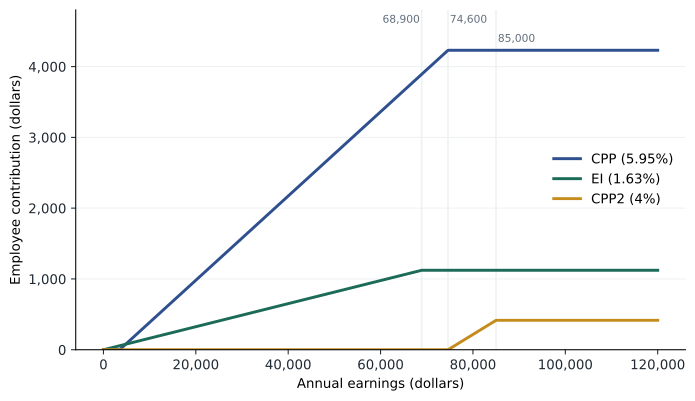
Because the CPP and EI ceilings are low relative to many salaries, the payroll burden is regressive at the top: a worker earning $85,000 and one earning $200,000 pay exactly the same CPP and EI. Overcontributions, which occur when an employee works for more than one employer in a year, are refunded when the return is filed. Self-employed individuals pay both halves of CPP on their net business income through their return but do not pay EI unless they opt in to the special benefits program. Leah's business income will not attract any CPP for 2026, because her employment earnings have already reached the maximum.
Registered pension plans
Employer pension plans registered under section 147.1 come in two main forms. In a defined benefit plan, the employer promises a pension based on salary and service; in a defined contribution plan, contributions accumulate in an account and the pension depends on investment returns. Employer contributions are not taxable benefits and employee contributions are deductible under paragraph 8(1)(m), within limits. To keep the total tax-assisted saving roughly equal for everyone, each year's pension accrual is measured as a pension adjustment, reported on the T4, which reduces the employee's RRSP room for the following year (lesson 11). Red River has no pension plan, so Leah saves through her RRSP instead.
Common mistakes
MistakeTaxing an option benefit when the option is granted.
InsteadSection 7 taxes the benefit when the shares are acquired, or on disposition for CCPC options.
MistakeForgetting to add the option benefit to the cost base of the shares.
InsteadUnder 53(1)(j), the cost base includes the benefit, so the shares cost their value at acquisition.
MistakeDeducting employment expenses without a T2200.
InsteadMost section 8 deductions require the employer to certify that the employee had to pay them.
MistakeTreating all CPP contributions as a credit.
InsteadThe base part is a credit; the first enhancement and CPP2 are deductions.
MistakeCharging CPP on self-employment income when employment has already maxed it out.
InsteadSchedule 8 takes employment contributions into account; Leah owes no CPP on her business income for 2026.
Summary and key terms
- Section 7 taxes the stock option benefit when shares are acquired: value minus exercise price.
- The 110(1)(d) deduction halves the benefit if the exercise price was at least market value at grant; a $200,000 annual vesting limit applies to large non-CCPC employers.
- CCPC option benefits are deferred until the shares are sold.
- Employees can deduct only the expenses listed in section 8, usually only if required by their contract (T2200).
- For 2026, CPP is 5.95 per cent up to $74,600 plus CPP2 of 4 per cent to $85,000; EI is 1.63 per cent up to $68,900.
- Base CPP and EI are credits at 14 per cent; enhanced CPP and CPP2 are deductions.
- Pension adjustments reduce RRSP room to equalize tax-assisted saving.
- Employers withhold, remit and report; employees reconcile on their returns.
- Stock option benefit
- The excess of the shares' value over the exercise price, included in employment income under section 7.
- Security options deduction
- The deduction of half the stock option benefit under paragraph 110(1)(d) or (d.1).
- T2200
- The employer's declaration of the conditions of employment that support an employee's expense claims.
- CPP2
- Second-tier CPP contributions of 4 per cent on earnings between the YMPE and the YAMPE.
- Pension adjustment
- The value of a year's pension accrual, which reduces RRSP room.
- Year's maximum pensionable earnings (YMPE)
- The earnings ceiling for first-tier CPP contributions, $74,600 for 2026.
- Stock option
- A right to buy shares at a fixed price for a set period.
- Exercise price
- The price at which an option holder may buy the shares.
Practice problems
Work each problem on paper first, then reveal the answer to check.
Leah's colleague exercises options on 500 shares at $12 when they trade at $30. The exercise price equalled market value at grant. What is the net addition to taxable income?
Show answer
Benefit $9,000, deduction $4,500, net $4,500.
In the program, change the exercise-date value to $20. What happens?
Show answer
There is no benefit or deduction; the cost base is $20,000 and the whole $20,000 gain on sale at $40 is a capital gain.
Why are CCPC option benefits deferred until sale?
Show answer
Private company shares are hard to sell to pay tax; deferral helps start-ups attract employees.
What does a T2200 certify?
Show answer
That the employee was required by the contract to pay certain expenses, without reimbursement, under the conditions the deduction needs.
An employee earns $60,000. What are her 2026 CPP contributions?
Show answer
5.95% × ($60,000 − $3,500) = $3,361.75; no CPP2.
Why is the enhanced part of CPP deductible rather than a credit?
Show answer
To treat enhanced contributions like registered pension contributions, deductible at the marginal rate.
Can an employee deduct mortgage interest for a home workspace?
Show answer
No; mortgage interest and CCA are never deductible by an employee.
What limits the 8(1)(f) deduction?
Show answer
The employee's commission income for the year.
What is the employer's EI premium for Leah?
Show answer
1.4 × $1,123.07 = $1,572.30.
Leah's shares fall to $25 after she exercises at $34. What is the problem?
Show answer
She is taxed on a benefit measured at $34, but the later capital loss can only offset capital gains.
Lesson quiz · 5 questions
Score 60% or more to complete this lesson.
Create a free account to save your progress, take quizzes and earn a certificate.