
ACCT-351 · Lesson 10 of 12 · 27 min
Capital gains II: principal residence, deemed dispositions and the LCGE
For most Canadian families, the largest capital gain they will ever realize is on their home, and that gain is usually tax-free under the principal residence exemption. This lesson begins with that exemption: what qualifies, how the designation formula works, and what happens when a family owns a home and a cottage, or rents out a home it used to live in. It then covers the deemed dispositions that tax gains without any sale: on a gift, on a change in use, and above all on death, which is the moment when most accrued gains in Canada are finally taxed. It ends with the lifetime capital gains exemption for small business shares and farm and fishing property.
The principal residence exemption
Paragraph 40(2)(b) reduces the gain on the disposition of a principal residence by the fraction (1 + number of years designated as principal residence after 1971) ÷ number of years owned after 1971. A property qualifies as a principal residence for a year if it is a housing unit (a house, condominium, cottage, mobile home or even a houseboat), the taxpayer owns it alone or jointly, the taxpayer, their spouse or common-law partner, former spouse or child ordinarily inhabited it at some time in the year, and the taxpayer designates it. "Ordinarily inhabited" does not require living there year-round: a cottage used each summer can qualify. The land qualifies up to half a hectare, or more if the taxpayer shows it is necessary for the use and enjoyment of the home.
The "plus one" in the formula lets a family that sells one home and buys another in the same year shelter both, because each property can be designated for the year of the move. Two limits make the exemption a family rather than an individual benefit. For years after 1981, a family unit, meaning the taxpayer, their spouse or common-law partner and their unmarried minor children, can designate only one property as a principal residence for each year. And since 2016, the plus one is not available to a person who was not resident in Canada in the year the property was acquired.
Since 2016, a taxpayer who sells a principal residence must report the sale and the designation on Schedule 3 of the return (and form T2091 if the property was not designated for every year), even if the whole gain is exempt. A late designation can be accepted, but the CRA can charge a penalty of $100 for each complete month it is late, up to $8,000, and the normal reassessment period does not start to run on an unreported sale. The residential property flipping rule (lesson 6) also denies the exemption for housing held less than 365 days unless a life event applies.
A home and a cottage
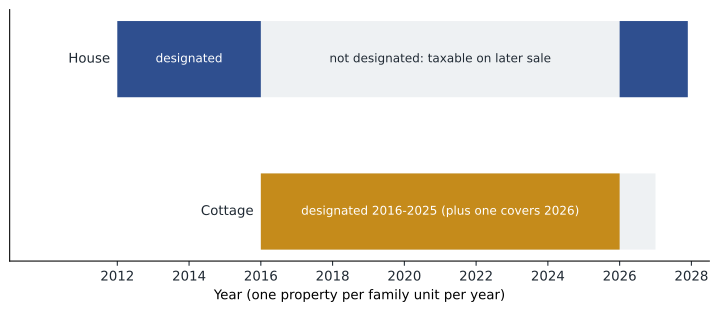
Leah and Tomás own their Winnipeg house, bought in 2012, and a lake cottage, bought in 2016, which the family uses every summer. In 2026 they sell the cottage. Because they are a family unit, they can designate only one of the two properties for each year from 2016 onward. The program shows how much of the cottage gain is exempt for different numbers of years designated.
# Principal residence designation: house versus cottage (illustrative)
# Leah and Tomas own a Winnipeg house (bought 2012) and a lake cottage (bought 2016).
# They sell the cottage in 2026 and expect to keep the house for years.
house = {"bought": 2012, "cost": 310_000, "value_2026": 560_000}
cottage = {"bought": 2016, "cost": 180_000, "sold": 2026, "proceeds": 395_000, "outlays": 15_000}

def exempt_share(years_designated, years_owned):
    return min(1, (1 + years_designated) / years_owned)        # the "one plus" formula

c_years = cottage["sold"] - cottage["bought"] + 1               # 2016-2026 inclusive = 11
c_gain = cottage["proceeds"] - cottage["outlays"] - cottage["cost"]
h_years = 2026 - house["bought"] + 1                            # 15 so far
h_gain_per_year = (house["value_2026"] - house["cost"]) / h_years
print(f"Cottage gain {c_gain:,} over {c_years} years = {c_gain / c_years:,.0f} a year")
print(f"House gain so far {house['value_2026'] - house['cost']:,} over {h_years} years "
      f"= {h_gain_per_year:,.0f} a year")
print()
print(f"{'cottage years designated':>25}{'exempt':>10}{'taxable gain':>14}")
for d in [0, 5, 10]:
    ex = round(c_gain * exempt_share(d, c_years))
    print(f"{d:>25}{ex:>10,}{(c_gain - ex) / 2:>14,.0f}")
print("Each year designated for the cottage is a year the house cannot use later.")Cottage gain 200,000 over 11 years = 18,182 a year
House gain so far 250,000 over 15 years = 16,667 a year
cottage years designated exempt taxable gain
0 18,182 90,909
5 109,091 45,454
10 200,000 0
Each year designated for the cottage is a year the house cannot use later.The cottage gained $200,000 over 11 years of ownership (2016 to 2026 counted inclusively), about $18,182 a year, slightly more per year than the house has gained so far. Designating ten years for the cottage exempts the whole gain because of the plus one. But each year designated for the cottage is a year that cannot later be designated for the house, and the house's gain for those years will become taxable when it is sold, unless prices fall. Choosing the designation therefore requires estimating the future gain on the house. A common approach is to designate the property with the higher average gain per year for as many years as needed, keep track of which years were used, and remember that the decision is made only when the first property is sold. Because the per-year gains here are similar and the house will probably keep appreciating, the Brandts might designate the cottage for fewer years and accept some taxable gain now, or designate fully now and accept a taxable gain on the house later.
Change in use
When a taxpayer starts using property for a different purpose, for example turning a home into a rental property or moving into a former rental, subsection 45(1) deems a disposition at fair market value, followed by a reacquisition at the same value. For a home that becomes a rental, the deemed gain for the years it was a principal residence is usually exempt, and the property starts its life as a rental with a cost equal to its value. Two elections can prevent the deemed disposition. Under subsection 45(2), a taxpayer who starts renting out their home can elect to be treated as not having changed its use, and can then designate it as a principal residence for up to four years while it is rented, as long as no CCA is claimed and no other property is designated; the four-year limit is extended if the move was required by an employer. Under subsection 45(3), a taxpayer who moves into a former rental can elect to defer the gain, provided no CCA was claimed on the property after 1984.
A partial change in use, such as a basement suite or a home office, is common. The CRA's position is that no change in use occurs if the income-producing use is ancillary to the main use of the property as a residence, there is no structural change to the property and no CCA is claimed on it. A taxpayer who claims CCA on a rental suite in their home risks losing the exemption on that portion, which is why advisers usually recommend against claiming it.
Gifts, transfers to a spouse and deemed dispositions on death
Canada has no gift or estate tax. Instead, accrued gains are taxed when property is transferred. Under section 69, a gift, or a transfer to a non-arm's length person for less than fair market value, is deemed a disposition at fair market value by the donor, and the recipient acquires the property at that value. A sale to a related person for less than fair market value is worse: the seller is deemed to receive fair market value, but the buyer's cost is only the price paid, so the same gain can be taxed twice. Transfers to a spouse or common-law partner, or a spousal trust, are the main exception: under subsection 73(1), they occur automatically at the transferor's cost, so no gain arises until the spouse disposes of the property, unless the transferor elects out. The attribution rules (lesson 8) then attribute later income and gains back to the transferor.
Death is the most important deemed disposition. Subsection 70(5) deems a deceased individual to have disposed of all capital property immediately before death at fair market value, so all accrued gains, net of the principal residence exemption and any available lifetime exemption, are taxed on the final (terminal) return. Depreciable property can produce recapture. The fair market value of RRSPs and RRIFs is included in income, unless they pass to a surviving spouse or a financially dependent child or grandchild. The main relief is the spousal rollover in subsection 70(6): property left to a spouse, common-law partner or spousal trust passes at the deceased's cost, deferring the gain until the survivor sells or dies. Provincial probate fees, which are based on the value of the estate, are a separate cost.
| Event | Rule | Effect |
|---|---|---|
| Gift to a child or friend | s. 69(1)(b) | Donor deemed to sell at FMV; recipient's cost is FMV |
| Sale to a related person below FMV | s. 69(1)(b), (a) | Seller deemed to receive FMV; buyer's cost is the price paid (double taxation risk) |
| Transfer to a spouse or spousal trust | s. 73(1) | Rollover at cost unless the transferor elects out |
| Death, property left to anyone but a spouse | s. 70(5) | Deemed disposition at FMV on the terminal return |
| Death, property left to a spouse or spousal trust | s. 70(6) | Rollover at cost; gain deferred to the survivor |
| Change in use (home to rental) | s. 45(1), 45(2) | Deemed disposition at FMV unless the 45(2) election is made |
| Emigration | s. 128.1(4) | Deemed disposition of most property at FMV |
Worked problem
Leah's father's estate
Leah's father, a widower, dies in 2026. He owns a non-registered share portfolio with an ACB of $120,000 and a fair market value of $300,000, a RRIF worth $250,000 and a house that has always been his principal residence. He leaves everything to Leah and her brother. What is included on his terminal return?
Show solution
- Shares: deemed disposition at $300,000; capital gain $180,000; taxable capital gain $90,000.
- RRIF: the full $250,000 is income, because it does not pass to a spouse or dependent child.
- House: deemed disposition, but the gain is fully exempt under the principal residence exemption, which the executor designates.
- Income on the terminal return includes $340,000 from these items, taxed at high marginal rates; the estate pays the tax before distributing the assets.
- Had he left the shares and RRIF to a surviving spouse, the 70(6) rollover and the RRIF rollover would have deferred all of it.
Answer: $90,000 of taxable capital gains plus $250,000 of RRIF income on the terminal return.
The lifetime capital gains exemption
Section 110.6 gives each individual resident in Canada a lifetime capital gains exemption (LCGE) for gains on the disposition of qualified small business corporation shares and qualified farm or fishing property. The exemption was raised to $1,250,000 for dispositions after 24 June 2024 and is indexed to inflation from 2026, when it is $1,275,000. The exemption is claimed as a Division C deduction, so the gain still appears in net income, and the claim is reduced by any cumulative net investment loss, a running total of investment expenses in excess of investment income since 1988. Shares qualify only if, broadly, the corporation is a Canadian-controlled private corporation using all or substantially all (90 per cent) of its assets in an active business in Canada at the time of sale, and more than 50 per cent throughout the preceding 24 months, during which nobody other than the taxpayer or a related person owned the shares. Gains sheltered by the exemption can create alternative minimum tax (lesson 11). Because the exemption is mainly relevant to owners of private corporations, ACCT-352 covers it in detail.
Brandt Aerial is a sole proprietorship, not a corporation, so Leah cannot use the LCGE for it as things stand. If she incorporated the business and later sold the shares at a large gain, the exemption could shelter that gain, which is one of several reasons owners of growing businesses consider incorporating.
Common mistakes
MistakeDesignating two properties as principal residences for the same year.
InsteadAfter 1981, only one property per family unit per year.
MistakeNot reporting the sale of a home because the whole gain is exempt.
InsteadThe sale and designation must be reported; penalties apply to late designations.
MistakeAssuming a gift to a child happens at the parent's cost.
InsteadSection 69 deems a disposition at fair market value.
MistakeForgetting that death triggers a deemed disposition.
InsteadSubsection 70(5) taxes accrued gains on the terminal return unless the spousal rollover applies.
MistakeClaiming CCA on a home rental suite without considering the exemption.
InsteadCCA on part of a home can make that part ineligible for the exemption.
Summary and key terms
- The principal residence exemption fraction is (1 + years designated) ÷ years owned.
- Only one property per family unit can be designated for each year after 1981.
- Sales of a principal residence must be reported with the designation.
- Change in use is a deemed disposition at FMV unless an election under 45(2) or 45(3) applies.
- Gifts and non-arm's length transfers are deemed to occur at fair market value; spousal transfers roll over at cost.
- Death triggers a deemed disposition of capital property at fair market value, except property left to a spouse.
- The LCGE is $1,275,000 for 2026 for qualified small business shares and farm or fishing property.
- Canada has no gift or estate tax; tax is collected through deemed dispositions instead.
- Principal residence
- A housing unit ordinarily inhabited by the taxpayer or family and designated for exemption.
- Family unit
- The taxpayer, spouse or common-law partner and unmarried minor children, who share one principal residence designation per year.
- Deemed disposition
- A disposition the Act treats as having occurred at fair market value without a sale.
- Spousal rollover
- The transfer of property to a spouse at cost, on gift or death, deferring the gain.
- Terminal return
- The final return of a deceased individual for the year of death.
- Lifetime capital gains exemption (LCGE)
- A deduction that shelters gains on qualified small business shares and farm or fishing property.
- Fair market value
- The highest price obtainable in an open market between informed, willing parties at arm's length.
Practice problems
Work each problem on paper first, then reveal the answer to check.
A house owned 20 years is designated for 14. What fraction of the gain is exempt?
Show answer
(1 + 14)/20 = 75 per cent.
In the program, how many years must be designated for the cottage to exempt the whole gain?
Show answer
Ten; with the plus one, 11 of 11 years are covered.
Leah's colleague moves to Calgary for work and rents out his Winnipeg house. What can he elect?
Show answer
A 45(2) election to keep it as his principal residence for up to four years (longer for employer relocations), with no CCA.
What is the effect of 70(6)?
Show answer
Property left to a spouse or spousal trust passes at the deceased's cost, deferring the gain.
What is the 2026 LCGE?
Show answer
$1,275,000.
Why can a below-value sale to a relative cause double taxation?
Show answer
The seller is deemed to receive FMV, but the buyer's cost is the lower price, so the same gain may be taxed again on resale.
What penalty can apply to a late principal residence designation?
Show answer
$100 per month, up to $8,000.
Does a cottage used only in summer qualify as a principal residence?
Show answer
Yes, if it is ordinarily inhabited by the family during the year and designated.
Which elements reduce the LCGE available in a year?
Show answer
A cumulative net investment loss, and prior exemption claims and ABILs.
What happens to RRIF assets at death if left to adult children who are not dependent?
Show answer
Their fair market value is included in the deceased's income on the terminal return.
Lesson quiz · 5 questions
Score 60% or more to complete this lesson.
Create a free account to save your progress, take quizzes and earn a certificate.