
ACCT-351 · Lesson 12 of 12 · 27 min
Filing, assessment, disputes and a complete return
This final lesson does two things. First, it covers the administrative life of a return: when it is due, what happens if it is late or tax is paid late, how instalments work, how the CRA assesses and reassesses, how long it has to do so, how a taxpayer disputes an assessment, and what penalties apply to errors and evasion. Second, it assembles Leah Brandt's complete 2026 federal return from the pieces computed in lessons 3 to 11 and uses it to review the course. As throughout, the figures are illustrative and the computation is federal; a real return also includes provincial tax and many details omitted here.
Filing deadlines and late filing
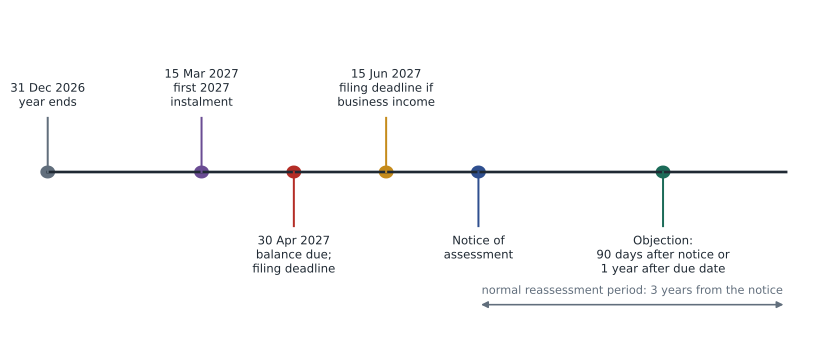
An individual's T1 return for 2026 is due on 30 April 2027. If the individual or their spouse or common-law partner carried on a business in 2026, other than one whose expenditures are mainly in tax shelters, the filing deadline is 15 June 2027, but any balance owing is still due on 30 April, so interest runs from that date. The return of a person who died in the year is due by the later of the normal date and six months after death. Most returns are filed electronically, and paid preparers who file more than a small number of returns must file electronically.
The late-filing penalty in subsection 162(1) is 5 per cent of the balance owing at the filing due date plus 1 per cent of that balance for each full month the return is late, up to 12 months. A taxpayer who was charged a late-filing penalty in any of the three previous years and who received a formal demand to file faces a doubled penalty: 10 per cent plus 2 per cent a month, up to 20 months. Interest on unpaid tax is compounded daily at the prescribed rate plus 4 percentage points, which was 7 per cent for the first quarter of 2026. Because the penalty is a percentage of the balance owing, a person who is owed a refund pays no penalty for filing late, but loses access to benefits and credits calculated from the return until it is filed.
Instalments
Employees have tax withheld from each paycheque, but income from business, rentals, investments and pensions often is not. To keep the payment system roughly current, section 156.1 requires an individual to pay quarterly instalments, on 15 March, 15 June, 15 September and 15 December, if their net tax owing (federal and provincial tax minus tax withheld at source) exceeds $3,000 in the current year and in either of the two preceding years ($1,800 for Quebec residents, who also pay Quebec instalments). There are three ways to calculate them: the no-calculation option, paying the amounts in the CRA's instalment reminders, which are based on the second preceding and the preceding years; the prior-year option, one quarter of the previous year's net tax owing each quarter; and the current-year option, one quarter of the estimated current year's net tax owing. Interest is charged on instalments that are late or insufficient under the method that produces the lowest requirement, and a further penalty applies if instalment interest exceeds $1,000. Taxpayers who use the CRA reminders are protected from instalment interest if they pay the reminder amounts on time.
Assessment and reassessment
After a return is filed, the CRA examines it, usually by automated matching against information slips and simple checks, and issues a notice of assessment. The notice starts the clock on two time limits. The normal reassessment period for an individual is three years from the date of the original notice of assessment (subsection 152(3.1)), during which the CRA can reassess for any reason. It is extended by three years for certain items, such as reassessments resulting from a carryback of losses, transactions with non-arm's length non-residents, and GAAR reassessments. The CRA can reassess at any time if the taxpayer made a misrepresentation attributable to neglect, carelessness or wilful default, or committed fraud, or if the taxpayer filed a waiver. A taxpayer can also ask the CRA to reassess within the normal period, and outside it the CRA may adjust to give a refund in some cases.
During an audit the CRA can require taxpayers and third parties to provide information and documents under section 231.2, and taxpayers must keep records and supporting documents for six years from the end of the year to which they relate. Many reviews are desk reviews of specific deductions or credits, such as child care, medical expenses or employment expenses, and are resolved by supplying receipts.
Objections and appeals
A taxpayer who disagrees with an assessment or reassessment files a notice of objection, generally within 90 days after the date of the notice or, for an individual, one year after the filing due date for the year, whichever is later. The objection goes to the CRA's Appeals Branch, which is separate from the auditors. For individuals, the CRA generally cannot take collection action on amounts under objection until 90 days after it confirms or varies the assessment, although interest continues to accrue, so many taxpayers pay the disputed amount to stop interest. If the objection is not resolved, the taxpayer can appeal to the Tax Court of Canada, either under the informal procedure for smaller amounts, where the taxpayer can appear without a lawyer and decisions do not set precedents, or under the general procedure. Appeals then lie to the Federal Court of Appeal and, with leave, the Supreme Court of Canada. The taxpayer generally bears the onus of disproving the facts the CRA assumed in making the assessment, except for penalties, where the CRA bears the onus.
Penalties for errors and evasion
Several penalties apply to errors in returns. Subsection 163(1) applies when a taxpayer fails to report income in a year and had also failed to report income in any of the three preceding years: the penalty is the lesser of 10 per cent of the unreported amount and 50 per cent of the difference between the understatement of tax and the tax withheld on it. Subsection 163(2) imposes a penalty of 50 per cent of the understated tax where a taxpayer knowingly, or in circumstances amounting to gross negligence, made a false statement or omission; gross negligence means a high degree of negligence tantamount to intentional acting or indifference as to whether the law is complied with. Tax evasion is a criminal offence under section 239. The Voluntary Disclosures Program, revised in 2025, gives relief from penalties and part of the interest to taxpayers who come forward to correct past non-compliance before the CRA contacts them, and the taxpayer relief provisions in subsection 220(3.1) let the CRA cancel penalties and interest for the previous ten years in cases of extraordinary circumstances, financial hardship or CRA error.
| Penalty | Provision | Amount |
|---|---|---|
| Late filing | s. 162(1) | 5% of balance owing + 1% per month, up to 12 months |
| Repeated late filing after demand | s. 162(2) | 10% + 2% per month, up to 20 months |
| Repeated failure to report income | s. 163(1) | Lesser of 10% of the unreported amount and 50% of the tax understatement net of withholding |
| False statement or omission (gross negligence) | s. 163(2) | 50% of the understated tax |
| GAAR transaction not disclosed | s. 245(5.1) | 25% of the tax benefit |
| Late or deficient instalments | s. 161, 163.1 | Interest; penalty if interest exceeds $1,000 |
| Tax evasion | s. 239 | Fines of 50% to 200% of tax evaded and up to 5 years in prison |
Capstone: Leah's 2026 federal return
The program below assembles Leah's 2026 federal computation. Each line comes from an earlier lesson: employment income from lesson 4, CPP from lesson 5, business income from lessons 6 and 7, rental income, interest and dividends from lesson 8, capital gains from lesson 9 and her RRSP deduction and donations from lesson 11. Tomás claims the child care deduction and the family's medical expenses on his own return.
# Capstone: Leah Brandt's 2026 federal return, simplified (illustrative)
inc = {"Employment income (T4)": 103_320, "Business income, Brandt Aerial (T2125)": 18_792,
       "Net rental income (T776)": 3_200, "Interest": 640,
       "Taxable eligible dividends (2,000 x 1.38)": 2_760,
       "Taxable capital gains (Schedule 3)": 6_200}
ded = {"RRSP deduction": 9_000, "CPP enhanced and CPP2 contributions": 711 + 416}
total_income = sum(inc.values())
net_income = total_income - sum(ded.values())
taxable = net_income
for k, v in inc.items():
    print(f"{k:<48}{v:>11,.2f}")
print(f"{'Total income (line 15000)':<48}{total_income:>11,.2f}")
for k, v in ded.items():
    print(f"  less {k:<42}{-v:>11,.2f}")
print(f"{'Net income = taxable income':<48}{net_income:>11,.2f}")

BRACKETS = [(58_523, 0.14), (117_045, 0.205), (181_440, 0.26), (258_482, 0.29), (float('inf'), 0.33)]
tax, lower = 0.0, 0.0
for upper, rate in BRACKETS:
    if taxable > lower:
        tax += (min(taxable, upper) - lower) * rate
    lower = upper
credits = 0.14 * (16_452 + 3_519.45 + 1_123.07 + 1_501)
donation = 0.14 * 200 + 0.29 * 1_000
dtc = 0.150198 * 2_760
basic = tax - credits - donation - dtc
print(f"{'Federal tax on taxable income':<48}{tax:>11,.2f}")
print(f"{'  less personal, CPP, EI, employment credits':<48}{-credits:>11,.2f}")
print(f"{'  less donation credit':<48}{-donation:>11,.2f}")
print(f"{'  less dividend tax credit':<48}{-dtc:>11,.2f}")
print(f"{'Basic federal tax':<48}{basic:>11,.2f}")
provincial = 13_400          # assumed for illustration; computed on form MB428
withheld = 28_900            # T4 box 22, federal and provincial combined (assumed)
balance = basic + provincial - withheld
print(f"{'Manitoba tax (assumed for illustration)':<48}{provincial:>11,.2f}")
print(f"{'Income tax deducted at source (T4)':<48}{-withheld:>11,.2f}")
print(f"{'Balance owing, due 30 April 2027':<48}{balance:>11,.2f}")
print("Instalments required for 2027 if net tax owing exceeds $3,000 in 2027 and in")
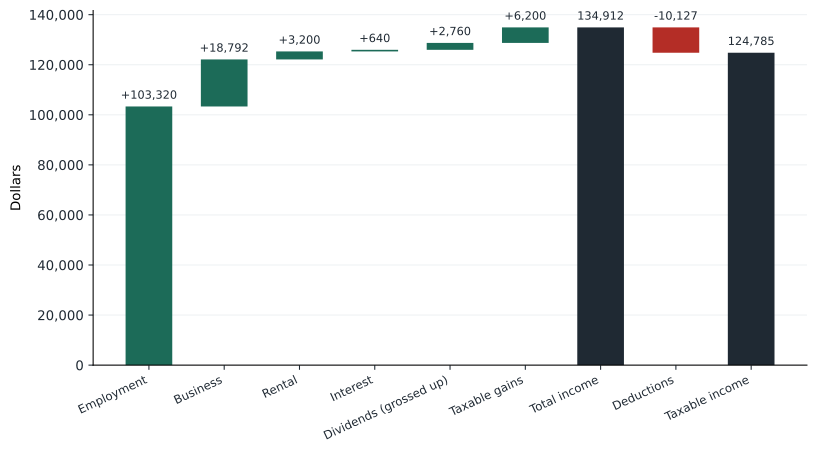
print("2026 or 2025.")Employment income (T4) 103,320.00 Business income, Brandt Aerial (T2125) 18,792.00 Net rental income (T776) 3,200.00 Interest 640.00 Taxable eligible dividends (2,000 x 1.38) 2,760.00 Taxable capital gains (Schedule 3) 6,200.00 Total income (line 15000) 134,912.00 less RRSP deduction -9,000.00 less CPP enhanced and CPP2 contributions -1,127.00 Net income = taxable income 124,785.00 Federal tax on taxable income 22,202.63 less personal, CPP, EI, employment credits -3,163.37 less donation credit -318.00 less dividend tax credit -414.55 Basic federal tax 18,306.71 Manitoba tax (assumed for illustration) 13,400.00 Income tax deducted at source (T4) -28,900.00 Balance owing, due 30 April 2027 2,806.71 Instalments required for 2027 if net tax owing exceeds $3,000 in 2027 and in 2026 or 2025.
Total income is $134,912 and net income, which is also taxable income, is $124,785, placing Leah in the 26 per cent federal bracket. Federal tax on that income is $22,202.63. Her non-refundable credits for the basic personal amount, base CPP, EI and the Canada employment amount are worth $3,163.37; the donation credit $318; and the dividend tax credit $414.55, leaving basic federal tax of $18,306.71. With provincial tax assumed at $13,400 for illustration and $28,900 of tax withheld by Red River, she owes $2,806.71, payable by 30 April 2027, although the return itself can be filed by 15 June because she has business income. Her net tax owing is just under $3,000, so she will not be required to pay instalments for 2027 on the basis of 2026; but if Brandt Aerial grows, she will cross the threshold and should expect instalment reminders.
| Item on Leah's return | Amount | Lesson |
|---|---|---|
| Employment income (salary, bonus, taxable benefits) | $103,320 | 4 |
| Enhanced CPP and CPP2 deduction | $1,127 | 5 |
| Business income after CCA of $6,318 | $18,792 | 6, 7 |
| Net rental income after $2,000 CCA | $3,200 | 8 |
| Interest; grossed-up eligible dividends | $640; $2,760 | 8 |
| Taxable capital gains | $6,200 | 9 |
| RRSP deduction | $9,000 | 11 |
| Credits: personal, CPP, EI, employment, donations, dividends | $3,895.92 in total | 3, 5, 8, 11 |
| Basic federal tax | $18,306.71 | 12 |
Reviewing the return and planning ahead
A good preparer does not stop at the bottom line. Reviewing Leah's return suggests several points for 2027. Her RRSP room of $17,200 is unused; another $5,000 contribution would save about $1,300 in federal tax at 26 per cent, plus provincial tax. Her rental condominium's CCA was deliberately limited; if she plans to sell it in a few years, keeping the UCC high reduces future recapture. Her capital gains were realized while she was in the 26 per cent bracket; the Bayline loss, deferred by the superficial loss rule, will reduce a future gain. Moving investment income to Tomás through a prescribed-rate loan could save a little each year. And if Brandt Aerial keeps growing, incorporation might become worth considering, a topic for ACCT-352. Each of these points is ordinary tax planning that uses provisions as Parliament intended.
Worked problem
Late filing and interest
Suppose Leah files her 2026 return on 20 September 2027 instead of 15 June, without having paid the $2,806.71 balance. What late-filing penalty applies, and from when does interest run?
Show solution
- Because she had business income, her filing due date is 15 June 2027, but the balance was due on 30 April.
- She is three full months late (15 June to 15 September): penalty = 5% × $2,806.71 + 3 × 1% × $2,806.71 = 8% × $2,806.71 = $224.54.
- Interest, compounded daily at the prescribed rate plus 4 per cent, runs on the $2,806.71 from 1 May 2027, and on the penalty from the date it is assessed.
- Filing on time, even without paying, would have avoided the penalty entirely.
Answer: A penalty of $224.54, plus interest from 1 May 2027.
Common mistakes
MistakeAssuming the 15 June deadline also applies to payment.
InsteadA self-employed person's balance is still due on 30 April.
MistakeMissing the objection deadline.
InsteadFile within 90 days of the notice or one year after the filing due date, whichever is later.
MistakeIgnoring instalment reminders because a refund is expected.
InsteadInstalment interest applies if net tax owing exceeds $3,000 and payments fall short under every method.
MistakeBelieving the CRA can never reassess after three years.
InsteadMisrepresentation through carelessness or fraud, waivers and several extended periods allow later reassessments.
MistakeFiling late when a refund is due and assuming nothing is lost.
InsteadNo penalty applies, but benefits and credits are delayed until the return is filed.
Summary and key terms
- T1 returns are due on 30 April; 15 June for the self-employed, but payment is still due on 30 April.
- The late-filing penalty is 5 per cent plus 1 per cent a month of the balance owing, up to 12 months.
- Instalments are required when net tax owing exceeds $3,000 in the current year and one of the two previous years.
- The normal reassessment period is three years from the notice of assessment, with extensions and no limit for misrepresentation or fraud.
- Objections go to the CRA Appeals Branch; appeals go to the Tax Court of Canada and higher courts.
- Gross negligence attracts a 50 per cent penalty; evasion is a crime.
- Leah's 2026 basic federal tax is $18,306.71; with assumed provincial tax she owes $2,806.71.
- Reviewing the finished return is the start of planning for the next year.
- Assessment notice (NOA)
- The CRA's statement of the tax assessed on a return, which starts the reassessment and objection periods.
- Normal reassessment period
- Three years from the original notice of assessment for an individual.
- Objection
- The formal dispute of an assessment, filed within the objection period.
- Instalments
- Quarterly prepayments of tax required when net tax owing exceeds $3,000.
- Gross negligence
- A high degree of negligence amounting to indifference to compliance, attracting the 50 per cent penalty.
- Voluntary Disclosures Program
- A CRA program giving relief to taxpayers who correct non-compliance before being contacted.
- Reasonable cause
- Circumstances beyond a taxpayer's control that excuse a penalty.
- Tax evasion
- A deliberate attempt to evade tax, a criminal offence.
Practice problems
Work each problem on paper first, then reveal the answer to check.
A return with a $10,000 balance owing is filed five months late. What is the penalty?
Show answer
5% + 5 × 1% = 10% of $10,000 = $1,000.
In the capstone program, add a $5,000 RRSP contribution. How does basic federal tax change?
Show answer
Taxable income falls by $5,000 at 26 per cent: basic federal tax falls by $1,300 to $17,006.71.
When does the normal reassessment period end for a notice of assessment dated 15 May 2027?
Show answer
15 May 2030.
What is the objection deadline for that notice, for an individual?
Show answer
The later of 13 August 2027 (90 days) and 30 April 2028 (one year after the due date of 30 April 2027).
Under what conditions must Leah pay instalments for 2027?
Show answer
If her net tax owing exceeds $3,000 in 2027 and also exceeded it in 2026 or 2025.
Who bears the onus of proof in a Tax Court appeal of a gross negligence penalty?
Show answer
The CRA.
What can the taxpayer relief provisions do?
Show answer
Cancel or waive penalties and interest for the previous ten years in extraordinary circumstances, hardship or CRA error.
Why might a taxpayer pay an amount under objection?
Show answer
To stop interest from accruing if the objection fails.
Name two planning points from the capstone review.
Show answer
For example using RRSP room, managing CCA on the condo, a prescribed-rate loan to Tomás, and considering incorporation.
How long must records be kept?
Show answer
Six years from the end of the year to which they relate.
Lesson quiz · 5 questions
Score 60% or more to complete this lesson.
Create a free account to save your progress, take quizzes and earn a certificate.