
ACCT-351 · Lesson 7 of 12 · 25 min
Business income II: capital cost allowance
A business that buys a drone, a computer or a building cannot deduct the cost in the year of purchase, because paragraph 18(1)(b) denies deductions for capital outlays. Nor can it deduct the depreciation recorded in its financial statements. Instead, paragraph 20(1)(a) allows a deduction for capital cost allowance (CCA), calculated under Part XI of the Income Tax Regulations at rates set by Parliament. CCA is the tax system's version of depreciation, but it differs in almost every detail: assets are pooled in classes, most classes use a declining balance method, the first-year claim follows special rules, the deduction is optional, and selling an asset can produce recapture or a terminal loss. This lesson works through the system using Brandt Aerial's 2026 asset purchases.
How the CCA system works
Each depreciable asset is assigned to a class listed in Schedule II of the Regulations, and all assets of the same class are pooled. The pool's balance is the undepreciated capital cost (UCC). Each year the UCC increases by the cost of additions, decreases by the lesser of the proceeds of disposition and the original cost of assets sold, and decreases by the CCA claimed. CCA for most classes is a fixed percentage of the UCC at year end, so the claim declines over time and the pool is never fully written off while assets remain. Property generally cannot be added to a class until it becomes available for use, a test in subsection 13(26) designed to stop taxpayers from claiming CCA on assets bought in December but not used until later.
| Class | Rate | Typical assets |
|---|---|---|
| 1 | 4% | Buildings acquired after 1987 (6% for non-residential buildings and 10% for manufacturing buildings in separate classes) |
| 8 | 20% | Furniture, equipment and machinery not in another class, including drones and cameras |
| 10 | 30% | Automobiles costing up to the class 10.1 limit, vans, trucks, general-purpose electronic equipment acquired before 2004 |
| 10.1 | 30% | Passenger vehicles costing more than $39,000 (2026), each in its own class, capital cost capped at $39,000 plus tax |
| 12 | 100% | Small tools and kitchen utensils under $500, application software, dental and medical instruments |
| 13 | Straight line | Leasehold improvements, over the lease term |
| 14.1 | 5% | Goodwill and other intangibles formerly called eligible capital property |
| 50 | 55% | Computer hardware and systems software |
| 54 | 30% | Zero-emission passenger vehicles, capital cost capped at $61,000 plus tax |
CCA is a maximum, not a requirement. A taxpayer can claim any amount from zero to the maximum for each class, and the unclaimed balance stays in the pool for future years. That flexibility is valuable: a taxpayer with a loss year, or one who expects to be in a higher bracket next year, can leave CCA unclaimed and use it later. The flexibility is limited in one important way for rental property: CCA cannot create or increase a loss from renting buildings (lesson 8).
The first year: half-year rule and accelerated investment incentive
Under the half-year rule in Regulation 1100(2), only half of the net additions to a class in a year (additions minus disposals) is included in the base for CCA in that year, so the first-year claim is half the normal amount. The rule exists for the same reason as accounting conventions: it assumes assets are bought evenly through the year. From late 2018, the accelerated investment incentive (AII) replaced the half-year rule for most property with an enhanced first-year allowance. For eligible property, the net addition is effectively increased by 50 per cent rather than reduced by 50 per cent, so the first-year claim is three times what the half-year rule would give. The AII was being phased out for property that became available for use after 2023, but Budget 2025 proposed reinstating it, and Bill C-15, which received royal assent on 26 March 2026, did so for eligible property that becomes available for use before 2030, with a phase-out after that. Immediate expensing is available for some property, such as zero-emission vehicles and manufacturing and processing equipment. The details depend on the class, the acquisition date and the available-for-use date, so check them for each asset.
Brandt Aerial's 2026 CCA schedule
At the start of 2026, Brandt Aerial's class 8 pool, holding drones and cameras bought in earlier years, had a UCC of $8,640. In March 2026 Leah bought a new inspection drone with a thermal camera for $9,000 and sold her oldest drone, which originally cost $6,000, for $2,500. In May she bought a laptop and storage array for $3,200, a class 50 addition. The program computes CCA under the AII and, for comparison, under the half-year rule.
# Brandt Aerial: capital cost allowance for 2026 (illustrative)
# Class 8 (20%): drones and cameras; class 50 (55%): computer hardware.
classes = {
    8:  {"rate": 0.20, "opening_ucc": 8_640, "additions": 9_000, "proceeds": 2_500},
    50: {"rate": 0.55, "opening_ucc": 0,     "additions": 3_200, "proceeds": 0},
}
print(f"{'class':>5}{'open UCC':>10}{'net add':>9}{'CCA (AII)':>11}{'CCA (half-yr)':>14}{'close UCC':>11}")
total_aii = total_hy = 0
for cls, c in classes.items():
    net_add = c["additions"] - c["proceeds"]        # proceeds capped at original cost
    base_aii = c["opening_ucc"] + net_add * 1.5     # enhanced allowance: +50% of net additions
    base_hy = c["opening_ucc"] + net_add * 0.5      # half-year rule: -50% of net additions
    cca_aii = round(c["rate"] * base_aii)
    cca_hy = round(c["rate"] * base_hy)
    close = c["opening_ucc"] + net_add - cca_aii
    total_aii += cca_aii; total_hy += cca_hy
    print(f"{cls:>5}{c['opening_ucc']:>10,}{net_add:>9,}{cca_aii:>11,}{cca_hy:>14,}{close:>11,}")
print(f"{'total':>5}{'':>19}{total_aii:>11,}{total_hy:>14,}")class open UCC net add CCA (AII) CCA (half-yr) close UCC
8 8,640 6,500 3,678 2,378 11,462
50 0 3,200 2,640 880 560
total 6,318 3,258For class 8, the net addition is $6,500: the new drone's cost of $9,000 minus the $2,500 proceeds of the old drone, which are below its original cost. Under the AII, the CCA base is the opening UCC of $8,640 plus 1.5 times the net addition, $18,390, and CCA at 20 per cent is $3,678. Under the half-year rule it would have been only $2,378. For class 50, the AII gives $2,640 in the first year, 82.5 per cent of the cost, against $880 under the half-year rule. Leah's total CCA for 2026 is $6,318, the amount used in lesson 6, and the classes carry forward with UCC balances of $11,462 and $560.
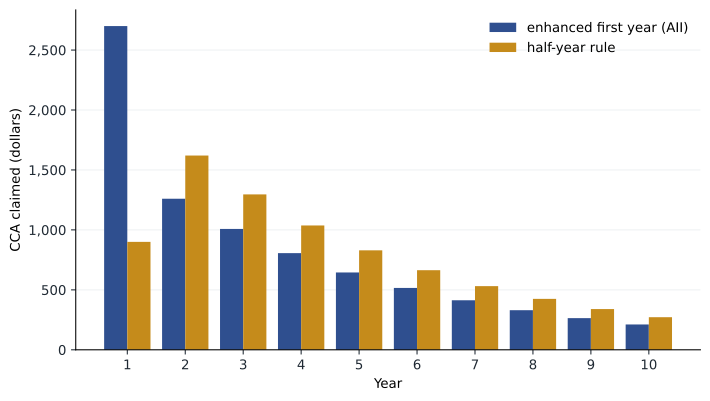
Is claiming the maximum always right? Not necessarily. CCA saves tax at Leah's marginal rate in the year claimed. Because her combined federal and Manitoba marginal rate is high and stable, and because a deduction now is worth more than the same deduction later, claiming the maximum makes sense for her. A taxpayer with a business loss, or in a very low bracket this year, might claim less and keep the UCC for later years.
Selling depreciable property: recapture and terminal loss
When an asset is sold, the UCC of its class is reduced by the lesser of the proceeds and the asset's capital cost. Three outcomes are possible. If the UCC is still positive and other assets remain in the class, nothing happens immediately: the remaining UCC continues to be claimed. If the class has no assets left and a positive balance remains, the balance is a terminal loss, fully deductible under subsection 20(16). If the reduction makes the UCC negative, the negative amount is recapture, included in income under subsection 13(1), because it shows that CCA claimed in earlier years exceeded the true decline in value. Any proceeds above the original cost are a capital gain, half taxable (lesson 9).
Suppose Leah closes the class 50 pool in 2027 by selling the laptop and storage array, her only class 50 assets, before claiming any 2027 CCA. The program shows the three possible outcomes.
# Disposing of the last asset in a class: recapture, terminal loss, capital gain
ucc_before_sale = 560          # class 50 UCC after the 2026 claim
cost = 3_200
for proceeds in [400, 900, 3_500]:
    deduct = min(proceeds, cost)                 # never more than original cost
    balance = ucc_before_sale - deduct
    recapture = max(0, -balance)
    terminal_loss = max(0, balance)              # only if the class is now empty
    capital_gain = max(0, proceeds - cost)
    print(f"proceeds {proceeds:>6,}: recapture {recapture:>6,}  terminal loss {terminal_loss:>5,}"
f" capital gain {capital_gain:>5,}")proceeds 400: recapture 0 terminal loss 160 capital gain 0 proceeds 900: recapture 340 terminal loss 0 capital gain 0 proceeds 3,500: recapture 2,640 terminal loss 0 capital gain 300
At proceeds of $400, the class is empty with $160 of UCC left, a terminal loss deductible in full. At $900, the deduction exceeds the $560 UCC by $340, which is recapture, fully taxable. At $3,500, the deduction is capped at the $3,200 original cost, producing recapture of $2,640 (all of the CCA claimed), and the $300 of proceeds above cost is a capital gain. The pooling system means that recapture and terminal losses usually arise only when a class is emptied, which is one reason many taxpayers keep classes open by holding at least one asset.
Worked problem
A passenger vehicle in class 10.1
A self-employed consultant buys a car for $52,000 including sales taxes on 1 April 2026 and uses it 70 per cent for business. Ignoring the tax component of the cap for simplicity, what is her maximum CCA for 2026, assuming the AII applies to the car?
Show solution
- The car costs more than $39,000, so it is class 10.1 and its capital cost is limited to $39,000.
- With the AII, the first-year base is 1.5 × $39,000 = $58,500; at 30 per cent, CCA is $17,550.
- Only the business share is deductible: 70% × $17,550 = $12,285.
- Class 10.1 cars are in separate classes, and there is no recapture or terminal loss when they are sold; instead half a year of CCA is allowed in the year of sale.
- Under the half-year rule instead, the claim would have been 70% × 30% × $19,500 = $4,095.
Answer: $12,285 of deductible CCA for 2026.
Other rules worth knowing
Several further rules matter in practice. Each rental building costing $50,000 or more goes in a separate class, so that recapture cannot be deferred by buying another building. Where an asset is used partly for personal purposes, only the business portion of CCA is deductible, and a change in use is treated as a disposition at fair market value. Short taxation years, such as the first year of a new business, prorate CCA by the number of days in the year. Since 2017, goodwill and other intangibles that used to be eligible capital property are in class 14.1 at 5 per cent. And CCA claimed on a principal residence's home office, or on a rental suite in a home, can jeopardize the principal residence exemption for that part (lesson 10), which is why most advisers recommend not claiming it.
Common mistakes
MistakeDeducting book depreciation on the tax return.
InsteadOnly CCA is deductible; add back depreciation.
MistakeReducing the class by the full proceeds when an asset sells for more than cost.
InsteadDeduct only the lesser of proceeds and capital cost; the excess is a capital gain.
MistakeClaiming a terminal loss while assets remain in the class.
InsteadTerminal losses arise only when the class is empty.
MistakePutting a $52,000 car in class 10 at full cost.
InsteadCars over the 2026 limit go in class 10.1 with cost capped at $39,000 plus tax.
MistakeAssuming the half-year rule always applies.
InsteadEligible property available for use before 2030 gets the enhanced first-year allowance reinstated in 2026; check each asset.
Summary and key terms
- Capital outlays are recovered through CCA, not accounting depreciation.
- Assets are pooled by class; each class uses a prescribed rate, usually declining balance.
- CCA is optional up to the maximum; unclaimed UCC carries forward.
- The half-year rule halves first-year additions; the reinstated accelerated investment incentive multiplies them by 1.5 for eligible property.
- Brandt Aerial claims $6,318 of CCA for 2026.
- Recapture arises when a class goes negative; a terminal loss when a class is emptied with UCC left.
- Proceeds above original cost produce a capital gain.
- Passenger vehicles over $39,000 go in class 10.1, each in a separate class with no recapture.
- Capital cost allowance (CCA)
- The deduction for the cost of depreciable property under paragraph 20(1)(a) and the Regulations.
- Undepreciated capital cost (UCC)
- The balance of a CCA class after additions, disposals and claims.
- Half-year rule
- The rule that includes only half of net additions in the first year's CCA base.
- Accelerated investment incentive
- An enhanced first-year allowance that adds 50 per cent of net additions to the CCA base for eligible property.
- Terminal loss
- The UCC remaining in a class after its last asset is disposed of, fully deductible.
- Available-for-use rule
- The rule that CCA cannot be claimed on property until it is available for use.
- Depreciable property
- Property used in a business or to earn income whose cost is recovered over time.
- Recapture
- Income that arises when depreciation deductions taken exceed the property's actual decline in value, revealed by a sale.
Practice problems
Work each problem on paper first, then reveal the answer to check.
A class 8 pool has a UCC of $10,000 and no additions. What is the maximum CCA?
Show answer
20% × $10,000 = $2,000.
In the CCA program, change the class 8 proceeds to $0. What is the new CCA under the AII?
Show answer
Net addition $9,000; base $8,640 + $13,500 = $22,140; CCA $4,428.
When does a terminal loss arise?
Show answer
When the last asset in a class is disposed of and a positive UCC balance remains.
A class has a UCC of $1,000 and its only asset, which cost $5,000, is sold for $6,500. What results?
Show answer
Deduct $5,000: recapture of $4,000, plus a capital gain of $1,500.
Why does the Act have an available-for-use rule?
Show answer
To prevent CCA claims on assets bought but not yet in use.
What is the 2026 capital cost limit for class 10.1?
Show answer
$39,000 plus sales tax.
Why might a taxpayer claim less than the maximum CCA?
Show answer
To save UCC for a year with higher income or to avoid wasting deductions in a loss year.
What happens when a class 10.1 car is sold?
Show answer
There is no recapture or terminal loss; half a year's CCA is allowed in the year of sale.
Which class holds goodwill acquired after 2016?
Show answer
Class 14.1, at 5 per cent.
In the disposal program, what proceeds would leave neither recapture nor a terminal loss?
Show answer
Exactly $560, the UCC before the sale.
Lesson quiz · 5 questions
Score 60% or more to complete this lesson.
Create a free account to save your progress, take quizzes and earn a certificate.