
ACCT-351 · Lesson 8 of 12 · 26 min
Investment and rental income: interest, dividends, passive activities and the kiddie tax
Investment income is the return on capital that the owner does not actively work to earn: interest on a bond, dividends on a share, rent from a building, royalties from a patent. The Code treats these differently from wages and business income in several ways. Qualified dividends get the same preferential rates as long-term capital gains; some interest is exempt; rental income is reported on Schedule E and is passive, so losses are restricted; a 3.8 percent surtax applies to the investment income of higher earners; and a child's unearned income above a small threshold is taxed at the parents' rate. This lesson covers each of these and adds the Brandts' interest, dividends and rental condominium to their 2026 picture.
Kinds of investment income
Section 61 includes interest, rents, royalties and dividends in gross income. For reporting and rate purposes, the categories that matter are taxable interest (Schedule B), tax-exempt interest (reported but not taxed), ordinary dividends, qualified dividends, capital gain distributions from mutual funds, rental and royalty income (Schedule E) and nondividend distributions, which are a return of capital that reduces the basis of the shares rather than income. The holding of investments is not a trade or business, so investment expenses are governed by section 212 rather than section 162, and since 2018, investment advisory fees and similar expenses are miscellaneous itemized deductions that are not deductible at all, a rule the 2025 act made permanent.
Interest
Interest is taxable when received by a cash-method individual, but for bonds issued at a discount, the original issue discount rules require the holder to include the discount in income as it accrues each year, even though nothing is paid until maturity. Interest on obligations of states and municipalities is excluded by section 103, although it counts in measuring how much Social Security is taxable and can be an AMT preference for some private activity bonds. Interest on US Treasury securities is federally taxable but exempt from state income tax. Interest on Series EE and I savings bonds can be deferred until redemption. Banks and brokers report interest on Form 1099-INT. Interest in IRAs, 401(k)s and HSAs is not taxed as earned (lesson 11).
Dividends: ordinary and qualified
Dividends are distributions from a corporation's earnings and profits. Ordinary dividends are taxed at regular rates, but qualified dividends are taxed at the long-term capital gain rates of 0, 15 or 20 percent. A dividend is qualified if it is paid by a domestic corporation or a qualified foreign corporation (one incorporated in a US possession, eligible for a comprehensive US income tax treaty, or whose shares trade on an established US market) and the shareholder held the shares for more than 60 days during the 121-day period beginning 60 days before the ex-dividend date. Dividends from money market funds, most REIT dividends and dividends on shares held only briefly are not qualified. REIT dividends that are not qualified may be eligible for the 20 percent section 199A deduction, which the 2025 act made permanent.
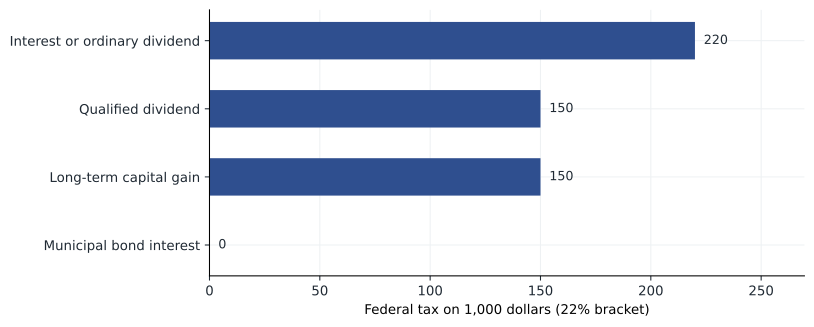
The program compares the federal tax on $1,000 received in different forms by the Brandts, who are in the 22 percent bracket, and then works through their rental condominium.
# Investment income: $1,000 of each kind for the Brandts (22% bracket), 2026
ordinary, preferred = 0.22, 0.15
print(f"{'$1,000 of':<34}{'federal tax':>12}")
for k, t in [("Interest (bank or corporate bond)", 1_000 * ordinary),
             ("Ordinary (nonqualified) dividend", 1_000 * ordinary),
             ("Qualified dividend", 1_000 * preferred),
             ("Long-term capital gain", 1_000 * preferred),
             ("Municipal bond interest", 0.0)]:
    print(f"{k:<34}{t:>12,.2f}")

# Rental condo: depreciation and the passive activity loss rules
rent = 21_600
costs = {"Mortgage interest": 7_400, "Property tax": 2_900, "HOA fees": 4_200,
         "Insurance": 650, "Repairs": 1_250}
depreciation = round(200_000 / 27.5)        # building basis, straight line, full year
net = rent - sum(costs.values()) - depreciation
magi = 159_459                              # modified AGI before the rental loss
allowance = max(0, 25_000 - 0.5 * max(0, magi - 100_000))
allowed = min(-net, allowance) if net < 0 else 0
print()
print(f"Net rental result {net:,} (depreciation {depreciation:,})")
print(f"Active participation allowance at MAGI {magi:,}: {allowance:,.0f}")
print(f"Loss allowed {allowed:,}; suspended and carried forward {-net - allowed:,}")$1,000 of federal tax Interest (bank or corporate bond) 220.00 Ordinary (nonqualified) dividend 220.00 Qualified dividend 150.00 Long-term capital gain 150.00 Municipal bond interest 0.00 Net rental result -2,073 (depreciation 7,273) Active participation allowance at MAGI 159,459: 0 Loss allowed 0; suspended and carried forward 2,073
Qualified dividends and long-term capital gains are taxed at 15 percent for the Brandts, against 22 percent for interest and ordinary dividends, and municipal bond interest is not taxed at all, which is why high-bracket investors often hold municipal bonds in taxable accounts. Comparing a municipal bond yielding 3.5 percent with a corporate bond yielding 4.5 percent, the after-tax corporate yield at a 22 percent rate is 3.51 percent, almost exactly the same; at 32 percent it is only 3.06 percent, so the municipal bond wins. The Brandts received $640 of taxable interest and $2,000 of qualified dividends in 2026.
Rental income and the passive activity rules
Rental income is reported on Schedule E: gross rents minus mortgage interest, property taxes, insurance, homeowners' association fees, repairs, management fees and depreciation of the building (27.5 years for residential property, lesson 7). Depreciation is not optional; the basis is reduced whether or not it is claimed. A property used partly as a personal residence is subject to section 280A: if it is rented for fewer than 15 days in the year, the rent is tax-free and no rental expenses are deducted; if personal use exceeds the greater of 14 days and 10 percent of the days rented, expenses are limited to rental income.
Section 469 limits losses from passive activities, which are trade or business activities in which the taxpayer does not materially participate and, with exceptions, all rental activities. Passive losses can offset only passive income; the excess is suspended and carried forward until there is passive income or the taxpayer disposes of the entire activity in a fully taxable transaction. Two exceptions matter most for individuals. An individual who actively participates in a rental real estate activity, for example by approving tenants and setting rents, may deduct up to $25,000 of rental losses against other income, but the allowance is reduced by half of modified AGI above $100,000 and is gone at $150,000. These thresholds have never been indexed. And a qualifying real estate professional, who spends more than 750 hours a year and more than half of their working time in real property businesses in which they materially participate, can treat rentals as non-passive.
The Brandts' condominium earned $21,600 of rent in 2026. After mortgage interest, taxes, fees, insurance and repairs of $16,400 and depreciation of $7,273, it shows a loss of $2,073. Leah actively participates, but the Brandts' modified AGI of about $159,459 exceeds $150,000, so the special allowance is zero. The loss is suspended and carried forward; it will be deductible in a future year when the Brandts have passive income or their income falls below the phase-out range, or when they sell the condominium. A short-term rental with an average stay of seven days or less is not a rental activity for these rules, a point that matters for owners of vacation rentals.
Investment interest and the net investment income tax
Interest on money borrowed to buy investments is investment interest under section 163(d). It is deductible only as an itemized deduction, and only up to net investment income: interest, ordinary dividends, royalties and short-term gains, minus investment expenses. Qualified dividends and long-term capital gains are excluded from net investment income unless the taxpayer elects to treat them as ordinary income, giving up the preferential rate on that amount. Disallowed investment interest carries forward indefinitely. Interest on personal debt, such as car loans and credit cards, is not deductible, with two exceptions: qualified home mortgage interest on up to $750,000 of acquisition debt (made permanent by the 2025 act), and, for 2025 through 2028, up to $10,000 of interest on a loan for a new personal-use vehicle assembled in the United States.
The net investment income tax in section 1411 adds 3.8 percent to the lesser of net investment income and the amount by which modified AGI exceeds $200,000 for single filers or $250,000 for joint filers. Net investment income includes interest, dividends, capital gains, rents, royalties and passive business income, but not wages, active business income, or distributions from retirement plans. The thresholds are not indexed, so more taxpayers pay the tax each year. The Brandts' modified AGI of about $159,459 is below $250,000, so they owe none.
Income shifting and the kiddie tax
Because the Brandts file jointly, shifting income between spouses does not change their tax. Shifting income to children or other relatives can, and two doctrines limit it. The assignment of income doctrine, from Lucas v. Earl (1930) and Helvering v. Horst (1940), taxes income to the person who earns it or owns the property that produces it: assigning a paycheck, or the interest coupons on a bond one keeps, does not shift the income. Giving away the property itself does shift future income, which is why parents give shares or savings to children. The kiddie tax in section 1(g) limits that technique: the unearned income of a child under 19, or under 24 if a full-time student, above a small indexed threshold ($2,700 for 2025) is taxed at the parents' marginal rate rather than the child's. Parents can sometimes elect to report a young child's interest and dividends on their own return.
Other techniques for shifting income to children use structures Congress has approved: custodial accounts under the Uniform Transfers to Minors Act (subject to the kiddie tax), 529 education savings plans, whose earnings are tax-free if used for qualified education costs, Roth IRAs for children with earned income, and, starting 2026, Trump accounts, tax-deferred accounts for children under 18 created by the 2025 act, with a $1,000 federal seed contribution for children born from 2025 through 2028. Paying a child reasonable wages for real work in a family business shifts earned income, which the kiddie tax does not reach.
| Technique | Does it shift income? | Why |
|---|---|---|
| Assigning wages to a child | No | Assignment of income doctrine: earned income is taxed to the earner |
| Gifting shares to an adult child | Yes, future dividends and gains | The child owns the property |
| Gifting shares to a 12-year-old | Partly | Unearned income above the threshold is taxed at the parents' rate |
| Paying a teenager reasonable wages in the family business | Yes | Earned income is not subject to the kiddie tax |
| Contributing to a 529 plan | Earnings become tax-free if used for education | Statutory exclusion |
For the Brandts, Nora is six, so any investment income from property given to her would be subject to the kiddie tax above the threshold. A 529 plan is the usual alternative for education savings: contributions are not deductible federally (Iowa and many other states allow a state deduction), but earnings are tax-free when used for qualified expenses, and the 2025 act broadened the list of qualified expenses for elementary and secondary education.
Worked problem
Investment interest
Suppose the Brandts borrow $20,000 on margin at 7 percent to buy dividend-paying shares, paying $1,400 of interest in 2026, and that they itemize. Their investment income is $640 of interest and $2,000 of qualified dividends. How much investment interest can they deduct?
Show solution
- Net investment income without an election is the $640 of interest; qualified dividends are excluded.
- Deductible investment interest: $640; the remaining $760 carries forward.
- If they elect to treat $760 of qualified dividends as ordinary income, net investment income becomes $1,400 and all the interest is deductible, but those dividends are taxed at 22 percent instead of 15.
- In fact the Brandts take the standard deduction (lesson 11), so the interest would give them no benefit at all.
Answer: $640 without the election, or $1,400 with it, but only if they itemize.
Common mistakes
MistakeTreating all dividends as qualified.
InsteadCheck the payer and the 60-day holding period; money market fund and most REIT dividends are not qualified.
MistakeSkipping depreciation on a rental to avoid recapture later.
InsteadDepreciation allowed or allowable reduces basis, so skipping it only loses the deduction.
MistakeDeducting a rental loss against wages at high income.
InsteadThe $25,000 allowance phases out completely at $150,000 of modified AGI; the loss is suspended.
MistakeAssigning a paycheck or bond coupons to a child.
InsteadIncome is taxed to the earner or the owner of the property.
MistakeIgnoring original issue discount on a zero-coupon bond.
InsteadOID is included as it accrues each year.
Summary and key terms
- Interest, dividends, rents and royalties are gross income; investment expenses are generally not deductible.
- Municipal bond interest is excluded; Treasury interest is exempt from state tax; OID accrues annually.
- Qualified dividends are taxed at 0, 15 or 20 percent if holding-period and payer tests are met.
- Rental activities are passive; the $25,000 active participation allowance phases out between $100,000 and $150,000 of modified AGI.
- The Brandts report $640 of interest and $2,000 of qualified dividends; their $2,073 rental loss is suspended.
- Investment interest is deductible up to net investment income; the NIIT adds 3.8 percent above $200,000 or $250,000 of MAGI.
- The assignment of income doctrine and the kiddie tax limit shifting income to family members.
- 529 plans, Trump accounts and reasonable wages are approved ways to direct income to children.
- Qualified dividend
- A dividend from a domestic or qualified foreign corporation, held for the required period, taxed at capital gain rates.
- Passive activity
- A business in which the taxpayer does not materially participate, or a rental activity.
- Active participation
- Participation in management decisions of a rental, such as approving tenants, needed for the $25,000 allowance.
- Net investment income tax (NIIT)
- A 3.8 percent tax on net investment income above MAGI thresholds.
- Kiddie tax
- The rule taxing a child's unearned income above a threshold at the parents' rate.
- Investment interest
- Interest on money borrowed to buy investments, deductible up to net investment income.
- Property income
- Income from owning property, such as interest, dividends, rent and royalties.
- Current expense
- A cost that maintains property and is deducted in the year incurred, as opposed to a capital improvement.
Practice problems
Work each problem on paper first, then reveal the answer to check.
Compute the federal tax on $1,000 of qualified dividends and of interest at the 22 percent bracket.
Show answer
$150 and $220.
In the rental program, change MAGI to $120,000. How much of the loss is allowed?
Show answer
The allowance is $15,000, so the whole $2,073 loss is allowed.
Why is the Brandts' rental loss suspended?
Show answer
Their modified AGI exceeds $150,000, so the active participation allowance is zero and they have no passive income.
Can a single filer with $260,000 of MAGI and $30,000 of net investment income owe the NIIT?
Show answer
Yes: 3.8% × the lesser of $30,000 and $60,000 = $1,140.
What does the kiddie tax do?
Show answer
It taxes a child's unearned income above a threshold at the parents' marginal rate.
Is replacing a broken furnace with a similar one a current or capital expense?
Show answer
Generally current, as a repair restoring the property; a much better system or a new addition would be capital.
Which case is the source of the assignment of income doctrine?
Show answer
Lucas v. Earl (1930).
When are suspended passive losses released?
Show answer
When there is passive income to absorb them or when the taxpayer disposes of the entire activity in a fully taxable sale.
Why might a high-bracket investor prefer a municipal bond at a lower yield?
Show answer
The interest is federally tax-exempt, so the after-tax yield can exceed a taxable bond's.
Are investment advisory fees deductible in 2026?
Show answer
No; they are miscellaneous itemized deductions, permanently disallowed.
Lesson quiz · 5 questions
Score 60% or more to complete this lesson.
Create a free account to save your progress, take quizzes and earn a certificate.