
ACCT-351 · Lesson 6 of 12 · 26 min
Business income: what counts and what is deductible
Leah's drone business is a small example of the most varied source of income in the Act. Business income is computed under subdivision b of Division B, mainly sections 9 to 37, together with the general limitations in sections 18, 67 and 67.1. The starting point is simple: income from a business is the profit from it, measured under ordinary commercial principles. Most of the complexity lies in three questions this lesson answers. Is there a business at all, or a hobby, an employment or a personal activity? Is a particular receipt or gain on income account, or a capital gain? And which expenses can be deducted, when, and how much? Lesson 7 takes up the special case of capital assets and capital cost allowance.
Is there a business?
Section 248 defines a business to include a profession, calling, trade, manufacture or undertaking of any kind, and an adventure or concern in the nature of trade. In Stewart v. Canada (2002), the Supreme Court of Canada set out a two-stage test. First, is the activity undertaken in pursuit of profit, or is it a personal endeavour? If the activity is clearly commercial and has no personal or hobby element, it is a source of income and the inquiry ends; the taxpayer's expectation of profit is not reassessed with hindsight. Only where there is a personal element, as with horse breeding, art, a cottage rented to family or, perhaps, drone photography, does the court ask whether the activity is carried on in a sufficiently commercial manner, looking at the taxpayer's profit and loss history, training, intended course of action and the capability of the venture to show a profit. A hobby is not a source, so its revenue is not taxed and its losses cannot be deducted.
Brandt Aerial passes easily. Leah holds a Transport Canada advanced pilot certificate, carries liability insurance, invoices commercial clients for roof and tower inspections, keeps separate books and has earned a profit in each of the last three years. A venture like this, run in a businesslike way, is a source of income even in a year when it loses money.
Business income or capital gain?
A gain on the sale of property can be business income, fully taxable, or a capital gain, half taxable. The distinction is one of the most litigated in Canadian tax law. A person who buys and sells property as part of a business, such as a dealer in real estate or securities, earns business income. A person who buys property to hold for investment or personal use and later sells it earns a capital gain. Between these lies the adventure or concern in the nature of trade: an isolated transaction entered into with the intention of reselling at a profit. The courts consider the taxpayer's intention at the time of purchase, including any secondary intention to sell if the primary plan failed, the nature of the property (a commodity that produces no income suggests trading), the period of ownership, the frequency of similar transactions, the work done to make the property more saleable and the relationship of the transaction to the taxpayer's ordinary business.
Since 1 January 2023, a residential property flipping rule in subsection 12(12) removes the uncertainty for one common case: a gain on the sale of a housing unit, or a right to acquire one, owned for less than 365 consecutive days is business income, unless the sale results from one of several life events such as death, a new job, separation, illness or the birth of a child. Gains on cryptocurrency held by people who trade frequently, and gains on shares bought for quick resale, raise the same questions; the CRA's position is that each case depends on its facts.
Measuring profit
Section 9 says that a taxpayer's income from a business is the taxpayer's profit from it. The Act does not define profit, so the courts have filled the gap. In Canderel Ltd. v. Canada (1998), the Supreme Court held that profit is determined by the method that gives an accurate picture of the taxpayer's profit for the year, consistent with the Act, established case law and well-accepted business principles. Generally accepted accounting principles are an interpretive aid but not binding. In practice, most businesses start from their accounting income and adjust for specific statutory rules. Income is computed on an accrual basis; section 12 explicitly includes amounts receivable for services rendered or goods sold in the year (paragraph 12(1)(b)) and amounts received for services to be rendered or goods to be delivered later (paragraph 12(1)(a)), for which a reasonable reserve can be deducted under paragraph 20(1)(m).
Individuals who carry on a business must use a fiscal period ending on 31 December, under section 249.1, unless they elect an alternative method under section 34.1 that requires them to estimate and include additional business income for the stub period. Inventory is valued at the lower of cost and fair market value under section 10, or at fair market value for all items. Professionals such as accountants and lawyers must now include work in progress in income; a long-standing election to exclude it was phased out between 2017 and 2023.
What can be deducted
Paragraph 18(1)(a) is the general limitation: an outlay is deductible only to the extent it was made or incurred for the purpose of gaining or producing income from the business. Paragraph 18(1)(b) denies deductions for capital outlays, which are recovered through capital cost allowance instead (lesson 7). Paragraph 18(1)(h) denies personal or living expenses. Section 67 adds that any deductible outlay is limited to an amount that is reasonable in the circumstances. Several specific rules sit on top of these.
| Rule | Provision | Effect |
|---|---|---|
| Meals and entertainment | s. 67.1 | Only 50 per cent deductible, with exceptions such as staff parties for all employees (up to six a year) |
| Home workspace | s. 18(12) | Deductible only if the principal place of business or used exclusively and regularly to meet clients; cannot create or increase a loss, excess carried forward |
| Fines and penalties | s. 67.6 | Fines and penalties imposed under a law are not deductible |
| Illegal payments | s. 67.5 | Bribes and similar payments are not deductible; illegal income is still taxable |
| Automobile costs | ss. 67.2, 67.3 | Interest limited to $350 a month and lease costs to $1,100 a month (plus tax) for 2026 contracts |
| Interest on borrowed money | s. 20(1)(c) | Deductible if the money is used to earn business or property income |
| Interest and penalties on income tax | s. 18(1)(t) | Not deductible |
| Prepaid expenses | s. 18(9) | Deducted in the year to which they relate |
| Life insurance premiums | s. 18(1)(a), (b) | Not deductible unless the policy is assigned as collateral for a business loan (s. 20(1)(e.2)) |
Two older cases still shape the general limits. In Symes v. Canada (1993), the Supreme Court held that child care costs of a self-employed lawyer were not business expenses, because Parliament had provided a separate, limited child care deduction in section 63; the case shows the courts reading the Act as a whole. In Imperial Oil Ltd. v. Canada (1947), damages paid after a collision were deductible because the risk arose from the ordinary operation of the business. The modern approach, from 65302 British Columbia Ltd. v. Canada (1999), is that an expense incurred for the purpose of earning income is deductible unless a specific provision denies it, which is why Parliament added the rule against deducting fines.
From accounting income to taxable business income
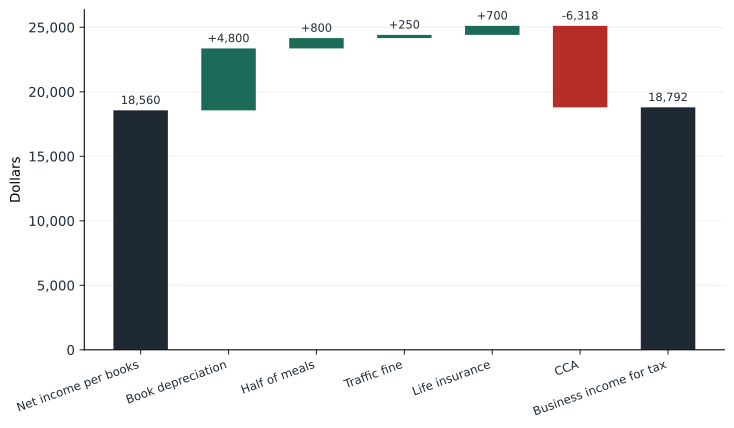
The program below takes Brandt Aerial's 2026 income statement, prepared on Leah's own accounting basis, and converts it to business income for tax on form T2125, Statement of Business or Professional Activities.
# Brandt Aerial: from accounting income to business income for tax, 2026 (illustrative)
revenue = 36_500
expenses = {"Depreciation (books)": 4_800, "Client meals": 1_600, "Insurance": 1_900,
            "Software subscriptions": 1_450, "Vehicle lease and operating (business share)": 4_300,
            "Home workspace (8% of home costs)": 1_440, "Traffic fine": 250,
            "Advertising": 600, "Pilot certificate training": 900,
            "Life insurance premium on Leah": 700}
book_income = revenue - sum(expenses.values())
add_backs = {"Depreciation (books)": 4_800,
             "Half of client meals (s. 67.1)": 0.5 * 1_600,
             "Traffic fine (s. 67.6)": 250,
             "Life insurance premium (s. 18(1)(a), (b))": 700}
cca = 6_318                                          # from the CCA schedule in lesson 7
home_costs, home_share = 18_000, 0.08
print(f"{'Revenue':<48}{revenue:>10,.2f}")
print(f"{'Expenses per books':<48}{-sum(expenses.values()):>10,.2f}")
print(f"{'Net income per books':<48}{book_income:>10,.2f}")
for k, v in add_backs.items():
    print(f"  add: {k:<42}{v:>10,.2f}")
print(f"  deduct: capital cost allowance{'':<16}{-cca:>10,.2f}")
taxable_business = book_income + sum(add_backs.values()) - cca
print(f"{'Business income for tax (T2125)':<48}{taxable_business:>10,.2f}")
income_before_home = taxable_business + home_costs * home_share
print(f"Income before the workspace claim {income_before_home:,.2f} exceeds the")
print(f"claim of {home_costs * home_share:,.2f}, so s. 18(12) does not restrict it")Revenue 36,500.00 Expenses per books -17,940.00 Net income per books 18,560.00 add: Depreciation (books) 4,800.00 add: Half of client meals (s. 67.1) 800.00 add: Traffic fine (s. 67.6) 250.00 add: Life insurance premium (s. 18(1)(a), (b)) 700.00 deduct: capital cost allowance -6,318.00 Business income for tax (T2125) 18,792.00 Income before the workspace claim 20,232.00 exceeds the claim of 1,440.00, so s. 18(12) does not restrict it
Leah's books show net income of $18,560. Four items need adjusting. Book depreciation of $4,800 is added back because the Act allows only capital cost allowance, which is deducted instead: $6,318 for 2026, worked out in lesson 7. Half of the client meals is added back under section 67.1. The traffic fine is added back under section 67.6. The premium on a life insurance policy on Leah's own life is added back because it is not an outlay to earn income, and the policy is not assigned to a lender. The vehicle lease and operating costs were recorded at the business share only, based on her logbook, and the home workspace costs are 8 per cent of her total home costs, the share of the house's floor area used exclusively as her office; both are deductible. Business income for tax is $18,792. Because the workspace claim is small relative to her income, section 18(12) does not restrict it.
Worked problem
A prepayment and a reserve
On 10 December 2026, a property management client pays Brandt Aerial $3,000 in advance for a package of six roof inspections to be done between April and September 2027. Leah's books record it as unearned revenue. How is it treated for tax?
Show solution
- Paragraph 12(1)(a) includes the $3,000 in income for 2026, because it was received for services to be rendered later.
- Paragraph 20(1)(m) allows a reasonable reserve for services that it is reasonably anticipated will have to be rendered after the year end: here, all six inspections.
- Leah deducts a $3,000 reserve for 2026, so the net effect is nil.
- In 2027 the reserve is added back under 12(1)(e), and the services are performed, so the income is taxed in 2027, matching her books.
Answer: Included under 12(1)(a) and offset by a 20(1)(m) reserve; taxed in 2027.
Reporting, losses and other obligations
A sole proprietor reports business income on form T2125 with the T1 return, which is due on 15 June, although any balance owing is due on 30 April. Business income is not subject to withholding, so self-employed people with significant income usually pay quarterly instalments (lesson 12). Self-employed individuals also pay both shares of CPP on net business income, computed on Schedule 8, unless their employment contributions already reached the maximum, as Leah's did. A business with taxable supplies over $30,000 in four consecutive calendar quarters must register for GST/HST and collect it from customers; ACCT-352 covers GST/HST.
When business expenses exceed business income, the loss reduces other income in the same year under paragraph 3(d), and any unused amount becomes a non-capital loss, which can be carried back three years and forward twenty under section 111. A taxpayer whose chief source of income is not farming faces a restricted farm loss limit on farm losses, a special rule that reflects the long history of hobby farms.
Common mistakes
MistakeAssuming every activity that loses money is a hobby.
InsteadUnder Stewart, a commercial activity with no personal element is a source of income even in a loss year.
MistakeDeducting accounting depreciation.
InsteadAdd back depreciation and deduct capital cost allowance instead.
MistakeDeducting the full cost of client meals.
InsteadSection 67.1 limits meals and entertainment to 50 per cent.
MistakeIgnoring the residential flipping rule on a condo sold after eight months.
InsteadGains on housing held less than 365 days are business income unless a life event applies.
MistakeUsing a home workspace claim to create a business loss.
InsteadSection 18(12) limits the claim to business income before it; the excess is carried forward.
Summary and key terms
- Under Stewart, a commercial activity is a source of income; only activities with a personal element need the commercial manner test.
- Gains on property bought for resale, including adventures in the nature of trade, are business income.
- Profit under section 9 follows well-accepted business principles, adjusted by the Act; accounting is a guide, not a rule.
- Section 18 denies outlays not made to earn income, capital outlays and personal expenses; section 67 requires reasonableness.
- Meals are 50 per cent deductible, fines are not deductible, and the home workspace claim cannot create a loss.
- Advance payments are included under 12(1)(a) and offset by a reserve under 20(1)(m).
- Brandt Aerial's 2026 business income for tax is $18,792.
- Business losses offset other income and carry back 3 and forward 20 years.
- Adventure or concern in the nature of trade
- An isolated transaction undertaken with the intention of reselling at a profit, taxed as business income.
- Secondary intention
- An intention, at the time of purchase, to sell at a profit if the primary purpose cannot be achieved.
- Reserve
- A deduction allowed by the Act for amounts included in income but not yet earned, such as under s. 20(1)(m).
- T2125
- The form on which an individual reports business or professional income.
- Commercial manner test
- The Stewart inquiry into whether an activity with a personal element is carried on commercially.
- Residential property flipping rule
- Section 12(12), which treats gains on housing held under 365 days as business income.
- Capital outlay
- An expenditure that brings an enduring benefit, recovered over time rather than deducted at once.
- Hobby
- An activity carried on mainly for pleasure rather than profit.
Practice problems
Work each problem on paper first, then reveal the answer to check.
What is the first question under the Stewart test?
Show answer
Whether the activity is undertaken in pursuit of profit or is a personal endeavour.
In the program, suppose the life insurance policy is assigned to Leah's bank as collateral for a business loan. What changes?
Show answer
A deduction under 20(1)(e.2) may be available for the lesser of the premium and the net cost of pure insurance, so the $700 add-back may fall away, increasing deductions and reducing business income.
Leah buys a condominium in March 2026 and sells it in November at a $40,000 gain. No life event applies. How is the gain taxed?
Show answer
As business income under the flipping rule in 12(12), fully taxable.
Name two items added back in converting Brandt Aerial's book income.
Show answer
For example, book depreciation, half of meals, the traffic fine and the life insurance premium.
Why was child care not a business expense in Symes?
Show answer
Parliament had provided a specific child care deduction in section 63, which governs.
What is the deadline for filing a T1 with business income, and when is the balance due?
Show answer
15 June; the balance is due 30 April.
Can a home workspace claim create a business loss?
Show answer
No; the excess is carried forward to the next year.
How long can a 2026 non-capital loss be carried forward?
Show answer
Twenty years; or back three.
Is income from an illegal business taxable?
Show answer
Yes; illegal income is taxable, although bribes and fines are not deductible.
A client prepays $3,000 for 2027 services. What does Leah include and deduct for 2026?
Show answer
Include $3,000 under 12(1)(a) and deduct a $3,000 reserve under 20(1)(m).
Lesson quiz · 5 questions
Score 60% or more to complete this lesson.
Create a free account to save your progress, take quizzes and earn a certificate.