
ACCT-351 · Lesson 4 of 12 · 26 min
Employment income: salary, benefits and allowances
For most Canadians, employment is the largest source of income, and subdivision a of Division B (sections 5 to 8) governs it. The rules are short but broad: an employee is taxed on salary, wages and other remuneration received in the year, plus the value of benefits of almost any kind received or enjoyed because of the employment. Deductions are tightly restricted. This lesson starts with the question that decides which rules apply, whether a worker is an employee or a self-employed contractor, then covers remuneration, taxable and non-taxable benefits, allowances, and the automobile benefit, the most heavily litigated benefit of all. Lesson 5 continues with stock options, the deductions an employee can claim and payroll contributions.
Employee or independent contractor?
The distinction between an employee, who has a contract of service, and an independent contractor, who has a contract for services, matters enormously. An employee is taxed under subdivision a, with income on a cash basis, few deductions and income tax, CPP and EI deducted at source. A self-employed contractor reports business income under subdivision b, can deduct reasonable expenses incurred to earn income, pays both the employee and employer shares of CPP, has no EI coverage unless they opt in, and must register for GST/HST once taxable supplies exceed $30,000 in four consecutive quarters. Payers who misclassify employees as contractors face assessments for unremitted source deductions.
The courts decide the question by looking at the whole relationship. In Wiebe Door Services Ltd. v. M.N.R. (1986), the Federal Court of Appeal identified four factors: control over the work, ownership of tools, chance of profit and risk of loss, and integration into the payer's business. In 671122 Ontario Ltd. v. Sagaz Industries Canada Inc. (2001), the Supreme Court of Canada framed the central question as whether the person is performing services as a person in business on their own account. Later cases, such as Royal Winnipeg Ballet v. M.N.R. (2006) and Connor Homes (2013), add that the parties' common intention is relevant when it is reflected in how they actually behave. No single factor decides; a worker who sets their own hours but uses the payer's equipment and has no chance of profit may still be an employee.
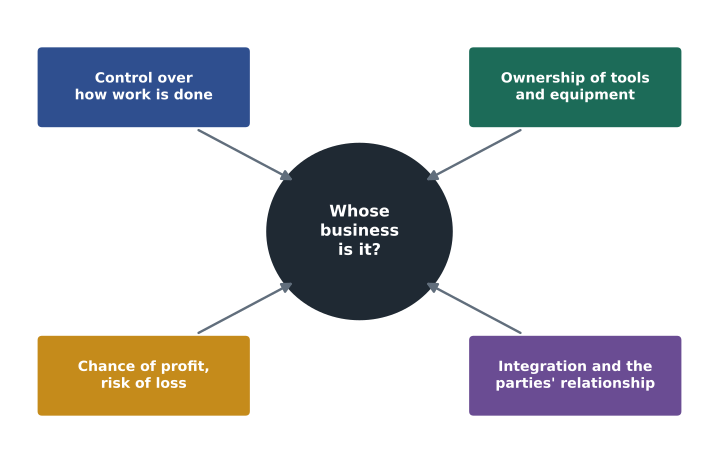
Leah's two activities show the distinction. At Red River she works the hours her manager sets, uses the company's equipment, is paid a salary with no chance of profit and does work that is integral to the company's business: she is an employee. Brandt Aerial is her own business: she owns the drones, chooses her clients, sets her prices and bears the risk of loss if a client does not pay or a drone crashes. The same person can have both kinds of income in the same year.
Salary, wages and other remuneration
Section 5 includes the salary, wages and other remuneration, including gratuities, received by the taxpayer in the year. Three words do a lot of work. "Remuneration" includes commissions, bonuses, vacation pay, overtime and tips, whether paid by the employer or by customers. "Received" means employment income is taxed on a cash basis: a bonus declared in December and paid in January belongs to the year of payment. And because only amounts received are taxed, the Act contains rules against deferring salary indefinitely: under the salary deferral arrangement rules in subsection 6(11), deferred amounts are taxed in the year earned unless the arrangement is one of the permitted exceptions, such as a registered pension plan or a bonus paid within three years after the end of the year in which it was earned.
Amounts received after employment ends are covered by other rules. A retiring allowance, which includes payments on retirement and damages for loss of employment such as a wrongful dismissal settlement, is income under subparagraph 56(1)(a)(ii) rather than section 5, and part of it may be transferred to an RRSP for years of service before 1996. Signing bonuses and payments to induce someone to accept employment are taxed under section 6(3), which also catches payments for agreeing not to compete.
Benefits: the general rule
Paragraph 6(1)(a) includes in income "the value of board, lodging and other benefits of any kind whatever received or enjoyed" by the taxpayer in the year in respect of, in the course of, or by virtue of an office or employment. The provision is deliberately broad. The courts ask whether the employee received an economic advantage, measurable in money, primarily for their own benefit rather than the employer's. In Lowe v. Canada (1996), an employee who accompanied clients on a trip where he worked most of the time was held not to have received a taxable benefit, because the trip was primarily for the employer's benefit. Benefits are valued at their fair market value, generally what the employee would have paid for the same thing in an arm's length transaction, and the employer reports them on the T4.
| Usually taxable (s. 6(1)(a) and specific rules) | Usually not taxable |
|---|---|
| Personal use of an employer-provided car (standby charge and operating benefit) | Employer contributions to a private health services plan, such as dental and drug coverage |
| Employer-paid premiums for group term life insurance (s. 6(4)) | Employer contributions to a registered pension plan or deferred profit sharing plan |
| Low-interest or interest-free employee loans (s. 80.4) | Training primarily for the employer's benefit, even if it leads to a credential |
| Cash and near-cash gifts, such as gift cards, of any amount | Non-cash gifts and awards up to $500 a year under CRA policy, plus a separate $500 long-service award every five years |
| Recreational club memberships, unless primarily for the employer's benefit | Discounts available to all employees that do not reduce the price below cost |
| Board and lodging, and rent-free or low-rent housing | Uniforms and protective clothing, and subsidized meals if the employee pays a reasonable charge |
| Employer-paid personal tuition unrelated to the job | Social events offered to all employees, within a reasonable cost per person |
Some benefits are excluded because the Act or CRA policy says so, rather than because they fail the economic advantage test. Employer contributions to a private health services plan, for example, are specifically excluded by subparagraph 6(1)(a)(i), although Quebec taxes them for provincial purposes. The CRA's policy on gifts and awards allows employers to give non-cash gifts worth up to $500 a year tax-free, but any cash or near-cash item, such as a gift card that can be used like cash, is fully taxable. These administrative concessions are worth knowing because employers rely on them in designing compensation.
Allowances and reimbursements
An allowance is an arbitrary amount paid to an employee for expenses without requiring receipts, such as $400 a month for a car. A reimbursement repays specific expenses the employee proves with receipts. The distinction matters because reimbursements of business expenses are not income, while paragraph 6(1)(b) taxes allowances unless an exception applies. The most important exceptions are reasonable allowances for the use of a motor vehicle in performing employment duties, if computed solely by reference to the kilometres driven for business, and reasonable travel allowances for employees who sell property or negotiate contracts. For 2026 the CRA considers per-kilometre allowances up to 73 cents for the first 5,000 business kilometres and 67 cents after that to be reasonable (4 cents more in the territories). A flat monthly car allowance is taxable, and so is an allowance that combines a flat amount with a per-kilometre rate for the same use.
The automobile benefit
When an employer makes a car available to an employee, the employee is taxed on two amounts. The standby charge in subsection 6(2) compensates for the fact that the car is available for personal use: it is 2 per cent of the car's cost, including sales taxes, for each month it is available, or two thirds of the lease cost if the employer leases it. If the employee uses the car more than 50 per cent for employment, the standby charge is reduced by the ratio of personal kilometres to 1,667 kilometres per month of availability. The operating expense benefit in paragraph 6(1)(k) covers fuel, insurance and maintenance paid by the employer for personal driving: 34 cents per personal kilometre for 2026, or, if business use exceeds 50 per cent and the employee notifies the employer in writing, half the standby charge. Commuting between home and a regular place of work is personal driving.
The program below computes Leah's employment income for 2026 and then the benefit for one of her colleagues, a sales manager with a company car.
# Employment income and an automobile benefit, 2026 (illustrative)
# Part 1: Leah's employment income for the year
items = {"Salary": 96_000, "Bonus paid in 2026": 6_000,
         "Group term life premiums paid by employer": 420,
         "Fitness club membership paid by employer": 900}
excluded = {"Per-km allowance, 2,400 km at $0.70": 2_400 * 0.70,
            "Employer-paid private health plan": 2_150}
for k, v in items.items():
    print(f"{k:<50}{v:>10,.2f}")
print(f"{'Employment income (T4 box 14)':<50}{sum(items.values()):>10,.2f}")
for k, v in excluded.items():
    print(f"  not taxable: {k:<37}{v:>10,.2f}")

# Part 2: a co-worker's company car (standby charge and operating benefit)
cost, months = 48_000, 12          # cost includes GST and PST
total_km, personal_km = 30_000, 12_000
standby = 0.02 * cost * months
if personal_km / total_km < 0.5:   # car used more than half for business
    limit = 1_667 * months         # 20,004 km for a full year
    standby *= min(1, personal_km / limit)
operating_per_km = 0.34 * personal_km
operating_half_standby = standby / 2   # election open when business use exceeds 50%
print()
print(f"Reduced standby charge                    {standby:>10,.2f}")
print(f"Operating benefit at 34 cents per km      {operating_per_km:>10,.2f}")
print(f"Operating benefit at half the standby     {operating_half_standby:>10,.2f}")
print(f"Total benefit (choosing the lower option) {standby + min(operating_per_km, operating_half_standby):>10,.2f}")Salary 96,000.00 Bonus paid in 2026 6,000.00 Group term life premiums paid by employer 420.00 Fitness club membership paid by employer 900.00 Employment income (T4 box 14) 103,320.00 not taxable: Per-km allowance, 2,400 km at $0.70 1,680.00 not taxable: Employer-paid private health plan 2,150.00 Reduced standby charge 6,910.62 Operating benefit at 34 cents per km 4,080.00 Operating benefit at half the standby 3,455.31 Total benefit (choosing the lower option) 10,365.93
Leah's employment income is $103,320: her salary and bonus plus two taxable benefits, the group term life premiums and the fitness club membership, which the CRA treats as primarily for her benefit because Red River offers it as a perk rather than requiring it for her work. The per-kilometre allowance she receives for driving to supplier sites is not income because it is reasonable and based solely on business kilometres, and the employer's contributions to the private health plan are excluded by the Act. Her colleague's car cost $48,000 and was driven 30,000 km, of which 12,000 were personal. Because business use exceeded 50 per cent, the standby charge of $11,520 is reduced to 12,000/20,004 of that amount, or $6,910.62. The operating benefit is the lower of $4,080 at 34 cents a kilometre and half the standby charge, $3,455.31, if the colleague elects; the total benefit is $10,365.93.
Worked problem
An employee loan
Red River lends an engineer $100,000 at 1 per cent interest on 1 January 2026 to help buy a home near a new plant. Assume the prescribed rate is 3 per cent for every quarter of 2026 and the employee pays the 1 per cent interest by 30 January 2027. What is the taxable benefit?
Show solution
- Section 80.4 computes the benefit as interest at the prescribed rate minus interest actually paid within 30 days after year end.
- Prescribed-rate interest: 3% × $100,000 = $3,000.
- Interest paid: 1% × $100,000 = $1,000.
- Taxable benefit: $2,000, included in employment income.
- For a home purchase loan, the prescribed rate in effect when the loan was made caps the rate used for five years, which protects the employee if rates rise.
Answer: A $2,000 taxable benefit for 2026.
Common mistakes
MistakeRelying on a contract that calls the worker a contractor.
InsteadThe courts look at the actual relationship: control, tools, profit and loss, and integration.
MistakeTaxing a reimbursement of business expenses as an allowance.
InsteadA reimbursement supported by receipts is not income; an arbitrary allowance generally is.
MistakeTreating gift cards as tax-free non-cash gifts.
InsteadCash and near-cash gifts are always taxable.
MistakeTreating commuting in a company car as business driving.
InsteadDriving between home and a regular workplace is personal.
MistakeReporting a December bonus paid in January in the year declared.
InsteadEmployment income is taxed when received.
Summary and key terms
- Whether a worker is an employee or self-employed depends on the whole relationship: control, tools, profit and loss, and integration.
- Section 5 taxes salary, wages and remuneration when received.
- Paragraph 6(1)(a) taxes benefits of any kind at fair market value, unless excluded by the Act or CRA policy.
- Private health plan premiums and pension contributions paid by the employer are not taxable benefits.
- Allowances are taxable unless they are reasonable per-kilometre car allowances or other listed exceptions; reimbursements are not income.
- The automobile benefit combines a standby charge of 2 per cent of cost per month with an operating benefit of 34 cents per personal kilometre for 2026.
- Low-interest employee loans create a benefit at the prescribed rate.
- Employers report income and benefits on the T4.
- Taxable benefit
- An economic advantage received because of employment and included in income under s. 6(1)(a).
- Allowance
- An arbitrary periodic amount paid for expenses without receipts.
- Standby charge
- The taxable benefit for the availability of an employer car for personal use under s. 6(2).
- Operating expense benefit
- The taxable benefit for employer-paid car operating costs for personal driving.
- Retiring allowance
- An amount received on retirement or for loss of employment, including wrongful dismissal damages.
- Salary deferral arrangement
- A plan to defer salary to a later year, generally taxed in the year earned unless an exception applies.
- Independent contractor
- A self-employed person who provides services under a contract for services and carries on business on their own account.
- Fair market value
- The price agreed between a willing buyer and a willing seller acting at arm's length.
Practice problems
Work each problem on paper first, then reveal the answer to check.
Name the four factors from Wiebe Door, or the three IRS categories of evidence.
Show answer
Control, ownership of tools, chance of profit and risk of loss, and integration.
A sales manager receives a $500 monthly car allowance. Is it taxable?
Show answer
Yes; it is not computed solely by reference to kilometres driven.
In the program, change the colleague's personal kilometres to 18,000. What happens?
Show answer
Personal use is now 60 per cent, so business use is not more than 50 per cent: the standby charge is not reduced ($11,520), the half-standby election is unavailable, and the operating benefit is $6,120.
Is a $300 gift card given at year end taxable?
Show answer
Yes; near-cash gifts are taxable whatever the amount.
Is the employer's payment of dental plan premiums a taxable benefit?
Show answer
No, federally; it is a private health services plan. Quebec taxes it provincially.
When is a signing bonus taxed, and under which provision?
Show answer
When received, under s. 6(3), as remuneration for entering into employment.
What is the 2026 operating benefit rate per personal kilometre?
Show answer
34 cents.
Why was the employee in Lowe not taxed on the trip?
Show answer
The trip was primarily for the employer's benefit; he worked most of the time.
Leah also invoices clients through Brandt Aerial. Why is that business income rather than employment income?
Show answer
She owns the equipment, chooses clients and prices, and bears the risk of profit and loss.
A loan of $60,000 at 0 per cent for a year, with a 3 per cent prescribed rate. What is the benefit?
Show answer
$1,800.
Lesson quiz · 5 questions
Score 60% or more to complete this lesson.
Create a free account to save your progress, take quizzes and earn a certificate.