
ACCT-351 · Lesson 9 of 12 · 26 min
Capital gains I: dispositions, adjusted cost base and losses
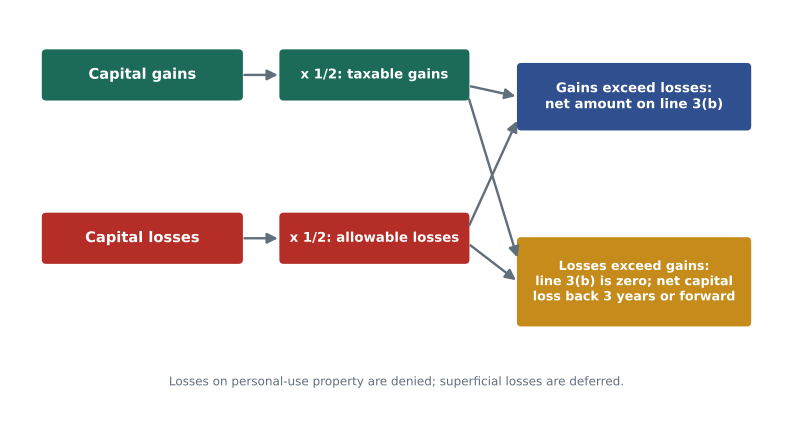
Canada did not tax capital gains at all until 1972. Since then, subdivision c of Division B (sections 38 to 55) has taxed them, but more lightly than other income: only half of a capital gain is included in income as a taxable capital gain, and only half of a capital loss is an allowable capital loss. This lesson covers the mechanics: what counts as a disposition, how proceeds and adjusted cost base are measured, how identical properties are averaged, how losses are restricted and carried over, and several anti-avoidance rules, including the superficial loss rule. Lesson 10 covers the principal residence exemption, deemed dispositions and the lifetime capital gains exemption.
Capital property and dispositions
A capital gain arises when a taxpayer disposes of capital property for proceeds that exceed its adjusted cost base (ACB) plus the outlays and expenses of disposition. Capital property is property whose gain or loss would be a capital gain or loss, which in practice means property held as an investment or for personal use, as opposed to inventory or property bought for resale (lesson 6). Depreciable property is capital property too, but, as lesson 7 showed, the CCA system deals with the part of the proceeds up to original cost; only proceeds above cost produce a capital gain.
A disposition, defined in section 248, includes any transaction or event entitling a taxpayer to proceeds of disposition: a sale, an exchange, the redemption or cancellation of a share or debt, the expropriation or destruction of property, and a gift. Several events are deemed dispositions even though nothing is received: emigration (lesson 2), death and a change in use of property (lesson 10). Proceeds of disposition include the sale price and, for a gift or a non-arm's length transfer, a deemed amount equal to fair market value under section 69. The ACB is generally the cost of the property, including acquisition costs such as commissions and legal fees, adjusted by section 53 for items such as reinvested distributions (added) and returns of capital (subtracted). If the ACB of a share or fund unit becomes negative because of returns of capital, the negative amount is a capital gain at that time.
The inclusion rate
Section 38 sets the inclusion rate at one half. The rate has changed several times: it was one half when capital gains taxation began in 1972, two thirds from 1988, three quarters from 1990 to February 2000, then two thirds again briefly, and one half since 18 October 2000. In the 2024 budget the government proposed raising the inclusion rate to two thirds for gains realized by individuals above $250,000 a year, and by all corporations and trusts, from 25 June 2024. The proposal was never enacted: the effective date was deferred to 2026 in January 2025, and on 21 March 2025 the government announced that the increase was cancelled. For 2026 the inclusion rate is one half for all taxpayers.
The low inclusion rate is justified on several grounds: part of a nominal gain merely reflects inflation; corporate profits behind share gains have already borne corporate tax; and taxing gains fully would discourage investment and lock investors into assets they would otherwise sell. Critics respond that the preference mainly benefits high-income taxpayers and invites efforts to convert ordinary income into capital gains, which is why the line between business income and capital gains (lesson 6) is so heavily contested.
Identical properties and the average cost rule
When a taxpayer owns several identical properties, such as shares of the same class of the same corporation or units of the same fund, bought at different times and prices, section 47 requires the ACB of each one to be the average cost of all of them. Each purchase recalculates the average; sales do not change it. Investors cannot choose to sell their highest-cost shares first, as they can in some countries. Brokers' reports often do not track ACB correctly, especially when shares are held in more than one account or when distributions are reinvested, so taxpayers must keep their own records.
The program below computes Leah's 2026 capital gains. She owns 500 shares of Maple Grid Corp., an invented Canadian public company, bought in two lots, and sells 400 of them. She also sells units of an index ETF at a gain and sells shares of Bayline Energy at a loss, but buys them back within the month.
# Leah's 2026 dispositions: average cost, a superficial loss and netting (illustrative)
purchases = [(2019, 300, 40.00, 15), (2021, 200, 55.00, 15)]   # year, shares, price, commission
shares = sum(p[1] for p in purchases)
acb_total = sum(n * px + fee for _, n, px, fee in purchases)
acb_per = acb_total / shares
sold, price, fee = 400, 68.00, 20
proceeds = sold * price
gain_maple = proceeds - fee - sold * acb_per
print(f"Maple Grid: {shares} shares, total ACB {acb_total:,.2f}, average {acb_per:.4f}")
print(f"  sold {sold} at {price:.2f}: proceeds {proceeds:,.2f}, outlays {fee}, "
      f"ACB {sold * acb_per:,.2f}, gain {gain_maple:,.2f}")
print(f"  ACB of the 100 shares left: {(shares - sold) * acb_per:,.2f}")

# ETF units sold at a gain
gain_etf = 3_644.00
# Bayline Energy: sold at a loss and repurchased within 30 days
loss, repurchased = -1_500.00, True
denied = -loss if repurchased else 0
print(f"Bayline loss {loss:,.2f} is superficial: denied {denied:,.2f}, added to ACB of new shares")

total_gain = gain_maple + gain_etf + (loss + denied)
print()
print(f"Net capital gains for 2026          {total_gain:>10,.2f}")
print(f"Taxable capital gains (1/2) {total_gain / 2:>10,.2f}")Maple Grid: 500 shares, total ACB 23,030.00, average 46.0600 sold 400 at 68.00: proceeds 27,200.00, outlays 20, ACB 18,424.00, gain 8,756.00 ACB of the 100 shares left: 4,606.00 Bayline loss -1,500.00 is superficial: denied 1,500.00, added to ACB of new shares Net capital gains for 2026 12,400.00 Taxable capital gains (1/2) 6,200.00
The 500 Maple Grid shares cost $23,030 in total, including commissions, an average of $46.06 each. Selling 400 at $68 produces proceeds of $27,200, minus a $20 commission, and an ACB of $18,424, for a gain of $8,756. The remaining 100 shares keep the $46.06 average. With the ETF gain of $3,644, her net capital gains are $12,400 and her taxable capital gains $6,200, reported on Schedule 3 and carried into her return in lesson 12. The Bayline loss of $1,500 is a superficial loss and is denied, as explained below.
Capital losses
Allowable capital losses can be deducted only against taxable capital gains, under paragraph 3(b) (lesson 3). If a taxpayer's allowable capital losses exceed taxable capital gains for the year, the excess is a net capital loss, which can be carried back three years or forward indefinitely and deducted under paragraph 111(1)(b) against taxable capital gains of those years. When a net capital loss is carried to a year with a different inclusion rate, it is adjusted to that year's rate. In the year of death and the preceding year, net capital losses can be deducted against any income, to the extent they exceed capital gains exemptions previously claimed.
Losses on personal-use property, such as a car, a boat or furniture, are not deductible at all, because declines in their value usually reflect personal consumption. To save record keeping, the ACB and the proceeds of personal-use property are each deemed to be at least $1,000. Listed personal property, a subset that tends to appreciate, consisting of art, jewellery, rare books, stamps and coins, is treated differently: gains are taxable, and losses can be deducted, but only against gains from listed personal property, with a three-year carryback and seven-year carryforward. Business investment losses, losses on shares or debt of a small business corporation, are a special favourable case: half of such a loss is an allowable business investment loss, deductible against any income.
The superficial loss rule and other loss restrictions
Without a special rule, an investor could sell shares at a loss near year end to claim the loss, then immediately buy them back, keeping the same investment. The superficial loss rule prevents this. A loss is superficial, and denied, if the taxpayer or an affiliated person acquires the same or identical property in the period beginning 30 days before and ending 30 days after the disposition, and still owns it at the end of that period. Affiliated persons include a spouse or common-law partner and corporations they control; the CRA also treats purchases in the taxpayer's own RRSP or TFSA as caught. The denied loss is added to the ACB of the substituted property, so it is deferred rather than lost, except where the substitute is held in a registered plan, where the loss is effectively lost forever. Selling property directly to one's own RRSP or TFSA at a loss is also denied permanently under subparagraph 40(2)(g)(iv).
Leah sold 100 Bayline Energy shares for a $1,500 loss on 18 November 2026 and, worried about missing a rebound, bought 100 again on 2 December. She still owns them on 18 December. The loss is superficial; her new shares' ACB is their cost plus $1,500. Had she waited 31 days, or bought a different energy company's shares, the loss would have been allowed. Tax-loss selling, realizing losses to offset gains, is legitimate planning; the rules simply require the taxpayer to give up the investment for 30 days or substitute a property that is not identical.
| Rule | Provision | Effect |
|---|---|---|
| Superficial loss | s. 54, 40(2)(g)(i) | Loss denied and added to ACB of substituted property |
| Loss on personal-use property | s. 40(2)(g)(iii) | Denied; $1,000 minimum ACB and proceeds |
| Listed personal property | s. 41 | Losses only against LPP gains; carryback 3, forward 7 years |
| Transfer to own RRSP or TFSA at a loss | s. 40(2)(g)(iv) | Loss denied permanently |
| Net capital loss | s. 111(1)(b) | Carryback 3 years, forward indefinitely, against taxable capital gains |
| Allowable business investment loss | s. 39(1)(c), 38(c) | Half of a loss on small business corporation shares or debt, deductible against any income |
Reserves and other timing rules
When a taxpayer sells capital property and does not receive all of the proceeds in the year of sale, subparagraph 40(1)(a)(iii) allows a reserve for proceeds not yet due, so that the gain is spread over the years payments are received. The reserve is limited so that at least one fifth of the gain is recognized each year, cumulatively: the whole gain must be included by the fourth year after the sale. A ten-year reserve is available for transfers of family farm or fishing property and small business shares to a child. Two other timing rules are worth knowing. Canadian securities owned by a taxpayer who is not a trader or dealer can be designated as capital property for life under subsection 39(4), which removes any argument that gains on them are business income. And foreign exchange gains and losses on personal transactions are taxed as capital gains, with the first $200 of net gain or loss each year ignored.
Worked problem
A capital gains reserve
Tomás sells a vacant lot he owned as an investment in 2026 for $120,000. Its ACB is $60,000 and his legal and real estate costs are $4,000. The buyer pays $30,000 on closing and $30,000 at the end of each of the next three years. What is the minimum capital gain Tomás must report in 2026 and in each later year?
Show solution
- Gain: $120,000 − $60,000 − $4,000 = $56,000.
- The reserve is the lesser of the gain × proceeds not yet due / total proceeds = $56,000 × 90/120 = $42,000, and 4/5 of the gain in the year of sale = $44,800.
- Reserve for 2026: $42,000, so the gain recognized is $14,000 (taxable $7,000).
- 2027: reserve is the lesser of $56,000 × 60/120 = $28,000 and 3/5 × $56,000 = $33,600, so $28,000; gain recognized is $42,000 − $28,000 = $14,000.
- The same pattern recognizes $14,000 in 2028 and $14,000 in 2029, matching the cash received.
Answer: $14,000 of capital gain ($7,000 taxable) in each of 2026 to 2029.
Common mistakes
MistakeUsing the cost of the specific shares sold.
InsteadSection 47 requires average cost for identical properties.
MistakeDeducting a net capital loss against employment income.
InsteadNet capital losses offset only taxable capital gains (except in the year of death).
MistakeSelling at a loss and repurchasing in a spouse's account the next week.
InsteadA spouse is affiliated, so the loss is superficial.
MistakeClaiming a loss on the sale of a personal car.
InsteadLosses on personal-use property are denied.
MistakeAssuming the two-thirds inclusion rate applies to large gains.
InsteadThe increase was cancelled in March 2025; the rate is one half.
Summary and key terms
- A capital gain is proceeds minus ACB minus outlays; half is a taxable capital gain.
- Dispositions include sales, gifts and deemed dispositions on death, emigration and change of use.
- The inclusion rate remains one half for 2026; the proposed increase was cancelled.
- Identical properties are averaged under section 47.
- Leah's 2026 net capital gains are $12,400, giving taxable capital gains of $6,200.
- Allowable capital losses offset only taxable capital gains; net capital losses carry back 3 years and forward indefinitely.
- Superficial losses are denied when identical property is reacquired within 30 days by the taxpayer or an affiliated person.
- A reserve spreads a gain over up to five years when proceeds are received later.
- Adjusted cost base (ACB)
- The cost of capital property, adjusted under section 53.
- Taxable capital gain
- The included half of a capital gain.
- Allowable capital loss
- The deductible half of a capital loss.
- Superficial loss
- A loss denied because identical property was acquired within 30 days by the taxpayer or an affiliated person.
- Personal-use property
- Property owned mainly for personal use, whose losses are not deductible.
- Listed personal property
- Art, jewellery, rare books, stamps and coins, whose losses offset only gains on such property.
- Capital loss
- A loss on the disposition of capital property.
- Proceeds of disposition
- The amount received or deemed received on a disposition.
Practice problems
Work each problem on paper first, then reveal the answer to check.
Shares bought: 100 at $10 and 300 at $14. What is the ACB per share?
Show answer
($1,000 + $4,200) / 400 = $13.00.
In the program, change the Maple Grid sale price to $45. What happens?
Show answer
Proceeds $18,000 less $20 less ACB $18,424 gives a loss of $444; net gains become $3,200 and taxable gains $1,600.
What happens to a net capital loss in the year of death?
Show answer
It can be deducted against any income in the year of death or the preceding year, net of capital gains exemptions claimed.
Leah sells shares at a loss on 1 December and buys them back on 5 January. Is the loss superficial?
Show answer
No; 5 January is more than 30 days after 1 December.
A painting bought for $600 is sold for $900. What is the gain?
Show answer
ACB and proceeds are each deemed $1,000, so the gain is nil.
What is the minimum fraction of a gain that must be recognized each year under the reserve rules?
Show answer
One fifth cumulatively each year, so the whole gain by the fourth year after the sale.
Why does a negative ACB produce a gain?
Show answer
Returns of capital have exceeded cost, so the excess is treated as a capital gain.
Why was the proposed inclusion rate increase never applied?
Show answer
It was deferred in January 2025 and cancelled on 21 March 2025.
Name two kinds of listed personal property.
Show answer
For example jewellery, art, rare books, stamps and coins.
What does a 39(4) election do?
Show answer
It deems all Canadian securities the taxpayer owns to be capital property, so gains are capital gains.
Lesson quiz · 5 questions
Score 60% or more to complete this lesson.
Create a free account to save your progress, take quizzes and earn a certificate.