
ACCT-351 · Lesson 3 of 12 · 24 min
Computing income, taxable income and tax
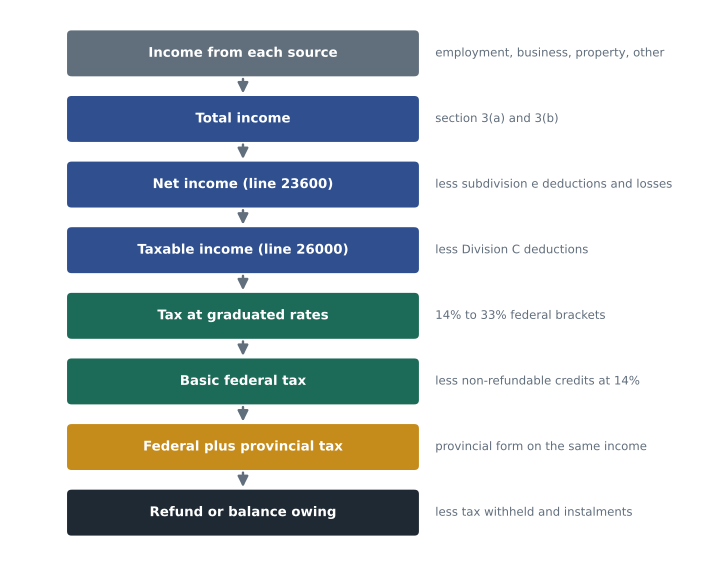
Every individual's federal tax is computed through the same sequence of steps, set out in the structure of the Income Tax Act. First, income is computed source by source and combined under the rules of section 3 to give net income. Second, a few deductions are subtracted to reach taxable income. Third, tax is calculated on taxable income at the graduated rates. Fourth, non-refundable credits reduce that tax, and refundable credits and amounts already paid determine the refund or balance owing. This lesson walks through that structure before the following lessons look at each kind of income in detail. If you understand the structure, you will always know where a new item belongs and what it is worth.
Income from a source
Canadian income tax law has its roots in the British idea that income comes from a source: an office or employment, a business, a property or certain other listed sources. Section 3 says that a taxpayer's income for the year includes income from each source "inside or outside Canada". A receipt that has no source is not income. That is why gifts, inheritances, lottery winnings, most windfalls and the proceeds of a life insurance policy on someone's death are not taxed, and why a hobby that never had a reasonable expectation of profit is not a business. Subdivision d of Division B adds specific items that might otherwise escape, such as pension benefits, retiring allowances, Employment Insurance benefits, spousal support received and scholarships above an exemption, while section 81 lists exempt amounts.
Income is computed for the calendar year, which is the taxation year for every individual. The timing rules depend on the source. Employment income is taxed when received, so a bonus declared in December 2026 but paid in January 2027 is 2027 income. Business and property income is generally computed on an accrual basis using profit determined by well-accepted business principles, adjusted by the Act. Capital gains are recognized when property is disposed of. These differences create planning opportunities and traps, which later lessons explore.
Section 3: putting the sources together
Section 3 combines the sources in a specific order, and the order matters because it limits how losses can be used.
| Paragraph | What it does | Effect |
|---|---|---|
| 3(a) | Adds income from every office, employment, business and property, plus other income in subdivision d | Losses from these sources are not deducted here |
| 3(b) | Adds taxable capital gains minus allowable capital losses (other than from listed personal property, which has its own rule) | Cannot be negative: excess allowable capital losses become a net capital loss for other years |
| 3(c) | Subtracts subdivision e deductions, such as RRSP contributions, child care, moving expenses and support paid | The result cannot be negative |
| 3(d) | Subtracts losses from offices, employment, businesses and property, and allowable business investment losses | If the result would be negative, net income is nil and the unused loss is a non-capital loss |
The 3(b) rule is the one students forget. Capital losses can only reduce capital gains. If Sam has $4,000 of taxable capital gains and $6,000 of allowable capital losses, line 3(b) is zero, not minus $2,000, and the $2,000 excess becomes a net capital loss that can be carried back three years or forward indefinitely to reduce taxable capital gains in those years. Business losses, by contrast, can reduce any kind of income in the year they arise, through paragraph 3(d), and any unused excess becomes a non-capital loss that can be carried back three years or forward twenty.
From net income to taxable income
Division C allows a short list of deductions from net income to reach taxable income. The main ones are losses of other years (section 111), the security options deduction for employee stock options (paragraphs 110(1)(d) and (d.1), lesson 5), the lifetime capital gains exemption (section 110.6, lesson 10), the northern residents deduction, and offsetting deductions for social assistance and workers' compensation payments, which are included in net income so that they count when income-tested benefits are calculated but then deducted so that they are not taxed. Why does the Act distinguish net income from taxable income? Because net income is the measure used for income-tested credits and benefits, such as the medical expense threshold, the Canada child benefit and the Old Age Security recovery tax. Division C deductions reduce tax but do not make a person appear poorer for those programs.
Losses carried forward are applied in Division C, which is why they do not reduce net income. The taxpayer chooses the order and amount of loss claims, within limits, and generally applies losses that will expire first.
Computing tax: rates and credits
Tax is computed on taxable income using the brackets from lesson 1. The result is then reduced by non-refundable tax credits, which are calculated by multiplying a credit base by the lowest federal rate, 14 per cent for 2026. The main credit bases are the basic personal amount, the spouse or eligible dependant amount, the age amount, the pension amount, the Canada employment amount, CPP and EI contributions, disability, tuition, medical expenses and donations. Non-refundable credits can reduce tax to zero but cannot create a refund, and most unused credits are lost. Refundable credits, such as the Canada workers benefit and the refundable medical expense supplement, are paid even if no tax is owed. The dividend tax credit and the foreign tax credit are also non-refundable reductions of tax.
The 14 per cent rate for credits is deliberate. Because every taxpayer gets credits at the same rate, a $1,000 credit base is worth $140 to everyone, while a $1,000 deduction is worth $140 to someone in the lowest bracket and $330 to someone in the top bracket. Parliament converted most personal exemptions from deductions to credits in 1988 for exactly this reason. When the lowest rate fell to 14 per cent, credits fell in value too; to protect taxpayers whose credit amounts exceed the first bracket threshold of $58,523, which mainly happens with large medical or tuition claims, a temporary top-up tax credit for 2025 to 2030 keeps the 15 per cent value on the excess. Provincial and territorial tax is then calculated on the same taxable income at provincial rates with provincial credits, on a separate form (for example, form MB428 for Manitoba). Quebec residents receive a 16.5 per cent federal abatement because Quebec funds certain programs itself.
Putting it together: a worked computation
The program below follows Sam Whitford, an invented employee with a side business that lost money in 2026 and a mix of capital gains and losses. It applies the section 3 ordering, then computes federal tax and the main credits.
# Section 3 ordering, taxable income and federal tax, 2026 (illustrative)
# Sam Whitford (invented): employee with a side business that lost money.
employment = 72_000
business_loss = 9_000
taxable_capital_gains = 4_000      # half of a 8,000 gain
allowable_capital_losses = 6_000   # half of a 12,000 loss
rrsp_deduction = 5_000             # a subdivision e deduction
cpp_enhanced = 0.01 * (min(employment, 74_600) - 3_500)   # deductible part of CPP

s3a = employment                                         # income from offices, employment, business, property
s3b = max(0, taxable_capital_gains - allowable_capital_losses)
s3c = max(0, s3a + s3b - rrsp_deduction - cpp_enhanced)
net_income = max(0, s3c - business_loss)                 # s. 3(d)
net_capital_loss = max(0, allowable_capital_losses - taxable_capital_gains)

print(f"3(a) income from non-capital sources    {s3a:>10,.2f}")
print(f"3(b) TCG less ACL (not below zero)      {s3b:>10,.2f}")
print(f"3(c) less RRSP and enhanced CPP         {-(rrsp_deduction + cpp_enhanced):>10,.2f}")
print(f"3(d) less business loss                 {-business_loss:>10,.2f}")
print(f"Net income (Division B)                 {net_income:>10,.2f}")
print(f"Net capital loss carried over           {net_capital_loss:>10,.2f}")

taxable = net_income                                     # no Division C deductions
BRACKETS = [(58_523, 0.14), (117_045, 0.205), (181_440, 0.26), (258_482, 0.29), (float('inf'), 0.33)]
tax, lower = 0.0, 0.0
for upper, rate in BRACKETS:
    if taxable > lower:
        tax += (min(taxable, upper) - lower) * rate
    lower = upper
cpp_base = 0.0495 * (min(employment, 74_600) - 3_500)
ei = 0.0163 * min(employment, 68_900)
credit_amounts = {"basic personal amount": 16_452, "CPP (base)": cpp_base,
                  "EI premiums": ei, "Canada employment amount": 1_501}
credits = 0.14 * sum(credit_amounts.values())
print(f"Taxable income                          {taxable:>10,.2f}")
print(f"Tax on taxable income                   {tax:>10,.2f}")
for k, v in credit_amounts.items():
    print(f"  credit base: {k:<26}{v:>10,.2f}")
print(f"Non-refundable credits at 14%           {-credits:>10,.2f}")
print(f"Basic federal tax {tax - credits:>10,.2f}")3(a) income from non-capital sources 72,000.00 3(b) TCG less ACL (not below zero) 0.00 3(c) less RRSP and enhanced CPP -5,685.00 3(d) less business loss -9,000.00 Net income (Division B) 57,315.00 Net capital loss carried over 2,000.00 Taxable income 57,315.00 Tax on taxable income 8,024.10 credit base: basic personal amount 16,452.00 credit base: CPP (base) 3,390.75 credit base: EI premiums 1,123.07 credit base: Canada employment amount 1,501.00 Non-refundable credits at 14% -3,145.35 Basic federal tax 4,878.75
Sam's $8,000 capital gain and $12,000 capital loss produce taxable capital gains of $4,000 and allowable capital losses of $6,000. Line 3(b) is zero; the $2,000 excess is a net capital loss for other years. His RRSP contribution and the enhanced part of his CPP contributions (lesson 5) are subtracted under 3(c), and his $9,000 business loss under 3(d), leaving net income of $57,315. With no Division C deductions, that is also his taxable income, which falls just inside the first bracket, so his tax before credits is $8,024.10. His credits, all at 14 per cent, total $3,145.35: the basic personal amount, the base part of his CPP contributions, his EI premiums and the Canada employment amount. Basic federal tax is $4,878.75, an average federal rate of about 8.5 per cent of net income. Provincial tax would be added.
Worked problem
A deduction versus a credit
Leah's taxable income puts her in the 26 per cent federal bracket. Compare the federal tax saving from (a) a $1,000 RRSP deduction and (b) $1,000 more of a non-refundable credit base, such as the Canada employment amount.
Show solution
- (a) The RRSP deduction reduces taxable income by $1,000, all of it taxed at 26 per cent: saving $260.
- (b) A credit base of $1,000 is worth 14 per cent: saving $140, whatever her bracket.
- The deduction is worth almost twice as much to Leah; to someone in the 14 per cent bracket the two would be worth the same.
Answer: $260 for the deduction, $140 for the credit.
Rounding, forms and software
The T1 General return arranges this computation on numbered lines: total income on line 15000, net income on line 23600, taxable income on line 26000, and federal tax on Schedule 1 and the provincial form. Most returns are now prepared with certified tax software and filed through NETFILE (by individuals) or EFILE (by preparers), and the CRA's Auto-fill my return service downloads slips directly. Software is reliable at arithmetic but not at judgment: it will accept a business loss from an activity with no expectation of profit, or an RRSP deduction above the taxpayer's limit, if the user enters it. Knowing the structure lets you check the output.
Common mistakes
MistakeNetting a capital loss against employment income.
InsteadAllowable capital losses can reduce only taxable capital gains; the excess is a net capital loss for other years.
MistakeTreating Division C deductions as reducing net income.
InsteadThey reduce taxable income only; net income is used for income-tested credits and benefits.
MistakeAssuming a deduction and a credit of the same amount are worth the same.
InsteadA deduction is worth the marginal rate; a credit base is worth 14 per cent.
MistakeIncluding a gift or inheritance in income.
InsteadReceipts with no source are not income, although gains on inherited property later sold are.
MistakeReporting a bonus in the year it was declared.
InsteadEmployment income is taxed when received.
Summary and key terms
- Income is computed source by source and combined in the section 3 order.
- Line 3(b) cannot be negative: allowable capital losses offset only taxable capital gains.
- Subdivision e deductions and business losses reduce income from all sources.
- Division C deductions, including loss carryovers, reduce net income to taxable income.
- Tax at graduated rates is reduced by non-refundable credits at 14 per cent, then provincial tax is added.
- A deduction is worth the marginal rate; a credit is worth the same to every taxpayer who can use it.
- Non-capital losses carry back 3 and forward 20 years; net capital losses carry back 3 and forward indefinitely.
- Software computes; the accountant must still understand the structure to catch errors.
- Net income
- Income from all sources computed under section 3 (line 23600), used for income-tested credits and benefits.
- Taxable income
- Net income less Division C deductions (line 26000), the base for computing tax.
- Net capital loss
- Allowable capital losses that exceed taxable capital gains, available to offset taxable capital gains in other years.
- Non-capital loss
- A loss from employment, business or property that exceeds other income in the year.
- Division C
- The part of the Act that lists deductions from net income in computing taxable income.
- Basic federal tax
- Federal tax on taxable income less non-refundable credits, before the foreign tax credit and other adjustments.
- Refundable credit
- A credit paid to the taxpayer even if it exceeds the tax owed.
- Non-refundable credit
- A credit that can reduce tax to zero but not below.
Practice problems
Work each problem on paper first, then reveal the answer to check.
List the four paragraphs of section 3 in order.
Show answer
3(a) non-capital income, 3(b) TCG less ACL, 3(c) subdivision e deductions, 3(d) losses.
In the program, change Sam's capital gain so that taxable capital gains are $7,000. What is net income?
Show answer
3(b) becomes $1,000, so net income rises to $58,315, and no net capital loss carries over.
Why does the Act distinguish net income from taxable income?
Show answer
Net income measures ability to pay for income-tested benefits; Division C deductions reduce tax without affecting those programs.
A $1,000 credit base and a $1,000 deduction: which is worth more to someone in the top federal bracket?
Show answer
The deduction, worth $330, versus $140 for the credit base.
How long can a non-capital loss arising in 2026 be carried forward?
Show answer
Twenty years; it can also be carried back three years.
Is a lottery prize taxable in Canada?
Show answer
No; it has no source. Income later earned on the winnings is taxable.
At what rate are non-refundable credits calculated for 2026?
Show answer
14 per cent, the lowest federal rate.
A bonus is declared on 20 December 2026 and paid on 8 January 2027. When is it taxed?
Show answer
In 2027, when received.
What is the top-up tax credit for?
Show answer
It preserves the 15 per cent value of credit amounts above the first bracket threshold after the lowest rate fell to 14 per cent.
Lesson quiz · 5 questions
Score 60% or more to complete this lesson.
Create a free account to save your progress, take quizzes and earn a certificate.