
ACCT-351 · Lesson 7 of 12 · 25 min
Business income II: depreciation, section 179 and bonus depreciation
A business that buys a drone, a computer or a building generally cannot deduct the cost in the year of purchase, because section 263 requires capital expenditures to be capitalized. Instead, section 167 allows a depreciation deduction, computed for most tangible property placed in service after 1986 under the Modified Accelerated Cost Recovery System (MACRS) in section 168. In practice, however, two provisions often let small businesses deduct the entire cost of equipment at once: the election to expense under section 179 and bonus depreciation under section 168(k), which the 2025 act restored to 100 percent permanently for property acquired after 19 January 2025. This lesson explains all three, then the rules for selling depreciated property, using Brandt Aerial's 2026 asset purchases.
How MACRS works
MACRS assigns each asset a recovery period, a method and a convention. Recovery periods under the general depreciation system (GDS) are 3, 5, 7, 10, 15 or 20 years for personal property, based on class lives published by the IRS, plus 27.5 years for residential rental buildings and 39 years for nonresidential real property. Cars, light trucks, computers and office machines are 5-year property; office furniture and most equipment without a specific class life are 7-year property. Personal property in the 3- to 10-year classes uses the 200 percent declining balance method, switching to straight line when that gives a larger deduction; 15- and 20-year property uses 150 percent declining balance; real property uses straight line. An alternative depreciation system (ADS) with longer straight-line periods applies to some property and to taxpayers who elect it.
| Recovery period | Method | Typical assets |
|---|---|---|
| 5-year | 200% declining balance, half-year convention | Cars, light trucks, computers, copiers, drones used for data collection |
| 7-year | 200% declining balance, half-year convention | Office furniture and fixtures, most machinery and equipment, property with no class life |
| 15-year | 150% declining balance | Land improvements such as fences, roads and qualified improvement property |
| 27.5-year | Straight line, mid-month convention | Residential rental buildings |
| 39-year | Straight line, mid-month convention | Nonresidential buildings such as offices and stores |
Depreciation is computed using IRS tables that build in the method and convention. The half-year convention treats all personal property as placed in service at the midpoint of the year, so the first-year deduction is half a year's worth and the last half-year spills into an extra year: 5-year property is depreciated over six tax years. If more than 40 percent of the depreciable basis of personal property placed in service in a year is placed in service in the last quarter, the mid-quarter convention applies to all of it, which reduces the first-year deduction for assets bought late. Real property uses the mid-month convention. Unlike Canada's optional CCA, MACRS depreciation is "allowed or allowable": basis is reduced by the depreciation the taxpayer was entitled to take, even if it was not claimed, so skipping it gives no later benefit.
Section 179 expensing
Section 179 lets a taxpayer elect to deduct the cost of qualifying property, mainly tangible personal property and off-the-shelf software used more than 50 percent in an active trade or business, in the year it is placed in service. For 2026 the maximum is $2,560,000, reduced dollar for dollar when the total cost of qualifying property placed in service exceeds $4,090,000; sport utility vehicles are capped at $32,000. The deduction cannot exceed the taxpayer's taxable income from active trades or businesses, including wages, with any excess carried forward. Because the election is made asset by asset, the taxpayer can choose which assets to expense. If business use later falls to 50 percent or less, part of the deduction is recaptured as income.
Bonus depreciation
Bonus depreciation under section 168(k) allows an additional first-year deduction for qualified property, which includes new and used MACRS property with a recovery period of 20 years or less, computer software and qualified improvement property. The 2017 act set the rate at 100 percent and scheduled it to fall by 20 percentage points a year from 2023, reaching 40 percent in 2025. The 2025 act permanently restored 100 percent bonus depreciation for property acquired after 19 January 2025. Bonus depreciation applies automatically unless the taxpayer elects out for a whole class of property, is not limited by taxable income and can create a net operating loss. Many states do not follow federal bonus depreciation, so a state return may need separate depreciation schedules.
# Brandt Aerial: depreciation choices for 2026 (illustrative)
def macrs_table(life, method=2.0):
    """Half-year convention, declining balance switching to straight line."""
    rate, basis, out = method / life, 1.0, []
    years = life + 1
    for y in range(1, years + 1):
        remaining = life - (y - 1.5) if y > 1 else life
        db = basis * rate * (0.5 if y == 1 else 1)
        sl = basis / remaining * (0.5 if y == 1 else 1) if remaining > 0 else basis
        d = min(basis, max(db, sl)) if y < years else basis
        out.append(d); basis -= d
    return out

assets = [("Drone and camera kit", 9_000, 7), ("Computer", 3_200, 5)]
for name, cost, life in assets:
    t = macrs_table(life)
    print(f"{life}-year table %: " + " ".join(f"{100 * x:.2f}" for x in t))
print()
print(f"{'asset':<22}{'cost':>8}{'MACRS yr 1':>12}{'bonus 100%':>12}{'sec. 179':>10}")
tot = [0, 0, 0]
for name, cost, life in assets:
    m = round(cost * macrs_table(life)[0])
    print(f"{name:<22}{cost:>8,}{m:>12,}{cost:>12,}{cost:>10,}")
    tot[0] += m; tot[1] += cost; tot[2] += cost
print(f"{'total 2026 deduction':<30}{tot[0]:>12,}{tot[1]:>12,}{tot[2]:>10,}")

# Selling the old drone: section 1245 recapture
old_cost, accumulated, price = 6_000, 5_600, 2_500
adjusted_basis = old_cost - accumulated
gain = price - adjusted_basis
recapture = min(gain, accumulated)
print()
print(f"Old drone: adjusted basis {adjusted_basis:,}, gain {gain:,}, "
f"of which sec. 1245 ordinary income {recapture:,}")7-year table %: 14.29 24.49 17.49 12.49 8.92 8.92 8.92 4.46 5-year table %: 20.00 32.00 19.20 11.52 11.52 5.76 asset cost MACRS yr 1 bonus 100% sec. 179 Drone and camera kit 9,000 1,286 9,000 9,000 Computer 3,200 640 3,200 3,200 total 2026 deduction 1,926 12,200 12,200 Old drone: adjusted basis 400, gain 2,100, of which sec. 1245 ordinary income 2,100
Leah's new drone and thermal camera kit, used for inspection data collection, is treated here as 7-year property, and the laptop and storage array as 5-year property. Under regular MACRS with the half-year convention, the first-year deduction would be $1,926. With bonus depreciation, which applies automatically, the whole $12,200 is deducted in 2026, which is the figure used in lesson 6; section 179 would give the same result here. The tables printed by the program differ slightly from the IRS published percentages in a few years (for example 8.92 rather than 8.93 percent in year 5 of the 7-year table) because the IRS rounds its tables so that each one adds to exactly 100 percent.
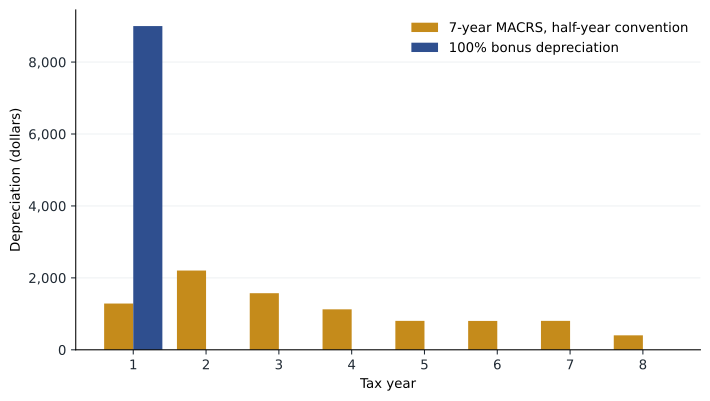
Is deducting everything at once always right? Not necessarily. Depreciation saves tax at the marginal rate in the year claimed. A taxpayer in a low bracket this year who expects higher income later might elect out of bonus depreciation and spread the deduction; one whose state does not follow bonus depreciation must keep a separate state schedule anyway. And deducting the full cost now does not avoid tax forever: it reduces the asset's basis to zero, so any sale proceeds will be taxed as ordinary income under the recapture rules.
Selling depreciable property: recapture and section 1231
When depreciated property is sold, the gain is the amount realized minus the adjusted basis, which is cost minus all depreciation allowed or allowable, including section 179 and bonus depreciation. Section 1245 recaptures, as ordinary income, the gain on personal property such as equipment and vehicles to the extent of all depreciation taken. Any gain above the original cost is section 1231 gain. For buildings, section 1250 recaptures only depreciation in excess of straight line, which is nil for MACRS real property, but the part of the gain attributable to straight-line depreciation is unrecaptured section 1250 gain, taxed at a maximum rate of 25 percent. Net section 1231 gains from business property held more than one year are treated as long-term capital gains and net losses as ordinary losses, subject to a five-year lookback rule that recharacterizes gains as ordinary to the extent of section 1231 losses deducted in the previous five years.
Leah's sale of her old drone in 2026 shows the recapture rule. The drone cost $6,000 in 2023 and had been depreciated by $5,600, leaving an adjusted basis of $400. She sold it for $2,500, so the entire $2,100 gain is section 1245 ordinary income, reported on Form 4797. The program below shows how the character of the result changes with the sale price.
# Selling the old drone at different prices: section 1245 and section 1231
cost, accumulated = 6_000, 5_600          # bought 2023; depreciation allowed
basis = cost - accumulated
for price in [300, 2_500, 7_000]:
    gain = price - basis
    ordinary_1245 = max(0, min(gain, accumulated))
    gain_1231 = gain - ordinary_1245      # negative means a section 1231 loss
    print(f"price {price:>6,}: gain {gain:>6,}  sec. 1245 ordinary {ordinary_1245:>6,}"
f" sec. 1231 {gain_1231:>6,}")price 300: gain -100 sec. 1245 ordinary 0 sec. 1231 -100 price 2,500: gain 2,100 sec. 1245 ordinary 2,100 sec. 1231 0 price 7,000: gain 6,600 sec. 1245 ordinary 5,600 sec. 1231 1,000
At $300, the sale produces a $100 loss, a section 1231 loss that is ordinary if her section 1231 transactions for the year net to a loss. At $2,500, the whole $2,100 gain is recaptured as ordinary income. At $7,000, recapture is capped at the $5,600 of depreciation taken, and the remaining $1,000 is section 1231 gain, treated as long-term capital gain if her net section 1231 result for the year is a gain and the lookback rule does not apply. Because each asset is tracked separately, every sale of depreciated equipment above its adjusted basis produces recapture immediately, unlike a pooled system where proceeds simply reduce the pool. The general point: deductions taken in excess of the real decline in value come back as ordinary income when the asset is sold.
Worked problem
A rental building under MACRS
The Brandts' rental condominium building (excluding land) has a basis of $200,000. Suppose it had been placed in service in August 2026 instead of in an earlier year. What would the 2026 depreciation be, and what is the full-year amount?
Show solution
- Residential rental property is depreciated straight line over 27.5 years with the mid-month convention.
- Placed in service in August, it is treated as placed in service in mid-August: 4.5 months in 2026.
- 2026 depreciation: $200,000 / 27.5 × 4.5/12 = $2,727.
- Each full year after that: $200,000 / 27.5 = $7,273, the amount used in lesson 8.
- Land is never depreciable, so the purchase price must be allocated between land and building.
Answer: $2,727 in the first year, then $7,273 a year.
Other rules worth knowing
Several further rules matter in practice. Listed property under section 280F, mainly passenger vehicles, must be used more than 50 percent for business to qualify for section 179, bonus depreciation or accelerated MACRS, and annual depreciation on passenger cars is capped at inflation-adjusted luxury auto limits. Contemporaneous records of business use are required under section 274(d). The de minimis safe harbor in the repair regulations lets taxpayers deduct items costing up to $2,500 each ($5,000 with audited financial statements) instead of capitalizing them. Depreciation on a home office reduces the basis of the home and creates unrecaptured section 1250 gain on its sale that is not covered by the home sale exclusion (lesson 10). Intangibles acquired in buying a business, such as goodwill, are amortized over 15 years under section 197.
Common mistakes
MistakeAssuming depreciation can be postponed by not claiming it.
InsteadBasis is reduced by depreciation allowable, so unclaimed depreciation is simply lost.
MistakeTreating all gain on equipment as capital gain.
InsteadGain up to prior depreciation is section 1245 ordinary income.
MistakeTaking section 179 beyond business taxable income.
InsteadThe section 179 deduction is limited to business taxable income; the excess carries forward.
MistakeForgetting the mid-quarter convention.
InsteadIf over 40 percent of the year's personal property is placed in service in the fourth quarter, the mid-quarter convention applies.
MistakeAssuming the state follows federal bonus depreciation.
InsteadMany states decouple from bonus depreciation and require their own schedules.
Summary and key terms
- Capital expenditures are recovered through MACRS depreciation, section 179 or bonus depreciation.
- Each asset has a recovery period, method and convention under MACRS.
- Depreciation allowed or allowable reduces basis, so unclaimed depreciation is lost.
- Section 179 expenses up to $2,560,000 for 2026, limited to business taxable income.
- 100 percent bonus depreciation is permanent for property acquired after 19 January 2025; Brandt Aerial deducts $12,200.
- Section 1245 recaptures depreciation on personal property as ordinary income; unrecaptured section 1250 gain on buildings is taxed at up to 25 percent.
- Net section 1231 gains are long-term capital gains; net losses are ordinary.
- Listed property must be used more than 50 percent for business for accelerated methods.
- MACRS
- The Modified Accelerated Cost Recovery System of section 168.
- Recovery period
- The number of years over which an asset is depreciated under MACRS.
- Half-year convention
- The convention treating personal property as placed in service at mid-year.
- Section 179 deduction
- An election to expense the cost of qualifying business property in the year placed in service.
- Bonus depreciation
- An additional first-year depreciation deduction under section 168(k), 100 percent for property acquired after 19 January 2025.
- Section 1231 property
- Depreciable and real property used in a business and held more than one year.
- Depreciable property
- Property used in a business or to earn income whose cost is recovered over time.
- Recapture
- Income that arises when depreciation deductions taken exceed the property's actual decline in value, revealed by a sale.
Practice problems
Work each problem on paper first, then reveal the answer to check.
What is the first-year MACRS percentage for 5-year property?
Show answer
20 percent, under the half-year convention.
In the depreciation program, change the drone kit to 5-year property. What is the regular MACRS first-year total?
Show answer
$1,800 + $640 = $2,440.
What limits the section 179 deduction?
Show answer
The annual dollar limit and phase-out, and the taxpayer's active business taxable income.
Equipment that cost $10,000 with $7,000 of depreciation sells for $12,000. What is the character of the gain?
Show answer
$7,000 of section 1245 ordinary income and $2,000 of section 1231 gain.
Why does the mid-quarter convention exist?
Show answer
To stop taxpayers from buying assets late in the year and claiming a half-year deduction.
When was 100 percent bonus depreciation restored, and for what property?
Show answer
By the 2025 act, for property acquired after 19 January 2025, permanently.
Why might a taxpayer elect out of bonus depreciation?
Show answer
To spread deductions into years with higher expected marginal rates, or to align with a state that does not follow bonus depreciation.
What rate applies to unrecaptured section 1250 gain?
Show answer
A maximum of 25 percent.
Over what period is purchased goodwill amortized?
Show answer
15 years under section 197.
What is the de minimis safe harbor for taxpayers without audited statements?
Show answer
Items costing up to $2,500 each can be deducted.
Lesson quiz · 5 questions
Score 60% or more to complete this lesson.
Create a free account to save your progress, take quizzes and earn a certificate.