
ACCT-351 · Lesson 6 of 12 · 27 min
Business income: what counts and what is deductible
Leah's drone business is a small example of the most varied source of income in the Code. A sole proprietor reports business income and expenses on Schedule C, and the governing rules are spread across many sections: section 162 allows ordinary and necessary business expenses, section 262 denies personal expenses, section 263 requires capital expenditures to be capitalized, section 183 limits hobby activities, and sections 274 and 280A restrict meals, travel and home office deductions. Most of the complexity lies in three questions this lesson answers. Is there a trade or business at all, or a hobby or an investment? Which receipts are business income and which are capital gains? And which expenses can be deducted, when, and how much? The lesson ends with the two taxes that ride on top of Schedule C profit: self-employment tax and the qualified business income deduction. Lesson 7 takes up depreciation.
Trade or business, or hobby?
Section 162 allows deductions for activities that rise to the level of a trade or business, which the Supreme Court in Commissioner v. Groetzinger (1987) described as an activity engaged in with continuity and regularity, with the primary purpose of income or profit. Section 183 deals with activities not engaged in for profit, commonly called hobbies. The regulations list nine factors for deciding whether there is a profit motive: the manner in which the activity is carried on, the expertise of the taxpayer or advisers, the time and effort spent, the expectation that assets will appreciate, success in other activities, the history of income or losses, the amount of occasional profits, the taxpayer's financial status and elements of personal pleasure. An activity that shows a profit in three of five consecutive years (two of seven for horse activities) is presumed to be engaged in for profit. Since 2018, hobby income is fully taxable but hobby expenses are not deductible at all, a rule the 2025 act made permanent, so classifying an activity as a hobby is expensive.
Brandt Aerial passes easily. Leah holds an FAA remote pilot certificate, carries liability insurance, invoices commercial clients for roof and tower inspections, keeps separate books and has earned a profit in each of the last three years. A venture like this, run in a businesslike way, is a trade or business even in a year when it loses money.
Ordinary income or capital gain?
A gain on the sale of property can be ordinary income or capital gain. Section 1221 defines a capital asset as property held by the taxpayer, except for inventory and property held primarily for sale to customers in the ordinary course of business, depreciable and real property used in a business (which section 1231 treats separately), and certain other categories. Whether real estate is held primarily for sale to customers depends on factors such as the purpose of acquisition, the frequency and continuity of sales, the extent of improvement and subdivision, advertising and sales activity, and the length of the holding period. A person who buys houses to renovate and resell, or subdivides land and sells lots, is likely a dealer with ordinary income; a person who holds land for years and sells it in one transaction is likely an investor with capital gain. Securities traders who meet strict tests may elect mark-to-market treatment under section 475(f).
Digital assets such as cryptocurrency are property for federal tax purposes, so a sale or exchange produces capital gain or loss for an investor and ordinary income for a dealer; using crypto to pay for goods is also a sale. Brokers must report digital asset sales on Form 1099-DA starting with transactions in 2025. The distinction between ordinary income and capital gain matters most because of the rate difference: in 2026, up to 37 percent for ordinary income against a maximum of 20 percent for long-term capital gains, plus self-employment tax on business income.
Measuring profit
Individuals may use the cash method or the accrual method for a business, subject to limits. A business with average annual gross receipts of $32 million or less over the prior three years (the 2026 threshold) may use the cash method even if it has inventory, and may treat inventory as non-incidental materials and supplies or follow its book method. Under the accrual method, income is recognized when all events have occurred that fix the right to receive it and the amount can be determined with reasonable accuracy; under section 451(c), advance payments for goods or services can be deferred only to the year after receipt, to the extent deferred in the financial statements. A cash-method business cannot deduct a bad debt for unpaid fees, because the fees were never included in income; an accrual-method business deducts specific bad debts when they become worthless under section 166.
Individuals report business income for the calendar year, the tax year of the owner. Inventory must generally be accounted for using a method that clearly reflects income, such as first-in, first-out or last-in, first-out (which requires conformity in financial statements), with costs capitalized under the uniform capitalization rules of section 263A unless the small business exception applies.
What can be deducted
Section 162(a) allows a deduction for all the ordinary and necessary expenses paid or incurred during the year in carrying on a trade or business. Ordinary means normal or customary in the type of business, not that the expense recurs; necessary means appropriate and helpful. Compensation must be reasonable. Section 262 denies personal, living and family expenses, and section 263 requires amounts paid for new buildings, permanent improvements or betterments to be capitalized and recovered through depreciation (lesson 7). Several specific rules sit on top of these.
| Rule | Provision | Effect |
|---|---|---|
| Business meals | s. 274(k), (n) | 50 percent deductible; the taxpayer or an employee must be present and the meal not lavish |
| Entertainment | s. 274(a) | Not deductible since 2018, including tickets and club dues |
| Home office | s. 280A | Regular and exclusive use as the principal place of business or to meet clients; limited to business income; simplified method $5 per square foot up to 300 square feet |
| Fines and penalties | s. 162(f) | Amounts paid to a government for violating a law are not deductible, except restitution |
| Illegal bribes and kickbacks | s. 162(c) | Not deductible; illegal income is still taxable |
| Business use of a car | s. 274(d), 280F | Standard mileage rate or actual costs with records; depreciation limits for passenger cars |
| Life insurance on the owner | s. 262, 264 | Not deductible |
| Capital expenditures | s. 263 | Capitalized and depreciated, subject to de minimis safe harbors (up to $2,500 per item without audited statements) |
Two old cases still shape the general rules. In Welch v. Helvering (1933), payments a businessman made to creditors of his former bankrupt company, to restore his reputation, were held not to be ordinary expenses: they were unusual and in the nature of capital. In INDOPCO, Inc. v. Commissioner (1992), the Supreme Court held that costs creating significant long-term benefits must be capitalized even if they do not create a separate asset, which led to detailed regulations on intangibles and repairs. The repair regulations now distinguish deductible repairs from capital improvements by asking whether the work results in a betterment, a restoration or an adaptation of the unit of property.
From accounting income to taxable business income
The program below builds Brandt Aerial's 2026 Schedule C from its income statement, then computes self-employment tax and the qualified business income deduction.
# Brandt Aerial: Schedule C, self-employment tax and the QBI deduction, 2026 (illustrative)
revenue = 36_500
expenses = {"Depreciation (100% bonus, lesson 7)": 12_200, "Meals (50% of 1,600)": 800,
            "Insurance": 1_900, "Software subscriptions": 1_450,
            "Vehicle lease and operating (business share)": 4_300,
            "Home office (Form 8829, 8% of home costs)": 1_440,
            "Advertising": 600, "Pilot certificate training": 900}
not_deductible = {"Traffic fine (sec. 162(f))": 250, "Life insurance on Leah (sec. 262)": 700}
net_profit = revenue - sum(expenses.values())
for k, v in expenses.items():
    print(f"  {k:<46}{v:>9,.2f}")
for k, v in not_deductible.items():
    print(f"  not deductible: {k:<30}{v:>9,.2f}")
print(f"Schedule C net profit                           {net_profit:>9,.2f}")

se_earnings = 0.9235 * net_profit
wages_for_ss = 103_320                        # Leah's Social Security wages
ss_room = max(0, 184_500 - wages_for_ss)
se_tax = 0.124 * min(se_earnings, ss_room) + 0.029 * se_earnings
half_se = se_tax / 2
qbi = net_profit - half_se                    # simplified: no SEP or SE health insurance
print(f"Self-employment tax (Schedule SE)               {se_tax:>9,.2f}")
print(f"Deductible half of SE tax (above the line)      {half_se:>9,.2f}")
print(f"QBI deduction at 20% (below thresholds) {0.20 * qbi:>9,.2f}")Depreciation (100% bonus, lesson 7) 12,200.00 Meals (50% of 1,600) 800.00 Insurance 1,900.00 Software subscriptions 1,450.00 Vehicle lease and operating (business share) 4,300.00 Home office (Form 8829, 8% of home costs) 1,440.00 Advertising 600.00 Pilot certificate training 900.00 not deductible: Traffic fine (sec. 162(f)) 250.00 not deductible: Life insurance on Leah (sec. 262) 700.00 Schedule C net profit 12,910.00 Self-employment tax (Schedule SE) 1,824.12 Deductible half of SE tax (above the line) 912.06 QBI deduction at 20% (below thresholds) 2,399.59
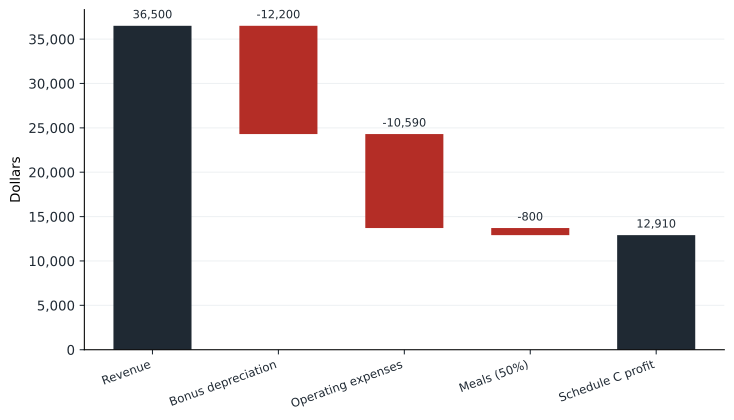
Brandt Aerial's Schedule C profit is $12,910. Depreciation is the full $12,200 cost of the new drone and computer, because 100 percent bonus depreciation applies (lesson 7). Only half of the $1,600 of meals is deducted. The traffic fine and the premium on a life insurance policy on Leah's own life are not deductible at all. The vehicle costs are the business share from her mileage log, and the home office is 8 percent of home costs under the regular method, which here exceeds the simplified method's $1,000 for her 200 square-foot office. Schedule SE then applies: 92.35 percent of the profit is net earnings from self-employment, and because her Social Security wages leave $81,180 of room under the wage base, the full 15.3 percent applies, for $1,824.12. Half of that is an above-the-line deduction. The QBI deduction is 20 percent of the profit after the deductible half of SE tax, or $2,399.59, because the Brandts' taxable income is below the 2026 threshold of $403,500 for joint filers, so neither the wage limit nor the restriction on specified service businesses applies.
Worked problem
Is it a hobby?
Tomás's brother restores and sells vintage motorcycles in his garage. In the last five years he has reported losses of $6,000, $4,500, $7,200 and $3,800 and one profit of $900. He keeps receipts but no separate accounts, works on the bikes when he has free time and rides them himself. He wants to deduct a $5,000 loss for 2026. What is the likely result?
Show solution
- He shows a profit in only one of five years, so the section 183 presumption does not help him.
- The nine factors point toward a hobby: no separate books, no business plan, spare-time work and a large element of personal pleasure.
- If the activity is not engaged in for profit, his sales revenue is taxable, but none of his expenses is deductible.
- He could strengthen his position for the future by keeping separate records, changing methods to improve profitability and seeking expert advice.
Answer: Probably a hobby: revenue taxable, no deductions.
Self-employment tax and the QBI deduction
Self-employment tax is the self-employed person's equivalent of FICA. It applies at 15.3 percent, 12.4 percent for Social Security up to the wage base less any wages already subject to Social Security tax and 2.9 percent for Medicare without limit, to 92.35 percent of net earnings from self-employment. The 92.35 percent factor mimics the fact that employees do not pay FICA on the employer's share. Self-employment tax applies once net earnings reach $400, and the additional 0.9 percent Medicare tax applies above the combined thresholds. Half of self-employment tax is deductible in arriving at AGI.
The qualified business income deduction in section 199A, enacted in 2017 and made permanent in 2025, allows individuals a deduction of up to 20 percent of qualified business income from sole proprietorships, partnerships, S corporations and some trusts. Below a taxable income threshold, $201,750 for most filers and $403,500 for joint filers for 2026, the deduction is simply 20 percent of QBI, limited to 20 percent of taxable income minus net capital gain. Above the threshold, a limit based on W-2 wages paid and the basis of qualified property phases in, and specified service trades or businesses such as law, accounting, health, consulting and financial services lose the deduction entirely over the phase-in range, which the 2025 act widened to $75,000 ($150,000 joint). Starting in 2026, the 2025 act also guarantees a minimum deduction of $400 for taxpayers with at least $1,000 of QBI from businesses in which they materially participate. The deduction is taken after AGI, is available whether or not the taxpayer itemizes, and does not reduce self-employment tax.
Common mistakes
MistakeAssuming every activity that loses money is a hobby.
InsteadThe nine factors and the profit history decide; a businesslike activity can lose money in some years.
MistakeDeducting the full cost of a capital asset as a repair.
InsteadCapital improvements are capitalized and depreciated unless a safe harbor or expensing election applies.
MistakeDeducting entertainment such as sports tickets for clients.
InsteadEntertainment has been nondeductible since 2018; business meals are 50 percent deductible.
MistakeTreating a series of house flips as capital gains.
InsteadFrequent purchases for resale make the taxpayer a dealer with ordinary income.
MistakeForgetting self-employment tax on side business profits.
InsteadSchedule SE applies once net earnings reach $400, at 15.3 percent below the wage base.
Summary and key terms
- A trade or business requires continuity, regularity and a profit motive; hobby expenses are not deductible.
- Property held primarily for sale to customers produces ordinary income, not capital gain.
- Small businesses may use the cash method; accrual taxpayers follow the all-events test.
- Section 162 allows ordinary and necessary expenses; sections 262 and 263 deny personal and capital costs.
- Meals are 50 percent deductible, entertainment and fines are not, and the home office deduction is limited to business income.
- Self-employment tax is 15.3 percent of 92.35 percent of net earnings, below the wage base.
- Brandt Aerial's 2026 Schedule C profit is $12,910, with SE tax of $1,824.12 and a QBI deduction of $2,399.59.
- The QBI deduction, permanent since 2025, gives up to 20 percent of qualified business income.
- Ordinary and necessary
- The section 162 standard: customary in the business and appropriate and helpful.
- Schedule C
- The form on which a sole proprietor reports business income and expenses.
- Self-employment tax
- Social Security and Medicare tax on net earnings from self-employment.
- Qualified business income (QBI) deduction
- The section 199A deduction of up to 20 percent of qualified business income.
- Dealer property
- Property held primarily for sale to customers, producing ordinary income.
- Specified service trade or business
- A business such as law, accounting, health or consulting that loses the QBI deduction above the income thresholds.
- Capital outlay
- An expenditure that brings an enduring benefit, recovered over time rather than deducted at once.
- Hobby
- An activity carried on mainly for pleasure rather than profit.
Practice problems
Work each problem on paper first, then reveal the answer to check.
What does the section 183 presumption require?
Show answer
A profit in three of five consecutive years (two of seven for horses).
In the program, change the meals to $3,000. What is the new net profit?
Show answer
Deductible meals rise to $1,500, so net profit falls to $12,210.
Leah buys three houses in 2026, renovates them and sells them at a profit. How are the gains likely taxed?
Show answer
As ordinary income; she is likely a dealer holding property primarily for sale.
Name two expenses Brandt Aerial cannot deduct.
Show answer
The traffic fine and the life insurance premium on Leah's life.
What did INDOPCO decide?
Show answer
That costs producing significant long-term benefits must be capitalized even if no separate asset is created.
Leah's wages were $190,000. How would her SE tax change?
Show answer
Her Social Security wages would exceed the $184,500 base, so only the 2.9 percent Medicare part would apply, about $346.
What is the simplified home office method?
Show answer
$5 per square foot of qualifying space, up to 300 square feet, or $1,500.
Why is the 92.35 percent factor used in Schedule SE?
Show answer
It mirrors the employee's position, where the employer's share of FICA is not part of wages.
Is income from an illegal business taxable?
Show answer
Yes; illegal income is taxable, although bribes and fines are not deductible.
What is the 2026 QBI threshold for joint filers?
Show answer
$403,500 of taxable income.
Lesson quiz · 5 questions
Score 60% or more to complete this lesson.
Create a free account to save your progress, take quizzes and earn a certificate.