
ACCT-351 · Lesson 5 of 12 · 25 min
Equity compensation, payroll taxes and employee deductions
Lesson 4 covered wages and fringe benefits. This lesson completes the picture of employment income with three topics. The first is equity compensation: nonqualified stock options, incentive stock options, employee stock purchase plans and restricted stock, each with its own timing and character rules. The second is payroll taxes, which take a bigger bite than income tax for many workers. The third is the very short list of deductions still available to employees, after the 2017 act suspended most unreimbursed employee expenses and the 2025 act made the change permanent, together with the new temporary deduction for overtime pay and the retirement plan contributions that reduce taxable wages.
Nonqualified stock options and restricted stock
Under section 83 and the regulations, a nonqualified stock option (NSO) without a readily ascertainable value, which describes almost all employee options, is not taxed when granted. When the employee exercises it, the spread between the fair market value of the shares and the exercise price is compensation, reported on Form W-2, subject to income tax withholding and to Social Security and Medicare taxes. The employee's basis in the shares becomes their fair market value at exercise, and the holding period starts then; any later gain or loss is capital. The employer deducts the same amount as compensation when the employee includes it.
Restricted stock, shares transferred subject to vesting conditions such as continued employment, is taxed under section 83(a) when it vests, at its value then, unless the employee makes a section 83(b) election within 30 days after the transfer to be taxed immediately on the value at grant. The election is a bet: if the shares rise, all of the growth becomes capital gain with a holding period starting at grant; if the employee forfeits the shares, no deduction is allowed for the income already reported. Restricted stock units, which are promises to deliver shares later, are taxed when the shares are delivered, and the 83(b) election does not apply to them.
An employee stock purchase plan under section 423 lets employees buy shares at up to a 15 percent discount, through payroll deductions, with no tax at purchase. If the employee holds the shares for more than two years from the offering date and one year from purchase, the discount at the offering date is ordinary income at sale and the rest is long-term capital gain. If not, the bargain element at purchase is ordinary income. Employers report ESPP transfers on Form 3922.
Incentive stock options
Incentive stock options (ISOs) under section 422 receive more favorable regular tax treatment. No income arises at grant or at exercise. If the employee holds the shares for at least two years after the grant and one year after exercise, the entire gain on sale, measured from the exercise price, is long-term capital gain, and the employer gets no deduction. If the employee sells earlier, in a disqualifying disposition, the spread at exercise (or the actual gain, if less) is ordinary compensation income in the year of sale, though not subject to FICA. ISOs may be granted only to employees, under a shareholder-approved plan, with an exercise price at least equal to fair market value at grant, and only $100,000 of stock (measured at grant) may first become exercisable in any year; the excess is treated as NSOs.
The catch is the alternative minimum tax. For AMT purposes, the spread at exercise of an ISO is a preference item included in alternative minimum taxable income in the year of exercise, unless the shares are sold in the same year. Large ISO exercises in years when the share price later collapsed left some employees owing AMT on gains that disappeared, although the AMT paid can create a credit for later years. The program below computes Leah's 2026 payroll taxes and then compares an NSO with an ISO: suppose she exercises options on 1,000 shares granted at $20 when the shares trade at $34 and sells them 18 months later for $40.
# Leah's 2026 FICA, and NSOs versus ISOs (illustrative)
fica_wages = 103_320
ss = 0.062 * min(fica_wages, 184_500)
medicare = 0.0145 * fica_wages
addl = 0.009 * max(0, fica_wages - 200_000)       # withholding threshold
print(f"Social Security tax withheld    {ss:>10,.2f}")
print(f"Medicare tax withheld           {medicare:>10,.2f}")
print(f"Additional Medicare withheld    {addl:>10,.2f}")
print(f"Employer match (SS + Medicare)  {ss + medicare:>10,.2f}")

shares, strike, fmv_exercise, sale_price = 1_000, 20.00, 34.00, 40.00
spread = shares * (fmv_exercise - strike)
print()
print("Sale 18 months after exercise, more than 2 years after grant")
print(f"{'':<26}{'NSO':>10}{'ISO':>10}")
nso = {"Ordinary income at exercise": spread, "AMT preference at exercise": 0,
       "Basis in shares": shares * fmv_exercise,
       "Long-term gain on sale": shares * sale_price - shares * fmv_exercise}
iso = {"Ordinary income at exercise": 0, "AMT preference at exercise": spread,
       "Basis in shares": shares * strike,
       "Long-term gain on sale": shares * sale_price - shares * strike}
for k in nso:
    print(f"{k:<26}{nso[k]:>10,.0f}{iso[k]:>10,.0f}")
print(f"{'FICA on exercise':<26}{0.0765 * spread:>10,.0f}{0:>10,.0f}")Social Security tax withheld 6,405.84
Medicare tax withheld 1,498.14
Additional Medicare withheld 0.00
Employer match (SS + Medicare) 7,903.98
Sale 18 months after exercise, more than 2 years after grant
NSO ISO
Ordinary income at exercise 14,000 0
AMT preference at exercise 0 14,000
Basis in shares 34,000 20,000
Long-term gain on sale 6,000 20,000
FICA on exercise 1,071 0Leah's FICA wages of $103,320 are below the 2026 Social Security wage base of $184,500, so Social Security tax applies to all of them at 6.2 percent, $6,405.84, and Medicare tax at 1.45 percent, $1,498.14. The additional 0.9 percent Medicare tax is withheld only on wages above $200,000, and on the return it applies to combined wages and self-employment income above $250,000 for joint filers. Red River pays matching amounts, plus federal and state unemployment taxes.
With an NSO, Leah has $14,000 of ordinary wage income at exercise, subject to FICA of about $1,071, and a basis of $34,000; the later sale produces a $6,000 long-term capital gain. With an ISO and a qualifying disposition, she has no regular income at exercise, a $14,000 AMT preference, a basis of $20,000 for regular tax and a $20,000 long-term capital gain at sale. Whether the ISO is better depends on whether the AMT applies in the year of exercise, which for an employee with her income and a $14,000 spread is unlikely given the 2026 AMT exemption of $140,200 for joint filers, but which becomes a serious risk for large exercises.
Deductions for employees
Since 2018, miscellaneous itemized deductions subject to the 2 percent floor, which included unreimbursed employee business expenses, union dues, job-hunting costs and home office expenses of employees, have been disallowed. The 2017 act suspended them through 2025, and the 2025 act made the disallowance permanent. As a result, an employee who pays for their own tools, travel or home office receives no federal deduction, which is why reimbursement under an accountable plan matters so much (lesson 4). A few groups can still deduct employee expenses above the line: eligible educators (up to $300 of classroom supplies), Armed Forces reservists traveling more than 100 miles, qualified performing artists and fee-basis government officials. Moving expenses are deductible only by members of the Armed Forces on active duty moving under orders and, from 2026, certain members of the intelligence community.
| Item | Treatment for employees in 2026 |
|---|---|
| Unreimbursed business travel, tools, uniforms, home office | Not deductible (miscellaneous itemized deductions disallowed permanently) |
| Union and professional dues | Not deductible |
| Classroom supplies of K–12 educators | Up to $300 above the line |
| Elective deferrals to a 401(k) or 403(b) | Excluded from box 1 wages, up to $24,500 plus catch-up contributions |
| Premium portion of FLSA overtime pay | Deductible up to $12,500 ($25,000 joint), 2025–2028, phased out above $150,000 of MAGI ($300,000 joint) |
| Qualified tips | Deductible up to $25,000, 2025–2028, phased out above $150,000 of MAGI ($300,000 joint) |
| Moving expenses | Deductible only by active-duty military and certain intelligence community members |
The overtime deduction shows how narrow the new provisions are. It covers only the premium part of overtime compensation required by section 7 of the Fair Labor Standards Act, the "half" in time and a half, not the base pay for those hours, and not overtime paid under a more generous company policy or a state law. Employers must report qualified overtime separately. An employee paid $30 an hour who works 300 overtime hours at $45 receives $13,500 of overtime pay, of which $4,500 is the premium portion and potentially deductible. The deduction reduces income tax only; Social Security and Medicare taxes still apply.
Worked problem
Retirement plan deferrals and the overtime deduction
A production supervisor at Red River earns $78,000 of base pay and $9,000 of FLSA overtime, of which $3,000 is the premium portion. He defers $10,000 to the 401(k). His modified AGI as a single filer is $76,000. What are his box 1 wages and his overtime deduction?
Show solution
- Box 1 wages: $78,000 + $9,000 − $10,000 = $77,000.
- Overtime deduction: the $3,000 premium portion, well below the $12,500 limit.
- His modified AGI is below $150,000, so no phase-out applies.
- Social Security and Medicare taxes apply to the full $87,000, including the deferral and the overtime.
Answer: Box 1 wages of $77,000 and a $3,000 overtime deduction.
Payroll taxes and withholding
Employers must withhold federal income tax based on the employee's Form W-4, together with the employee's Social Security tax (6.2 percent up to the $184,500 wage base for 2026) and Medicare tax (1.45 percent of all wages, plus 0.9 percent of wages above $200,000). The employer pays matching Social Security and Medicare taxes and federal unemployment tax of 6.0 percent on the first $7,000 of each employee's wages, reduced to an effective 0.6 percent by credits for state unemployment taxes. Deposits are due on a monthly or semiweekly schedule, and quarterly returns are filed on Form 941. An employee who works for two employers in a year may have too much Social Security tax withheld, because each employer applies the wage base separately; the excess is claimed as a credit on the employee's return.
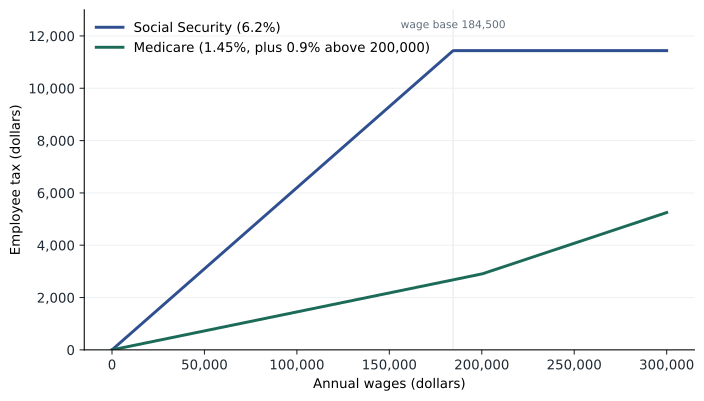
Because the Social Security wage base caps that part of the tax, payroll taxes are a smaller share of income for high earners: a worker earning $184,500 and one earning $400,000 pay the same Social Security tax, though Medicare tax has no cap. Self-employed individuals pay both halves through self-employment tax (lesson 6). Leah's Social Security wages leave room under the wage base, so her Brandt Aerial profits will attract self-employment tax at the full 15.3 percent.
Retirement plans at work
A 401(k) plan lets employees defer up to $24,500 of wages in 2026, plus catch-up contributions for those aged 50 or older, either as pre-tax deferrals that reduce box 1 wages or as Roth contributions that are taxed now but grow tax-free. Employer matching and profit-sharing contributions are not taxable when made. Under the SECURE 2.0 Act, catch-up contributions by employees whose prior-year wages exceed an indexed threshold must generally be made as Roth contributions starting in 2026. Distributions from pre-tax accounts are ordinary income, generally with a 10 percent additional tax before age 59½ unless an exception applies. Leah defers $9,000 to Red River's 401(k) in 2026.
Common mistakes
MistakeReporting income when an NSO is granted.
InsteadAn NSO without a readily ascertainable value is taxed at exercise.
MistakeUsing the exercise price as the basis of NSO shares.
InsteadBasis is the exercise price plus the amount included in income, so it equals the value at exercise.
MistakeDeducting unreimbursed job expenses on Schedule A.
InsteadThese deductions are permanently disallowed for most employees; ask the employer to reimburse under an accountable plan.
MistakeDeducting the whole of overtime pay.
InsteadOnly the FLSA premium portion is deductible, within limits, through 2028.
MistakeIgnoring the AMT on a large ISO exercise.
InsteadThe spread at exercise is an AMT preference; model the AMT before exercising and holding.
Summary and key terms
- NSOs create ordinary wage income at exercise equal to the spread, subject to FICA.
- ISOs held two years from grant and one year from exercise produce only long-term capital gain, but the spread is an AMT preference.
- Restricted stock is taxed at vesting unless a section 83(b) election is made within 30 days.
- Most unreimbursed employee expenses are permanently nondeductible.
- For 2026, Social Security tax is 6.2 percent up to $184,500 and Medicare tax 1.45 percent on all wages, plus 0.9 percent on high earnings.
- The overtime and tips deductions for 2025–2028 reduce income tax but not payroll taxes.
- 401(k) deferrals of up to $24,500 for 2026 reduce income tax wages but not FICA wages.
- Employers withhold, remit and report; employees reconcile on their returns.
- Nonqualified stock option (NSO)
- An option that creates ordinary income equal to the spread at exercise.
- Incentive stock option (ISO)
- A statutory option that gives capital gain treatment if holding periods are met, with an AMT preference at exercise.
- Disqualifying disposition
- A sale of ISO shares before the holding periods end, creating ordinary income.
- Section 83(b) election
- An election to be taxed on restricted property when received rather than when it vests.
- FICA
- Social Security and Medicare taxes on wages, paid by employees and employers.
- Social Security wage base
- The ceiling on wages subject to Social Security tax, $184,500 for 2026.
- Stock option
- A right to buy shares at a fixed price for a set period.
- Exercise price
- The price at which an option holder may buy the shares.
Practice problems
Work each problem on paper first, then reveal the answer to check.
A colleague exercises NSOs on 500 shares at $12 when they trade at $30. What is his ordinary income and his basis?
Show answer
Ordinary income $9,000; basis $15,000.
In the program, change the sale price to $30. What happens under each option type?
Show answer
NSO: $14,000 ordinary income and a $4,000 capital loss. ISO (qualifying): $10,000 long-term gain and still a $14,000 AMT preference at exercise.
What are the ISO holding periods?
Show answer
Two years from grant and one year from exercise.
Name two groups of employees who can still deduct some job expenses.
Show answer
For example eligible educators, Armed Forces reservists, qualified performing artists and fee-basis government officials.
An employee earns $60,000. What are her 2026 Social Security and Medicare taxes?
Show answer
$3,720 and $870.
Why might an employee with two jobs get a refund of Social Security tax?
Show answer
Each employer withholds up to the wage base separately; total withholding above the cap is credited on the return.
Can an employee deduct a home office used for the employer's convenience?
Show answer
No; employee home office expenses are not deductible.
What is the 2026 401(k) elective deferral limit?
Show answer
$24,500, plus catch-up contributions for those 50 or older.
What does the employer pay in matching FICA for Leah?
Show answer
$7,903.98.
Leah exercises ISOs worth $300,000 more than the exercise price and holds the shares. What should she check?
Show answer
Whether the AMT applies in the year of exercise, because the spread is a preference item.
Lesson quiz · 5 questions
Score 60% or more to complete this lesson.
Create a free account to save your progress, take quizzes and earn a certificate.