
ACCT-351 · Lesson 4 of 12 · 24 min
Employment income: wages and fringe benefits
For most Americans, wages are the largest source of income. Section 61(a)(1) includes "compensation for services, including fees, commissions, fringe benefits, and similar items" in gross income, and the regulations say that compensation paid in any form other than cash is income at its fair market value. Fringe benefits are therefore taxable unless a specific provision excludes them, and the Code contains many such exclusions. This lesson starts with the question that decides which rules apply, whether a worker is an employee or an independent contractor, then covers wages and their timing, the major statutory exclusions, the valuation of taxable fringe benefits, reimbursements, and how all of it appears on Form W-2. Lesson 5 continues with equity compensation, payroll taxes and the very limited deductions an employee can claim.
Employee or independent contractor?
The distinction between an employee and an independent contractor matters enormously. An employee receives a Form W-2, has income tax and FICA withheld, and since 2018 can deduct almost no unreimbursed job expenses. An independent contractor receives a Form 1099-NEC if paid $600 or more (rising to $2,000 for payments made after 2025 under the 2025 act, indexed later), reports income and expenses on Schedule C, pays self-employment tax of 15.3 percent on net earnings, and may claim the qualified business income deduction. Employers who misclassify workers face back payroll taxes, interest and penalties, and may also face claims under labor laws, which use their own tests.
The IRS and the courts apply a common-law test that asks whether the business has the right to direct and control how the work is done, not merely the result. The IRS groups the evidence into three categories: behavioral control (instructions, training, evaluation of how the work is done), financial control (significant investment, unreimbursed expenses, opportunity for profit or loss, offering services to the market, method of payment) and the relationship of the parties (written contracts, benefits, permanency, whether the services are a key activity of the business). Either party can ask the IRS for a determination on Form SS-8, and section 530 of the Revenue Act of 1978 gives employers relief from federal employment taxes if they had a reasonable basis for treating workers as contractors and treated them consistently. Labels in a contract do not decide the question; the facts do.
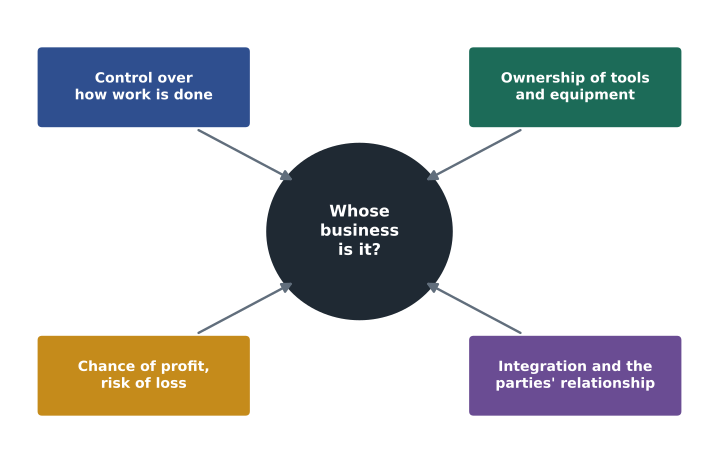
Leah's two activities show the distinction. At Red River she works the hours her manager sets, uses the company's equipment and procedures, is paid a salary with benefits and does work that is a key part of the company's business: she is an employee. Brandt Aerial is her own business: she owns the drones, chooses her clients, sets her prices, advertises and bears the risk of loss if a client does not pay or a drone crashes. The same person can have both kinds of income in the same year, and the Brandts' return will include both a W-2 and a Schedule C.
Wages and their timing
Wages include salaries, bonuses, commissions, vacation pay, severance and tips. Employees are taxed on wages when actually or constructively received. Nonqualified deferred compensation plans let executives postpone receiving salary or bonuses to a later year, but section 409A imposes strict rules on the timing of deferral elections and distributions; a plan that fails them causes all deferred amounts to be taxed immediately, with a 20 percent additional tax and interest. Severance pay and back-pay awards are wages, and settlements of employment disputes are wages to the extent they replace lost pay. Tips are taxable and must be reported to the employer; for 2025 through 2028 the 2025 act allows a deduction of up to $25,000 for qualified tips in occupations that customarily receive them, phased out above $150,000 of modified AGI ($300,000 joint), but the tips remain wages for payroll tax purposes.
The employer reports wages on Form W-2, which shows taxable wages in box 1, Social Security wages in box 3, Medicare wages in box 5, federal income tax withheld in box 2, and many coded amounts in box 12, such as elective deferrals to a 401(k) (code D), employer health coverage cost (code DD, reported but not taxed) and the taxable cost of group-term life insurance over $50,000 (code C). Because 401(k) deferrals are excluded from income tax but not from payroll taxes, box 1 is usually lower than boxes 3 and 5.
Fringe benefits: the exclusions
Because section 61 includes all compensation, the question for any fringe benefit is whether an exclusion applies. Section 132 provides several of the most common ones, many subject to nondiscrimination rules that deny the exclusion to highly compensated employees if the benefit is not offered broadly. Other sections exclude employer-provided health and accident coverage (section 106) and benefits paid under it (section 105), group-term life insurance up to $50,000 of coverage (section 79), meals and lodging furnished on the business premises for the employer's convenience (section 119), up to $5,250 of educational assistance, including payments on the employee's student loans (section 127), and dependent care assistance of up to $7,500 a year starting in 2026 (section 129, as amended in 2025). Benefits that are not excluded are valued under the regulations, generally at fair market value.
| Exclusion | Section | Example and limit |
|---|---|---|
| No-additional-cost service | 132(b) | Airline employee flying standby on an empty seat |
| Qualified employee discount | 132(c) | Up to the gross profit percentage on goods; 20 percent on services |
| Working condition fringe | 132(d) | Business use of a company car or phone; professional dues the employee could have deducted |
| De minimis fringe | 132(e) | Occasional snacks, holiday turkeys, occasional tickets; cash and gift cards never qualify |
| Qualified transportation fringe | 132(f) | Transit passes and parking up to $340 a month each for 2026 |
| On-premises athletic facility | 132(j)(4) | A gym operated by the employer on its premises |
| Employer health coverage | 106 | Premiums paid by the employer, without limit |
| Group-term life insurance | 79 | Cost of the first $50,000 of coverage |
Taxable fringe benefits that do not qualify for an exclusion are valued under Treasury Regulation 1.61-21. For an employer-provided car, the regulations offer the general valuation rule (fair market value of the personal use), the annual lease value rule, the cents-per-mile rule for lower-value cars, and the commuting rule, which values commuting-only use at $1.50 each way. Below-market loans to employees create imputed interest income under section 7872, measured at the applicable federal rate. Employer-paid personal expenses, such as a gym membership off the premises, are wages at their full cost.
Reimbursements: accountable and nonaccountable plans
Amounts paid to an employee for business expenses are excluded from wages only if paid under an accountable plan, which requires a business connection, substantiation of the expenses within a reasonable period, and the return of any excess. Reimbursements and allowances under a plan that fails these rules are nonaccountable and taxable as wages, subject to withholding. Mileage allowances at or below the IRS standard mileage rate, and per diem allowances at or below federal rates, are treated as substantiated if the employee documents the time, place and business purpose. Because employees can no longer deduct unreimbursed business expenses, having the employer reimburse under an accountable plan is much more valuable than a salary increase of the same amount.
Valuing a company car
When an employer provides a car, business use is excluded as a working condition fringe, and personal use, including commuting, is a taxable fringe. Under the annual lease value rule, the employer finds the car's fair market value when first provided, looks up its annual lease value in the IRS table and multiplies by the personal-use percentage; fuel provided is added at fair market value or a cents-per-mile amount. The cents-per-mile rule, available for cars below an indexed value that are used regularly in business or driven a minimum distance, multiplies personal miles by the standard mileage rate. The commuting rule, available when the employer requires the employee to commute in the car for business reasons and prohibits other personal use, values each one-way commute at $1.50. Employers must keep records of business and personal miles to support whichever method they use.
The program below computes the wage amounts on Leah's 2026 Form W-2 and lists the benefits she receives tax-free.
# Wages and fringe benefits on Leah's Form W-2, 2026 (illustrative)
age, coverage, salary = 41, 400_000, 96_000
table_i = {(40, 44): 0.10, (45, 49): 0.15}       # IRS Table I, $ per $1,000 per month
rate = next(r for (lo, hi), r in table_i.items() if lo <= age <= hi)
gtl = (coverage - 50_000) / 1_000 * rate * 12    # coverage above $50,000 is taxable

pay = {"Salary": salary, "Bonus": 6_000, "Group-term life over $50,000 (Table I)": gtl,
       "Fitness club membership (taxable fringe)": 900}
deferral_401k = 9_000
box1 = sum(pay.values()) - deferral_401k
box3 = min(sum(pay.values()), 184_500)           # Social Security wages
box5 = sum(pay.values())                         # Medicare wages
for k, v in pay.items():
    print(f"{k:<44}{v:>10,.2f}")
print(f"{'Less 401(k) elective deferral':<44}{-deferral_401k:>10,.2f}")
print(f"{'Box 1  wages, tips, other compensation':<44}{box1:>10,.2f}")
print(f"{'Box 3  Social Security wages':<44}{box3:>10,.2f}")
print(f"{'Box 5  Medicare wages':<44}{box5:>10,.2f}")
excluded = {"Employer health premiums (sec. 106)": 14_800,
            "Transit pass, 12 x $300 (sec. 132(f))": 3_600,
            "Accountable-plan mileage refund": 1_680}
for k, v in excluded.items():
print(f" excluded: {k:<38}{v:>10,.2f}")Salary 96,000.00 Bonus 6,000.00 Group-term life over $50,000 (Table I) 420.00 Fitness club membership (taxable fringe) 900.00 Less 401(k) elective deferral -9,000.00 Box 1 wages, tips, other compensation 94,320.00 Box 3 Social Security wages 103,320.00 Box 5 Medicare wages 103,320.00 excluded: Employer health premiums (sec. 106) 14,800.00 excluded: Transit pass, 12 x $300 (sec. 132(f)) 3,600.00 excluded: Accountable-plan mileage refund 1,680.00
Leah's box 1 wages are $94,320: salary and bonus, plus two taxable fringe benefits, minus her $9,000 elective deferral to the 401(k). The group-term life insurance cost is taxable only for coverage above $50,000, and it is computed from the IRS Table I rate, not the employer's actual premium: $350,000 of excess coverage at 10 cents per $1,000 per month for her age group gives $420. The fitness club is off the premises, so no exclusion applies. Boxes 3 and 5 are $103,320, because 401(k) deferrals are subject to payroll taxes. Her employer-paid health coverage, her transit pass (within the $340 monthly limit) and mileage reimbursed under an accountable plan are all excluded.
Worked problem
Group-term life for an older employee
Red River provides $300,000 of group-term life insurance to a 52-year-old engineer and pays the whole premium. What is the taxable amount for 2026, and how does it change if the employee pays $20 a month toward the coverage?
Show solution
- Coverage above $50,000 is $250,000, or 250 units of $1,000.
- The Table I rate for ages 50 to 54 is 23 cents per $1,000 per month.
- Annual cost: 250 × $0.23 × 12 = $690, taxable as wages (box 12, code C).
- If the employee pays $240 for the year after tax, the taxable amount falls to $690 − $240 = $450.
Answer: $690 of imputed income, or $450 if the employee contributes $240.
Common mistakes
MistakeRelying on a contract that calls the worker a contractor.
InsteadThe courts look at the actual relationship: control, tools, profit and loss, and integration.
MistakeTreating any reimbursement as tax-free.
InsteadOnly reimbursements under an accountable plan are excluded; otherwise they are wages.
MistakeTreating gift cards as de minimis fringes.
InsteadCash and cash equivalents never qualify as de minimis.
MistakeExcluding all use of a company car as a working condition fringe.
InsteadOnly business use is excluded; commuting and other personal use are taxable.
MistakeReporting the actual group-term life premium as income.
InsteadUse the Table I cost of coverage above $50,000, less any employee contributions.
Summary and key terms
- Whether a worker is an employee or self-employed depends on the whole relationship: control, tools, profit and loss, and integration.
- Wages, bonuses, commissions and tips are gross income when actually or constructively received.
- Fringe benefits are taxable unless a specific exclusion applies, such as those in sections 79, 106, 119, 127, 129 and 132.
- Employer health coverage and the cost of the first $50,000 of group-term life insurance are excluded.
- Reimbursements are excluded only under an accountable plan.
- Personal use of a company car is valued under the general, annual lease value, cents-per-mile or commuting rules.
- Below-market employee loans create imputed income at the applicable federal rate.
- Employers report wages and fringe benefits on Form W-2.
- Fringe benefit
- Non-cash compensation, taxable unless a specific exclusion applies.
- De minimis fringe
- A benefit so small that accounting for it is unreasonable, such as occasional snacks.
- Working condition fringe
- A benefit that would be deductible by the employee if paid for personally, such as business use of a company car.
- Accountable plan
- A reimbursement arrangement with business connection, substantiation and return of excess.
- Qualified transportation fringe
- Employer-provided transit and parking, excluded up to $340 a month each for 2026.
- Form W-2
- The annual statement of wages and withholding issued by an employer.
- Independent contractor
- A self-employed person who provides services under a contract for services and carries on business on their own account.
- Fair market value
- The price agreed between a willing buyer and a willing seller acting at arm's length.
Practice problems
Work each problem on paper first, then reveal the answer to check.
Name the four factors from Wiebe Door, or the three IRS categories of evidence.
Show answer
Behavioral control, financial control and the relationship of the parties.
An employee receives a $500 monthly car allowance without having to account for mileage. Is it taxable?
Show answer
Yes; it is paid under a nonaccountable plan and is wages.
In the program, change Leah's age to 47. What is the group-term life amount?
Show answer
At 15 cents per $1,000 per month, $350 × 0.15 × 12 = $630.
Is a $300 gift card given at year end excluded as de minimis?
Show answer
No; cash equivalents are never de minimis fringes, so it is wages.
Is the employer's payment of health insurance premiums taxable?
Show answer
No; section 106 excludes it, though the cost is reported in box 12, code DD.
Why are boxes 3 and 5 of Leah's W-2 higher than box 1?
Show answer
Her 401(k) deferrals reduce income tax wages but not wages subject to Social Security and Medicare.
What is the 2026 monthly limit for excluded transit benefits?
Show answer
$340.
What happens if a deferred compensation plan fails section 409A?
Show answer
All deferred amounts become taxable immediately, with a 20 percent additional tax and interest.
Leah also invoices clients through Brandt Aerial. Why is that business income rather than employment income?
Show answer
She owns the equipment, chooses clients and prices, and bears the risk of profit and loss.
An employee receives a $60,000 interest-free loan. What rule creates imputed income?
Show answer
Section 7872, at the applicable federal rate, subject to exceptions for small loans.
Lesson quiz · 5 questions
Score 60% or more to complete this lesson.
Create a free account to save your progress, take quizzes and earn a certificate.