
ACCT-351 · Lesson 3 of 12 · 24 min
Computing gross income, AGI, taxable income and tax
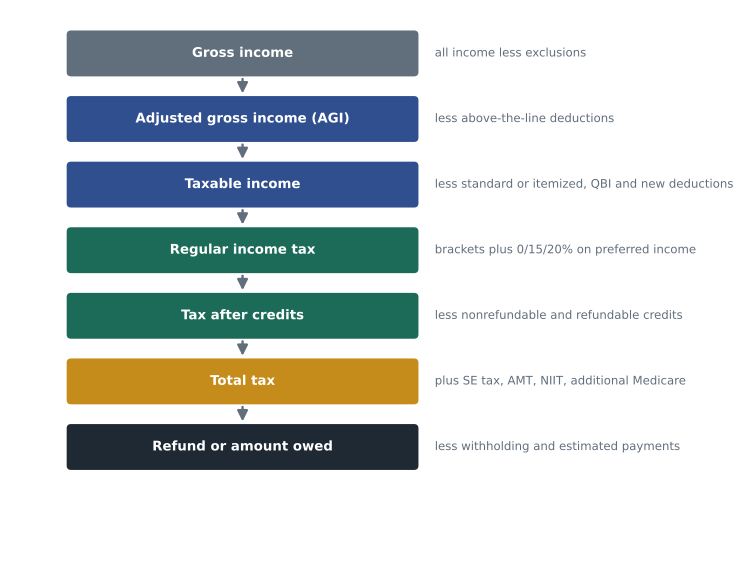
Every individual's federal income tax is computed through the same sequence of steps, set out on Form 1040 and in sections 61 to 63 of the Code. First, gross income is identified, after excluding items the Code exempts. Second, deductions "above the line" are subtracted to reach adjusted gross income (AGI). Third, the larger of the standard deduction or itemized deductions, together with the qualified business income deduction and certain new temporary deductions, is subtracted to reach taxable income. Fourth, tax is computed at the graduated rates, with lower rates for qualified dividends and long-term capital gains. Finally, credits reduce the tax, other taxes such as self-employment tax are added, and payments determine the refund or amount owed. This lesson walks through that structure before the following lessons look at each kind of income in detail.
Gross income: all income from whatever source
Section 61(a) defines gross income as "all income from whatever source derived" and gives a non-exhaustive list: compensation for services, business income, gains from dealings in property, interest, rents, royalties, dividends, annuities, pensions and more. The Supreme Court in Commissioner v. Glenshaw Glass Co. (1955) read the phrase broadly, holding that punitive damages were income because they were "undeniable accessions to wealth, clearly realized, and over which the taxpayers have complete dominion". The result is the opposite starting point from many countries: everything is income unless the Code excludes it. Exclusions include gifts and inheritances (section 102), life insurance proceeds paid on death (section 101), interest on state and local bonds (section 103), qualified scholarships for tuition (section 117), most employer-provided health coverage (section 106) and the gain on the sale of a main home up to a limit (section 121). Lottery and gambling winnings, prizes, found money and canceled debts are income unless an exception applies.
Income is computed for the calendar year, which is the tax year of almost every individual. Most individuals use the cash method: income is reported when actually or constructively received, and expenses are deducted when paid. Under the doctrine of constructive receipt, income credited to an account, set apart or otherwise made available without substantial restriction is taxable even if the taxpayer chooses not to collect it: a December paycheck the employee declines to pick up until January is still December income. Businesses may use the accrual method, and those with inventories or larger receipts must generally do so. Gains on property are recognized when the property is sold or exchanged.
Adjusted gross income
Section 62 lists the deductions subtracted from gross income to arrive at adjusted gross income. They are called above-the-line deductions because they are taken before the line on Form 1040 where AGI appears. AGI is the most important single number on the return after taxable income, because it is the base for many phase-outs and floors: the medical expense floor, the phase-out of IRA deductions, the active participation allowance for rental losses, and eligibility for many credits all depend on AGI or a modified version of it.
| Above-the-line deduction | Code section | Notes |
|---|---|---|
| Trade or business expenses of the self-employed (on Schedule C) | 62(a)(1), 162 | Reduce net profit directly |
| Deductible half of self-employment tax | 164(f) | Equalizes treatment with employees |
| Self-employed health insurance and retirement contributions | 162(l), 404 | Subject to limits |
| Traditional IRA contributions | 219 | Phased out if covered by a workplace plan above income limits |
| Health savings account contributions | 223 | $4,400 self-only, $8,750 family for 2026 |
| Student loan interest | 221 | Up to $2,500, phased out at higher incomes |
| Losses from the sale of property and capital losses up to $3,000 | 165, 1211 | Reflected in total income |
| Alimony paid under divorce agreements made before 2019 | 215 (repealed for later agreements) | Not deductible for later agreements |
Capital losses, however, are treated differently from business losses. A net capital loss can reduce ordinary income by only $3,000 a year ($1,500 if married filing separately), with the rest carried forward indefinitely to offset future capital gains. A loss from a business reported on Schedule C, by contrast, offsets any kind of income in the year it arises, subject to the excess business loss limit in section 461(l), which the 2025 act made permanent: for 2026, net business losses above $256,000 ($512,000 joint) are disallowed and carried forward as part of a net operating loss. A net operating loss from 2021 or later can be carried forward indefinitely, but it can offset only 80 percent of taxable income in the carryforward year, and most cannot be carried back.
From AGI to taxable income
From AGI, a taxpayer subtracts the larger of the standard deduction or total itemized deductions. For 2026 the standard deduction is $16,100 for single filers and married people filing separately, $24,150 for heads of household and $32,200 for married couples filing jointly, with an additional $1,650 per spouse ($2,050 if unmarried) for those 65 or older or blind. Itemized deductions, claimed on Schedule A, include state and local taxes up to a cap of $40,400 for 2026, home mortgage interest, charitable contributions and medical expenses above 7.5 percent of AGI (lesson 11). After the standard deduction roughly doubled in 2018, about nine in ten households stopped itemizing.
Two other deductions come after AGI but are available whether or not the taxpayer itemizes. The qualified business income deduction in section 199A allows up to 20 percent of qualified business income from pass-through businesses and sole proprietorships (lesson 6); the 2025 act made it permanent. And for 2025 through 2028, the 2025 act added deductions of up to $25,000 for qualified tips, up to $12,500 ($25,000 joint) for the premium portion of qualified overtime pay, up to $10,000 of interest on loans for new vehicles assembled in the United States, and $6,000 for each taxpayer aged 65 or older, each with income-based phase-outs. The personal exemption, once a deduction for each family member, is zero.
Computing tax: rates, credits and other taxes
Tax on ordinary taxable income is computed at the graduated rates from lesson 1. Qualified dividends and net long-term capital gains are stacked on top of ordinary income and taxed at 0, 15 or 20 percent depending on where they fall (lessons 8 and 9). The result is reduced by credits. Non-refundable credits, such as the credit for other dependents, the lifetime learning credit and the foreign tax credit, can reduce tax to zero but no further. Refundable credits, such as the earned income tax credit, part of the child tax credit and part of the American opportunity credit, are paid even if no tax is owed. Then other taxes are added: self-employment tax, the alternative minimum tax if it applies, the 3.8 percent net investment income tax and the 0.9 percent additional Medicare tax for high earners.
The difference between a deduction and a credit matters. A $1,000 deduction reduces taxable income by $1,000, so it is worth $100 to someone in the 10 percent bracket and $370 to someone in the 37 percent bracket. A $1,000 credit reduces tax by $1,000 for everyone who has enough tax to absorb it, or for everyone at all if it is refundable. Congress uses credits when it wants a benefit to be worth the same to every family, as with the $2,200 child tax credit for 2026. For high earners, the 2025 act also caps the value of itemized deductions at 35 cents per dollar for taxpayers in the 37 percent bracket.
Putting it together: a worked computation
The program below follows Sam Whitford, an invented single employee with a side business that lost money in 2026 and a mix of capital gains and losses. It computes total income, AGI and taxable income, then applies the 2026 single brackets.
# Gross income to tax, single filer, 2026 (illustrative)
# Sam Whitford (invented): employee with a side business that lost money.
wages = 72_000
schedule_c = -9_000
lt_gain, st_loss = 4_000, -6_000
ira_deduction = 5_000          # traditional IRA, not covered by a workplace plan

net_capital = lt_gain + st_loss                 # -2,000
capital_allowed = max(net_capital, -3_000)      # up to 3,000 of net loss per year
carryover = net_capital - capital_allowed
total_income = wages + schedule_c + capital_allowed
agi = total_income - ira_deduction
standard = 16_100
taxable = max(0, agi - standard)

BRACKETS = [(12_400, 0.10), (50_400, 0.12), (105_700, 0.22), (201_775, 0.24),
            (256_225, 0.32), (640_600, 0.35), (float('inf'), 0.37)]
tax, lower = 0.0, 0.0
for upper, rate in BRACKETS:
    if taxable > lower:
        tax += (min(taxable, upper) - lower) * rate
    lower = upper

for label, amount in [("Wages (Form W-2, box 1)", wages), ("Schedule C loss", schedule_c),
                      ("Net capital loss allowed", capital_allowed), ("Total income", total_income),
                      ("Less traditional IRA deduction", -ira_deduction), ("Adjusted gross income", agi),
                      ("Less standard deduction", -standard), ("Taxable income", taxable),
                      ("Income tax from brackets", tax)]:
    print(f"{label:<34}{amount:>10,.2f}")
print(f"Capital loss carried forward      {carryover:>10,.2f}")
print(f"Average rate on AGI {tax / agi:>10.1%}")Wages (Form W-2, box 1) 72,000.00 Schedule C loss -9,000.00 Net capital loss allowed -2,000.00 Total income 61,000.00 Less traditional IRA deduction -5,000.00 Adjusted gross income 56,000.00 Less standard deduction -16,100.00 Taxable income 39,900.00 Income tax from brackets 4,540.00 Capital loss carried forward 0.00 Average rate on AGI 8.1%
Sam's $4,000 long-term gain and $6,000 short-term loss net to a $2,000 capital loss, which is fully deductible because it is below the $3,000 annual limit, so nothing carries forward. His $9,000 Schedule C loss offsets his wages directly. The traditional IRA deduction brings AGI to $56,000, and the standard deduction leaves taxable income of $39,900, all in the 10 and 12 percent brackets: $1,240 on the first $12,400 and $3,300 on the remaining $27,500, for $4,540. His average rate on AGI is 8.1 percent. If Sam had a self-employment profit instead of a loss, he would also owe self-employment tax (lesson 6); if he had children, the child tax credit would reduce his tax (lesson 11).
Worked problem
A deduction versus a credit
The Brandts are in the 22 percent bracket and take the standard deduction. Compare the federal tax saving from (a) a $1,000 above-the-line deduction, such as a traditional IRA contribution, (b) a $1,000 itemized deduction, and (c) a $1,000 credit.
Show solution
- (a) The above-the-line deduction reduces AGI and taxable income by $1,000: saving $220.
- (b) The itemized deduction saves nothing, because they take the larger standard deduction instead.
- (c) The credit saves $1,000, if they have at least that much tax.
Answer: $220, nothing and $1,000.
Rounding, forms and software
Form 1040 arranges this computation on numbered lines, with schedules for the details: Schedule 1 for additional income and adjustments, Schedule 2 for additional taxes, Schedule 3 for additional credits and payments, Schedule A for itemized deductions, Schedule B for interest and dividends, Schedule C for a sole proprietorship, Schedule D and Form 8949 for capital gains, Schedule E for rentals and Schedule SE for self-employment tax. Most returns are prepared with commercial software and filed electronically, and the IRS also offers free filing options for some taxpayers. Software is reliable at arithmetic but not at judgment: it will accept a business loss from an activity not engaged in for profit if the user enters it. Knowing the structure lets you check the output.
Common mistakes
MistakeDeducting a large net capital loss against wages.
InsteadOnly $3,000 of net capital loss a year can offset ordinary income; the rest carries forward.
MistakeItemizing when the standard deduction is larger.
InsteadTake the larger of the two; itemizing makes sense only when the total exceeds the standard deduction.
MistakeAssuming a deduction and a credit of the same amount are worth the same.
InsteadA deduction is worth the marginal rate; a credit is worth its face amount.
MistakeExcluding a prize or canceled debt because no work was done for it.
InsteadGross income includes all accessions to wealth unless the Code excludes them.
MistakeIgnoring constructive receipt.
InsteadIncome made available without restriction is taxable even if not collected.
Summary and key terms
- Gross income includes all income from whatever source unless the Code excludes it.
- Above-the-line deductions produce AGI, the base for many phase-outs.
- Taxpayers deduct the larger of the standard deduction or itemized deductions.
- The QBI deduction and the 2025–2028 deductions for tips, overtime, car loan interest and seniors are available without itemizing.
- Tax at graduated and preferential rates is reduced by credits, and other taxes are added.
- A deduction is worth the marginal rate; a credit is worth the same to every taxpayer who can use it.
- Net operating losses carry forward indefinitely, limited to 80 percent of taxable income; capital losses carry forward indefinitely.
- Software computes; the accountant must still understand the structure to catch errors.
- Gross income
- All income from whatever source derived, unless excluded by the Code.
- Adjusted gross income (AGI)
- Gross income less above-the-line deductions, used for many limits and phase-outs.
- Itemized deductions
- Deductions on Schedule A, such as state and local taxes, mortgage interest and charitable gifts, taken instead of the standard deduction.
- Standard deduction
- A fixed deduction set by filing status, taken instead of itemizing.
- Constructive receipt
- The doctrine that income made available to a taxpayer without restriction is received.
- Net operating loss
- A business loss exceeding income that is carried to other years.
- Refundable credit
- A credit paid to the taxpayer even if it exceeds the tax owed.
- Non-refundable credit
- A credit that can reduce tax to zero but not below.
Practice problems
Work each problem on paper first, then reveal the answer to check.
What is the difference between an exclusion and a deduction?
Show answer
An exclusion keeps an item out of gross income; a deduction is subtracted after the item is included.
In the program, change the long-term gain to $8,000. What are AGI and the tax?
Show answer
The net capital gain becomes $2,000, AGI $60,000 and taxable income $43,900. The program taxes everything at bracket rates and shows $5,020, but a long-term gain inside the 0 percent band is untaxed, so the correct tax is on $41,900 of ordinary income: $4,780. Lesson 9 adds the preferential rates.
Why is AGI important even for taxpayers who take the standard deduction?
Show answer
Many phase-outs, floors and credit eligibility rules depend on AGI.
A $1,000 credit base and a $1,000 deduction: which is worth more to someone in the top federal bracket?
Show answer
The deduction is worth $370, or $350 under the itemized deduction cap; a $1,000 credit is worth $1,000.
How much net capital loss can a joint filer deduct against ordinary income each year?
Show answer
$3,000.
Is a lottery prize taxable in the United States?
Show answer
Yes; it is gross income.
Name three above-the-line deductions.
Show answer
For example the deductible half of self-employment tax, traditional IRA contributions and HSA contributions.
A bonus is declared on 20 December 2026 and paid on 8 January 2027. When is it taxed?
Show answer
In 2027 if it was not made available until then; if the employer offered it in December and the employee chose to wait, constructive receipt makes it 2026 income.
What are the 2025–2028 deductions added by the 2025 act?
Show answer
Deductions for qualified tips, qualified overtime premium pay, interest on loans for new US-assembled vehicles and an extra deduction for taxpayers aged 65 or older.
Lesson quiz · 5 questions
Score 60% or more to complete this lesson.
Create a free account to save your progress, take quizzes and earn a certificate.