
ACCT-351 · Lesson 2 of 12 · 27 min
Who is taxed: citizenship, residency and filing status
Before computing anyone's income, you need to know whether, and on what, the United States can tax them, and which filing status they use. The United States is one of very few countries that tax their citizens on worldwide income wherever they live. It also taxes resident aliens on worldwide income and nonresident aliens only on income connected with the United States. This lesson explains citizenship-based taxation, the two tests that make a foreign national a resident for tax purposes, how nonresidents are taxed, how US citizens abroad are relieved from double tax, and how filing status and dependents are determined. Filing status matters because it sets the brackets, the standard deduction and eligibility for many credits.
The basic rule: citizens and residents on world income
Section 1 of the Internal Revenue Code imposes tax on the taxable income of every individual, and the regulations make clear that citizens and residents are taxed on income from all sources worldwide. A US citizen living permanently in Canada, Japan or France must file a US return every year and report worldwide income, even if every dollar was earned abroad. Double taxation is relieved through the foreign tax credit in section 901, the foreign earned income exclusion in section 911 and tax treaties. Citizens who renounce their citizenship may face an exit tax under section 877A if they meet net worth or tax liability thresholds.
Nonresident aliens are taxed in two ways. Income effectively connected with a US trade or business, including wages for work performed in the United States, is taxed at the normal graduated rates on Form 1040-NR, with limited deductions. Fixed, determinable, annual or periodical income from US sources, such as dividends, rents and royalties, is subject to a flat 30 percent tax, usually withheld by the payer; treaties often reduce the rate, for example to 15 percent on portfolio dividends paid to residents of Canada. Portfolio interest and bank deposit interest paid to nonresident aliens are generally exempt, and most capital gains of nonresident aliens are not taxed unless they relate to US real property, which the Foreign Investment in Real Property Tax Act of 1980 brings into the tax net.
Citizens, green card holders and the substantial presence test
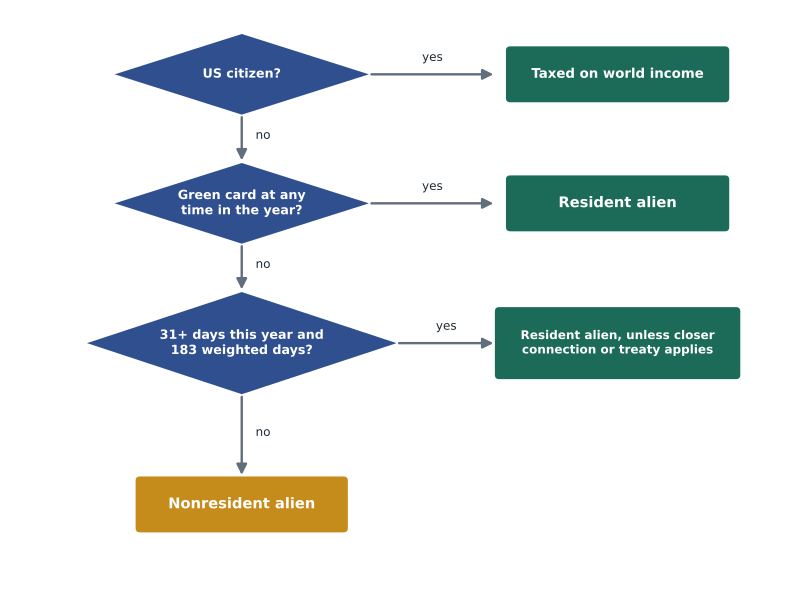
Every US citizen, including a person born in the United States who has never lived there, is taxed on worldwide income. A foreign national, called an alien in the Code, is a resident alien for income tax purposes under section 7701(b) if either of two objective tests is met. The first is the green card test: a person who is a lawful permanent resident at any time during the year is a resident, until the status is formally revoked or abandoned. The second is the substantial presence test, which counts days of physical presence.
Under the substantial presence test, a person is a resident alien for a calendar year if they are physically present in the United States for at least 31 days in that year and for at least 183 days over the three-year period consisting of the current year, the first preceding year and the second preceding year, counting all days in the current year, one third of the days in the first preceding year and one sixth of the days in the second preceding year. Days do not count for exempt individuals, such as foreign government officials, teachers and trainees on J or Q visas for limited periods, and students on F, J, M or Q visas for up to five calendar years. Days spent in transit, days a person cannot leave because of a medical condition that arose in the United States, and days of regular commuters from Canada or Mexico also do not count.
Exceptions, elections and dual-status years
A person who meets the substantial presence test may still be treated as a nonresident in two situations. Under the closer connection exception, a person present for fewer than 183 days in the current year who has a tax home in a foreign country and a closer connection to that country than to the United States can file Form 8840 to be treated as a nonresident. Under a tax treaty, a person who is a resident of both countries under their domestic laws can use the treaty's tie-breaker rules to be treated as a resident of the other country only; the position is disclosed on Form 8833. A person who arrives late in a year and will meet the test in the following year may make a first-year choice to be treated as a resident from arrival.
The program below applies the substantial presence test to three invented visitors. Observe that a person can be a resident alien in a year when they spent only 100 days in the United States, because days from prior years count.
# Substantial presence test, United States, 2026 (illustrative)
# days present in the US in 2026, 2025 and 2024 (invented)
people = {
    "Arjun (contract engineer)":       (140, 150, 120),
    "Mei (frequent business visitor)":(100, 180, 180),
    "Ola (seasonal guide)":            (30, 270, 300),
}
for name, (d0, d1, d2) in people.items():
    weighted = d0 + d1 / 3 + d2 / 6
    meets = d0 >= 31 and weighted >= 183
    print(f"{name:<32} 2026:{d0:>4}  weighted:{weighted:>6.1f}  "
          f"resident alien: {'yes' if meets else 'no'}")
print()
print("A person who meets the test may still be a nonresident under the")
print("closer-connection exception (fewer than 183 days in the current year,")
print("tax home abroad, Form 8840) or a tax treaty tie-breaker (Form 8833).")Arjun (contract engineer) 2026: 140 weighted: 210.0 resident alien: yes Mei (frequent business visitor) 2026: 100 weighted: 190.0 resident alien: yes Ola (seasonal guide) 2026: 30 weighted: 170.0 resident alien: no A person who meets the test may still be a nonresident under the closer-connection exception (fewer than 183 days in the current year, tax home abroad, Form 8840) or a tax treaty tie-breaker (Form 8833).
Arjun's 140 days in 2026, plus a third of 150 and a sixth of 120, total 210 weighted days, so he is a resident alien for 2026 and taxed on worldwide income for the year. Mei spent only 100 days in the United States in 2026, but her heavy presence in the two prior years brings her to 190 weighted days; she may be able to use the closer connection exception, because she was present fewer than 183 days in 2026, if her tax home and ties are abroad. Ola fails the 31-day threshold for 2026 even though he was present for most of the two previous years, so he is a nonresident alien for 2026 regardless of the weighted total. A person who is a resident for only part of a year, for example because they arrived in September, is a dual-status alien, taxed as a nonresident before the residency starting date and as a resident after it.
US citizens and residents abroad
Citizens and resident aliens living abroad remain taxable on worldwide income, but three reliefs prevent most double taxation. The foreign earned income exclusion in section 911 lets a qualifying individual exclude foreign earned income up to $132,900 for 2026, plus a housing exclusion, if their tax home is abroad and they meet either the bona fide residence test or the physical presence test of 330 full days abroad in 12 consecutive months. The foreign tax credit in section 901 credits foreign income taxes against US tax on the same income, subject to a limitation. Tax treaties allocate taxing rights, although most US treaties contain a saving clause that preserves US taxation of its own citizens. Separate reporting rules carry heavy penalties: a citizen with foreign financial accounts exceeding $10,000 in total at any time in the year must file an FBAR (FinCEN Form 114), and Form 8938 is required for specified foreign financial assets above higher thresholds.
Worked problem
Leah's brother moves to Toronto
Leah's brother Kai, a US citizen, accepts a permanent job in Toronto. He moves on 1 July 2026, and his family follows in August. His 2026 salary is $90,000 from his US employer to 30 June and the equivalent of $65,000 from his Canadian employer after that. How is he taxed in the United States?
Show solution
- As a citizen, Kai remains taxable in the United States on worldwide income for the whole year and must file Form 1040.
- He will not meet the 330-day physical presence test or the bona fide residence test for 2026 as a full year, but he can qualify on a 12-month period that overlaps 2027 and prorate the exclusion; alternatively he can claim a foreign tax credit.
- Canadian tax on his Canadian salary will usually exceed US tax on the same income, so the foreign tax credit often eliminates US tax on it and creates carryforwards.
- He must file an FBAR if his Canadian accounts exceed $10,000 in total at any time, and report his Canadian registered plans as required.
Answer: Still a US taxpayer on world income; the foreign tax credit or the earned income exclusion relieves double tax.
| Status | Taxed in the United States on | Return |
|---|---|---|
| Citizen (anywhere) | World income for the year | Form 1040 |
| Resident alien (green card or substantial presence) | World income for the year | Form 1040 |
| Dual-status alien | World income while resident; US-source and effectively connected income while nonresident | Form 1040 or 1040-NR with statement |
| Nonresident alien | Effectively connected income at graduated rates; FDAP income at 30% or treaty rate | Form 1040-NR |
Filing status
Filing status is determined on the last day of the tax year. There are five statuses. Married filing jointly combines both spouses' income and deductions on one return, with joint and several liability for the tax. Married filing separately is available to married people but usually costs more, because many credits are reduced or unavailable and some brackets are narrower. Head of household is available to an unmarried person, or one considered unmarried, who pays more than half the cost of keeping up a home that is the main home of a qualifying person for more than half the year; it carries wider brackets and a larger standard deduction than single. Qualifying surviving spouse lets a widow or widower with a dependent child use joint rates for the two years after the year of death. Single applies to everyone else.
The Brandts file jointly, which is almost always the better choice for a married couple with unequal incomes. Married couples can face a marriage penalty, when their joint tax exceeds the combined tax they would pay as two single people, or a marriage bonus, when it is lower. Since 2018 the joint brackets have been exactly double the single brackets for every rate up to 35 percent, so penalties mainly arise in the 37 percent bracket and from credits with phase-outs that are not doubled for joint filers.
| Filing status (2026) | Standard deduction | Who may use it |
|---|---|---|
| Single | $16,100 | Unmarried and not eligible for another status |
| Married filing jointly | $32,200 | Married at year end, both spouses agree |
| Married filing separately | $16,100 | Married at year end, filing separate returns |
| Head of household | $24,150 | Unmarried, paying over half the cost of a home for a qualifying person |
| Qualifying surviving spouse | $32,200 | Widowed in the prior two years, with a dependent child |
Dependents and who must file
A dependent can be a qualifying child or a qualifying relative. A qualifying child must be the taxpayer's child, stepchild, foster child, sibling or a descendant of one of them; be under 19 at year end, or under 24 and a full-time student, or permanently disabled; live with the taxpayer for more than half the year; not provide more than half of their own support; and not file a joint return except to claim a refund. A qualifying relative must have gross income below an indexed limit, receive more than half of their support from the taxpayer, and either live with the taxpayer all year or be a relative listed in the Code. Since 2018 the personal exemption for each dependent has been zero, a change the 2025 act made permanent, but dependents still determine head of household status, the child tax credit, the credit for other dependents and the earned income tax credit.
An individual must generally file if gross income equals or exceeds the standard deduction for their filing status, with adjustments for age and dependents, or if net earnings from self-employment are $400 or more, or if they owe special taxes or received advance credit payments. Many people below the threshold should still file to claim refundable credits such as the earned income tax credit and the refundable portion of the child tax credit, and to recover income tax withheld. The return for a person who died in the year is filed by the personal representative, by the normal due date.
Common mistakes
MistakeAssuming a US citizen living abroad no longer needs to file.
InsteadCitizens are taxed on worldwide income wherever they live and must file if over the threshold.
MistakeCounting only current-year days for the substantial presence test.
InsteadCount all current-year days plus one third and one sixth of the two prior years, after the 31-day threshold.
MistakeIgnoring foreign account reporting.
InsteadAn FBAR is required when foreign accounts exceed $10,000 in total at any time in the year.
MistakeChoosing married filing separately to save tax without checking credits.
InsteadSeparate filing often loses credits and narrows brackets; compare both calculations.
MistakeForgetting withholding on payments to nonresident aliens.
InsteadThe US payer must withhold 30 percent, or the treaty rate, on FDAP income.
Summary and key terms
- The United States taxes citizens and resident aliens on world income and nonresident aliens on US-connected income.
- A foreign national is a resident alien under the green card test or the substantial presence test.
- The substantial presence test requires 31 days this year and 183 weighted days over three years.
- Dual-status aliens are taxed as residents only for the resident part of the year.
- Citizens abroad use the foreign earned income exclusion or the foreign tax credit to avoid double tax.
- Nonresident aliens pay graduated tax on effectively connected income and 30 percent on FDAP income.
- Treaty tie-breakers resolve dual residence by looking at a permanent home, center of vital interests, habitual abode and nationality.
- Filing status, set at year end, determines brackets, the standard deduction and access to credits.
- Resident alien
- A foreign national taxed as a resident because of the green card test or the substantial presence test.
- Substantial presence test
- The day-count test of 31 days in the current year and 183 weighted days over three years.
- Dual-status alien
- A person who is a nonresident for part of the year and a resident for the rest.
- Filing status
- The category, determined at year end, that sets a taxpayer's brackets and standard deduction.
- Head of household
- A filing status for unmarried taxpayers who maintain a home for a qualifying person.
- FBAR
- FinCEN Form 114, required when foreign financial accounts exceed $10,000 in total.
- Factual resident
- A person who has settled into a routine of life in a country, determined from all the facts.
- Tie-breaker rules
- Treaty rules that assign a dual resident to one country based on home, vital interests, habitual abode and nationality.
- Foreign tax credit
- A credit against domestic tax for foreign income tax paid on the same income.
Practice problems
Work each problem on paper first, then reveal the answer to check.
What is the difference between a resident alien and a nonresident alien?
Show answer
A resident alien meets the green card or substantial presence test and is taxed on world income; a nonresident alien is taxed only on US-connected income.
Change Ola's 2026 days in the program to 31. What happens?
Show answer
His weighted total becomes 171 days, still below 183, so he remains a nonresident alien.
Arjun's days are 140, 150 and 120. Show the weighted total.
Show answer
140 + 150/3 + 120/6 = 140 + 50 + 20 = 210 days.
Name two groups whose days do not count for the substantial presence test.
Show answer
Exempt individuals such as qualifying students and teachers or trainees, and regular commuters from Canada or Mexico.
What is the flat rate on FDAP income paid to nonresident aliens before treaty relief?
Show answer
30 percent.
What is the 2026 foreign earned income exclusion limit?
Show answer
$132,900, plus a housing exclusion.
Why might a married couple pay more tax filing separately?
Show answer
Many credits are reduced or unavailable and some limits are halved for separate filers.
Name the five filing statuses.
Show answer
Single, married filing jointly, married filing separately, head of household and qualifying surviving spouse.
Under the Canada–US treaty, what is the first tie-breaker test for an individual?
Show answer
Where the individual has a permanent home available to them.
Kai's Canadian accounts reach $14,000. What must he file?
Show answer
An FBAR (FinCEN Form 114), because his foreign accounts exceeded $10,000.
Lesson quiz · 5 questions
Score 60% or more to complete this lesson.
Create a free account to save your progress, take quizzes and earn a certificate.