
ACCT-351 · Lesson 12 of 12 · 26 min
Filing, examinations, disputes and a complete return
This final lesson does two things. First, it covers the administrative life of a return: when it is due, what happens if it is late or tax is paid late, how estimated tax works, how the IRS examines returns, how long it has to assess additional tax, how a taxpayer disputes a proposed adjustment, and what penalties apply to errors and evasion. Second, it assembles the Brandts' complete 2026 federal return from the pieces computed in lessons 3 to 11 and uses it to review the course. As throughout, the figures are illustrative and the computation is federal; a real return also includes state tax and many details omitted here.
Filing deadlines and late filing
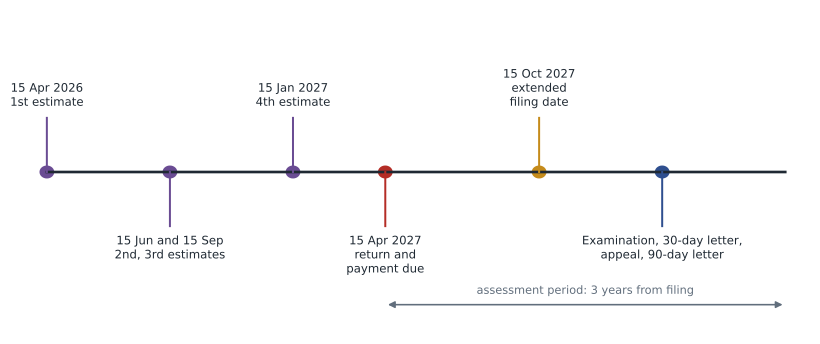
Form 1040 for 2026 is due on 15 April 2027 (moved to the next business day if it falls on a weekend or holiday). An automatic six-month extension to 15 October is available by filing Form 4868 or making an electronic payment designated as an extension payment, but it extends only the time to file, not the time to pay: tax not paid by 15 April bears interest and may bear a failure-to-pay penalty. US citizens living abroad get an automatic two-month extension to 15 June. Most returns are filed electronically, and preparers who file more than ten returns a year must e-file.
The failure-to-file penalty in section 6651(a)(1) is 5 percent of the unpaid tax for each month or part of a month the return is late, up to 25 percent, with a minimum penalty for returns more than 60 days late. The failure-to-pay penalty is 0.5 percent of the unpaid tax per month, up to 25 percent; when both apply in the same month, the filing penalty is reduced by the payment penalty. Interest on underpayments is charged at the federal short-term rate plus 3 percentage points, compounded daily. A taxpayer owed a refund faces no penalty for filing late but must claim the refund within three years of the due date, or it is lost. The IRS can waive penalties for reasonable cause, and its first-time abatement policy usually removes filing and payment penalties for a taxpayer with a clean record for the previous three years.
Estimated tax
Taxpayers whose income is not fully covered by withholding must pay estimated tax in four installments, due 15 April, 15 June and 15 September of the tax year and 15 January of the following year. Section 6654 imposes an addition to tax, computed like interest, on underpayments unless the tax owing after withholding and credits is less than $1,000 or the payments meet a safe harbor: 90 percent of the current year's tax, or 100 percent of the prior year's tax (110 percent if the prior year's AGI exceeded $150,000, or $75,000 for married filing separately). Withholding is treated as paid evenly through the year regardless of when it was withheld, which makes increasing withholding late in the year a useful way to cure an underpayment. Farmers and fishermen have special rules.
Assessment and reassessment
After a return is filed, the IRS processes it and may later select it for examination. Many adjustments come from automated underreporting notices (CP2000) when income on the return does not match information returns. Examinations may be correspondence examinations by mail, office examinations or field examinations at the taxpayer's place of business. Under section 6501, the IRS generally must assess additional tax within three years after the return was filed (a return filed early is treated as filed on the due date). The period is six years if the taxpayer omitted more than 25 percent of gross income, and unlimited if the return was fraudulent or no return was filed. The taxpayer and the IRS can agree to extend the period on Form 872, which the IRS often requests during an examination. A refund claim must generally be filed within three years after the return was filed or two years after the tax was paid, whichever is later.
Taxpayers should keep records supporting each item on a return for at least as long as the period of limitations remains open, and records of property basis for as long as the property is held plus three years. The IRS has broad summons powers in section 7602 to obtain records from taxpayers and third parties.
Appeals and litigation
After an examination, the IRS issues a report and a 30-day letter proposing adjustments. The taxpayer can agree, or ask for a hearing before the IRS Independent Office of Appeals, which is separate from examinations and can weigh the hazards of litigation in settling. If no agreement is reached, the IRS issues a statutory notice of deficiency, the 90-day letter, and the taxpayer has 90 days (150 days if addressed outside the country) to petition the US Tax Court. The Tax Court is the only forum in which the taxpayer can litigate without first paying the tax; its small tax case procedure, for disputes of $50,000 or less per year, is informal and its decisions cannot be appealed or cited as precedent. Alternatively, the taxpayer can pay the tax, claim a refund and, if refused, sue in a federal district court, where a jury is available, or the Court of Federal Claims. Appeals go to the circuit courts of appeals and, rarely, the Supreme Court. The Taxpayer Advocate Service helps taxpayers with problems they cannot resolve through normal channels.
Penalties for errors and evasion
The accuracy-related penalty in section 6662 is 20 percent of an underpayment attributable to negligence or disregard of rules, a substantial understatement of income tax (one exceeding the greater of 10 percent of the correct tax and $5,000), or certain valuation misstatements; it rises to 40 percent for gross valuation misstatements and undisclosed transactions lacking economic substance. Disclosure of a position with a reasonable basis, or substantial authority for the position, can reduce or avoid the substantial understatement penalty, and reasonable cause and good faith are a defense to most accuracy penalties. The civil fraud penalty in section 6663 is 75 percent of the underpayment attributable to fraud, which the IRS must prove by clear and convincing evidence. Tax evasion is a felony under section 7201. Taxpayers who discover errors can file an amended return on Form 1040-X; those with willful non-compliance, especially involving foreign accounts, may use the IRS voluntary disclosure practice.
| Penalty | Section | Amount |
|---|---|---|
| Failure to file | 6651(a)(1) | 5% per month, up to 25% |
| Failure to pay | 6651(a)(2) | 0.5% per month, up to 25% |
| Underpayment of estimated tax | 6654 | Interest-like addition on each underpaid installment |
| Accuracy-related | 6662 | 20% (40% for gross valuation misstatements and undisclosed transactions lacking economic substance) |
| Civil fraud | 6663 | 75% of the underpayment due to fraud |
| Preparer penalty for unreasonable positions | 6694 | Greater of $1,000 and 50% of the preparer's fee |
| Tax evasion | 7201 | Fines and up to 5 years in prison |
Capstone: the Brandts' 2026 Form 1040
The program below assembles the Brandts' 2026 joint return. Each line comes from an earlier lesson: Leah's W-2 wages from lesson 4, Brandt Aerial's Schedule C profit and self-employment tax from lessons 6 and 7, interest, dividends and the suspended rental loss from lesson 8, the capital gain from lesson 9, and the standard deduction and child tax credit from lesson 11. Tomás's W-2 shows $38,000 of wages.
# Capstone: the Brandts' 2026 Form 1040, married filing jointly, simplified (illustrative)
wages = 94_320 + 38_000            # Leah's and Tomas's Forms W-2, box 1
interest, qualified_div = 640, 2_000
sched_c, rental = 12_910, 0        # rental loss of 2,073 is suspended (passive)
net_cap_gain = 12_501.50
se_tax = 1_824.12
total_income = wages + interest + qualified_div + sched_c + rental + net_cap_gain
agi = total_income - se_tax / 2
standard = 32_200
before_qbi = agi - standard
pref = qualified_div + net_cap_gain
qbi = min(0.20 * (sched_c - se_tax / 2), 0.20 * (before_qbi - pref))
taxable = before_qbi - qbi

BR = [(24_800, 0.10), (100_800, 0.12), (211_400, 0.22), (403_550, 0.24),
      (512_450, 0.32), (768_700, 0.35), (float('inf'), 0.37)]
def bracket_tax(x):
    t, lo = 0.0, 0.0
    for hi, r in BR:
        if x > lo:
            t += (min(x, hi) - lo) * r
        lo = hi
    return t
ordinary = taxable - pref
zero_room = max(0, 98_900 - ordinary)              # 0% band ends at 98,900 (MFJ)
at_zero = min(pref, zero_room)
at_15 = min(pref - at_zero, max(0, 613_700 - max(ordinary, 98_900)))
at_20 = pref - at_zero - at_15
income_tax = bracket_tax(ordinary) + 0.15 * at_15 + 0.20 * at_20
ctc = 2_200
total_tax = income_tax - ctc + se_tax
withheld = 11_900 + 2_600

rows = [("Wages", wages), ("Taxable interest", interest), ("Qualified dividends", qualified_div),
        ("Schedule C profit", sched_c), ("Capital gain (Schedule D)", net_cap_gain),
        ("Total income", total_income), ("Less half of SE tax", -se_tax / 2),
        ("Adjusted gross income", agi), ("Less standard deduction", -standard),
        ("Less QBI deduction", -qbi), ("Taxable income", taxable),
        ("Tax: ordinary income at bracket rates", bracket_tax(ordinary)),
        ("Tax: preferential income at 15%", 0.15 * at_15),
        ("Less child tax credit", -ctc), ("Plus self-employment tax", se_tax),
        ("Total tax", total_tax), ("Less federal tax withheld", -withheld),
        ("Amount owed, due 15 April 2027", total_tax - withheld)]
for k, v in rows:
    print(f"{k:<40}{v:>11,.2f}")
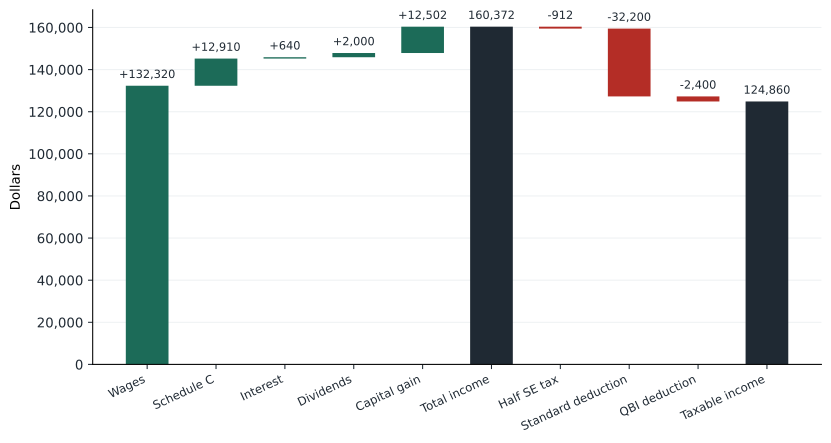
print(f"Withholding covers {withheld / total_tax:.1%} of the 2026 tax: the 90% safe harbor is met")Wages 132,320.00 Taxable interest 640.00 Qualified dividends 2,000.00 Schedule C profit 12,910.00 Capital gain (Schedule D) 12,501.50 Total income 160,371.50 Less half of SE tax -912.06 Adjusted gross income 159,459.44 Less standard deduction -32,200.00 Less QBI deduction -2,399.59 Taxable income 124,859.85 Tax: ordinary income at bracket rates 13,702.84 Tax: preferential income at 15% 2,175.22 Less child tax credit -2,200.00 Plus self-employment tax 1,824.12 Total tax 15,502.18 Less federal tax withheld -14,500.00 Amount owed, due 15 April 2027 1,002.18 Withholding covers 93.5% of the 2026 tax: the 90% safe harbor is met
Total income is $160,371.50 and AGI, after the deductible half of self-employment tax, is $159,459.44. The standard deduction of $32,200 and the QBI deduction of $2,399.59 leave taxable income of $124,859.85. The $14,501.50 of qualified dividends and net capital gain is taxed at 15 percent, and the remaining $110,358.35 at the bracket rates, giving income tax of $15,878.06. The $2,200 child tax credit reduces it and $1,824.12 of self-employment tax is added, for total tax of $15,502.18. Withholding from both W-2s was $14,500, so they owe $1,002.18 by 15 April 2027. Because withholding covered 93.5 percent of the 2026 tax, more than 90 percent, no estimated tax penalty applies even though the balance is over $1,000. The suspended rental loss of $2,073 carries forward on Form 8582.
| Item on the Brandts' return | Amount | Lesson |
|---|---|---|
| Wages (both W-2s, after Leah's 401(k) deferral) | $132,320 | 4, 5 |
| Schedule C profit after $12,200 bonus depreciation | $12,910 | 6, 7 |
| Self-employment tax; deductible half | $1,824.12; $912.06 | 6 |
| Interest; qualified dividends | $640; $2,000 | 8 |
| Rental loss (suspended) | $2,073 | 8 |
| Net capital gain | $12,501.50 | 9 |
| Standard deduction; QBI deduction | $32,200; $2,399.59 | 6, 11 |
| Child tax credit | $2,200 | 11 |
| Total tax | $15,502.18 | 12 |
Reviewing the return and planning ahead
A good preparer does not stop at the bottom line. Reviewing the Brandts' return suggests several points for 2027. Their 2026 AGI exceeded $150,000, so the prior-year safe harbor for 2027 estimated tax requires payments of 110 percent of the 2026 tax; if their withholding stays at $14,500, they should increase it or pay estimated tax to avoid a penalty if Brandt Aerial earns more. Leah could raise her 401(k) deferral, which would save tax at 22 percent. The suspended rental loss will be released when the condominium is sold or if their income falls. Bonus depreciation made 2026 Schedule C profit low, but it also reduced the basis of the drone and computer to zero, so any sale will produce section 1245 recapture. Leah's next sale of shares should identify high-basis lots specifically. And as Brandt Aerial grows, an S corporation election might reduce self-employment tax, a topic for ACCT-352. Each of these is ordinary tax planning that uses provisions as Congress intended.
Worked problem
Estimated tax for 2027
The Brandts expect 2027 income similar to 2026. Their 2026 total tax was $15,502.18 and their 2026 AGI exceeded $150,000. What estimated payments, in addition to $14,500 of expected withholding, keep them inside the prior-year safe harbor for 2027?
Show solution
- The prior-year safe harbor requires 110% × $15,502.18 = $17,052.40 of total payments.
- Expected withholding covers $14,500, leaving $2,552.40.
- They can pay about $638.10 with each of the four estimated payments on Form 1040-ES (15 April, 15 June and 15 September 2027 and 15 January 2028), or ask their employers to withhold an extra $2,552.40 over the year, which is treated as paid evenly.
- If 2027 income turns out lower, the 90 percent of current-year tax test may require less.
Answer: About $2,552 more, paid as four estimated payments of about $638 or through extra withholding.
Common mistakes
MistakeAssuming an extension gives more time to pay.
InsteadForm 4868 extends only the filing deadline; interest and penalties apply to tax not paid by 15 April.
MistakeMissing the 90-day deadline to petition the Tax Court.
InsteadThe deadline is jurisdictional; missing it means paying first and suing for a refund.
MistakeRelying on the $1,000 rule when the balance is larger.
InsteadAbove $1,000, a penalty applies unless a safe harbor such as 90 percent of current-year or 100–110 percent of prior-year tax is met.
MistakeBelieving the IRS can never assess after three years.
InsteadOmissions over 25 percent of gross income extend the period to six years; fraud has no limit.
MistakeFiling late when a refund is due and assuming nothing is lost.
InsteadRefund claims are lost if not made within three years.
Summary and key terms
- Form 1040 is due on 15 April; an extension to 15 October extends filing but not payment.
- Failure to file is 5 percent a month and failure to pay 0.5 percent a month, each up to 25 percent.
- Estimated tax safe harbors are 90 percent of current-year or 100 percent (110 percent above $150,000 AGI) of prior-year tax.
- The IRS has three years to assess, six for large omissions and no limit for fraud.
- Disputes go to IRS Appeals and then the Tax Court, a district court or the Court of Federal Claims.
- Accuracy-related penalties are 20 percent; civil fraud is 75 percent; evasion is a felony.
- The Brandts' 2026 total tax is $15,502.18; they owe $1,002.18 with no estimated tax penalty.
- Reviewing the finished return is the start of planning for the next year.
- Statute of limitations
- The period within which the IRS must assess tax, generally three years after filing.
- Statutory notice of deficiency
- The 90-day letter that allows a taxpayer to petition the Tax Court.
- Estimated tax
- Quarterly payments of tax on income not covered by withholding.
- Safe harbor
- A payment level that protects a taxpayer from the estimated tax penalty.
- Accuracy-related penalty
- A 20 percent penalty for negligence or substantial understatement.
- Independent Office of Appeals
- The IRS office that settles disputes independently of examination staff.
- Reasonable cause
- Circumstances beyond a taxpayer's control that excuse a penalty.
- Tax evasion
- A deliberate attempt to evade tax, a criminal offense.
Practice problems
Work each problem on paper first, then reveal the answer to check.
A return with $10,000 unpaid is filed three months late. What are the failure-to-file and failure-to-pay penalties, roughly?
Show answer
Failure to pay 3 × 0.5% = $150; failure to file 3 × 5% = $1,500 less the $150 overlap = $1,350; total about $1,500, plus interest.
In the capstone program, increase Leah's 401(k) deferral by $5,000. How does total tax change?
Show answer
Wages fall by $5,000, all in the 22 percent bracket, so tax falls by about $1,100.
When does the assessment period end for a 2026 return filed on 1 March 2027?
Show answer
15 April 2030, because an early return is treated as filed on the due date.
What is the deadline to petition the Tax Court after a notice of deficiency?
Show answer
90 days after the notice is mailed (150 days if addressed outside the United States).
What are the two main estimated tax safe harbors?
Show answer
Paying 90 percent of the current year's tax, or 100 percent of the prior year's (110 percent if prior AGI exceeded $150,000).
Who must prove civil fraud, and to what standard?
Show answer
The IRS, by clear and convincing evidence.
What is first-time abatement?
Show answer
An IRS policy removing filing and payment penalties for taxpayers with clean records for the prior three years.
Why might a taxpayer choose a district court over the Tax Court?
Show answer
To have a jury trial or to benefit from favorable circuit precedent, after paying the tax.
Name two planning points from the capstone review.
Show answer
For example adjusting withholding for the 110 percent safe harbor, raising 401(k) deferrals, identifying high-basis lots and considering an S corporation.
How long should property basis records be kept?
Show answer
For as long as the property is held, plus the assessment period for the year of sale.
Lesson quiz · 5 questions
Score 60% or more to complete this lesson.
Create a free account to save your progress, take quizzes and earn a certificate.