
ACCT-351 · Lesson 11 of 12 · 24 min
Retirement accounts, deductions and credits
The previous lessons covered wages, business income, investment income and capital gains. This lesson gathers the remaining pieces of an individual's return: other kinds of income such as Social Security benefits and retirement distributions, the tax-advantaged accounts that shelter saving, itemized deductions and the choice between itemizing and taking the standard deduction, the major credits, and the alternative minimum tax. Along the way it settles the Brandts' choices for 2026 and introduces the new deduction for taxpayers aged 65 and over through Leah's father.
Other income
Other items of gross income include unemployment compensation, alimony received under divorce or separation agreements executed before 2019 (later agreements are neither deductible nor taxable), distributions from traditional IRAs and pre-tax 401(k) accounts, pensions and annuities (with a tax-free return of after-tax contributions), gambling winnings, prizes, jury duty pay and canceled debts. Gambling losses are deductible only as an itemized deduction and only up to winnings, and from 2026 the 2025 act limits the deduction to 90 percent of losses. Social Security benefits are partly taxable for higher-income recipients: if provisional income (AGI excluding Social Security, plus tax-exempt interest, plus half of benefits) exceeds $25,000 for single filers or $32,000 for joint filers, up to 50 percent of benefits are taxable, and above $34,000 or $44,000, up to 85 percent. These thresholds have never been indexed. Child support, gifts, inheritances, qualified scholarships for tuition and Roth IRA qualified distributions are not taxable.
Tax-advantaged accounts
Tax-advantaged accounts are the most widely used tax planning tool in the United States. Each combines a deduction or a tax-free withdrawal with tax-free growth inside the account.
| Account | Contributions | Growth | Withdrawals | 2026 limit |
|---|---|---|---|---|
| Traditional IRA | Deductible, phased out if covered by a workplace plan | Tax-deferred | Taxable; 10% additional tax before 59½ unless excepted | $7,500, plus $1,100 catch-up at 50+ |
| Roth IRA | Not deductible; income limits | Tax-free | Tax-free if qualified (age 59½ and five years) | Same combined limit as traditional |
| 401(k), 403(b) | Pre-tax or Roth deferrals through payroll | Tax-deferred or tax-free | Taxable (pre-tax) or tax-free (Roth) | $24,500 deferral, plus catch-up |
| Health savings account | Deductible, with a high-deductible health plan | Tax-free | Tax-free for medical expenses | $4,400 self-only, $8,750 family, +$1,000 at 55+ |
| 529 plan | Not deductible federally (many states allow a deduction) | Tax-free | Tax-free for qualified education costs | No annual federal limit; gift tax rules apply |
Traditional IRA contributions are deductible in full if neither spouse is covered by a workplace retirement plan; otherwise the deduction phases out over modified AGI ranges that depend on filing status and on which spouse is covered. Leah is covered by Red River's 401(k), and the Brandts' income is above the phase-out range for a covered participant, so a traditional IRA contribution would not be deductible for her. Roth IRA contributions are limited above higher income ranges, though high earners can use a nondeductible traditional IRA contribution followed by a conversion. The HSA is the only account that is deductible on the way in and tax-free on the way out when used for medical costs, which is why it is often called triple tax-advantaged. Whether a traditional or Roth account is better depends mostly on the taxpayer's marginal rate now compared with their expected rate on withdrawal.
Worked problem
Social Security and the senior deduction
Leah's father, a 70-year-old widower filing as single, receives $30,000 of Social Security benefits, a $28,000 pension and $4,000 of taxable interest in 2026. How much of his Social Security is taxable, what deductions does he get, and what is his federal income tax?
Show solution
- Provisional income: $28,000 + $4,000 + half of $30,000 = $47,000, which exceeds the $34,000 upper threshold.
- Taxable benefits: the lesser of 85% × $30,000 = $25,500 and 85% × ($47,000 − $34,000) + $4,500 = $15,550, so $15,550.
- AGI: $28,000 + $4,000 + $15,550 = $47,550.
- Deductions: standard $16,100 + additional amount for age $2,050 + senior deduction $6,000 (his MAGI is below $75,000) = $24,150.
- Taxable income $23,400; tax: $1,240 + 12% × $11,000 = $2,560.
Answer: $15,550 of benefits is taxable; deductions total $24,150; tax is $2,560.
Itemized deductions
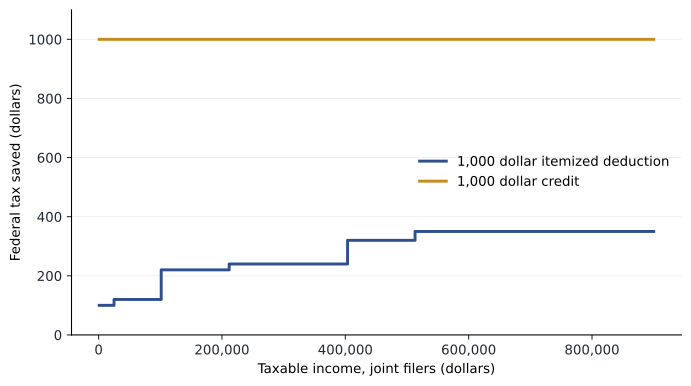
A taxpayer who itemizes deducts the total of the following on Schedule A instead of the standard deduction. State and local income or sales taxes and property taxes are deductible up to a cap, which the 2025 act raised from $10,000 to $40,000 for 2025 and $40,400 for 2026, rising 1 percent a year through 2029 and reverting to $10,000 in 2030; the cap is reduced by 30 percent of modified AGI above $505,000 for 2026, but not below $10,000. Home mortgage interest is deductible on up to $750,000 of acquisition debt (made permanent), and from 2026 mortgage insurance premiums are again deductible. Charitable contributions are deductible up to percentage limits of AGI (60 percent for cash to public charities), and from 2026 only to the extent they exceed 0.5 percent of AGI. Medical and dental expenses are deductible above 7.5 percent of AGI. Casualty losses are deductible only in federally declared disasters. For taxpayers in the 37 percent bracket, the 2025 act limits the value of itemized deductions to 35 cents per dollar.
Credits
Credits reduce tax dollar for dollar. Non-refundable credits can reduce income tax to zero; refundable credits are paid even if they exceed the tax.
| Credit | 2026 amount | Notes |
|---|---|---|
| Child tax credit | $2,200 per qualifying child under 17 | Refundable up to $1,700; phased out above $200,000 ($400,000 joint); child needs an SSN |
| Credit for other dependents | $500 per dependent | Non-refundable; for older children and relatives |
| Earned income tax credit | Up to $664 (no children) to $8,231 (three or more) | Refundable; phased out by income; investment income limit $12,200 |
| Child and dependent care credit | A percentage of up to $3,000 ($6,000 for two or more) of care costs | The 2025 act raised the maximum rate from 2026 |
| American opportunity credit | Up to $2,500 per student | First four years of college; 40% refundable |
| Lifetime learning credit | Up to $2,000 per return | Phased out between $80,000 and $90,000 ($160,000–$180,000 joint) |
| Adoption credit | Up to $17,670 | Up to $5,120 refundable from 2025 |
| Foreign tax credit | Foreign income tax paid, subject to a limit | Lesson 2 |
The child tax credit is the credit most families claim. For 2026 it is $2,200 for each qualifying child under 17 who has a Social Security number, indexed to inflation, with up to $1,700 refundable for families with earnings above $2,500. It is reduced by $50 for each $1,000 of modified AGI above $200,000, or $400,000 for joint filers, so middle-income families like the Brandts receive the full amount. The earned income tax credit is the largest refundable credit for low-income working families. Many energy credits, including those for new and used clean vehicles and for energy-efficient home improvements, ended for vehicles acquired after September 2025 or property placed in service after 2025 under the 2025 act.
The Brandts' choices
The program checks whether the Brandts should itemize and computes their child tax credit, then shows how the SALT cap shrinks for a high-income couple.
# Standard or itemized deduction, and the child tax credit, 2026 (illustrative)
agi = 159_459                                   # the Brandts' approximate AGI
salt_paid = 7_900                               # state income tax and property tax
salt_cap = 40_400
if agi > 505_000:                               # cap phases down above $505,000 of MAGI
    salt_cap = max(10_000, salt_cap - 0.30 * (agi - 505_000))
itemized = {"State and local taxes (capped)": min(salt_paid, salt_cap),
            "Mortgage interest (home)": 9_800,
            "Charitable gifts": 1_200,
            "Medical above 7.5% of AGI": max(0, 3_400 - 0.075 * agi)}
standard = 32_200
total = sum(itemized.values())
for k, v in itemized.items():
    print(f"  {k:<34}{v:>9,.0f}")
print(f"Itemized total {total:,.0f} versus standard {standard:,}: "
      f"take the {'itemized' if total > standard else 'standard'} deduction")

# Child tax credit for Nora
children, ctc = 1, 2_200
reduction = 50 * max(0, -(-(agi - 400_000) // 1_000))   # $50 per $1,000 over $400,000
credit = max(0, children * ctc - reduction)
print(f"Child tax credit: {credit:,} (refundable portion up to $1,700 per child)")

# High-income couple for contrast: MAGI $640,000, SALT paid $52,000
agi2 = 640_000
cap2 = max(10_000, 40_400 - 0.30 * (agi2 - 505_000))
print(f"At MAGI {agi2:,}: SALT cap falls to {cap2:,.0f}")State and local taxes (capped) 7,900 Mortgage interest (home) 9,800 Charitable gifts 1,200 Medical above 7.5% of AGI 0 Itemized total 18,900 versus standard 32,200: take the standard deduction Child tax credit: 2,200 (refundable portion up to $1,700 per child) At MAGI 640,000: SALT cap falls to 10,000
Their potential itemized deductions total $18,900: $7,900 of state income and property taxes (well under the SALT cap), $9,800 of mortgage interest and $1,200 of charitable gifts, with no medical expenses above the 7.5 percent floor. That is far below their $32,200 standard deduction, so they take the standard deduction, like most households. Because they do not itemize, their charitable gifts give no deduction in 2026 unless they qualify for the new non-itemizer deduction of up to $2,000 for cash gifts to public charities by joint filers, which starts in 2026; for simplicity, the capstone ignores it. Their child tax credit is the full $2,200, because their modified AGI is well below $400,000. For contrast, a couple with $640,000 of modified AGI would see the SALT cap reduced to the $10,000 floor.
Clawbacks and the alternative minimum tax
The alternative minimum tax is a parallel tax system meant to ensure that taxpayers with large deductions, exclusions and preferences pay at least a minimum amount. Alternative minimum taxable income starts from taxable income, adds back items such as the standard deduction, state and local taxes, the spread on exercised incentive stock options and interest on private activity bonds, and subtracts an exemption of $90,100 for single filers and $140,200 for joint filers in 2026. The exemption phases out by 50 cents per dollar of AMTI above $500,000 ($1,000,000 joint), a faster phase-out than before 2026 under the 2025 act. Tax at 26 percent and 28 percent, with capital gains and qualified dividends still at their preferential rates, gives the tentative minimum tax; the taxpayer pays the excess over regular tax as AMT. Since the 2017 changes, few middle-income families pay AMT; the main triggers are large ISO exercises and very large state tax payments.
Two other surtaxes apply to high earners: the 3.8 percent net investment income tax (lesson 8) and the 0.9 percent additional Medicare tax on wages and self-employment income above $200,000 for single filers or $250,000 for joint filers (lesson 5). Phase-outs of credits and deductions, such as the child tax credit and the new deductions for tips, overtime and seniors, create higher effective marginal rates in particular income ranges, a point worth remembering when advising clients near those ranges.
Common mistakes
MistakeItemizing just because the family has a mortgage.
InsteadItemize only if the total exceeds the standard deduction; most families do not.
MistakeForgetting the SALT cap phase-down.
InsteadAbove $505,000 of modified AGI for 2026 the cap shrinks toward $10,000.
MistakeAssuming Social Security is never taxed.
InsteadUp to 85 percent of benefits are taxable above provisional income thresholds.
MistakeDeducting a traditional IRA contribution when covered by a workplace plan at high income.
InsteadThe deduction phases out for covered participants above income limits.
MistakeIgnoring AMT on a large ISO exercise.
InsteadThe ISO spread is an AMT preference in the year of exercise.
Summary and key terms
- Unemployment, retirement distributions and part of Social Security are taxable; child support, gifts and Roth qualified distributions are not.
- Traditional accounts give a deduction now and tax later; Roth accounts give tax-free withdrawals; HSAs give both for medical costs.
- The Brandts' itemized deductions of $18,900 are below the $32,200 standard deduction.
- The SALT cap is $40,400 for 2026, phased down above $505,000 of modified AGI.
- The child tax credit is $2,200 per child, up to $1,700 refundable.
- The EITC is the main refundable credit for low-income workers.
- Taxpayers 65 and over get a $6,000 senior deduction for 2025–2028, phased out above $75,000 of MAGI ($150,000 joint).
- The AMT exemption is $140,200 for joint filers in 2026, phased out at 50 percent above $1,000,000.
- Provisional income
- AGI excluding Social Security, plus tax-exempt interest and half of benefits, used to tax Social Security.
- Traditional IRA
- An individual retirement account with possibly deductible contributions and taxable withdrawals.
- Roth IRA
- An individual retirement account with nondeductible contributions and tax-free qualified withdrawals.
- Health savings account
- An account for people with high-deductible health plans, deductible and tax-free for medical costs.
- SALT cap
- The limit on itemized deductions for state and local taxes.
- Child tax credit
- A credit of $2,200 per qualifying child under 17 for 2026, partly refundable.
- Refundable credit
- A credit paid even if it exceeds tax owed.
- Alternative minimum tax
- A parallel tax computation that sets a floor on tax for taxpayers with large preferences.
Practice problems
Work each problem on paper first, then reveal the answer to check.
Compute the 2026 standard deduction for a married couple, both aged 67.
Show answer
$32,200 + 2 × $1,650 = $35,500, plus each may claim the $6,000 senior deduction if eligible.
In the program, change mortgage interest to $26,000. Should they itemize?
Show answer
Yes: itemized $35,100 exceeds $32,200.
Why is Leah's father taxed on only part of his Social Security?
Show answer
Only up to 85 percent of benefits can be taxable, and the formula taxes $15,550 at his provisional income.
Is alimony received under a 2020 divorce agreement taxable?
Show answer
No; for agreements after 2018 it is neither deductible nor taxable.
From 2026, what floor applies to itemized charitable deductions?
Show answer
0.5 percent of AGI.
What is the medical expense floor for AGI of $60,000?
Show answer
7.5% × $60,000 = $4,500.
Leah's father's MAGI rises to $95,000. What happens to his senior deduction?
Show answer
It is reduced by 6 percent of the excess over $75,000: $6,000 − $1,200 = $4,800.
What are the 2026 IRA and 401(k) limits?
Show answer
$7,500 (plus $1,100 catch-up) and $24,500.
Name two AMT preference items.
Show answer
For example the ISO spread at exercise, state and local taxes and private activity bond interest.
What happens to the SALT cap in 2030?
Show answer
It reverts to $10,000.
Lesson quiz · 5 questions
Score 60% or more to complete this lesson.
Create a free account to save your progress, take quizzes and earn a certificate.