
ACCT-212 · Lesson 8 of 12 · 26 min
Income taxes II: losses, valuation, uncertainty and presentation
Lesson 7 assumed that Northlake was profitable every year, so every deferred tax asset would be used. Real companies make losses, take tax positions that tax authorities may challenge, and operate in several jurisdictions with different rates. This lesson covers the accounting for tax losses, the recognition and valuation of deferred tax assets, uncertain tax positions, the reconciliation of statutory and effective rates and other disclosures, the global minimum tax, and the simpler taxes payable method available to Canadian private enterprises.
Tax losses: carrybacks and carryforwards
When a company's deductions exceed its income, it has a tax loss. Canadian tax law allows a non-capital loss to be carried back three years, generating a refund of tax paid on income in those years, or carried forward twenty years to reduce future taxable income. A carryback produces a current tax asset (a receivable for the refund) because the refund is certain once claimed. A carryforward produces a deferred tax asset, because its benefit depends on future taxable profit. Net capital losses can be carried back three years and forward indefinitely, but only against taxable capital gains.
Worked problem
A tax loss in a difficult year
In 2029 a fire closes one of Northlake's plants for months, and the company has a tax loss of $2,000,000. Taxable income in 2026 to 2028 totalled $1,200,000, on which tax was paid at 26.5 per cent. How is the loss accounted for?
Show solution
- Carry back $1,200,000 to the three prior years: refund receivable 1,200,000 × 26.5% = $318,000 (current tax recovery).
- Carry forward the remaining $800,000: potential deferred tax asset 800,000 × 26.5% = $212,000.
- Recognize the deferred tax asset if it is probable that taxable profit will be available; Northlake expects to return to profit when the plant reopens.
- Total tax recovery for 2029: 318,000 + 212,000 = $530,000, so the after-tax loss is $1,470,000.
Answer: Current tax recovery $318,000 plus a deferred tax asset of $212,000.
Recognizing deferred tax assets
IAS 12 recognizes a deferred tax asset for deductible temporary differences and unused losses and credits only to the extent that it is probable (more likely than not) that taxable profit will be available against which they can be used. Sources of such profit include the reversal of existing taxable temporary differences, expected future taxable profit and tax planning opportunities. When an entity has a history of recent losses, IAS 12 requires convincing other evidence before recognizing an asset for unused losses. The carrying amount of deferred tax assets is reviewed at each reporting date and reduced, or previously unrecognized assets recognized, as circumstances change. IFRS presents only the recognized net amount; it has no separate allowance account.
Both frameworks reach similar answers in most cases, but presentation differs: a US company discloses a gross deferred tax asset and a valuation allowance, while an IFRS company reports only the net amount it recognizes, with the unrecognized amount disclosed in the notes. Readers should watch for changes in these amounts. A company that reverses a large valuation allowance, or recognizes previously unrecognized losses, can report a tax benefit that makes net income look far better than operating results. Conversely, recording a new allowance signals that management has lost confidence in future profits.
Uncertain tax positions
Tax law is complex, and companies often take positions on their returns, such as the deductibility of an expense or the pricing of transactions between related companies in different countries, that a tax authority may challenge. The question for financial reporting is how much of the benefit of such a position to recognize before it is settled.
IFRIC 23, Uncertainty over Income Tax Treatments, effective since 2019, requires an entity to assume the tax authority will examine every position with full knowledge. If it is probable that the authority will accept the treatment, the entity reflects it as filed. If not, the entity reflects the uncertainty using either the most likely amount or the expected value, whichever better predicts the resolution. Uncertain treatments may be considered individually or together. The resulting liability is a current or deferred tax liability, not a provision under IAS 37.
# Uncertain tax position: a deduction worth $250,000 of tax if fully sustained
outcomes = [   # (tax benefit sustained, probability)
    (250_000, 0.30),
    (150_000, 0.30),
    (100_000, 0.20),
    (      0, 0.20),
]
expected = sum(b * p for b, p in outcomes)
print(f"Expected value of the benefit: {expected:,.0f}")
most_likely = max(outcomes, key=lambda o: o[1])
print(f"Highest single probability: {most_likely[1]:.0%} (ties possible)")

# ASC 740: largest amount with cumulative probability above 50%
cum = 0
for benefit, p in sorted(outcomes, reverse=True):
    cum += p
    print(f"  benefit {benefit:>8,}  cumulative probability {cum:.0%}")
    if cum > 0.5:
        print(f"ASC 740 measures the benefit at {benefit:,}; unrecognized tax benefit {250_000 - benefit:,}")
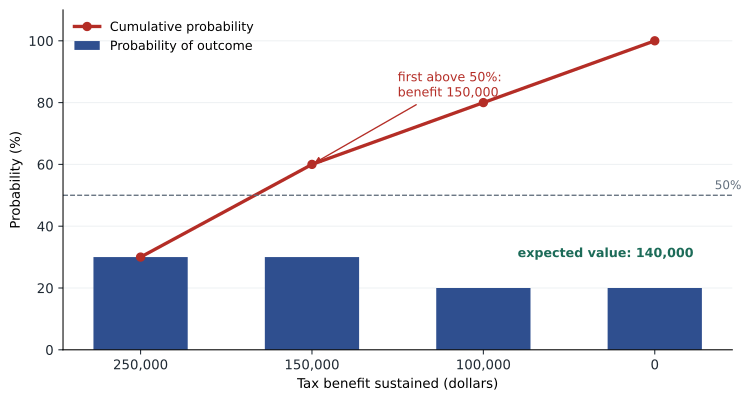
breakExpected value of the benefit: 140,000 Highest single probability: 30% (ties possible) benefit 250,000 cumulative probability 30% benefit 150,000 cumulative probability 60% ASC 740 measures the benefit at 150,000; unrecognized tax benefit 100,000
Northlake's lawyers think there is only a 30 per cent chance the full $250,000 benefit will survive an audit, so acceptance is not probable under IFRIC 23. With several possible outcomes, the expected value of $140,000 better predicts the result than any single outcome, so Northlake recognizes a benefit of $140,000 and a tax liability of $110,000 for the difference. A US GAAP reporter, applying the cumulative-probability test, would recognize $150,000, the largest amount with more than a 50 per cent cumulative likelihood. The two answers are close here but can differ substantially.
The rate reconciliation and other disclosures
Tax disclosures explain why the effective tax rate differs from the statutory rate. The rate reconciliation starts with pre-tax profit times the statutory rate and lists the effects of permanent differences, different rates in other jurisdictions, changes in tax rates, changes in valuation allowances or unrecognized assets, and adjustments for prior years. Readers use it to judge whether a low tax rate is sustainable: a rate held down by tax credits for research may persist; one held down by releasing a valuation allowance will not.
Worked problem
Northlake's 2027 rate reconciliation
Using lesson 7's numbers: pre-tax profit $6,000,000; statutory rate 26.5 per cent; non-deductible meals $40,000. Reconcile to tax expense.
Show solution
- Tax at the statutory rate: 6,000,000 × 26.5% = $1,590,000.
- Non-deductible meals: 40,000 × 26.5% = $10,600.
- Tax expense: $1,600,600 (current $1,362,100 plus deferred $238,500).
- Effective rate: 1,600,600 ÷ 6,000,000 = 26.68 per cent.
Answer: Effective rate 26.68 per cent, reconciled to the 26.5 per cent statutory rate.
IAS 12 requires the major components of tax expense, the tax relating to items of other comprehensive income, an explanation of the relationship between tax expense and accounting profit (either a numerical reconciliation of tax amounts or of rates), and, for each type of temporary difference and unused loss, the deferred tax assets and liabilities recognized. It also requires disclosure of deductible temporary differences and unused losses for which no deferred tax asset is recognized.
The global minimum tax
The OECD's Pillar Two rules impose a 15 per cent minimum effective tax rate on large multinational groups with consolidated revenue of at least €750 million, through a top-up tax collected in the jurisdictions where profits are taxed below 15 per cent. Canada enacted the Global Minimum Tax Act in June 2024, effective for fiscal years beginning on or after 31 December 2023. In May 2023 the IASB amended IAS 12 to provide a temporary mandatory exception from recognizing and disclosing deferred taxes related to Pillar Two top-up taxes; instead, entities disclose current top-up tax expense and information about their exposure. Northlake is far too small to be affected, but its larger competitors are.
The taxes payable method under ASPE
ASPE Section 3465 lets a private enterprise choose between the future income taxes method, broadly the same as IAS 12's liability method, and the taxes payable method. Under the taxes payable method, tax expense is simply the current tax for the year, with no deferred taxes recognized; the entity discloses a reconciliation of its effective rate to the statutory rate and, if it recognized any tax on items outside profit, explains it. Many small owner-managed companies choose this method because their statements are used mainly by owners, bankers and the CRA, and computing deferred taxes adds cost without much benefit. A company that chose the taxes payable method would report Northlake's 2027 tax expense as $1,362,100 rather than $1,600,600.
| Topic | IFRS (IAS 12) | US GAAP (for comparison) |
|---|---|---|
| Deferred tax asset recognition | Recognize to the extent probable | Recognize in full, less a valuation allowance |
| Rate changes | Substantively enacted | Enacted |
| Uncertain positions | IFRIC 23: probable acceptance, else most likely or expected value | More likely than not, then largest amount above 50 per cent cumulative |
| Loss carrybacks | Canada: 3 years back, 20 forward | Federal: none after 2017; indefinite forward, 80 per cent limit |
| Private company option | ASPE taxes payable method | None; full ASC 740 |
Reading a tax note: a short case
Suppose a competitor's notes show pre-tax income of $40 million, tax expense of $6 million and an effective rate of 15 per cent against a statutory rate of about 25 per cent. The rate reconciliation lists three items: research and development tax credits worth 3 percentage points, lower rates in foreign jurisdictions worth 2 points, and the release of a valuation allowance (or recognition of previously unrecognized losses) worth 5 points. The deferred tax note shows that the released amount related to losses in a subsidiary that has now been profitable for two years. A careful reader would conclude that the credits and foreign rates may persist, but the 5-point benefit is a one-time event. A normalized effective rate is about 20 per cent, and normalized net income is about $32 million rather than $34 million.
The same reader would check the unrecognized deductible differences and losses disclosed under IAS 12, which signal future benefits that may be recognized when profitability is established, and the amount and timing of tax loss expiries. Canadian companies with losses also disclose the years in which non-capital losses expire, since twenty-year carryforwards from the 2000s and 2010s begin to lapse. Finally, the reconciliation of liabilities for uncertain tax treatments, and any disclosures about tax audits under way, show where the tax authority might reach a different conclusion. Taken together, these notes let an analyst separate recurring tax costs from accounting events.
Common mistakes
MistakeRecognizing a deferred tax asset for all losses carried forward regardless of future profits.
InsteadRecognize the asset only to the extent future taxable profit is probable.
MistakeTreating a loss carryback refund as a deferred tax asset.
InsteadA carryback refund is a current tax receivable.
MistakeRecognizing the full benefit of a tax position the authority will probably not accept.
InsteadUse the most likely amount or expected value when acceptance is not probable.
MistakeAssuming a low effective tax rate is sustainable.
InsteadRead the rate reconciliation: one-time items such as allowance releases will not recur.
MistakeAssuming every Canadian private company records deferred taxes.
InsteadASPE allows the taxes payable method.
Summary and key terms
- Canadian non-capital losses carry back three years (a current refund) and forward twenty years (a deferred tax asset).
- Deferred tax assets are recognized only to the extent future taxable profit is probable.
- Recent losses are strong negative evidence against recognizing deferred tax assets.
- IFRIC 23 reflects uncertain treatments using the most likely amount or expected value when acceptance is not probable.
- The rate reconciliation explains differences between statutory and effective rates.
- Pillar Two deferred taxes are excluded by a temporary IAS 12 exception.
- ASPE allows private enterprises to use the taxes payable method.
- Non-capital loss
- A Canadian business loss that can be carried back three years and forward twenty.
- Taxes payable method
- An ASPE option that recognizes only current tax expense.
- Most likely amount
- The single most likely outcome in a range of possible outcomes.
- Tax loss carryforward
- An unused tax loss available to reduce future taxable income.
- Tax loss carryback
- Applying a current tax loss against prior years' taxable income to obtain a refund.
- Uncertain tax position
- A tax treatment whose acceptance by the tax authority is uncertain.
- Rate reconciliation
- A disclosure explaining differences between the statutory and effective tax rates.
- Pillar Two
- OECD rules imposing a 15 per cent global minimum tax on large multinational groups.
- Top-up tax
- Additional tax that brings a group's effective rate in a jurisdiction up to 15 per cent.
Practice problems
Work each problem on paper first, then reveal the answer to check.
Loss of $500,000; prior three years' taxable income $300,000; rate 26.5 per cent. Refund and deferred tax asset?
Show answer
Refund $79,500; DTA 200,000 × 26.5% = $53,000 if probable.
An entity has three years of losses and no firm plans for profit. Recognize a DTA for its losses?
Show answer
Probably not without convincing other evidence.
Outcomes: $100,000 at 40 per cent, $60,000 at 30 per cent, $0 at 30 per cent. Expected value?
Show answer
$58,000.
Same outcomes. Largest amount with cumulative probability above 50 per cent?
Show answer
$60,000 (40 then 70 per cent).
Rerun the uncertain-position program with probabilities 0.55, 0.15, 0.15, 0.15. ASC 740 amount?
Show answer
$250,000, because the first outcome alone exceeds 50 per cent.
Pre-tax profit $2 million; rate 25 per cent; tax credit of $40,000. Effective rate?
Show answer
23 per cent.
Why is a valuation allowance release a warning sign for analysts?
Show answer
It produces a one-time tax benefit that inflates net income.
A private enterprise using the taxes payable method has current tax of $90,000 and would have deferred tax of $15,000. Tax expense?
Show answer
$90,000.
Which group size triggers Pillar Two?
Show answer
Consolidated revenue of at least €750 million.
What does the taxes-paid disclosure show?
Show answer
Under IAS 12, the components of tax expense; jurisdiction-level taxes paid are a US requirement.
Lesson quiz · 5 questions
Score 60% or more to complete this lesson.
Create a free account to save your progress, take quizzes and earn a certificate.