
ACCT-212 · Lesson 7 of 12 · 25 min
Income taxes I: current and deferred tax
Northlake's accounting profit and its taxable income are almost never the same number. Accounting standards aim to measure performance; tax law aims to raise revenue and encourage certain behaviour, such as investment in machinery. Tax law often lets a company deduct an asset's cost faster than the asset is depreciated in the financial statements, taxes some revenue when cash is received rather than when it is earned, and denies deductions for some expenses entirely. If a company simply reported the tax it owes for the year as its tax expense, that expense would bear little relation to the profit in the same income statement. Deferred tax accounting fixes this by recognizing the future tax consequences of transactions already recorded.
This lesson and the next apply IAS 12, Income Taxes, ASPE Section 3465 and, for comparison, US GAAP's ASC 740. The details of Canadian tax law, how capital cost allowance classes work, how taxable income is computed and how corporate rates are set, belong to ACCT-351 and ACCT-352. Here, tax law is a given; the question is how to account for it.
Accounting profit, taxable income and two kinds of differences
Accounting profit (or pre-tax book income) is profit before tax expense measured under the financial reporting framework. Taxable income is income on which tax is payable, measured under tax law. The differences between them are of two kinds. Permanent differences arise from items that are recognized in one measure but never in the other: fines and penalties, which are not deductible; half of business meal and entertainment costs, which both Canada and the United States disallow; and some income, such as most dividends received by a Canadian corporation from another Canadian corporation, which is not taxed. Permanent differences affect the effective tax rate but never create deferred taxes.
Temporary differences arise because an item is recognized in both measures but in different periods. A machine deducted for tax faster than it is depreciated in the books creates a temporary difference that reverses as book depreciation catches up. A warranty provision recognized as an expense when products are sold but deductible for tax only when claims are paid creates a temporary difference that reverses as claims are paid. IAS 12 defines temporary differences using the balance sheet: a temporary difference is the difference between the carrying amount of an asset or liability and its tax base, the amount attributable to it for tax purposes.
The balance sheet liability method
Under the balance sheet liability method, the entity compares each asset and liability's carrying amount with its tax base. A taxable temporary difference, which will result in taxable amounts in future years, gives rise to a deferred tax liability. An asset carried above its tax base (because tax deductions have run ahead of depreciation) is the classic example. A deductible temporary difference, which will result in deductible amounts in future years, gives rise to a deferred tax asset; a liability such as a warranty provision with a tax base of zero is the classic example. Deferred tax assets also arise from unused tax losses and credits carried forward (lesson 8).
Deferred tax is measured at the tax rates expected to apply when the asset is realized or the liability settled, based on rates enacted or substantively enacted by the end of the reporting period. In Canada a rate is generally considered substantively enacted when the bill has been tabled in Parliament or a provincial legislature for third reading (or, for a minority government, passed third reading in the House of Commons). Deferred tax is not discounted. The combined federal and Ontario general corporate rate, 26.5 per cent (15 per cent federal plus 11.5 per cent provincial), is used for Northlake's examples; rates differ by province and for small businesses, which pay lower rates on their first $500,000 of active business income.
A worked example over four years
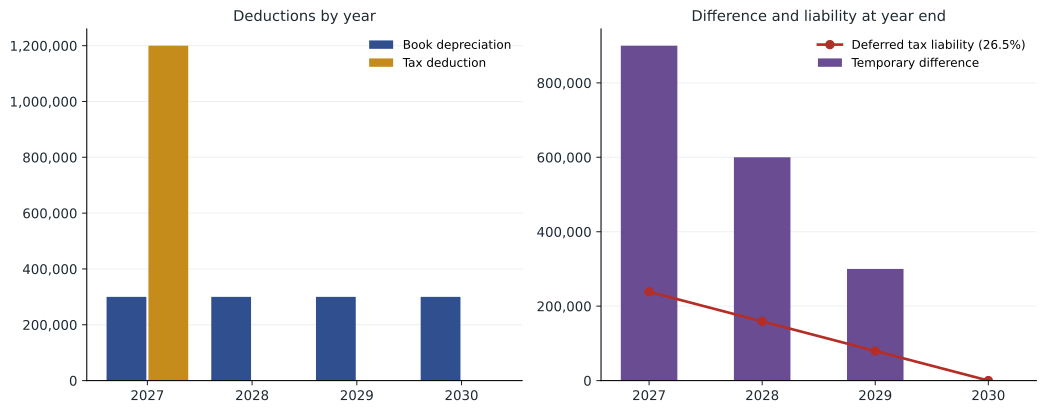
At the start of 2027 Northlake buys $1,200,000 of production machinery. In the books, it is depreciated straight-line over four years with no residual value, $300,000 a year. For tax, Northlake claims the full cost in 2027 under the immediate expensing available for eligible manufacturing and processing machinery acquired after 2024 (check current eligibility and phase-out rules). Pre-tax accounting profit is $6,000,000 in each year. Non-deductible meals of $40,000 a year (half of $80,000 spent) are a permanent difference.
# Deferred tax on machinery expensed immediately for tax (Ontario combined rate, illustrative)
rate = 0.265
cost, life = 1_200_000, 4
book_dep = cost / life
tax_ded = [cost, 0, 0, 0]
pretax, nondeductible = 6_000_000, 40_000
carrying, tax_base, dtl_prev = cost, cost, 0
print(f"{'Year':>4} {'Taxable inc':>12} {'Current tax':>12} {'Temp diff':>10} {'DTL':>9} {'Deferred exp':>12} {'Total exp':>10} {'ETR':>7}")
for y in range(4):
    taxable = pretax + nondeductible + book_dep - tax_ded[y]
    current = taxable * rate
    carrying -= book_dep; tax_base -= tax_ded[y]
    temp = carrying - tax_base
    dtl = temp * rate
    deferred = dtl - dtl_prev; dtl_prev = dtl
    total = current + deferred
print(f"{2027 + y:>4} {taxable:>12,.0f} {current:>12,.0f} {temp:>10,.0f} {dtl:>9,.0f} {deferred:>12,.0f} {total:>10,.0f} {total / pretax:>7.2%}")Year Taxable inc Current tax Temp diff DTL Deferred exp Total exp ETR 2027 5,140,000 1,362,100 900,000 238,500 238,500 1,600,600 26.68% 2028 6,340,000 1,680,100 600,000 159,000 -79,500 1,600,600 26.68% 2029 6,340,000 1,680,100 300,000 79,500 -79,500 1,600,600 26.68% 2030 6,340,000 1,680,100 0 0 -79,500 1,600,600 26.68%
In 2027 taxable income is only $5,140,000 because the full $1,200,000 is deducted against $300,000 of book depreciation, so current tax is $1,362,100. But the machine's carrying amount, $900,000, now exceeds its tax base of zero by $900,000: Northlake will have $900,000 more taxable income than accounting profit over the next three years, as book depreciation continues with no tax deduction. A deferred tax liability of 900,000 × 26.5% = $238,500 is recognized, and deferred tax expense of $238,500 brings total tax expense to $1,600,600. In each later year the liability falls by $79,500 as the difference reverses, giving a deferred tax recovery that offsets higher current tax. Total tax expense is the same $1,600,600 every year, and the effective rate is a steady 26.68 per cent, slightly above the statutory 26.5 per cent because of the non-deductible meals.
The example shows why deferred taxes exist. Without them, Northlake would report a low tax expense in 2027 and higher expense in 2028 to 2030, even though its pre-tax profit was the same every year. Accelerated tax deductions defer tax; they do not eliminate it, as long as the company is profitable. For a growing company that keeps buying equipment, however, new deductions keep replacing reversing ones, and the deferred tax liability can grow for many years, a fact some analysts use to argue that it behaves more like equity than debt.
Deductible temporary differences: the warranty provision
Worked problem
Deferred tax asset on warranties
At the end of 2027 Northlake's warranty provision (lesson 2) stands at $120,625. Warranty costs are deductible for tax only when claims are paid, so the provision's tax base is zero. At a 26.5 per cent rate, what deferred tax arises?
Show solution
- Carrying amount of the liability: $120,625. Tax base: zero.
- Deductible temporary difference: $120,625; future claim payments will reduce taxable income.
- Deferred tax asset: 120,625 × 26.5% = $31,966, recognized if it is probable that taxable profit will be available to use it.
- Northlake is consistently profitable, so the asset is recognized, reducing deferred tax expense.
Answer: Deferred tax asset of $31,966.
| Item | Carrying amount vs tax base | Result |
|---|---|---|
| Machinery expensed faster for tax | Carrying amount above tax base | Deferred tax liability |
| Warranty provision deductible when paid | Liability with zero tax base | Deferred tax asset |
| Revenue taxed when cash is received (contract liability) | Liability with zero tax base | Deferred tax asset |
| Development costs capitalized in books, deducted for tax | Asset above tax base | Deferred tax liability |
| Unused tax losses | No carrying amount; future deductions available | Deferred tax asset (lesson 8) |
| Fines and penalties | No future tax effect | Permanent difference, no deferred tax |
Changes in tax rates and other recognition issues
When tax rates change, existing deferred tax balances are remeasured at the new rate, and the effect is recognized in profit or loss, except to the extent it relates to items previously recognized outside profit or loss, such as revaluation surpluses in other comprehensive income. If Ontario's rate were raised by one percentage point while Northlake had a $600,000 temporary difference on its machinery, the deferred tax liability would rise by $6,000, increasing tax expense in the year the change is substantively enacted.
IAS 12 includes an initial recognition exception: no deferred tax is recognized on temporary differences arising from the initial recognition of goodwill, or of an asset or liability in a transaction that is not a business combination and affects neither accounting nor taxable profit. A 2021 amendment, effective in 2023, narrowed the exception so that it does not apply to transactions, such as leases and decommissioning obligations, that create equal taxable and deductible temporary differences. Deferred tax is recognized separately on the right-of-use asset and the lease liability.
Presentation
Current tax assets and liabilities are presented separately from deferred tax. All deferred tax assets and liabilities are classified as non-current; IAS 1 does not allow them to be presented as current. Deferred tax assets and liabilities are offset only if the entity has a legally enforceable right to set off current tax assets and liabilities and they relate to taxes levied by the same authority on the same taxable entity. Tax expense is presented in profit or loss, with tax on items of other comprehensive income presented in OCI. ASPE allows private enterprises to choose the taxes payable method instead (lesson 8).
Deferred tax on leases, revaluations and investments
Three further situations show how widely the balance sheet approach reaches. First, leases: when Northlake recognizes its warehouse lease (lesson 5), the right-of-use asset of $842,473 has a tax base of zero, because Canadian tax law deducts rent as it is paid, and the lease liability has a tax base of zero as well. Since the 2021 amendment to IAS 12, Northlake recognizes a deferred tax liability on the asset and a deferred tax asset on the liability, equal at commencement. As depreciation runs ahead of the reduction in the liability in the early years, a small net deferred tax asset builds and then reverses. Second, revaluations: when an asset is revalued upward under IAS 16, its carrying amount rises but its tax base does not, so a deferred tax liability is recognized, and because the revaluation surplus is in other comprehensive income, the related deferred tax is charged to OCI as well. Tax follows the item it relates to: profit or loss, OCI or equity.
Third, investments in subsidiaries, branches and associates: the parent's carrying amount for its investment can differ from the tax base of the shares, often because of undistributed profits. IAS 12 does not require a deferred tax liability on these outside basis differences if the parent controls the timing of reversal and it is probable the difference will not reverse in the foreseeable future, for example because the subsidiary's profits will be reinvested. Many Canadian multinationals rely on this exception for foreign subsidiaries, disclosing the aggregate amount of unrecognized differences instead. These topics return in ACCT-311, which covers consolidation and foreign operations.
Common mistakes
MistakeRecording tax expense equal to tax payable for the year.
InsteadTax expense includes deferred tax: the change in deferred tax assets and liabilities.
MistakeCreating deferred tax on non-deductible fines.
InsteadPermanent differences never reverse, so no deferred tax arises; they change the effective rate.
MistakeMeasuring deferred tax at the current year's rate when a different future rate has been enacted.
InsteadUse the rate enacted or substantively enacted for the year of reversal.
MistakeDiscounting deferred tax liabilities.
InsteadDeferred taxes are not discounted under either framework.
MistakeClassifying the reversing portion of a deferred tax liability as current.
InsteadAll deferred tax balances are non-current.
Summary and key terms
- Accounting profit and taxable income differ because of permanent and temporary differences.
- Temporary differences are differences between carrying amounts and tax bases that will reverse.
- Taxable temporary differences create deferred tax liabilities; deductible ones create deferred tax assets.
- Tax expense equals current tax plus the change in net deferred tax.
- Deferred tax uses rates enacted or substantively enacted at the reporting date and is not discounted.
- Accelerated tax deductions defer tax rather than eliminate it for a profitable company.
- All deferred tax balances are presented as non-current.
- Tax base
- The amount attributable to an asset or liability for tax purposes.
- Substantively enacted
- A tax rate change whose remaining legislative steps will not change the outcome.
- Taxable income
- Income on which tax is payable under tax law.
- Permanent difference
- A difference between accounting profit and taxable income that never reverses.
- Temporary difference
- A difference between the carrying amount of an asset or liability and its tax base that will reverse.
- Deferred tax liability
- Tax payable in future periods on taxable temporary differences.
- Deferred tax asset
- Tax recoverable in future periods from deductible temporary differences, losses or credits.
- Current tax
- Tax payable or recoverable for the period's taxable income.
- Effective tax rate
- Total tax expense divided by pre-tax accounting profit.
- Statutory rate
- The tax rate set by law.
Practice problems
Work each problem on paper first, then reveal the answer to check.
Pre-tax profit $1 million; non-deductible fines $20,000; no temporary differences; rate 25 per cent. Tax expense and effective rate?
Show answer
$255,000; 25.5 per cent.
Asset carrying amount $500,000, tax base $300,000, rate 26.5 per cent. Deferred tax?
Show answer
Deferred tax liability $53,000.
Warranty liability $80,000, tax base zero, rate 25 per cent. Deferred tax?
Show answer
Deferred tax asset $20,000.
Current tax $400,000; net DTL rises from $100,000 to $130,000. Tax expense?
Show answer
$430,000.
Rerun the deferred tax program with a three-year book life. What happens to the DTL at the end of 2027?
Show answer
The temporary difference becomes $800,000, so the DTL falls; it reverses over two years instead of three.
Why is the effective rate in the program above the statutory rate?
Show answer
Non-deductible meals are a permanent difference.
A rate rise of 2 points applies to a $1 million taxable temporary difference. Effect?
Show answer
DTL and tax expense rise by $20,000.
When is a Canadian federal rate change usually substantively enacted?
Show answer
When the bill is tabled for third reading (or passed third reading for a minority government).
Revenue received in advance is taxed when received. What deferred tax arises?
Show answer
A deferred tax asset, because the contract liability has a zero tax base.
How are deferred tax balances classified?
Show answer
As non-current.
Lesson quiz · 5 questions
Score 60% or more to complete this lesson.
Create a free account to save your progress, take quizzes and earn a certificate.