
ACCT-212 · Lesson 11 of 12 · 27 min
Share-based payment and earnings per share
Many companies pay part of their employees' compensation in shares or share options rather than cash. Options align employees' interests with shareholders', conserve cash for young companies and help retain staff who would lose unvested awards by leaving. For decades, however, most companies recorded no expense for options granted at the market price, because the options had no 'intrinsic value' on the grant date. After years of debate, both boards concluded that options are valuable compensation and must be expensed at fair value: the IASB in IFRS 2 (2004) and the FASB in what is now ASC 718 (2004). This lesson explains how, and then turns to earnings per share, where options, convertible debt and preferred shares all affect the number that investors watch most closely.
Measuring equity-settled share-based payment
IFRS 2, Share-based Payment, requires an entity to recognize the goods or services received in a share-based payment transaction. For equity-settled awards to employees, such as share options and restricted share units settled in shares, the services are measured indirectly by reference to the fair value of the equity instruments at the grant date, the date the entity and employee agree to the terms. Fair value is not remeasured later. For options, fair value is estimated with an option-pricing model, such as Black–Scholes–Merton or a binomial lattice, using the share price, exercise price, expected life, expected volatility, expected dividends and the risk-free rate. FIN-301 lesson 11 derives the Black–Scholes formula.
The cost is recognized over the vesting period, the period during which employees must work to earn the award. Service conditions, such as remaining employed for four years, and non-market performance conditions, such as reaching a revenue target, affect how many awards are expected to vest, not their fair value per unit; the entity estimates the number expected to vest and trues up to the actual number at the end. Market conditions, such as a target share price, are built into the grant-date fair value and are not trued up: the cost is recognized even if the market condition is never met, as long as the service condition is.
Worked problem
Options with four-year cliff vesting
On 1 January 2027 Northlake grants 100,000 options to senior managers with an exercise price of $24, equal to the share price. The options vest at the end of four years if the managers are still employed (cliff vesting) and expire after ten years. Northlake estimates a fair value of $7.08 per option using Black–Scholes with an expected life of five years, volatility of 30 per cent, a dividend yield of 1 per cent and a risk-free rate of 3.5 per cent. It expects 92 per cent of the options to vest.
Show solution
- Total expected cost: 100,000 × 92% × $7.08 = about $651,400.
- Annual expense: 651,400 ÷ 4 = about $162,800, debited to compensation expense and credited to contributed surplus (or APIC).
- If at the end of year 2 the expected vesting rate falls to 88 per cent, cumulative expense is trued up: 100,000 × 88% × 7.08 × 2/4 = $311,520, so year 2 expense is 311,520 − 162,840 = $148,680.
- If the share price stays below $24 and the options are never exercised, the expense already recognized is not reversed.
Answer: About $162,800 of compensation expense a year, adjusted for changes in expected forfeitures.
# Black-Scholes value of an employee option and the cost recognized each year
from math import log, sqrt, exp, erf
N = lambda x: 0.5 * (1 + erf(x / sqrt(2)))
S, K, T, sigma, r, q = 24.0, 24.0, 5.0, 0.30, 0.035, 0.01
d1 = (log(S / K) + (r - q + sigma ** 2 / 2) * T) / (sigma * sqrt(T))
d2 = d1 - sigma * sqrt(T)
value = S * exp(-q * T) * N(d1) - K * exp(-r * T) * N(d2)
print(f"Fair value per option: {value:.2f}")

options, vest_years = 100_000, 4
expected_rate = [0.92, 0.88, 0.88, 0.86]       # estimate at the end of each year
cum_prev = 0
for y, rate in enumerate(expected_rate, start=1):
    cum = options * rate * round(value, 2) * y / vest_years
    print(f"Year {y}: expected vesting {rate:.0%}, cumulative cost {cum:,.0f}, expense {cum - cum_prev:,.0f}")
cum_prev = cumFair value per option: 7.08 Year 1: expected vesting 92%, cumulative cost 162,840, expense 162,840 Year 2: expected vesting 88%, cumulative cost 311,520, expense 148,680 Year 3: expected vesting 88%, cumulative cost 467,280, expense 155,760 Year 4: expected vesting 86%, cumulative cost 608,880, expense 141,600
Graded vesting, forfeitures and modifications
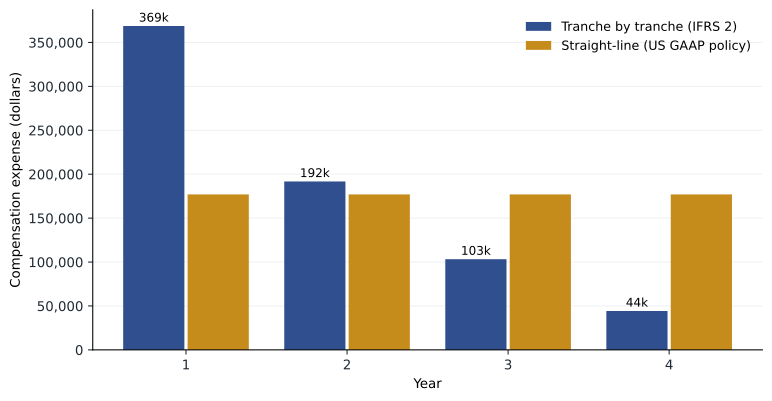
Many awards vest in instalments, for example 25 per cent at the end of each of four years (graded vesting). IFRS 2 treats each instalment as a separate award with its own vesting period, so expense is front-loaded: in year 1 the entity recognizes all of the first tranche's cost, half of the second's, a third of the third's and a quarter of the fourth's. Forfeitures must be estimated and trued up. If the terms of an award are modified, for example by lowering the exercise price after the share price falls (a repricing), the entity recognizes the incremental fair value of the modified award over the remaining vesting period, in addition to the original grant-date cost.
Worked problem
Graded vesting compared
Suppose Northlake's options instead vest 25 per cent a year over four years, total fair value $708,000 (ignore forfeitures, and assume each tranche has the same value). What is the year 1 expense?
Show solution
- Each tranche costs 708,000 ÷ 4 = $177,000.
- IFRS 2 tranche-by-tranche: 177,000 × (1 + 1/2 + 1/3 + 1/4) = $368,750 in year 1.
- Years 2 to 4: $191,750, $103,250 and $44,250.
- A US GAAP reporter could instead recognize $177,000 a year straight-line.
Answer: $368,750 in year 1 under IFRS 2, against $177,000 straight-line under a US GAAP policy.
Cash-settled awards and tax effects
Cash-settled share-based payments, such as share appreciation rights paid in cash, create a liability. IFRS 2 measures the liability at fair value at each reporting date until settlement, recognizing changes in profit or loss, so the total expense equals the cash eventually paid. In Canada, employees generally pay tax on the benefit when options are exercised, with a deduction that can reduce the effective rate to that of capital gains for qualifying options; the employer usually receives no tax deduction for equity-settled options, so no deferred tax asset arises, but a deduction is available for cash-settled awards and some other plans.
Basic earnings per share
Earnings per share (EPS) is profit attributable to ordinary (common) shareholders divided by the weighted average number of ordinary shares outstanding during the period. IAS 33, Earnings per Share, requires entities whose shares are publicly traded, or that are filing to issue them, to present basic and diluted EPS on the face of the statement of profit or loss. ASPE does not require EPS.
The numerator deducts preferred dividends: the current year's dividend on cumulative preferred shares, whether or not declared, and dividends declared on non-cumulative preferred shares. Dividends on preferred shares classified as liabilities are already in interest expense.
The denominator weights each share by the fraction of the year it was outstanding. Shares issued for cash are weighted from the issue date; shares repurchased are removed from the repurchase date. Stock dividends, stock splits and the bonus element of rights issues change the number of shares without changing resources, so they are applied retroactively to all periods presented, as if they had occurred at the start of the earliest period, even if they happen after year end but before the statements are issued.
Diluted earnings per share
Diluted EPS shows what EPS would be if all dilutive potential ordinary shares had been issued: options and warrants, convertible debt and convertible preferred shares, and contingently issuable shares. Each potential share is included only if it is dilutive, that is, if it would reduce EPS (or increase a loss per share). Two methods are used. The treasury stock method applies to options and warrants: assume they are exercised at the start of the year (or the issue date if later), and that the proceeds, including unrecognized compensation cost, are used to buy back shares at the average market price. Only the net incremental shares are added. Options with exercise prices above the average market price are antidilutive and excluded. The if-converted method applies to convertible securities: add back the after-tax interest (or preferred dividends) to the numerator and add the shares that would be issued on conversion to the denominator.
When there are several potential ordinary shares, they are ranked from most to least dilutive by their incremental EPS, the increase in the numerator divided by the increase in shares, and included in that order, stopping when the next one would be antidilutive. Under IFRS, the liability component of convertible debt produces interest expense at the straight-debt rate (lesson 4), so its add-back is larger, making the bond less likely to be dilutive than under US GAAP.
# Northlake 2027 EPS (IFRS figures; tax rate 26.5%)
profit = 4_500_000
pref_div = 250_000                       # cumulative preferred, equity-classified
num = profit - pref_div
# shares: 2,000,000 at 1 Jan; 300,000 issued 1 Jul; 100,000 repurchased 1 Oct; 10% stock dividend 1 Dec
weighted = 2_000_000 + 300_000 * 6/12 - 100_000 * 3/12
weighted *= 1.10                        # stock dividend applied retroactively
basic = num / weighted
print(f"Weighted shares {weighted:,.0f}; basic EPS {basic:.3f}")

# Options: 100,000 at $24 (stock-dividend adjusted to 110,000 at $21.82), average price $30
opts, ex = 110_000, 24 / 1.10
incremental_opts = opts - opts * ex / 30
# Convertible bond: liability interest 262,089 (lesson 4), converts into 200,000 shares
add_back = 262_089 * (1 - 0.265)
conv_shares = 200_000
print(f"Options add {incremental_opts:,.0f} shares; bond adds {add_back:,.0f} / {conv_shares:,} = {add_back / conv_shares:.3f} per share")
step1 = num / (weighted + incremental_opts)
print(f"After options: {step1:.3f}")
step2 = (num + add_back) / (weighted + incremental_opts + conv_shares)
print(f"After bond: {step2:.3f} -> {'dilutive, include' if step2 < step1 else 'antidilutive, exclude'}")
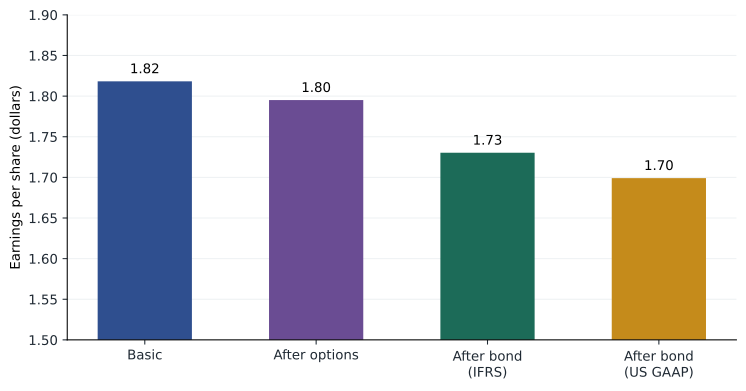
print(f"Diluted EPS {min(step1, step2):.3f}")Weighted shares 2,337,500; basic EPS 1.818 Options add 30,000 shares; bond adds 192,635 / 200,000 = 0.963 per share After options: 1.795 After bond: 1.730 -> dilutive, include Diluted EPS 1.730
Basic EPS is $1.82: $4,250,000 of earnings attributable to common shareholders over 2,337,500 weighted shares, after the stock dividend is applied retroactively. The options add 30,000 incremental shares under the treasury stock method. The convertible bond's incremental EPS is about 96 cents a share, below the $1.80 EPS after options, so it is dilutive and included, giving diluted EPS of $1.73.
| Item | Effect on numerator | Effect on denominator |
|---|---|---|
| Cumulative preferred dividends (equity) | Deduct the current year's dividend | None |
| Shares issued or repurchased | None | Weight by time outstanding |
| Stock dividends and splits | None | Apply retroactively to all periods |
| Options and warrants (treasury stock method) | None | Add net incremental shares if dilutive |
| Convertible debt (if-converted) | Add back after-tax interest | Add conversion shares if dilutive |
| Convertible preferred (if-converted) | Add back preferred dividends | Add conversion shares if dilutive |
Common mistakes
MistakeRecording no expense for options granted at the market price.
InsteadMeasure options at grant-date fair value and expense them over the vesting period.
MistakeRemeasuring equity-settled options to fair value each year.
InsteadEquity-settled awards keep their grant-date fair value; only the number expected to vest is trued up.
MistakeWeighting a stock dividend from the date it was issued.
InsteadApply stock dividends and splits retroactively to all periods.
MistakeIncluding out-of-the-money options in diluted EPS.
InsteadOptions with exercise prices above the average market price are antidilutive and excluded.
MistakeAdding potential shares in any order.
InsteadRank them by incremental EPS and include from most to least dilutive, stopping at the first antidilutive one.
Summary and key terms
- Equity-settled share-based payment is measured at grant-date fair value and recognized over the vesting period.
- Service and non-market performance conditions affect the number expected to vest; market conditions are in the fair value.
- IFRS 2 requires graded-vesting awards to be expensed tranche by tranche and forfeitures to be estimated.
- Cash-settled awards are liabilities remeasured to fair value until settlement.
- Basic EPS divides earnings attributable to common shareholders by the weighted average shares outstanding.
- Diluted EPS adds dilutive options (treasury stock method) and convertibles (if-converted method).
- Potential shares are included in order of dilution and only if they reduce EPS.
- Share appreciation right
- An award paying the increase in share price, in cash or shares.
- Grant date
- The date the entity and employee agree to the terms of a share-based award.
- Vesting period
- The period over which employees must provide service to earn an award.
- Cliff vesting
- Vesting of an entire award at a single date.
- Graded vesting
- Vesting of an award in instalments over several dates.
- Market condition
- A vesting condition linked to the share price, reflected in grant-date fair value.
- Basic EPS
- Earnings attributable to ordinary shareholders divided by weighted average ordinary shares.
- Diluted EPS
- EPS adjusted for all dilutive potential ordinary shares.
- Treasury stock method
- Assumes options are exercised and the proceeds repurchase shares at the average market price.
- If-converted method
- Assumes convertible securities are converted, adding back their interest or dividends.
- Antidilutive
- Having the effect of increasing EPS or reducing a loss per share; such securities are excluded.
Practice problems
Work each problem on paper first, then reveal the answer to check.
50,000 options with a fair value of $4, vesting after 3 years, 90 per cent expected to vest. Annual expense?
Show answer
50,000 × 90% × 4 ÷ 3 = $60,000.
The expected vesting rate falls to 80 per cent at the end of year 2. Year 2 expense?
Show answer
Cumulative 50,000 × 80% × 4 × 2/3 = $106,667; year 2 = $46,667.
Rerun the option program with volatility of 40 per cent. What happens to fair value?
Show answer
It rises to about $8.83, increasing the cost of the award.
An award vests one-third a year over 3 years; each tranche costs $30,000. IFRS 2 year 1 expense?
Show answer
30,000 × (1 + 1/2 + 1/3) = $55,000.
Profit $1 million; cumulative preferred dividend $100,000 (not declared). Numerator for basic EPS?
Show answer
$900,000.
500,000 shares at 1 January; 120,000 issued 1 May. Weighted average?
Show answer
500,000 + 120,000 × 8/12 = 580,000.
A 2-for-1 split occurs after year end but before issue. Effect on EPS?
Show answer
Restate the weighted shares for all periods, halving EPS.
20,000 options at $40; average price $50. Incremental shares?
Show answer
20,000 − 16,000 = 4,000.
Same options with an average price of $35?
Show answer
None; they are antidilutive.
A convertible bond adds $90,000 after tax and 100,000 shares; EPS before it is $0.80. Include?
Show answer
No; its incremental EPS of $0.90 exceeds $0.80, so it is antidilutive and excluded.
Lesson quiz · 5 questions
Score 60% or more to complete this lesson.
Create a free account to save your progress, take quizzes and earn a certificate.