
ACCT-212 · Lesson 5 of 12 · 27 min
Leases I: lessee accounting under IFRS 16 and ASPE
Northlake needs a larger warehouse for finished stations. Rather than buy a building, it signs a five-year lease. For decades, most such leases never appeared on the lessee's balance sheet: if the lease did not transfer substantially all the risks and rewards of ownership, the lessee simply expensed the rent. Analysts knew this hid enormous obligations; airlines and retailers carried billions of dollars of lease commitments in the notes only. In 2016 both the IASB and the FASB issued new standards, IFRS 16 and ASC 842, that bring almost all leases onto the lessee's balance sheet. The two boards agreed on that principle but not on how the expense should be presented, so lessee accounting is now one of the clearest examples of a remaining IFRS–US GAAP difference.
What is a lease?
A lease is a contract, or part of a contract, that conveys the right to control the use of an identified asset for a period of time in exchange for consideration. Two tests apply. First, there must be an identified asset, specified explicitly or implicitly, and the supplier must not have a substantive right to substitute a different asset throughout the period of use. Second, the customer must have the right to obtain substantially all the economic benefits from use of the asset and the right to direct how and for what purpose it is used. A contract to store goods in any available space in a supplier's warehouse is a service, not a lease; a contract for exclusive use of a specified building is a lease.
Many contracts contain embedded leases. An agreement for a supplier to provide data processing using dedicated servers in the customer's premises, or a transportation contract that uses specified railcars at the customer's direction, may contain a lease even though it is not called one. Contracts often mix lease components, such as the use of equipment, with non-lease components, such as maintenance. The consideration is allocated between them on a relative standalone price basis, although lessees may elect, by class of asset, to treat lease and non-lease components as a single lease component.
Initial measurement for the lessee
At the commencement date, when the lessor makes the asset available, the lessee recognizes a lease liability and a right-of-use asset. The lease liability is the present value of the lease payments not yet paid. Lease payments include fixed payments (less lease incentives receivable), variable payments that depend on an index or rate (measured using the index or rate at commencement), amounts expected under residual value guarantees, the exercise price of a purchase option the lessee is reasonably certain to exercise, and termination penalties if the lease term reflects termination. Variable payments linked to usage or sales, such as a percentage of store revenue, are excluded and expensed as incurred.
The discount rate is the interest rate implicit in the lease if it can be readily determined; otherwise the lessee's incremental borrowing rate, the rate it would pay to borrow over a similar term, with similar security, the funds needed to obtain an asset of similar value in a similar economic environment. The right-of-use asset is measured at the lease liability plus lease payments made at or before commencement, less incentives received, plus initial direct costs and an estimate of dismantling or restoration costs (lesson 2).
The lease term is the non-cancellable period plus periods covered by options to extend that the lessee is reasonably certain to exercise and periods covered by options to terminate that it is reasonably certain not to exercise. Judging 'reasonably certain' requires looking at economic incentives: significant leasehold improvements, relocation costs, below-market renewal rents and the importance of the asset to the lessee's operations.
Worked problem
Measuring the warehouse lease
On 1 January 2027 Northlake leases a warehouse for five years at $200,000 a year, paid at the end of each year. There are no renewal options, incentives or initial direct costs. The rate implicit in the lease is not known; Northlake's incremental borrowing rate is 6 per cent. What is recognized at commencement?
Show solution
- Lease payments: five annual payments of $200,000 in arrears.
- Lease liability: 200,000 × [1 − 1.06⁻⁵] ÷ 0.06 = $842,473.
- Right-of-use asset: equal to the liability, $842,473, because there are no prepayments, incentives or direct costs.
- Entry: debit right-of-use asset $842,473; credit lease liability $842,473.
Answer: Right-of-use asset and lease liability of $842,473 each.
Subsequent measurement under IFRS 16: a single model
IFRS 16 uses a single lessee model. Every lease that is recognized is accounted for like a financed purchase. The lease liability is measured at amortized cost using the effective interest method: interest expense is the opening liability times the discount rate, and payments reduce the liability. The right-of-use asset is depreciated, usually on a straight-line basis over the shorter of the lease term and the asset's useful life (over the useful life if ownership transfers or a purchase option is reasonably certain to be exercised), and tested for impairment under IAS 36. Because interest is highest at the start, total lease expense is front-loaded: higher in early years, lower later. In the income statement, depreciation is an operating expense and interest is a finance cost, so operating profit and EBITDA rise compared with the old rent-expense model. In the cash flow statement, the principal portion of payments is a financing outflow, and interest is classified according to the entity's policy for interest paid.
# Warehouse lease: IFRS 16 (single model) vs ASC 842 operating lease, 5 years at 6%
payment, rate, years = 200_000, 0.06, 5
liability = sum(payment / (1 + rate) ** t for t in range(1, years + 1))
rou0 = liability
dep = rou0 / years
print(f"Initial liability and ROU asset: {liability:,.0f}")
print(f"{'Year':>4} {'Interest':>9} {'Dep':>9} {'IFRS 16 total':>14} {'ASC 842 op cost':>16} {'Liability end':>14} {'Op-lease ROU end':>17}")
ifrs_total = us_total = 0
for y in range(1, years + 1):
    interest = liability * rate
    liability = liability + interest - payment
    ifrs = interest + dep
    us = payment                          # straight-line single lease cost
    rou_us = liability                    # with no prepaid/accrued rent, ROU equals the liability
    ifrs_total += ifrs; us_total += us
    print(f"{y:>4} {interest:>9,.0f} {dep:>9,.0f} {ifrs:>14,.0f} {us:>16,.0f} {liability:>14,.0f} {rou_us:>17,.0f}")
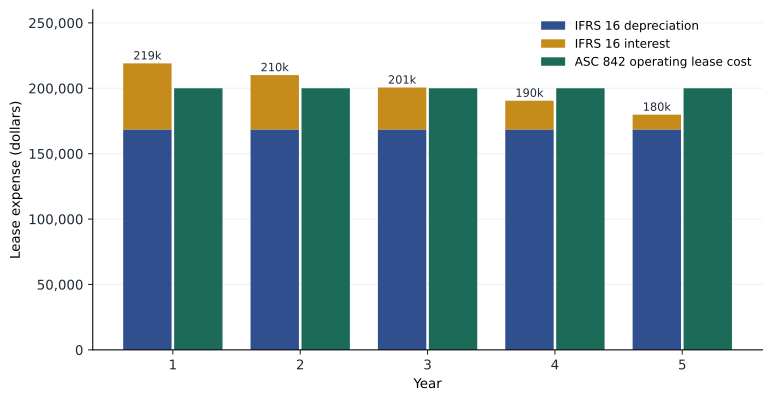
print(f"Totals: IFRS 16 {ifrs_total:,.0f}; ASC 842 operating {us_total:,.0f}")Initial liability and ROU asset: 842,473 Year Interest Dep IFRS 16 total ASC 842 op cost Liability end Op-lease ROU end 1 50,548 168,495 219,043 200,000 693,021 693,021 2 41,581 168,495 210,076 200,000 534,602 534,602 3 32,076 168,495 200,571 200,000 366,679 366,679 4 22,001 168,495 190,495 200,000 188,679 188,679 5 11,321 168,495 179,815 200,000 -0 -0 Totals: IFRS 16 1,000,000; ASC 842 operating 1,000,000
The program shows the difference. Under IFRS 16, lease expense in year 1 is $219,043 (interest of $50,548 plus depreciation of $168,495), falling to $179,815 in year 5. Under an ASC 842 operating lease, the expense is $200,000 every year. Both total $1,000,000 over the lease, and the liability is identical at every year end; only the pattern and presentation of expense differ. Because the operating-lease right-of-use asset is a plug, it equals the liability in each year in this simple case, while the IFRS right-of-use asset is depreciated faster than the liability is repaid in the early years.
Worked problem
Classifying an equipment lease (US comparison)
Northlake leases a calibration rig with an economic life of five years for four years, paying $60,000 a year in arrears. The rig's fair value is $230,000, and Northlake's incremental borrowing rate is 6 per cent. There is no purchase option or ownership transfer. How is the lease classified?
Show solution
- Under IFRS 16 there is no classification for lessees: the lease is recognized and accounted for under the single model.
- For comparison, a US GAAP reporter would test the criteria: the four-year term is 80 per cent of the five-year life, which meets a 75 per cent 'major part' policy.
- Present value of payments: 60,000 × [1 − 1.06⁻⁴] ÷ 0.06 = $207,906, about 90 per cent of fair value, which also meets the 'substantially all' threshold.
- Under ASC 842 the lease would be a finance lease; under IFRS 16 the expense pattern is the same as a US finance lease.
Answer: One IFRS 16 model; a US GAAP reporter would classify it as a finance lease.
Practical expedients and exemptions
IFRS 16 allows two recognition exemptions. A lessee may elect, by class of underlying asset, not to recognize short-term leases, those with a lease term of twelve months or less and no purchase option. It may also elect, lease by lease, not to recognize leases of low-value assets, such as tablets, small office furniture and telephones; the IASB's Basis for Conclusions refers to assets with a value of about US$5,000 or less when new. For exempt leases, payments are expensed on a straight-line basis. These exemptions, especially the low-value one, have no US GAAP equivalent.
Leases for private enterprises under ASPE
Canadian private enterprises that use ASPE still apply Section 3065, Leases, which keeps the pre-2019 model. A lessee classifies a lease as a capital lease if, at inception, it is likely to obtain ownership by the end of the term, the lease term is 75 per cent or more of the asset's economic life, or the present value of minimum lease payments is 90 per cent or more of fair value. Capital leases are recognized on the balance sheet like financed purchases. All other leases are operating leases, and the lessee simply expenses the rent, with commitments disclosed. The AcSB has been considering whether to update Section 3065, but as of 2026 private enterprises can still keep most leases off the balance sheet.
| Feature | IFRS 16 | ASPE 3065 |
|---|---|---|
| Lessee models | Single model | Capital or operating |
| Operating leases on balance sheet? | Yes (no operating category) | No; rent expensed |
| Expense pattern | Front-loaded: depreciation plus interest | Capital: front-loaded; operating: straight-line rent |
| Short-term exemption | Yes, twelve months or less | Not needed for operating leases |
| Low-value exemption | Yes, about US$5,000 new | Not applicable |
| Principal payments in cash flow statement | Financing | Capital: financing; operating: operating |
Effects on financial statement analysis
Bringing leases onto the balance sheet increased reported debt and assets for lease-heavy companies, raising debt-to-equity and lowering return on assets. Under IFRS 16 it also raised EBITDA, because rent was replaced by depreciation and interest, both excluded from EBITDA. Loan covenants written in terms of EBITDA or debt often had to be renegotiated or defined on a 'frozen GAAP' basis. Analysts comparing a retailer reporting under IFRS with one reporting operating leases under US GAAP must adjust: the US company's EBITDA includes lease cost, while the IFRS company's does not. Lease disclosures, including maturity analyses of lease liabilities, weighted-average remaining lease terms and discount rates, help with these adjustments.
Common mistakes
MistakeTreating a contract as a service because it is not called a lease.
InsteadApply the identified-asset and right-to-control tests; embedded leases are common.
MistakeExpensing warehouse rent straight-line under IFRS 16.
InsteadIFRS 16 recognizes a liability and right-of-use asset and front-loads depreciation plus interest, except for short-term and low-value leases.
MistakeIncluding sales-based variable rent in the lease liability.
InsteadOnly variable payments based on an index or rate are included; usage- and sales-based payments are expensed as incurred.
MistakeIgnoring a renewal option the lessee is reasonably certain to exercise.
InsteadInclude option periods in the lease term when exercise is reasonably certain.
MistakeAssuming IFRS and US GAAP lease expense always match.
InsteadThey match only for US finance leases; operating leases produce a different pattern and presentation.
Summary and key terms
- A lease conveys the right to control the use of an identified asset for a period of time.
- The lease liability is the present value of fixed and index-based payments, guarantees and reasonably certain options.
- The right-of-use asset starts at the liability plus prepayments, initial direct costs and restoration costs, less incentives.
- IFRS 16 has one lessee model: depreciation plus interest, front-loaded.
- Short-term and low-value leases may be expensed straight-line.
- ASPE 3065 still keeps operating leases off the balance sheet.
- Lease accounting changes debt, EBITDA and cash flow classification, so analysts adjust when comparing.
- Low-value asset
- An asset of low value when new, such as a tablet, that may be exempted from IFRS 16 recognition.
- Capital lease
- Under ASPE, a lease that transfers substantially all the benefits and risks of ownership.
- Lease
- A contract conveying the right to control the use of an identified asset for a period in exchange for consideration.
- Right-of-use asset
- The lessee's asset representing its right to use the underlying asset over the lease term.
- Lease liability
- The present value of lease payments not yet paid.
- Incremental borrowing rate
- The rate the lessee would pay to borrow, over a similar term and security, to obtain a similar asset.
- Lease term
- The non-cancellable period plus option periods the lessee is reasonably certain to use.
- Commencement date
- The date the lessor makes the underlying asset available to the lessee.
- Embedded lease
- A lease contained within a broader service or supply contract.
- Short-term lease
- A lease of twelve months or less with no purchase option.
Practice problems
Work each problem on paper first, then reveal the answer to check.
A contract allows a supplier to substitute any of its trucks at any time at little cost. Lease?
Show answer
No; the substitution right is substantive, so there is no identified asset.
Payments of $100,000 a year for 3 years in arrears at 5 per cent. Lease liability?
Show answer
$272,325.
Liability $272,325 and a $5,000 prepayment at commencement. Right-of-use asset?
Show answer
$277,325.
Year 1 interest on a $272,325 liability at 5 per cent, depreciation over 3 years. Total IFRS 16 expense?
Show answer
Interest $13,616 + depreciation $90,775 = $104,391.
Rerun the lease program at 8 per cent. What happens to year 1 IFRS 16 expense?
Show answer
Interest rises and the liability falls; year 1 expense rises to about $223,600 while the total stays $1,000,000.
Rent of 5 per cent of store sales. Included in the liability?
Show answer
No; it is expensed as incurred.
A two-year laptop lease costing $1,200 when new. Exemption?
Show answer
Low-value (and possibly short-term) exemption may be elected.
Why does IFRS 16 increase EBITDA?
Show answer
Rent is replaced by depreciation and interest, which EBITDA excludes.
A lessee has a five-year renewal option at half the market rent and has built costly improvements. Lease term?
Show answer
Include the renewal period; exercise is reasonably certain.
Under ASPE, a 6-year lease of an asset with an 8-year life. Capital lease?
Show answer
Yes; 75 per cent of the economic life.
Lesson quiz · 5 questions
Score 60% or more to complete this lesson.
Create a free account to save your progress, take quizzes and earn a certificate.