
ACCT-212 · Lesson 10 of 12 · 29 min
Shareholders' equity: share capital, dividends and reserves
Equity is the residual interest in a company's assets after deducting its liabilities. Lessons 1 to 9 dealt with liabilities; this lesson turns to the owners' claim. It looks at how shares are issued and recorded, what happens when a company buys back its own shares, how dividends of cash, property and shares are accounted for, how preferred shares are classified, and how the components of equity are presented. Canadian corporate law and US state corporate law shape the accounting here more than in most areas, so the two countries' practices differ in vocabulary and in some mechanics. Canadian companies speak of share capital, contributed surplus and shareholders' equity; this page follows that usage.
The corporate form and classes of shares
Most Canadian corporations are incorporated under the Canada Business Corporations Act (CBCA) or a provincial act such as Ontario's Business Corporations Act. These statutes require shares to be without nominal or par value, so the full amount received for shares is credited to the stated capital account for that class, called share capital in the financial statements. A corporation may have several classes of shares with different rights to vote, receive dividends and share in assets on liquidation. Common shares carry the residual interest; preferred shares usually carry a fixed dividend and priority over common shares. The articles of incorporation set out the authorized classes and any limits on the number of shares.
Worked problem
Issuing shares
Northlake issues 100,000 common shares for $25 each, paying $60,000 of legal and underwriting costs. How is the issue recorded?
Show solution
- Cash received net of costs: 2,500,000 − 60,000 = $2,440,000.
- Under IAS 32, transaction costs of an equity issue are deducted from equity, net of any income tax benefit.
- Entry: debit cash $2,440,000; credit share capital (common) $2,440,000. (Some companies credit share capital with $2,500,000 and debit a separate issue-cost reserve.)
- No gain or loss arises on transactions with owners in their capacity as owners.
Answer: Share capital increases by $2,440,000.
Shares can also be issued for non-cash consideration, such as property, services or a business. They are recorded at the fair value of what is received or, if that cannot be measured reliably, at the fair value of the shares issued. Shares issued to employees for services are share-based payment, covered in lesson 11. When shares and other securities are sold together for a lump sum, the proceeds are allocated using relative fair values or, when only one fair value is known, the incremental method.
Repurchasing and cancelling shares
Companies buy back their own shares to return cash to shareholders, offset dilution from employee options or signal that the shares are undervalued. Under the CBCA, shares a corporation acquires are cancelled or, if the articles limit the number of authorized shares, restored to the status of authorized but unissued shares. A corporation may not repurchase shares if it would fail the solvency tests in section 34 of the CBCA. Accounting follows the cancellation: share capital is reduced by the average per-share carrying amount of the class. If the price paid exceeds that amount, the excess is charged first to contributed surplus arising from earlier cancellations or resales of the same class, and then to retained earnings. If the price is less than average carrying amount, the difference is credited to contributed surplus. Holding repurchased shares as treasury shares is rare in Canada, though IAS 32 allows it and requires them to be deducted from equity.
Worked problem
Cancelling repurchased shares
Northlake has 2,000,000 common shares outstanding with share capital of $30,000,000 (an average of $15 a share) and contributed surplus of $50,000 from earlier cancellations. It buys back and cancels 100,000 shares at $22. Record the repurchase.
Show solution
- Average carrying amount of the shares cancelled: 100,000 × $15 = $1,500,000.
- Price paid: 100,000 × $22 = $2,200,000; excess $700,000.
- Charge the excess first to contributed surplus from earlier cancellations ($50,000), then to retained earnings ($650,000).
- Entry: debit share capital $1,500,000, contributed surplus $50,000 and retained earnings $650,000; credit cash $2,200,000.
Answer: Share capital falls $1.5 million; the $700,000 premium is charged to contributed surplus and retained earnings.
Dividends
A dividend is a distribution to shareholders. Three dates matter. On the declaration date, the board declares the dividend and it becomes a legal obligation, so a liability is recorded and retained earnings are reduced. On the record date, the company determines who owns shares and will receive the dividend; no entry is made. On the payment date, the dividend is paid and the liability settled. Because declaration creates the liability, dividends declared after the reporting period are not liabilities at year end; they are disclosed.
Corporate law restricts dividends to protect creditors. Under section 42 of the CBCA, a corporation may not declare or pay a dividend if there are reasonable grounds for believing that it would then be unable to pay its liabilities as they become due, or that the realizable value of its assets would be less than the aggregate of its liabilities and stated capital of all classes. Directors who authorize an improper dividend can be personally liable. Loan covenants often add tighter limits.
Dividends need not be in cash. A property dividend distributes non-cash assets, such as shares of another company held as an investment. Under IFRIC 17 a dividend payable in non-cash assets is measured at the fair value of the assets to be distributed; when the dividend is settled, the difference between that fair value and the assets' carrying amount is recognized in profit or loss.
A liquidating dividend returns contributed capital rather than distributing earnings, and is charged to share capital or APIC.
Stock dividends and stock splits
A stock dividend distributes additional shares to existing shareholders in proportion to their holdings. No assets leave the company and each shareholder's percentage ownership is unchanged; the dividend simply moves an amount from retained earnings to share capital. IFRS does not specify the amount, and Canadian companies commonly transfer the fair value of the shares issued, consistent with the CBCA requirement that shares issued as a dividend be added to stated capital at the amount the directors determine. A stock split increases the number of shares and reduces the per-share price proportionately; with no-par shares, no entry is needed beyond updating the share count. Both are applied retroactively in earnings per share (lesson 11).
Worked problem
A 10 per cent stock dividend
Northlake has 2,000,000 common shares outstanding with a market price of $24. It declares a 10 per cent stock dividend. How is it recorded?
Show solution
- Shares issued: 2,000,000 × 10% = 200,000.
- Amount transferred at fair value, as determined by the directors: 200,000 × $24 = $4,800,000.
- Entry: debit retained earnings $4,800,000; credit share capital $4,800,000 (through a stock dividend distributable account if declared before issue).
- Total equity is unchanged; each shareholder owns the same percentage.
Answer: Retained earnings fall by $4.8 million; total equity is unchanged.
Preferred shares: equity or liability?
Preferred shares come in many forms. Cumulative preferred shares carry a right to dividends that accumulate if unpaid (dividends in arrears) and must be paid before any common dividend. Participating preferred shares share in dividends beyond their fixed rate. Convertible preferred shares can be exchanged for common shares. Redeemable or retractable preferred shares can be bought back by the issuer, or must be bought back at the holder's request or on a fixed date.
IAS 32 classifies an instrument by its substance, not its legal form. A preferred share that requires the issuer to redeem it for a fixed amount on a fixed date, or at the holder's option, contains a contractual obligation to deliver cash and is a financial liability; its dividends are interest expense. A non-redeemable preferred share with discretionary dividends is equity. ASPE Section 3856 contains a narrow exception: preferred shares issued in certain tax planning arrangements, such as estate freezes, that are redeemable at the holder's option may be presented as equity, at par or redemption value, with disclosure.
# Allocating a dividend between cumulative preferred and common shares
pref_shares, pref_par, pref_rate = 50_000, 100, 0.05
years_in_arrears = 2
declared = 900_000
annual_pref = pref_shares * pref_par * pref_rate
pref_owed = annual_pref * (years_in_arrears + 1)
to_pref = min(declared, pref_owed)
to_common = declared - to_pref
print(f"Annual preferred dividend: {annual_pref:,.0f}")
print(f"Arrears ({years_in_arrears} years) plus current year: {pref_owed:,.0f}")
print(f"Paid to preferred: {to_pref:,.0f}; paid to common: {to_common:,.0f}")
common_shares = 2_000_000
print(f"Common dividend per share: {to_common / common_shares:.3f}")
# If only $400,000 were declared:
small = 400_000
print(f"With {small:,} declared: preferred {min(small, pref_owed):,}; common {max(0, small - pref_owed):,}; arrears left {pref_owed - min(small, pref_owed):,.0f}")Annual preferred dividend: 250,000 Arrears (2 years) plus current year: 750,000 Paid to preferred: 750,000; paid to common: 150,000 Common dividend per share: 0.075 With 400,000 declared: preferred 400,000; common 0; arrears left 350,000
Northlake's 5 per cent cumulative preferred shares carry a $250,000 annual dividend. With two years in arrears, the preferred shareholders must receive $750,000 before common shareholders get anything; from a $900,000 declaration, common shareholders receive $150,000, or 7.5 cents a share. Dividends in arrears are not a liability until declared, but they must be disclosed, because they stand ahead of common shareholders. If the board declared only $400,000, all of it would go to the preferred shareholders, and $350,000 of arrears would remain.
Retained earnings, reserves and the statement of changes in equity
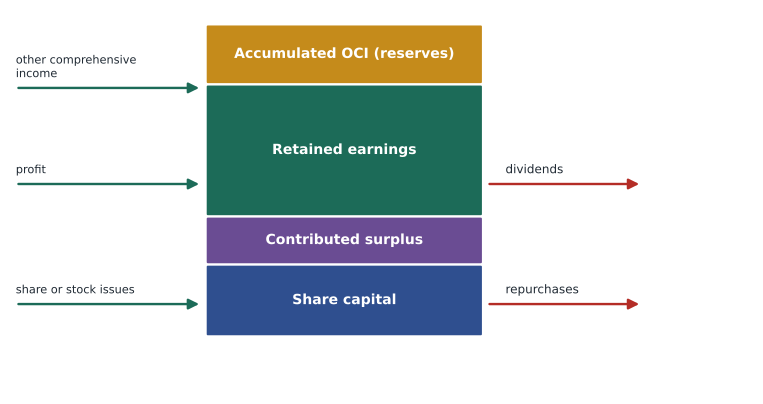
Retained earnings are the cumulative profits not distributed as dividends. Other components of equity under IFRS include contributed surplus (from share-based payment, cancellations below average cost and the equity component of convertible debt) and reserves of accumulated other comprehensive income, such as revaluation surplus (ACCT-211 lesson 10), fair value reserves for equity investments, cash flow hedge reserves and foreign currency translation reserves. Some companies appropriate retained earnings for specific purposes, such as a reserve required by a loan agreement; an appropriation is only a label within equity and does not set aside cash. The statement of changes in equity reconciles the opening and closing balance of each component, showing profit or loss, OCI, dividends, share issues and repurchases separately.
| Transaction | Canadian practice (IFRS/ASPE) | US practice (for comparison) |
|---|---|---|
| Share issue | Full proceeds to share capital (no par value) | Par to common stock, excess to APIC |
| Repurchase | Usually cancelled; reduce share capital at average cost | Usually treasury stock at cost |
| Small stock dividend | Commonly at fair value | At fair value; large dividends at par |
| Holder-redeemable preferred shares | Financial liability (ASPE tax-planning exception) | Temporary equity for SEC registrants |
| Accumulated OCI label | Reserves / AOCI | AOCI |
Common mistakes
MistakeRecording a gain when shares are repurchased for less than their original issue price.
InsteadTransactions with owners never produce gains or losses in profit or loss; differences go to equity accounts.
MistakeRecording a liability for dividends declared after year end.
InsteadThe obligation arises on declaration; disclose dividends declared after the reporting period.
MistakeRecording dividends in arrears on cumulative preferred shares as a liability.
InsteadArrears are disclosed, not recognized, until declared.
MistakePresenting preferred shares redeemable at the holder's option as equity under IFRS.
InsteadIAS 32 classifies them as financial liabilities.
MistakeThinking a stock dividend reduces total equity.
InsteadIt moves amounts within equity; total equity and percentage ownership are unchanged.
Summary and key terms
- Canadian shares have no par value; proceeds go to share capital.
- Equity issue costs are deducted from equity, not expensed.
- Repurchased shares are usually cancelled, reducing share capital at average cost, with excess charged to contributed surplus and retained earnings.
- Dividends become liabilities when declared; corporate law and covenants restrict them.
- Property dividends are measured at the fair value of the assets distributed.
- Preferred shares with redemption obligations are financial liabilities under IAS 32.
- The statement of changes in equity reconciles each component of equity.
- Share capital
- The amount received for shares issued, credited to stated capital for each class.
- Contributed surplus
- Equity from sources other than share capital and earnings, such as share-based payment and cancellations below average cost.
- Common shares
- Shares carrying the residual interest in a company.
- Preferred shares
- Shares with priority over common shares for dividends and on liquidation.
- Cumulative preferred
- Preferred shares whose unpaid dividends accumulate and must be paid before common dividends.
- Dividends in arrears
- Undeclared cumulative preferred dividends for past periods.
- Declaration date
- The date the board declares a dividend, creating a liability.
- Stock dividend
- A distribution of additional shares to existing shareholders.
- Stock split
- An increase in the number of shares with a proportionate reduction in per-share value.
- Property dividend
- A dividend paid in non-cash assets.
Practice problems
Work each problem on paper first, then reveal the answer to check.
50,000 shares issued at $12 with $8,000 of costs. Entry?
Show answer
Debit cash $592,000; credit share capital $592,000.
Average carrying amount $10 a share; 20,000 shares repurchased and cancelled at $8. Entry?
Show answer
Debit share capital $200,000; credit cash $160,000 and contributed surplus $40,000.
A dividend is declared on 15 January for a 31 December year end. Liability at year end?
Show answer
No; disclose it.
Investment carried at $400,000 with fair value $520,000 is distributed as a dividend. Gain?
Show answer
$120,000 in profit or loss.
6 per cent cumulative preferred, $1 million par, one year in arrears; $200,000 declared. Split?
Show answer
Preferred $120,000; common $80,000.
Rerun the dividend program with three years in arrears. What happens?
Show answer
Preferred are owed $1,000,000, so the full $900,000 goes to them and $100,000 of arrears remain.
1,000,000 shares at $30; 5 per cent stock dividend. Amount transferred?
Show answer
$1,500,000 from retained earnings to share capital.
A 3-for-1 split of 1 million shares trading at $90. Effect?
Show answer
3 million shares at about $30; no change in equity.
Preferred shares redeemable at the holder's option for $100 each. Classification under IFRS?
Show answer
Financial liability.
Why might a company appropriate retained earnings?
Show answer
To show amounts restricted by contract or law; it does not set aside cash.
Lesson quiz · 5 questions
Score 60% or more to complete this lesson.
Create a free account to save your progress, take quizzes and earn a certificate.