
ACCT-212 · Lesson 12 of 12 · 27 min
Accounting changes, error corrections and capstone: an integrated liabilities-and-equity case
Financial statements are most useful when they are comparable from year to year. Yet accounting policies change, estimates are revised as new information arrives, and errors are discovered. This lesson first explains how each kind of change is reported so that comparability is preserved as far as possible. It then pulls the course together in a capstone: Northlake's year-end review of its liabilities and equity, showing how the same transactions produce different numbers under the Canadian and US frameworks, and why.
Three kinds of change
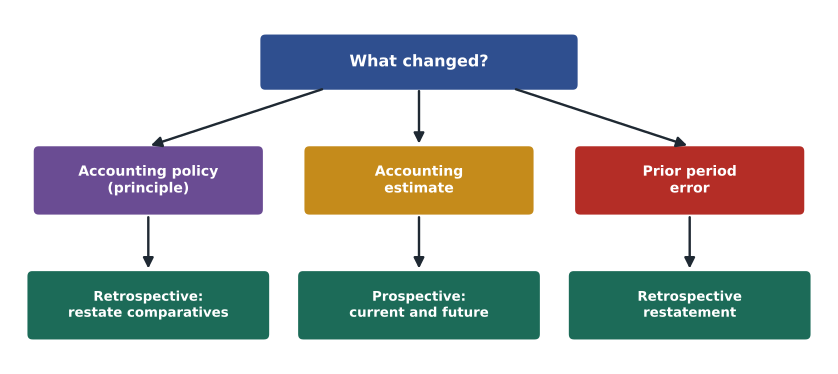
IAS 8, Accounting Policies, Changes in Accounting Estimates and Errors, distinguishes three situations. A change in accounting policy is a change in the principles, bases, conventions, rules and practices an entity applies, such as moving from the cost model to the revaluation model for a class of property, or adopting a new standard. A change in accounting estimate, since a 2021 amendment, is a change in a monetary amount that is subject to measurement uncertainty, such as the useful life of equipment, a warranty provision or a credit loss allowance. A prior period error is an omission or misstatement in earlier statements arising from failure to use, or misuse of, reliable information that was available when those statements were issued. When IFRS 18 takes effect in 2027, IAS 8 is renamed Basis of Preparation of Financial Statements, but these requirements continue. ASPE Section 1506 follows the same approach.
Changes in accounting policy
An entity may change an accounting policy only if a standard requires it or if the change results in reliable and more relevant information. New standards usually contain their own transition provisions, often with simplified options. Voluntary changes are applied retrospectively: the entity adjusts the opening balance of each affected component of equity for the earliest period presented and restates comparative amounts as if the new policy had always applied. If it is impracticable to determine the period-specific or cumulative effects, the entity applies the new policy from the earliest date practicable. The entity discloses the nature of and reasons for the change and the amount of the adjustment for each line item affected.
Changes in accounting estimates
Changes in estimates are applied prospectively: in the period of the change and, if the change affects future periods, in those periods too. Comparatives are not restated, because the earlier estimate was reasonable at the time. If Northlake revises the remaining life of its test equipment from four years to six, the remaining carrying amount is depreciated over six years from the start of the year of change. Disclosure is required of the nature and amount of a change that affects the current period or is expected to affect future periods. When it is hard to tell whether a change is in policy or estimate, both frameworks treat it as a change in estimate.
Correcting prior period errors
Material prior period errors are corrected retrospectively in the first set of statements authorized after their discovery, by restating the comparative amounts for the prior periods in which the error occurred or, if the error occurred before the earliest period presented, by restating the opening balances of assets, liabilities and equity for that period. The correction is not included in current-period profit or loss. The entity discloses the nature of the error and the correction for each line item and for basic and diluted EPS. IAS 1 also requires a third statement of financial position, at the start of the earliest comparative period, when a retrospective restatement has a material effect on it.
Worked problem
Correcting an omitted depreciation charge
In 2027 Northlake discovers that depreciation of $200,000 on the new factory was omitted from its 2026 statements. The tax deduction was claimed correctly, so the error also affects deferred tax. The tax rate is 26.5 per cent. How is it corrected?
Show solution
- Restate 2026 comparatives: depreciation expense up $200,000; deferred tax expense down 200,000 × 26.5% = $53,000; net income down $147,000.
- Restate the 31 December 2026 statement of financial position: property, plant and equipment down $200,000; deferred tax liability down $53,000; retained earnings down $147,000.
- The 2027 opening retained earnings reflect the restated amount; no correction passes through 2027 profit or loss.
- Disclose the nature of the error, the line items affected and the effect on 2026 basic and diluted EPS.
Answer: 2026 net income restated down $147,000; nothing passes through 2027 profit or loss.
| Type of change | Method | Comparatives restated? | Example |
|---|---|---|---|
| Change in accounting policy (voluntary) | Retrospective, unless impracticable | Yes | Changing inventory cost formula |
| New standard | Its transition provisions | Depends on the standard | Adopting IFRS 18 in 2027 |
| Change in estimate | Prospective | No | Revising useful life or warranty rates |
| Prior period error | Retrospective restatement | Yes | Omitted depreciation, mistaken lease classification |
Capstone: Northlake's year-end liabilities and equity
It is the end of 2027. Northlake's finance team, preparing IFRS statements, wants to understand how its main judgements on the liability and equity side would look to a US investor comparing it with a US GAAP competitor. The transactions are the ones followed through this course. The comparison is before income taxes and is illustrative; in practice, each difference would also change deferred tax.
# Northlake 2027: pre-tax effect of key liability and equity items, IFRS vs US GAAP
items = [  # (item, IFRS expense or (gain), US GAAP expense or (gain), lesson)
    ("Lawsuit (60% likely, range 0.8m-1.2m)",       1_000_000,       0, 2),
    ("Warehouse lease, year 1",                       219_043, 200_000, 5),
    ("Defined benefit pension cost",                  675_000, 587_500, 9),
    ("Bank loan modification",                       -421_236,       0, 4),
    ("Convertible bond interest, year 1",             262_089, 150_000, 4),
    ("Graded-vesting options, year 1",                368_750, 177_000, 11),
    ("Head office sale-and-leaseback gain",        -1_200_000, -2_000_000, 6),
]
print(f"{'Item':<42} {'IFRS':>11} {'US GAAP':>11} {'IFRS - US':>11}")
total_diff = 0
for name, ifrs, us, lesson in items:
    diff = ifrs - us
    total_diff += diff
    print(f"{name:<42} {ifrs:>11,} {us:>11,} {diff:>11,}  (L{lesson})")
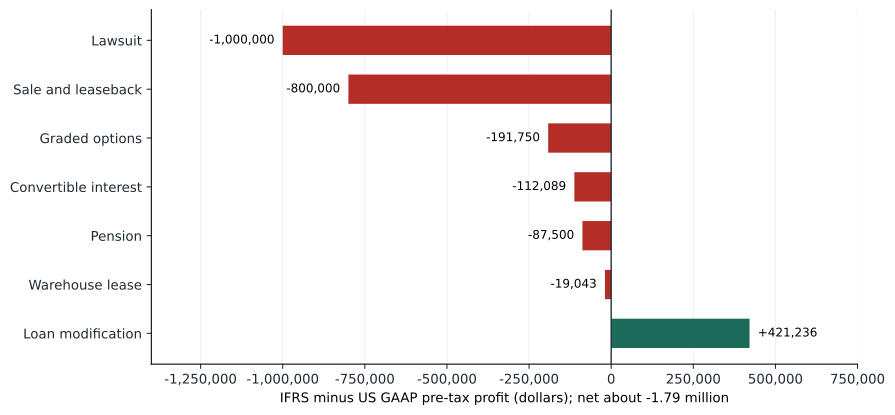
print(f"{'Net: IFRS pre-tax profit lower by':<42} {'':>11} {'':>11} {total_diff:>11,}")Item IFRS US GAAP IFRS - US Lawsuit (60% likely, range 0.8m-1.2m) 1,000,000 0 1,000,000 (L2) Warehouse lease, year 1 219,043 200,000 19,043 (L5) Defined benefit pension cost 675,000 587,500 87,500 (L9) Bank loan modification -421,236 0 -421,236 (L4) Convertible bond interest, year 1 262,089 150,000 112,089 (L4) Graded-vesting options, year 1 368,750 177,000 191,750 (L11) Head office sale-and-leaseback gain -1,200,000 -2,000,000 800,000 (L6) Net: IFRS pre-tax profit lower by 1,789,146
On these items alone, Northlake's IFRS pre-tax profit is about $1.79 million lower than it would be under US GAAP. The two biggest drivers are opposite in nature: the lawsuit provision, recognized under IAS 37's lower threshold and measured at the mid-point of the range, and the sale-and-leaseback, where IFRS 16 restricts the gain to the rights transferred. The loan modification works the other way, producing an immediate IFRS gain that US GAAP would spread over the remaining term. None of these differences changes Northlake's cash flows; they change when and where income is recognized.
Balance sheet and classification differences
Several differences affect the statement of financial position rather than profit. Northlake's $3 million bank loan due in June 2028, refinanced in February 2028 before the 2027 statements were issued (lesson 1's example rolled forward a year), is current under IFRS but non-current under US GAAP, so the IFRS current ratio is lower. The convertible bond is split between a liability of about $4.4 million and equity of about $0.6 million under IFRS, but is a single $5 million liability under US GAAP. Under IFRS the lawsuit adds a $1 million provision; under US GAAP it appears only in the notes. The pension deficit of $1.85 million is the same in both frameworks, but its accumulated OCI differs because only US GAAP amortizes actuarial losses through the corridor. A reader comparing debt-to-equity ratios across the two frameworks must adjust for all of these.
Worked problem
Adjusting a leverage ratio
Under IFRS, Northlake reports total liabilities of $46.0 million and equity of $38.0 million at the end of 2027. How might an analyst restate debt to equity to compare with a US GAAP competitor, using the capstone items?
Show solution
- Remove the lawsuit provision, which would not be recognized under US GAAP: liabilities − $1.0 million.
- Reclassify the convertible bond's equity component, about $0.63 million, to liabilities (reduced by amortization in practice; use the original amount for simplicity): liabilities + $0.63 million, equity − $0.63 million.
- Add the $1.79 million of pre-tax profit differences to equity, ignoring tax and later reversals for simplicity; the $1.0 million lawsuit is part of this amount: equity + $1.79 million.
- Restated: liabilities 46.0 − 1.0 + 0.63 = $45.63 million; equity 38.0 − 0.63 + 1.79 = $39.16 million; debt to equity falls from 1.21 to about 1.17.
Answer: Debt to equity about 1.17 on a US GAAP-like basis, against 1.21 as reported under IFRS: small differences, but enough to matter near a covenant.
Professional judgement and ethics
Liabilities are where financial reporting has failed most spectacularly. Before IFRS 16 and ASC 842, companies structured leases to keep billions of dollars of obligations off their balance sheets. Enron used special purpose entities to hide debt and inflate earnings (BUS-310 lesson 9). Companies have smoothed earnings by overstating provisions in good years and releasing them in bad ones, and have kept debt classified as non-current while in breach of covenants. Each of the standards in this course responds to such abuses by tightening definitions, requiring more disclosure or removing choices. But no standard can eliminate judgement: the probability of losing a lawsuit, the discount rate for a pension plan, the incremental borrowing rate for a lease and the likelihood of future taxable profit all depend on estimates. The CPA Canada Code of Professional Conduct and its provincial equivalents require accountants to act with integrity and objectivity and not to be associated with information they know to be false or misleading.
A well-prepared set of statements makes those judgements visible in the notes, and a careful reader checks them.
Comparing companies across frameworks in practice
Northlake's capstone is a small version of a task analysts perform routinely. Canadian companies listed in the United States may file with the SEC using IFRS without reconciling to US GAAP, a concession the SEC granted to foreign private issuers in 2007; some Canadian issuers, including several large railways and energy companies, use US GAAP instead, which Canadian securities rules permit for SEC registrants. An analyst comparing a Canadian IFRS reporter with a US-GAAP peer therefore has to identify the differences that matter for the industry. For a retailer or airline, lease presentation and EBITDA dominate; for a manufacturer with an old workforce, pensions; for a growth company, share-based payment and convertible debt; for an industrial company, provisions and decommissioning obligations.
A practical approach is to start with the cash flow statement, which is least affected by framework choices (apart from the classification of lease payments and interest), then work through the notes on leases, provisions, pensions, debt and equity, adjusting reported profit, debt and equity for the largest differences. The goal is not to reproduce the other framework precisely, which would require information only management has, but to remove differences large enough to change a conclusion about a company's profitability, leverage or liquidity. As this course has shown, those differences arise mostly in liabilities, because that is where estimates, thresholds and classification rules are most consequential.
Common mistakes
MistakeRestating prior years when a useful-life estimate changes.
InsteadChanges in estimates are prospective; only policy changes and errors are retrospective.
MistakeCorrecting a prior-year error through current-year profit or loss.
InsteadRestate the comparatives and opening equity; the correction is not part of current profit.
MistakeIgnoring the tax effect of an error correction.
InsteadCorrect the related current and deferred tax as well.
MistakeComparing leverage ratios across frameworks without adjustment.
InsteadAdjust for differences in provisions, leases, convertibles and classification before comparing.
MistakeConcluding that a framework difference changes cash flows.
InsteadThese differences affect timing and presentation of income, not cash.
Summary and key terms
- Changes in accounting policy are applied retrospectively, unless a new standard's transition rules or impracticability say otherwise.
- Changes in accounting estimates are applied prospectively, without restating comparatives.
- Material prior period errors are corrected by restating comparatives and opening equity, with tax effects.
- IAS 8 becomes Basis of Preparation of Financial Statements when IFRS 18 applies in 2027.
- Northlake's capstone shows IFRS and US GAAP diverging on provisions, leases, pensions, modifications, convertibles, share-based payment and sale-and-leasebacks.
- Balance sheet classification differences, such as refinanced debt, change liquidity and leverage ratios.
- Liability accounting depends heavily on judgement, so disclosures and professional ethics matter.
- Third statement of financial position
- An additional opening balance sheet required by IAS 1 when a restatement materially affects it.
- Change in accounting policy
- A change in the principles or rules an entity applies to prepare its financial statements.
- Change in accounting estimate
- A change in a monetary amount subject to measurement uncertainty.
- Prior period error
- An omission or misstatement in prior statements arising from misuse of available reliable information.
- Retrospective application
- Applying a new policy as if it had always been applied, restating comparatives.
- Retrospective restatement
- Correcting prior periods as if the error had never occurred.
- Prospective application
- Applying a change only to the current and future periods.
- Impracticable
- Unable to apply a requirement after making every reasonable effort.
- Preferability letter
- An auditor's letter stating that a voluntary accounting change is preferable.
Practice problems
Work each problem on paper first, then reveal the answer to check.
A company changes the estimated life of a machine from 8 to 10 years. Restate prior years?
Show answer
No; apply prospectively.
A company switches from FIFO to weighted average because it is more relevant. Method?
Show answer
Retrospective application, restating comparatives, unless impracticable.
An omitted $50,000 expense from last year is found; tax rate 26.5 per cent. Effect on opening retained earnings?
Show answer
Down $36,750.
Why are changes in estimates not restated?
Show answer
The original estimate was reasonable when made; new information belongs to the period it arrives.
Rerun the capstone program with the lawsuit probability at 80 per cent, so US GAAP accrues the $800,000 minimum. New net difference?
Show answer
About $989,146 lower under IFRS (the lawsuit difference falls to $200,000).
Which capstone item makes IFRS profit higher than US GAAP?
Show answer
The loan modification gain.
How does a refinancing after year end affect the IFRS current ratio?
Show answer
The loan stays current, lowering the ratio compared with US GAAP.
Why might the IFRS and US GAAP pension liabilities be equal but AOCI differ?
Show answer
Both recognize the funded status; only US GAAP amortizes OCI amounts into income through the corridor.
When does IAS 1 require a third balance sheet?
Show answer
When a retrospective change or restatement materially affects the opening balance of the earliest comparative period.
Name one historical abuse that the lease standards addressed.
Show answer
Structuring leases to keep large obligations off the balance sheet.
Lesson quiz · 5 questions
Score 60% or more to complete this lesson.
Create a free account to save your progress, take quizzes and earn a certificate.