
ACCT-212 · Lesson 4 of 12 · 29 min
Long-term debt II: notes, extinguishment, modifications and presentation
Lesson 3 followed a bond from issue to maturity. Real debt rarely behaves so neatly. Companies borrow from banks on instalment notes, repay bonds early when interest rates fall, renegotiate loans when they run into trouble, breach covenants, and issue debt that converts into shares. This lesson covers those events: instalment and mortgage notes, early extinguishment, modifications and troubled debt restructurings, the fair value option, convertible debt and the classification questions raised by covenants. The framework differences here are larger than for plain bonds, so the IFRS and US GAAP treatments are set side by side.
Instalment notes and mortgages
Many long-term notes are repaid in equal instalments that combine interest and principal, like a home mortgage. The payment is the annuity that amortizes the principal at the stated rate. Each payment is split: interest is the opening balance times the rate, and the rest reduces principal. Early payments are mostly interest; later payments are mostly principal. Only the principal due within twelve months is a current liability.
Worked problem
An instalment note
Northlake borrows $600,000 from its bank on 1 January 2027 to buy test equipment, repayable in four equal annual payments at 6 per cent, starting 31 December 2027. What are the payment and the split of the first payment?
Show solution
- Payment: 600,000 × 0.06 ÷ [1 − 1.06⁻⁴] = $173,155.
- Year 1 interest: 600,000 × 6% = $36,000. Principal repaid: 173,155 − 36,000 = $137,155.
- Balance after the first payment: $462,845.
- At 31 December 2027, the principal due in 2028 (173,155 − 462,845 × 6% = $145,384) is current; the remaining $317,461 is non-current.
Answer: Annual payment $173,155; the current portion at the end of year 1 is $145,384.
Mortgages are instalment notes secured by real property; the lender can take the property if the borrower defaults. Their accounting is the same, with additional disclosure of the assets pledged as security. Canadian residential mortgages compound interest semi-annually under the Interest Act, so the monthly rate is derived from the semi-annual rate (FIN-201 lesson 4); commercial loans usually compound monthly.
Extinguishing debt before maturity
A company may repay debt early by exercising a call option in the indenture, buying its bonds in the open market or refinancing through a new issue. When debt is extinguished, the difference between the reacquisition price (including any call premium and transaction costs) and the carrying amount of the debt, including unamortized discount, premium and issue costs, is recognized as a gain or loss in profit or loss. Because the carrying amount and the price rarely match, extinguishments often produce gains or losses that analysts treat as non-recurring.
Worked problem
Calling the bonds
On 31 December 2029, after six semi-annual payments, interest rates have fallen and Northlake calls its $10 million bonds from lesson 3 at 102. The carrying amount after the sixth payment is $9,811,901. What is recognized?
Show solution
- Reacquisition price: 10,000,000 × 1.02 = $10,200,000.
- Carrying amount: $9,811,901 (face value less the unamortized discount of $188,099).
- Loss on extinguishment: 10,200,000 − 9,811,901 = $388,099, in profit or loss.
- Entry: debit bonds payable $9,811,901 and loss on extinguishment $388,099; credit cash $10,200,000.
Answer: Loss of $388,099: the call premium plus the unamortized discount.
Under IFRS 9 a financial liability is derecognized when it is extinguished, that is, when the obligation is discharged, cancelled or expires. Derecognition gains and losses are presented in profit or loss, usually within finance costs or income. ASPE Section 3856 has similar derecognition requirements.
Modifications and exchanges of debt
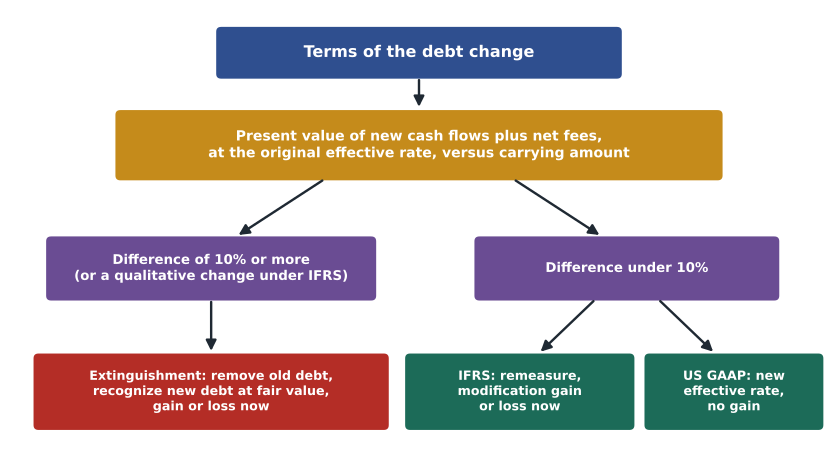
Instead of repaying debt, a borrower and lender may change its terms: a lower interest rate, a longer maturity, a reduced principal or added fees. The question is whether the change is so substantial that the old debt should be treated as extinguished and new debt recognized, or whether the old debt continues with modified terms. Both frameworks use a quantitative '10 per cent test': compare the present value of the cash flows under the new terms, including fees paid net of fees received, discounted at the original effective interest rate, with the present value of the remaining cash flows of the original debt (its carrying amount). If the difference is at least 10 per cent, the modification is substantial and treated as an extinguishment.
If the modification is not substantial, IFRS 9 recalculates the carrying amount of the liability as the present value of the modified cash flows discounted at the original effective interest rate, and recognizes the difference immediately as a modification gain or loss in profit or loss. Costs and fees incurred adjust the carrying amount and are amortized over the remaining term. IFRS 9 also requires a qualitative assessment: a change in currency or the addition of an equity conversion feature, for example, may be substantial even if the 10 per cent test is not met.
# The 10% test and accounting for a modified bank loan
original_eir = 0.06
carrying = 5_000_000                    # 6% loan, 3 years left, interest annual
def pv(flows, r):
    return sum(cf / (1 + r) ** t for t, cf in enumerate(flows, start=1))

# New terms: rate cut to 4%, maturity extended to 5 years, $100,000 fee paid to the lender
new_flows = [200_000] * 4 + [5_200_000]
fee_paid = 100_000
pv_new = pv(new_flows, original_eir) + fee_paid
change = (carrying - pv_new) / carrying
print(f"PV of new flows plus fee at 6%: {pv_new:,.0f}")
print(f"Difference from carrying amount: {change:.1%} -> {'extinguishment' if abs(change) >= 0.10 else 'modification'}")

# IFRS 9: remeasure at the original EIR, recognize a gain; fee adjusts the carrying amount
remeasured = pv(new_flows, original_eir)
print(f"IFRS 9 gain on modification: {carrying - remeasured:,.0f}; new carrying {remeasured - fee_paid:,.0f}")

# US GAAP (ASC 470-50): no gain; solve a new effective rate on carrying less the fee
target = carrying - fee_paid
lo, hi = 0.0, 0.2
for _ in range(100):
    mid = (lo + hi) / 2
    lo, hi = (mid, hi) if pv(new_flows, mid) > target else (lo, mid)
print(f"ASC 470-50: no gain; carrying {target:,.0f}; new effective rate {mid:.3%}")PV of new flows plus fee at 6%: 4,678,764 Difference from carrying amount: 6.4% -> modification IFRS 9 gain on modification: 421,236; new carrying 4,478,764 ASC 470-50: no gain; carrying 4,900,000; new effective rate 4.455%
The rate cut and extension reduce the present value of the loan by 6.4 per cent, under the 10 per cent threshold, so the debt is modified rather than extinguished. Under IFRS 9 Northlake recognizes a modification gain of $421,236 immediately and continues to recognize interest at the original 6 per cent on the lower carrying amount. Under US GAAP no gain is recognized; the carrying amount, reduced by the fee, becomes $4.9 million, and interest is recognized at a new effective rate of about 4.46 per cent for the next five years. Over the life of the loan the total effect is the same; only the timing differs.
Troubled debt restructurings, where a lender grants concessions to a borrower in financial difficulty, follow the same IFRS 9 modification and derecognition rules; there is no separate model. If a debtor transfers assets or equity to settle debt, the debt is derecognized and the gain measured against the fair value of what is given up. IFRIC 19 covers debt-for-equity swaps: the shares issued are measured at their fair value, and any difference from the carrying amount of the debt is a gain or loss.
The fair value option
IFRS 9 allows an entity to designate a financial liability at fair value through profit or loss at initial recognition if doing so eliminates or significantly reduces an accounting mismatch, or if the liability is managed on a fair value basis. Changes in fair value attributable to changes in the entity's own credit risk are presented in other comprehensive income and never recycled, unless that would create or enlarge an accounting mismatch. This prevents a company from reporting a gain in profit or loss because its own creditworthiness has deteriorated.
Convertible debt
A convertible bond gives the holder the right to exchange it for a fixed number of the issuer's shares. Under IAS 32 it is a compound financial instrument: a liability (the obligation to pay interest and principal) and an equity component (the conversion option). The issuer measures the liability first, at the present value of the cash flows discounted at the rate for similar debt without the conversion feature, and assigns the residual to equity. The liability is then accounted for at amortized cost, which produces interest expense at the higher straight-debt rate. On conversion, the carrying amount of the liability and the equity component are transferred to share capital, with no gain or loss. ASPE Section 3856 allows a private enterprise to measure the equity component at zero or to use the residual approach.
Worked problem
Splitting a convertible bond
Northlake issues $5 million of five-year convertible bonds at par with a 3 per cent annual coupon. Similar bonds without a conversion feature would yield 6 per cent. How is the issue recorded?
Show solution
- Present value of the cash flows at 6 per cent: 150,000 annuity for 5 years plus 5,000,000 at year 5 = $4,368,145.
- Liability component: $4,368,145, measured at amortized cost at 6 per cent.
- Equity component (residual): 5,000,000 − 4,368,145 = $631,855, credited to contributed surplus or a separate equity reserve.
- Year 1 interest expense: 4,368,145 × 6% = $262,089, against $150,000 of cash interest.
Answer: Liability $4,368,145 and equity $631,855.
Covenants, breaches and classification
Loan agreements contain covenants, such as a minimum current ratio or a maximum debt-to-EBITDA ratio. If the borrower breaches a covenant on or before the reporting date and the debt becomes repayable on demand, IAS 1 requires the debt to be classified as current, even if the lender agrees after the reporting date not to demand repayment. It is non-current only if, by the reporting date, the lender has granted a grace period of at least twelve months during which it cannot demand repayment. Since the 2022 amendments, covenants the entity must meet only after the reporting date do not affect classification, but the entity must disclose the covenants, the carrying amount of the related liabilities and facts indicating difficulty in complying.
| Event | IFRS | US GAAP (for comparison) |
|---|---|---|
| Refinanced after year end, before issue | Current | Non-current |
| Covenant breach at year end, waiver after year end | Current | Non-current if waived for more than a year |
| Non-substantial modification | Gain or loss now | New effective rate, no gain or loss |
| Convertible bond (no derivative) | Split liability and equity | Single liability |
| Fair value option: own credit changes | Other comprehensive income | Other comprehensive income |
Because the classification of debt can swing a current ratio dramatically, readers should study the notes on covenants and waivers, especially for companies near their limits. A reclassification of a large loan to current is often an early warning of financial distress, and auditors consider it carefully when assessing whether the going-concern basis is appropriate.
Common mistakes
MistakeRecording the call premium on early repayment as interest expense spread over the remaining term.
InsteadRecognize the difference between the price and the carrying amount immediately as a gain or loss on extinguishment.
MistakeTreating every change in loan terms as new debt.
InsteadApply the 10 per cent test (and, under IFRS, qualitative factors) to decide between extinguishment and modification.
MistakeSpreading the effect of a non-substantial modification over the remaining term.
InsteadIFRS 9 remeasures the liability at the original effective rate and recognizes the gain or loss now.
MistakeRecording a convertible bond entirely as a liability.
InsteadIAS 32 separates the equity conversion option from the liability.
MistakeClassifying the full instalment note as non-current.
InsteadThe principal due within twelve months is current.
Summary and key terms
- Instalment payments combine interest on the opening balance and principal; only next year's principal is current.
- Early extinguishment produces a gain or loss equal to the difference between the price paid and the carrying amount.
- The 10 per cent test compares the present value of modified cash flows, at the original effective rate, with the carrying amount.
- IFRS 9 recognizes a gain or loss on a non-substantial modification immediately.
- Under the fair value option, changes from the entity's own credit risk go to other comprehensive income.
- Convertible bonds are split into a liability measured at the straight-debt rate and an equity residual.
- A covenant breach at year end makes debt current unless a twelve-month grace period exists at the reporting date.
- Compound financial instrument
- An instrument with both liability and equity components.
- Instalment note
- A loan repaid in equal payments combining interest and principal.
- Extinguishment
- The discharge, cancellation or expiry of a liability, removing it from the balance sheet.
- Call premium
- The amount above face value an issuer pays to redeem bonds early.
- Modification
- A change in the terms of debt that is not substantial enough to be an extinguishment.
- Ten per cent test
- Comparison of the present value of modified cash flows with the carrying amount to decide whether a modification is substantial.
- Troubled debt restructuring
- A modification in which a lender grants concessions because the borrower is in financial difficulty.
- Fair value option
- An election to measure a financial liability at fair value with changes in profit or loss.
- Convertible bond
- A bond the holder may exchange for a fixed number of the issuer's shares.
- Covenant
- A condition in a loan agreement that the borrower must meet.
- Grace period
- A period after a breach during which the lender cannot demand repayment.
Practice problems
Work each problem on paper first, then reveal the answer to check.
$200,000 note, 3 annual payments at 5 per cent. Payment?
Show answer
$73,442.
Carrying amount $4.9 million; called at $5.1 million. Gain or loss?
Show answer
Loss of $200,000.
Bonds with a carrying amount of $10.3 million are repurchased at $10.1 million. Result?
Show answer
Gain of $200,000.
Carrying amount $2 million; PV of new flows plus fees at the original rate $1.75 million. Substantial?
Show answer
Yes; a 12.5 per cent difference.
Rerun the modification program with a $20,000 fee and the rate cut only to 5 per cent for three years. Result?
Show answer
The present value changes by about 2.3 per cent: a modification, not an extinguishment.
Non-substantial modification reduces the PV at the original rate by $300,000. IFRS entry?
Show answer
Debit the liability $300,000; credit a modification gain $300,000.
$1 million convertible at par; liability component PV $910,000. Equity component?
Show answer
$90,000.
Why do covenants matter for the current ratio?
Show answer
A breach can make long-term debt current, sharply reducing the ratio.
Under the fair value option, the entity's credit rating falls and its debt's fair value drops $500,000. Where does the gain go?
Show answer
To other comprehensive income, not profit or loss.
Why are early payments on an instalment note mostly interest?
Show answer
Interest is computed on the opening balance, which is highest at the start.
Lesson quiz · 5 questions
Score 60% or more to complete this lesson.
Create a free account to save your progress, take quizzes and earn a certificate.