
ACCT-212 · Lesson 1 of 12 · 32 min
Current liabilities
ACCT-211 followed Northlake Instruments, the invented maker of weather and air-quality sensor stations, through the asset side of its statement of financial position. This course turns to the other side: what the company owes and what belongs to its owners. Liabilities matter to every reader of financial statements. Lenders use them to judge whether a borrower can repay; suppliers use them to decide whether to extend credit; investors use them to understand how much of the business is financed by others and how much risk that creates. Because managers sometimes have reasons to make liabilities look smaller, the rules for when to recognize them, how to measure them and how to classify them are among the most carefully argued in accounting.
This first lesson covers the liabilities a business settles within its normal operating cycle: trade payables, short-term borrowings, the current portion of long-term debt, sales taxes, payroll and benefits, customer deposits and accrued expenses. Later lessons take up estimated liabilities (lesson 2), long-term debt (lessons 3 and 4), leases (lessons 5 and 6), income taxes (lessons 7 and 8) and pensions (lesson 9), before the course turns to equity.
What a liability is
The IASB's 2018 Conceptual Framework defines a liability as a present obligation of the entity to transfer an economic resource as a result of past events. Three ideas sit inside that definition. There must be an obligation, which can be legal (a contract or statute) or constructive (a pattern of past practice or a published policy that leaves the entity with no practical ability to avoid the transfer). The obligation must exist now, because of something that has already happened. And settling it must require the entity to give up something of value: cash, other assets or services. ASPE uses a similar definition in Section 1000, Financial Statement Concepts.
An obligation is not the same as an intention. A board decision to spend money next year on advertising creates no liability, because the company can still change its mind. A signed purchase order for goods not yet delivered is usually an executory contract: neither party has performed, so neither records an asset or liability until delivery, unless the contract has become onerous (lesson 2). By contrast, goods received before the invoice arrives create a liability at once, because the supplier has performed.
Classifying liabilities as current or non-current
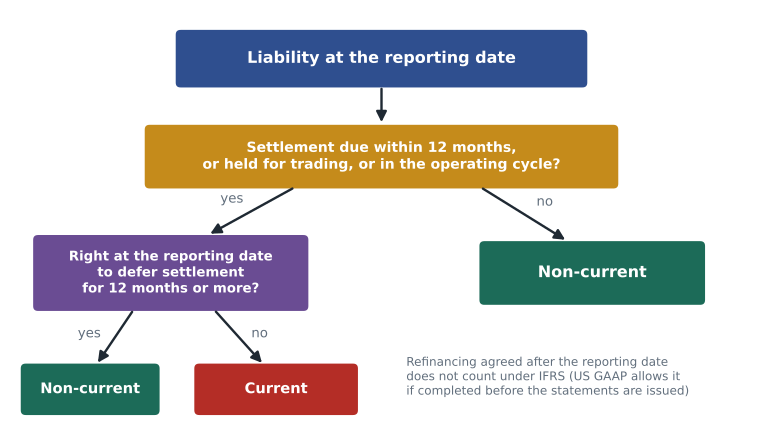
Under IAS 1, Presentation of Financial Statements, a liability is current if the entity expects to settle it in its normal operating cycle, holds it mainly for trading, must settle it within twelve months after the reporting period, or does not have the right at the end of the reporting period to defer settlement for at least twelve months. Amendments issued in 2020 and 2022, effective for annual periods beginning on or after 1 January 2024, clarified the last test. The right to defer must exist at the reporting date and have substance. Management's intentions do not matter: a loan due in eight months is current even if management plans to refinance it. Covenants that must be met only after the reporting date do not affect classification at that date, but the entity must disclose information that helps users assess the risk that the debt could become repayable within twelve months. IFRS 18, which replaces IAS 1 for annual periods beginning on or after 1 January 2027, carries these classification requirements forward. ASPE Section 1510 uses a similar twelve-month and operating-cycle test.
Worked problem
Classifying a maturing loan
Northlake has a $3 million bank loan due on 30 June 2027. Its year end is 31 December 2026, and the financial statements are authorized for issue on 20 February 2027. On 15 February 2027 the bank agrees to extend the loan to 2031. How is the loan classified at 31 December 2026?
Show solution
- At 31 December 2026 the loan is due within twelve months.
- Northlake had no right at that date to defer settlement; the extension was granted after the reporting period.
- Under IAS 1 the refinancing is a non-adjusting event after the reporting period: classify the loan as current and disclose the refinancing.
- Had the extension been an existing option in the loan agreement, exercisable at Northlake's discretion at year end, the loan would have been non-current.
Answer: Current under IFRS and ASPE, with disclosure of the refinancing.
Trade payables, notes and accrued liabilities
Accounts payable, also called trade payables, are amounts owed to suppliers for goods and services bought on credit. They are recorded when title to goods passes or services are received, at the invoice amount. Purchase discounts can be recorded using the gross method, which records purchases at the invoice price and recognizes discounts taken, or the net method, which records purchases net of available discounts and recognizes discounts lost as a finance cost. The net method better reflects the cost of the goods and highlights the expensive financing implicit in missing a 2/10, net 30 discount, which works out to an annual rate of more than 36 per cent.
Short-term notes payable are written promises to pay, often to banks. Interest-bearing notes are recorded at face value and accrue interest over time. A non-interest-bearing note carries an implicit interest charge: the borrower receives less than the face amount and records the difference as a discount that is amortized to interest expense. Lines of credit and bank overdrafts are current liabilities; under IAS 7 an overdraft repayable on demand that is an integral part of cash management may be netted with cash in the cash flow statement, but not on the statement of financial position unless the offset criteria are met.
The current portion of long-term debt is the principal due within twelve months. It is reclassified to current liabilities each year end, together with accrued interest. Dividends payable arise when the board declares a cash dividend, because declaration creates a legal obligation to shareholders (lesson 10). Accrued liabilities, also called accrued expenses, are costs incurred but not yet invoiced or paid at year end: interest, utilities, wages, professional fees and property taxes. Customer deposits and contract liabilities arise when customers pay before the entity performs; ACCT-211 lesson 4 covered their treatment under the revenue standard. Gift cards and loyalty points create contract liabilities that are reduced as they are redeemed or as breakage is recognized.
Sales taxes collected
A Canadian business registered for the goods and services tax or harmonized sales tax collects tax from customers on behalf of the government. The tax collected is not revenue: it is credited to a liability, GST/HST payable. Tax paid on business purchases is recoverable as an input tax credit, debited to a receivable or offset against the payable. The net amount is remitted to the Canada Revenue Agency monthly, quarterly or annually depending on the business's size. Provincial sales tax in British Columbia, Saskatchewan and Manitoba, and the Quebec sales tax, add separate registration and remittance obligations. Small suppliers with taxable sales of $30,000 or less over four consecutive quarters are not required to register.
Worked problem
Recording sales taxes
Northlake sells a station in Ontario for $40,000 plus 13 per cent HST. In the same month it buys components for $10,000 plus $1,300 HST. Record the effect on HST payable.
Show solution
- Sale: debit receivable $45,200; credit revenue $40,000; credit HST payable $5,200.
- Purchase: debit inventory $10,000 and HST receivable (input tax credit) $1,300; credit payables $11,300.
- Net HST owing for the month: 5,200 − 1,300 = $3,900, remitted to the CRA by the due date.
Answer: HST payable of $3,900 after input tax credits; none of it is revenue.
Payroll liabilities
Payroll creates several liabilities at once. The employer owes employees their net pay. It also withholds amounts from employees' gross pay, such as income tax and the employee share of social insurance contributions, and owes these to the government. On top of that it incurs its own payroll taxes and benefit costs, which are an expense in addition to gross wages. The withholdings and employer contributions are current liabilities until remitted, usually within weeks.
In Canada the main statutory items for 2026 (illustrative; confirm current rates with the CRA) are Canada Pension Plan contributions of 5.95 per cent of pensionable earnings above a $3,500 annual basic exemption, up to the year's maximum pensionable earnings of $74,600, plus a second tier (CPP2) of 4 per cent on earnings between that amount and $85,000; Employment Insurance premiums of 1.63 per cent of insurable earnings up to $68,900; and income tax withheld under federal and provincial tables. The employer matches the employee's CPP and CPP2 contributions and pays EI premiums at 1.4 times the employee rate. Provincial workers' compensation premiums and, in some provinces, employer health taxes add further costs. Quebec employers deduct Quebec Pension Plan and Quebec Parental Insurance Plan premiums instead of CPP and part of EI.
# One employee's monthly payroll in Ontario (2026 rates, illustrative)
gross = 6_000.00
cpp_rate, basic_exemption = 0.0595, 3_500 / 12
ei_rate, ei_employer_factor = 0.0163, 1.4
income_tax = 1_010.00                    # from the payroll tables (illustrative)

cpp_employee = round((gross - basic_exemption) * cpp_rate, 2)
ei_employee = round(gross * ei_rate, 2)
net_pay = gross - cpp_employee - ei_employee - income_tax
cpp_employer = cpp_employee
ei_employer = round(ei_employee * ei_employer_factor, 2)

print(f"Gross wages                    {gross:>10,.2f}")
print(f"  CPP withheld                 {cpp_employee:>10,.2f}")
print(f"  EI withheld                  {ei_employee:>10,.2f}")
print(f"  Income tax withheld          {income_tax:>10,.2f}")
print(f"Net pay owed to the employee   {net_pay:>10,.2f}")
print(f"Employer CPP                   {cpp_employer:>10,.2f}")
print(f"Employer EI                    {ei_employer:>10,.2f}")
remit = cpp_employee + ei_employee + income_tax + cpp_employer + ei_employer
print(f"Total remittance to the CRA    {remit:>10,.2f}")
print(f"Total cost to the employer {gross + cpp_employer + ei_employer:>10,.2f}")Gross wages 6,000.00 CPP withheld 339.65 EI withheld 97.80 Income tax withheld 1,010.00 Net pay owed to the employee 4,552.55 Employer CPP 339.65 Employer EI 136.92 Total remittance to the CRA 1,924.02 Total cost to the employer 6,476.57
The program shows why payroll is more expensive than the salary figure suggests. Northlake's $6,000 employee costs the company about $6,477 a month once employer CPP and EI are added, before workers' compensation, health benefits or vacation pay. Each month Northlake owes the employee $4,552.55 and owes the CRA $1,924.02, both current liabilities until paid.
Compensated absences and bonuses
Employees earn paid vacation as they work. IAS 19 treats accumulating paid absences, those that can be carried forward if unused, as a liability measured at the additional amount the entity expects to pay because of unused entitlement at the reporting date. Non-accumulating absences, such as sick days that lapse, are recognized only when taken. Provincial employment standards set minimum vacation: in Ontario two weeks after each year of employment, rising to three weeks after five years, with vacation pay of at least 4 or 6 per cent of wages. Bonuses and profit-sharing are accrued when the entity has a present legal or constructive obligation and can estimate the amount reliably, which usually means by year end for a plan based on that year's results.
Worked problem
Accruing vacation pay
At 31 December 2026, Northlake's 120 employees have earned 1,400 days of unused vacation that carries forward to 2027. The average daily pay rate expected in 2027, when the vacation will be taken, is $310, and employer payroll costs add 9 per cent. What liability is recognized?
Show solution
- Days earned but untaken: 1,400.
- Measure at the rate expected to be paid: 1,400 × $310 = $434,000.
- Add employer payroll costs that will arise when the vacation is paid: 434,000 × 9% = $39,060.
- Accrued vacation liability: $473,060, with the change from last year recognized as wage expense.
Answer: Accrued vacation of about $473,000, a current liability because the days are expected to be taken in 2027.
| Liability | Typical measurement | Usual classification |
|---|---|---|
| Trade payables | Invoice amount (net of expected discounts under the net method) | Current |
| Short-term notes and lines of credit | Face value plus accrued interest, or present value for non-interest-bearing notes | Current |
| Current portion of long-term debt | Principal due within twelve months | Current |
| GST/HST and PST payable | Tax collected less recoverable tax paid, where allowed | Current |
| Payroll withholdings and employer taxes | Statutory rates applied to wages | Current |
| Accrued vacation and bonuses | Amount expected to be paid, including payroll costs | Mostly current |
| Contract liabilities and deposits | Consideration received before performance | Current or non-current by expected performance |
Analysing short-term liquidity
Readers use current liabilities to assess liquidity. The current ratio divides current assets by current liabilities; the quick ratio divides cash, short-term investments and receivables by current liabilities; and days payable outstanding, accounts payable divided by cost of sales times 365, shows how long the company takes to pay suppliers. A company can improve these ratios at year end by paying down payables just before the reporting date, delaying purchases or, where the framework allows, reclassifying debt as non-current. Readers should therefore look at the notes on refinancing, covenant compliance and the maturity analysis of financial liabilities that IFRS 7 requires, and US companies disclose under ASC 470 and SEC rules.
Supplier finance arrangements, sometimes called reverse factoring, deserve special attention. A bank pays the company's suppliers early and the company pays the bank later, often on extended terms. The company's operating cash flow looks stronger because payments to suppliers become payments to a bank. Amendments to IAS 7 and IFRS 7, effective for annual periods beginning on or after 1 January 2024, now require disclosure of the terms of these arrangements, the carrying amounts involved and the range of payment due dates.
Common mistakes
MistakeTreating sales tax collected from customers as revenue.
InsteadSales tax collected is a liability to the government; only the price excluding tax is revenue.
MistakeRecording only the gross wage as payroll expense.
InsteadAdd the employer's own payroll taxes and benefit costs; withholdings are liabilities, not extra expense.
MistakeClassifying a loan as non-current because the bank agreed to extend it after year end.
InsteadUnder IAS 1 the right to defer settlement must exist at the reporting date; later refinancing is only disclosed.
MistakeRecording a liability for a purchase order when no goods have been received.
InsteadAn executory contract creates no liability until one party performs, unless it is onerous.
MistakeIgnoring unused vacation at year end.
InsteadAccumulating paid absences are a liability measured at the amount expected to be paid.
Summary and key terms
- A liability is a present obligation to transfer an economic resource as a result of past events.
- Under IAS 1 a liability is current unless the entity has a right at the reporting date to defer settlement for at least twelve months.
- Trade payables, short-term notes, the current portion of long-term debt, dividends payable and accrued expenses are the core current liabilities.
- GST/HST collected is a liability, offset by input tax credits on purchases.
- Payroll creates liabilities for net pay, withholdings and the employer's own payroll taxes.
- Accumulating vacation and earned bonuses are accrued at the amount expected to be paid.
- Liquidity ratios and supplier finance disclosures help readers judge short-term risk.
- Input tax credit
- GST/HST paid on business purchases that a registrant can recover from the CRA.
- Liability
- A present obligation of the entity to transfer an economic resource as a result of past events.
- Constructive obligation
- An obligation created by past practice or published policy that leaves the entity no realistic alternative but to settle.
- Executory contract
- A contract under which neither party has yet performed.
- Current liability
- An obligation expected to be settled within twelve months or the operating cycle.
- Accrued liability
- An expense incurred but not yet paid or invoiced at the reporting date.
- Current portion of long-term debt
- Principal of long-term borrowings due within twelve months.
- Withholdings
- Amounts deducted from employees' pay that the employer must remit to governments or others.
- Compensated absences
- Paid time off, such as vacation, earned by employees.
- Supplier finance arrangement
- A program in which a finance provider pays suppliers and the buyer pays the provider later.
- Quick ratio
- Cash, short-term investments and receivables divided by current liabilities.
Practice problems
Work each problem on paper first, then reveal the answer to check.
Is a signed contract to buy equipment next month a liability today?
Show answer
No; it is executory until the equipment is delivered.
A loan due in six months has a lender-granted option, held at year end, to extend it for three years at the borrower's choice. Classification under IAS 1?
Show answer
Non-current; the right to defer exists at the reporting date.
Terms 2/10, net 30. Approximate annual cost of skipping the discount?
Show answer
2/98 × 365/20 ≈ 37 per cent.
Sales of $10,000 plus 13 per cent HST and purchases of $4,000 plus HST. Net HST owing?
Show answer
1,300 − 520 = $780.
Gross pay of $5,000 a month. Employee CPP (ignore the maximum)?
Show answer
(5,000 − 291.67) × 5.95% = $280.15.
Why is employer payroll tax an expense but income tax withheld from employees is not?
Show answer
Withheld tax is part of the employee's gross wage; employer tax is an extra cost.
Rerun the payroll program with gross pay of $8,000. What happens to net pay?
Show answer
Withholdings rise with gross pay, so net pay rises by less than $2,000.
Unused vacation of 500 days at $280 a day plus 10 per cent payroll costs. Liability?
Show answer
500 × 280 × 1.10 = $154,000.
A board approves a voluntary advertising campaign for next year. Liability?
Show answer
No; the company can still avoid the spending.
Current assets $4.2 million; current liabilities $3.0 million; inventory $1.5 million. Current and quick ratios (assume no prepaids)?
Show answer
Current 1.4; quick (4.2 − 1.5) ÷ 3.0 = 0.9.
Lesson quiz · 5 questions
Score 60% or more to complete this lesson.
Create a free account to save your progress, take quizzes and earn a certificate.