
ACCT-212 · Lesson 7 of 12 · 24 min
Income taxes I: current and deferred tax
Northlake's accounting profit and its taxable income are almost never the same number. Accounting standards aim to measure performance; tax law aims to raise revenue and encourage certain behavior, such as investment in machinery. Tax law often lets a company deduct an asset's cost faster than the asset is depreciated in the financial statements, taxes some revenue when cash is received rather than when it is earned, and denies deductions for some expenses entirely. If a company simply reported the tax it owes for the year as its tax expense, that expense would bear little relation to the profit in the same income statement. Deferred tax accounting fixes this by recognizing the future tax consequences of transactions already recorded.
This lesson and the next apply ASC 740, Income Taxes, and, for comparison, IFRS's IAS 12. The details of US tax law, how MACRS and bonus depreciation work, how taxable income is computed, belong to tax courses. Here, tax law is a given; the question is how to account for it.
Accounting profit, taxable income and two kinds of differences
Accounting profit (or pre-tax book income) is profit before tax expense measured under the financial reporting framework. Taxable income is income on which tax is payable, measured under tax law. The differences between them are of two kinds. Permanent differences arise from items that are recognized in one measure but never in the other: fines and penalties, which are not deductible; half of business meal and entertainment costs, which both Canada and the United States disallow; and some income, such as most dividends received by a Canadian corporation from another Canadian corporation, which is not taxed. Permanent differences affect the effective tax rate but never create deferred taxes.
Temporary differences arise because an item is recognized in both measures but in different periods. A machine deducted for tax faster than it is depreciated in the books creates a temporary difference that reverses as book depreciation catches up. A warranty provision recognized as an expense when products are sold but deductible for tax only when claims are paid creates a temporary difference that reverses as claims are paid. ASC 740 defines temporary differences using the balance sheet: a temporary difference is the difference between the reported amount of an asset or liability and its tax basis.
The balance sheet liability method
Under the asset and liability method of ASC 740, the entity compares each asset and liability's reported amount with its tax basis. A taxable temporary difference gives rise to a deferred tax liability; an asset carried above its tax basis, because tax depreciation has run ahead of book depreciation, is the classic example. A deductible temporary difference gives rise to a deferred tax asset; a warranty liability with a tax basis of zero is the classic example. Deferred tax assets also arise from net operating loss and tax credit carryforwards (lesson 8).
Deferred tax is measured at the enacted tax rates expected to apply when the temporary difference reverses. Under US GAAP a rate change is recognized only when the law is enacted, signed by the President, not when it is substantively enacted as under IFRS. Deferred tax is not discounted. The examples use a combined rate of 25 percent, illustrative of the 21 percent federal rate set by the Tax Cuts and Jobs Act of 2017 plus a typical state rate net of the federal benefit; actual state rates vary widely.
A worked example over four years
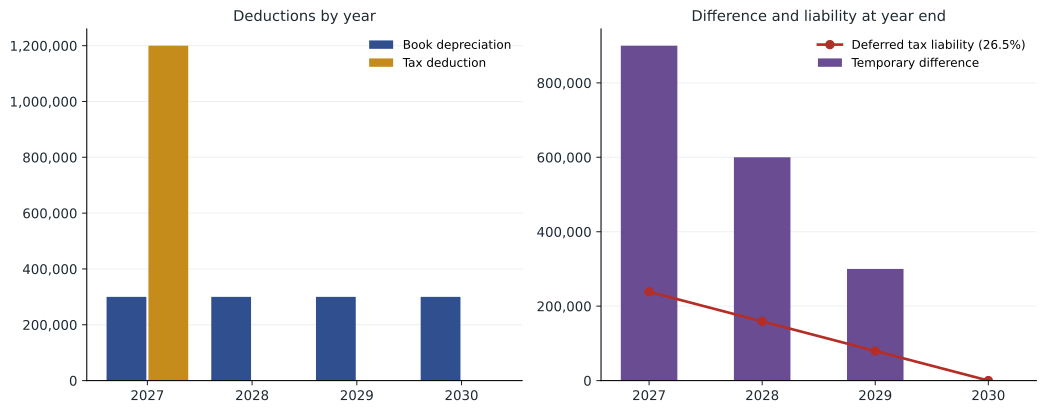
At the start of 2027 Northlake buys $1,200,000 of production machinery. In the books, it is depreciated straight-line over four years with no residual value, $300,000 a year. For tax, Northlake claims 100 percent bonus depreciation in 2027, which the One Big Beautiful Bill Act of 2025 made permanent for qualifying property acquired after 19 January 2025 (check current rules). Pre-tax accounting profit is $6,000,000 in each year. Non-deductible meals of $40,000 a year (half of $80,000 spent) are a permanent difference.
# Deferred tax on machinery with 100% bonus depreciation (25% combined rate, illustrative)
rate = 0.25
cost, life = 1_200_000, 4
book_dep = cost / life
tax_ded = [cost, 0, 0, 0]
pretax, nondeductible = 6_000_000, 40_000
carrying, tax_base, dtl_prev = cost, cost, 0
print(f"{'Year':>4} {'Taxable inc':>12} {'Current tax':>12} {'Temp diff':>10} {'DTL':>9} {'Deferred exp':>12} {'Total exp':>10} {'ETR':>7}")
for y in range(4):
    taxable = pretax + nondeductible + book_dep - tax_ded[y]
    current = taxable * rate
    carrying -= book_dep; tax_base -= tax_ded[y]
    temp = carrying - tax_base
    dtl = temp * rate
    deferred = dtl - dtl_prev; dtl_prev = dtl
    total = current + deferred
print(f"{2027 + y:>4} {taxable:>12,.0f} {current:>12,.0f} {temp:>10,.0f} {dtl:>9,.0f} {deferred:>12,.0f} {total:>10,.0f} {total / pretax:>7.2%}")Year Taxable inc Current tax Temp diff DTL Deferred exp Total exp ETR 2027 5,140,000 1,285,000 900,000 225,000 225,000 1,510,000 25.17% 2028 6,340,000 1,585,000 600,000 150,000 -75,000 1,510,000 25.17% 2029 6,340,000 1,585,000 300,000 75,000 -75,000 1,510,000 25.17% 2030 6,340,000 1,585,000 0 0 -75,000 1,510,000 25.17%
In 2027 taxable income is only $5,140,000 because the full $1,200,000 is deducted against $300,000 of book depreciation, so current tax is $1,285,000. But the machine's carrying amount, $900,000, now exceeds its tax basis of zero by $900,000: Northlake will have $900,000 more taxable income than book income over the next three years. A deferred tax liability of 900,000 × 25% = $225,000 is recognized, and deferred tax expense of $225,000 brings total tax expense to $1,510,000. In each later year the liability falls by $75,000 as the difference reverses, giving a deferred tax benefit that offsets higher current tax. Total tax expense is $1,510,000 every year, and the effective rate is a steady 25.17 percent, slightly above 25 percent because of the non-deductible meals.
The example shows why deferred taxes exist. Without them, Northlake would report a low tax expense in 2027 and higher expense in 2028 to 2030, even though its pre-tax profit was the same every year. Accelerated tax deductions defer tax; they do not eliminate it, as long as the company is profitable. For a growing company that keeps buying equipment, however, new deductions keep replacing reversing ones, and the deferred tax liability can grow for many years, a fact some analysts use to argue that it behaves more like equity than debt.
Deductible temporary differences: the warranty provision
Worked problem
Deferred tax asset on warranties
At the end of 2027 Northlake's warranty liability (lesson 2) stands at $120,625. Warranty costs are deductible for tax only when claims are paid, so the liability's tax basis is zero. At a 25 percent rate, what deferred tax arises?
Show solution
- Reported amount of the liability: $120,625. Tax basis: zero.
- Deductible temporary difference: $120,625; future claim payments will reduce taxable income.
- Deferred tax asset: 120,625 × 25% = $30,156, recognized in full and then reduced by a valuation allowance only if it is more likely than not that some of it will not be realized.
- Northlake is consistently profitable, so no valuation allowance is needed.
Answer: Deferred tax asset of $30,156.
| Item | Carrying amount vs tax base | Result |
|---|---|---|
| Machinery expensed faster for tax | Carrying amount above tax base | Deferred tax liability |
| Warranty provision deductible when paid | Liability with zero tax base | Deferred tax asset |
| Revenue taxed when cash is received (contract liability) | Liability with zero tax base | Deferred tax asset |
| Development costs capitalized in books, deducted for tax | Asset above tax base | Deferred tax liability |
| Unused tax losses | No carrying amount; future deductions available | Deferred tax asset (lesson 8) |
| Fines and penalties | No future tax effect | Permanent difference, no deferred tax |
Changes in tax rates and other recognition issues
When tax rates change, existing deferred tax balances are remeasured at the new rate in the period the change is enacted, and the effect is recognized in income from continuing operations, even if the original item was recorded in other comprehensive income (a 2018 accounting update allowed a one-time reclassification of these 'stranded' effects after the 2017 rate cut). If a state raised its rate so that Northlake's combined rate rose by one percentage point while it had a $600,000 temporary difference, the deferred tax liability would rise by $6,000, increasing tax expense in the year of enactment.
ASC 740 does not have IAS 12's initial recognition exception. Deferred taxes are recognized on almost all temporary differences, with some exceptions, such as goodwill that is not deductible for tax and certain undistributed earnings of foreign subsidiaries that are indefinitely reinvested. For leases, deferred taxes are recognized on both the right-of-use asset and the lease liability.
Presentation
Since ASU 2015-17, all deferred tax assets and liabilities, along with any valuation allowance, are classified as non-current on the balance sheet. Within a tax-paying component and jurisdiction, deferred tax assets and liabilities are offset and presented as a single amount. Income tax expense is presented in the income statement, with tax effects of other comprehensive income items presented in OCI.
Deferred tax on leases, revaluations and investments
Three further situations show how widely the asset and liability method reaches. First, leases: when Northlake recognizes its warehouse lease (lesson 5), the right-of-use asset of $842,473 has a tax basis of zero, because US tax law deducts rent as it is paid, and the lease liability has a tax basis of zero as well. Northlake recognizes a deferred tax liability on the asset and a deferred tax asset on the liability, which for an operating lease move almost in step because the asset is measured as a plug that tracks the liability. Second, items recognized in other comprehensive income, such as unrealized gains on available-for-sale debt securities, carry their deferred tax in OCI: the tax is allocated to the same place as the item, a process called intraperiod tax allocation, which also allocates tax among continuing operations, discontinued operations and equity.
Third, investments in subsidiaries: the parent's book basis in a foreign subsidiary can exceed its tax basis because of undistributed earnings. ASC 740 does not require a deferred tax liability on the outside basis difference of a foreign subsidiary if the earnings are indefinitely reinvested, an assertion management must support; the 2017 tax law's one-time transition tax and move toward a territorial system reduced the significance of this exception, but withholding taxes and state taxes can still apply. These topics return in ACCT-311, which covers consolidation and foreign operations.
Common mistakes
MistakeRecording tax expense equal to tax payable for the year.
InsteadTax expense includes deferred tax: the change in deferred tax assets and liabilities.
MistakeCreating deferred tax on non-deductible fines.
InsteadPermanent differences never reverse, so no deferred tax arises; they change the effective rate.
MistakeMeasuring deferred tax at the current year's rate when a different future rate has been enacted.
InsteadUse the enacted rate for the year of reversal.
MistakeDiscounting deferred tax liabilities.
InsteadDeferred taxes are not discounted under either framework.
MistakeClassifying the reversing portion of a deferred tax liability as current.
InsteadAll deferred tax balances are non-current.
Summary and key terms
- Accounting profit and taxable income differ because of permanent and temporary differences.
- Temporary differences are differences between carrying amounts and tax bases that will reverse.
- Taxable temporary differences create deferred tax liabilities; deductible ones create deferred tax assets.
- Tax expense equals current tax plus the change in net deferred tax.
- Deferred tax uses enacted rates and is not discounted.
- Accelerated tax deductions defer tax rather than eliminate it for a profitable company.
- All deferred tax balances are presented as non-current.
- Tax basis
- The amount attributable to an asset or liability for tax purposes.
- Enacted rate
- A tax rate signed into law.
- Taxable income
- Income on which tax is payable under tax law.
- Permanent difference
- A difference between accounting profit and taxable income that never reverses.
- Temporary difference
- A difference between the carrying amount of an asset or liability and its tax base that will reverse.
- Deferred tax liability
- Tax payable in future periods on taxable temporary differences.
- Deferred tax asset
- Tax recoverable in future periods from deductible temporary differences, losses or credits.
- Current tax
- Tax payable or recoverable for the period's taxable income.
- Effective tax rate
- Total tax expense divided by pre-tax accounting profit.
- Statutory rate
- The tax rate set by law.
Practice problems
Work each problem on paper first, then reveal the answer to check.
Pre-tax profit $1 million; non-deductible fines $20,000; no temporary differences; rate 25 percent. Tax expense and effective rate?
Show answer
$255,000; 25.5 percent.
Asset carrying amount $500,000, tax base $300,000, rate 26.5 percent. Deferred tax?
Show answer
Deferred tax liability $53,000.
Warranty liability $80,000, tax base zero, rate 25 percent. Deferred tax?
Show answer
Deferred tax asset $20,000.
Current tax $400,000; net DTL rises from $100,000 to $130,000. Tax expense?
Show answer
$430,000.
Rerun the deferred tax program with a three-year book life. What happens to the DTL at the end of 2027?
Show answer
The temporary difference becomes $800,000, so the DTL falls; it reverses over two years instead of three.
Why is the effective rate in the program above the statutory rate?
Show answer
Non-deductible meals are a permanent difference.
A rate rise of 2 points applies to a $1 million taxable temporary difference. Effect?
Show answer
DTL and tax expense rise by $20,000.
When is a US rate change recognized?
Show answer
When the law is enacted.
Revenue received in advance is taxed when received. What deferred tax arises?
Show answer
A deferred tax asset, because the contract liability has a zero tax base.
How are deferred tax balances classified?
Show answer
As non-current.
Lesson quiz · 5 questions
Score 60% or more to complete this lesson.
Create a free account to save your progress, take quizzes and earn a certificate.