
MELU-323 · Lesson 9 of 12 · 20 min
Contracts and mechanics' liens in West Virginia
▶ Video coming soon A video version of this lesson is on the way.
Two years ago, a developer who had hired Kanawha Ridge to wire a strip of four shops in Cross Lanes stopped paying after the third progress invoice. The general contractor was paid, but it passed nothing down. Dale had been through this before. He checked the date the company finished its work, counted forward on the calendar, and with the company's lawyer served a notice on the owner and recorded a notice of lien with the county clerk well within the deadline. The developer refinanced six weeks later, and the lien had to be paid off before the new loan could close. Kanawha Ridge was paid in full. Renee was the foreman on that job, and the lesson she took from it is the one this lesson teaches: in West Virginia, lien rights are strong, but they run on strict deadlines, and a contractor who misses one loses the right entirely.
This lesson covers the contract rules every West Virginia master should know, then the mechanics' lien law in Chapter 38, Article 2 of the West Virginia Code: who may claim a lien, the 100-day deadline to record, the notice a subcontractor must give the owner, the six-month deadline to sue, the residential defense added in 2015, and the bond that takes the place of liens on public jobs. It explains the law in general terms for an exam candidate; for a real dispute, talk to a lawyer.
Contracts
Most electrical work is done under a contract with an owner, a general contractor or another subcontractor. The Contractor Licensing Act adds two rules. Under section 30-42-10, a licensee may not do contracting work worth 10,000 dollars or more, counting materials and labor, without a written contract that describes the work and its cost and is signed by both the licensee and the person for whom the work is done. The Board publishes a standard contract form that meets the statute's minimum requirements. And under section 30-42-6, the contractor's license number must appear in every fully executed, binding contract.
A good electrical contract does more than meet those minimums. It identifies the parties and the property, describes the scope by drawings and specifications, states the price and how changes are priced, sets a payment schedule and retainage, assigns responsibility for permits and inspections, addresses delays and allocates the risk of unforeseen conditions. Kanawha Ridge's subcontracts also state the date Kanawha Ridge's work is considered complete, because that date starts the lien clock. The core course MELU-107 covers contract terms in depth; this lesson focuses on what happens when payment does not come.
Who may claim a lien
Article 2 of Chapter 38 gives a lien on the owner's interest in real estate to those who perform work or furnish materials for an improvement under a contract with the owner or under a contractor. The opening sections of the article cover general contractors who contract directly with the owner, subcontractors, those who furnish materials and those who perform labor. The lien attaches to the building or improvement and the owner's interest in the land, and it secures the amount due for the work and materials.
An electrical contractor can be in either position. When Kanawha Ridge contracts directly with a building owner, it is a general contractor for lien purposes and claims under the contractor rules. When it works for a general contractor, as on the Cross Lanes job, it is a subcontractor and must follow the subcontractor rules, which include notice to the owner. The deadline is the same 100 days in both cases, but the steps differ.
The 100-day deadline
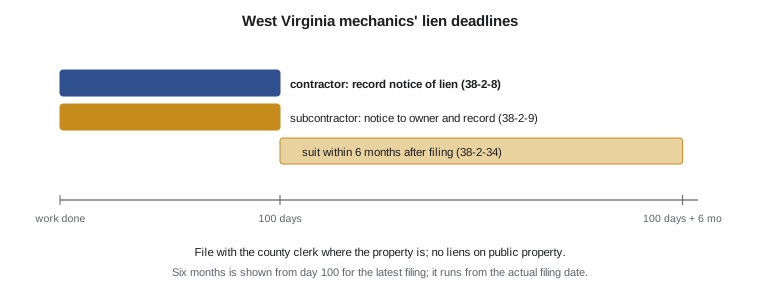
Under section 38-2-8, a general contractor who wants to perfect and preserve a lien must record a notice of lien within 100 days after the completion of the work provided for in the contract. The notice is recorded with the clerk of the county commission in the county where the property is located. It states the amount claimed, identifies the owner's interest in the real estate by a lot and block number or another adequate description, lists the buildings or improvements the lien covers, and is dated, signed and sworn by the claimant. The statute gives a model form, and a notice substantially in that form is sufficient.
Under section 38-2-9, a subcontractor has the same 100 days after finishing the subcontract to take two steps: give notice to the owner or the owner's agent, using a method the law allows for serving legal notice, and record the notice of lien with the county clerk. The notice to the owner follows a statutory form that includes the subcontractor's name, the general contractor, the nature of the work, a description of the property, the contract price, the amount unpaid and a sworn statement. If the subcontractor does not record within the 100 days, the statute says the lien is discharged and avoided.
Worked problem
Counting 100 days
Kanawha Ridge finished its work on the Cross Lanes shops, as a subcontractor, on March 14, 2024. By what date did it need to serve notice on the owner and record its notice of lien?
Show solution
- The deadline is 100 days after the subcontract work was finished.
- Count forward: the 17 days left in March make 17, April adds 30 (47), May adds 31 (78), and 22 days into June reach 100.
- That is June 22, 2024.
- Check how the statute and courts count the first day, and whether a weekend or holiday deadline moves; a lawyer should confirm the date in a real claim.
Answer: About June 22, 2024; Dale recorded in May, well before the deadline.
The six-month deadline to sue
Recording the notice preserves the lien, but it does not collect the money. Under section 38-2-34, a mechanics' lien is discharged unless the lienholder files a suit to enforce it in circuit court within six months after filing the lien notice with the clerk's office. A suit filed by one lienor also preserves the claims of other lienors on the same property, who may join the action. In the Cross Lanes case, the refinancing forced the developer to pay, so no suit was needed; but if the developer had held out, Kanawha Ridge would have had to file in circuit court within six months of the May recording.
The two clocks together give the structure an exam question will test. Up to 100 days after completion to record, then six months after recording to sue. A contractor who records on day 99 has six months from day 99; a contractor who records on day 30 has six months from day 30. Waiting to record does not extend the time to sue beyond the six months from the actual filing.
The residential defense
Section 38-2-34(b), effective July 1, 2015, created an affirmative defense for certain residential property, including an existing single-family dwelling. Where the owner has paid the contractor in full, or owes less than the amount of the lien, the owner can raise the defense against a lien filed by a subcontractor or supplier the general contractor did not pay. The point is to protect homeowners from paying twice for the same work. For an electrical subcontractor on residential remodeling, the lesson is clear: on an existing house, a lien may not protect you if the owner has already paid the general contractor. Know who you are working for, and check the general contractor's payment record before you extend credit.
| Rule | General contractor | Subcontractor |
|---|---|---|
| Deadline to record | 100 days after completion of the contract work (38-2-8) | 100 days after finishing the subcontract (38-2-9) |
| Owner notice | Not a separate step | Required within the same 100 days, in the statutory form |
| Where to record | County clerk where the property is | County clerk where the property is |
| Deadline to sue | 6 months after filing (38-2-34) | 6 months after filing (38-2-34) |
| Residential defense | Not the target | Owner who paid the general contractor may raise it on certain existing dwellings |
Public projects
There are no mechanics' liens on public buildings. Section 38-2-39 says so directly: nothing in the article creates a lien on a public building or improvement or the land under it. Instead, the public body, whether a state agency, county commission, board of education or other legal body, must require the contractor to post a bond in a penal sum at least equal to the reasonable cost of the materials, machinery, equipment and labor needed to complete the contract. The surety must be authorized in West Virginia, or the contractor may deposit cash or qualifying bonds of equal value. The bond is recorded in the county clerk's office where the work is done, and the contract is not binding until the bond is executed, delivered and recorded.
If the contractor does not pay for materials, equipment or labor, the bond and its sureties are liable to the unpaid suppliers, furnishers and laborers for the full value owed. A subcontractor on a school addition that goes unpaid makes a claim against the bond, not a lien. The claim procedure and deadlines for bond claims are set out in the bond, the statute and court decisions; an electrical subcontractor on public work should get a copy of the recorded bond at the start of the job and calendar any notice requirements.
Practical habits
Renee has seen enough lien problems to have a short list of habits. Record the completion date of every job and every phase in the job file, in writing, the day it happens. Keep signed contracts, change orders and invoices together. Track unpaid balances weekly and decide early, within the first 60 days after completion, whether a lien may be needed. Know the owner's name and the property description; a lien filed against the wrong owner or parcel can fail. On public jobs, get the bond. And when a customer asks for a lien waiver in exchange for payment, read it before signing; a final waiver given before the money clears can give away rights the contractor still needs.
None of these habits is unique to West Virginia, but the 100-day deadline is shorter than the window in some neighboring states and longer than in others, and a contractor working in several states must keep each state's clock separately. Kanawha Ridge works mostly in West Virginia, with occasional jobs across the river in Ohio, and Cora keeps a separate lien calendar for each state.
# Lien calendar for one job (illustrative dates)
from datetime import date, timedelta
completed = date(2024, 3, 14)
record_by = completed + timedelta(days=100)
recorded = date(2024, 5, 20)
def add_months(d, n):
    years, month0 = divmod(d.month - 1 + n, 12)
    return date(d.year + years, month0 + 1, min(d.day, 28))
print("Work completed:", completed)
print("Record notice of lien by:", record_by)
print("Recorded on:", recorded)
print("Sue to enforce by about:", add_months(recorded, 6))Work completed: 2024-03-14 Record notice of lien by: 2024-06-22 Recorded on: 2024-05-20 Sue to enforce by about: 2024-11-20
The function caps the day of the month at 28 to keep the example simple; a real calendar should use the exact date and a lawyer's confirmation.
Common mistakes
MistakeCounting the 100 days from the last invoice.
InsteadThe deadline runs from completion of the work under the contract or subcontract.
MistakeRecording a subcontractor lien without notice to the owner.
InsteadSection 38-2-9 requires notice to the owner and recording within the 100 days.
MistakeWaiting a year to sue on a recorded lien.
InsteadThe lien is discharged unless suit is filed within six months after filing.
MistakeFiling a lien on a public school.
InsteadThere are no liens on public property; claim against the public works bond.
MistakeStarting a 15,000-dollar job on a handshake.
InsteadSection 30-42-10 requires a written, signed contract for work of 10,000 dollars or more.
Summary and key terms
- Work of 10,000 dollars or more needs a written, signed contract with the license number.
- A general contractor records a notice of lien within 100 days after completion (38-2-8).
- A subcontractor gives notice to the owner and records within 100 days (38-2-9).
- Suit must be filed within six months after filing, or the lien is discharged (38-2-34).
- Owners of certain existing dwellings who paid the general contractor have a defense (since July 1, 2015).
- Public projects use a recorded bond under 38-2-39; there are no liens on public property.
- Mechanics' lien
- A claim against the owner's interest in improved real estate to secure payment for work or materials.
- Recorded notice of lien
- The sworn document recorded with the county clerk to perfect a lien.
- Completion
- The finish of the work under the contract or subcontract, which starts the 100-day clock.
- Affirmative defense
- A defense the owner raises, here based on having paid the general contractor.
- Public works bond
- A bond required on public buildings that protects unpaid suppliers and laborers.
Practice problems
Work each problem on paper first, then reveal the answer to check.
How long does a subcontractor have to record a notice of lien?
Show answer
100 days after finishing the subcontract, with notice to the owner in the same period.
Where is the notice recorded?
Show answer
With the county clerk in the county where the property is.
Kanawha Ridge records a lien on May 20. When must it sue?
Show answer
Within six months after filing, about November 20.
Can Kanawha Ridge lien a county courthouse?
Show answer
No; it claims against the public works bond.
Does a 9,000-dollar job require a written contract under 30-42-10?
Show answer
No, the rule applies at 10,000 dollars or more, though a written contract is still wise.
Lesson quiz · 5 questions
Score 60% or more to complete this lesson.
Create a free account to save your progress, take quizzes and earn a certificate.