
MELU-323 · Lesson 4 of 12 · 21 min
The exam format and the references allowed
▶ Video coming soon A video version of this lesson is on the way.
Two months before her exam date, Renee sat at the kitchen table with a stopwatch, her 2020 code book and a set of practice questions she had written from Dale's old job files. She finished the multiple-choice questions with time to spare and then spent almost forty minutes on a single commercial load calculation. That was the moment she understood how the West Virginia exam is built. The State Fire Marshal's master exam is short by national standards, but its scoring makes the calculations count for a quarter of the grade, and a candidate who runs out of time on them can fail with a strong multiple-choice score. This lesson covers the format, the scoring, the references allowed and how to prepare a code book for an open book exam.
The facts in this lesson come from the State Fire Marshal's licensing page and section 5 of the rule at 103 CSR 5. The page is the more detailed source for format and references, and it can change between sessions; check it before you prepare your book.
The format and scoring
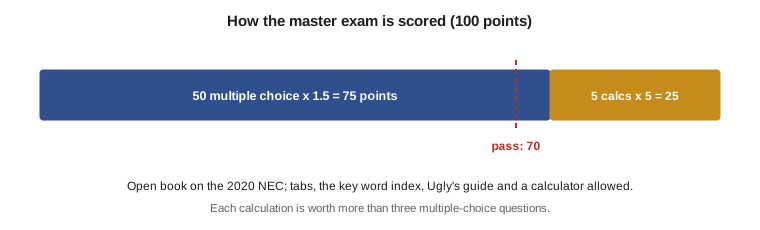
The State Fire Marshal's page describes the journeyman, master and single-family dwelling exams in the same way: 50 multiple-choice questions worth 1.5 points each and 5 calculations worth 5 points each. That makes 75 points for the multiple-choice part and 25 points for the calculations, a total of 100. The candidate has four hours. The other specialty exams are smaller: the low voltage exam has 25 multiple-choice questions worth 4 points each, and the electric sign and HVAC exams have 20 multiple-choice questions worth 5 points each.
A passing score is 70 or better, which the page states as 70 or above and the rule, in section 5.13, states as a score of at least 70 needed to receive a license. On a 100-point exam the two are the same. A candidate can therefore lose up to 30 points and still pass, but those points go fast on the calculations: missing two of the five calculations costs 10 points, as much as almost seven multiple-choice questions.
Worked problem
What score does a mix of answers earn?
Renee answers 44 of the 50 multiple-choice questions correctly and gets 3 of the 5 calculations right. Does she pass?
Show solution
- Multiple choice: 44 times 1.5 is 66 points.
- Calculations: 3 times 5 is 15 points.
- Total: 66 plus 15 is 81 points.
- The pass mark is 70.
Answer: Yes: 81 points passes with 11 to spare.
Run the same arithmetic with weak calculations and the picture changes. If Renee answered 40 multiple-choice questions correctly but got only one calculation right, she would have 60 plus 5, or 65 points, and fail. The page does not say whether partial credit is given on calculations, so plan as if each one is all or nothing.
Which code
The State Fire Marshal's page says all electrical exams are open book and based solely on the 2020 National Electrical Code. That matches the edition the State Fire Commission adopted, covered in Lesson 5. Section 5.12 of the rule says exam questions come from the National Electrical Code published by the National Fire Protection Association. The state's amendments are not the basis of the exam, and neither is any newer edition. A candidate who studies from the 2023 edition will find that some section numbers, and some rules, have moved or changed; bring and study from the 2020 edition.
This matters if the state adopts a newer edition. When that happens, the State Fire Marshal will announce when the exams change to the new edition, and the date may not be the same as the date the new code takes effect for work. Check the licensing page in the month you apply, and if it still names the 2020 edition, use the 2020 edition even if you are already wiring jobs to a newer one.
The references allowed
The page lists what a candidate may bring: the 2020 National Electrical Code, book tabs, the key word index, Ugly's Electrical References, a calculator and a No. 2 pencil. Read the list closely. It does not mention a handbook edition with commentary, a code book with handwritten notes, a phone or any other study guide. Bringing something that is not on the list risks having it taken away, or worse; ask the office before exam day if you are unsure about any item.
Tabs deserve care. Permanent tabs printed with article numbers are the most common aid, and they are on the allowed list. Many candidates also highlight key words in the code book. The page does not mention highlighting, so a candidate who wants to highlight should confirm the office's current policy and keep any marking to highlighting, never written notes, formulas or answers. Renee's book has one tab per chapter and per major article, and nothing written inside it.
| Allowed (per the licensing page) | Not listed: confirm or leave at home |
|---|---|
| 2020 National Electrical Code | A newer or older edition |
| Book tabs | Tabs with formulas or notes written on them |
| Key word index | Handbook editions with commentary |
| Ugly's Electrical References | Other reference books and study guides |
| Calculator | Phones, tablets and smart watches |
| No. 2 pencil | Loose notes or formula sheets |
What the exam covers
The State Fire Marshal does not publish a topic outline, and its page says study guides, prep courses and practice exams are not available from the office. The rule's definition of a master is the best guide to what is tested: knowledge of the code, the ability to read plans and the ability to calculate demand loads. Expect questions from every chapter of the code, with weight on the topics a master designs: services, feeders and branch circuits, overcurrent protection, conductor sizing and ampacity adjustments, grounding and bonding, wiring methods, motors, transformers and special occupancies.
The five calculations will most likely come from the master's design work. Dwelling and commercial service loads, feeder sizing with demand factors, motor branch circuit and feeder sizing, conduit fill and box fill, voltage drop, and transformer protection are all common calculation topics on master exams. Each one has a method in the core courses: MELU-102 for load calculations, MELU-103 for conductors and overcurrent protection, MELU-105 for motors and transformers. Practice each method until you can do it in fifteen minutes without looking up the steps.
Preparing the code book
Renee prepared her book over two weekends, and the order mattered. First she bought a new, clean copy of the 2020 edition, because her old one had notes in the margins from years of job-site use, and a book with written notes is exactly what the allowed list does not include. Then she placed tabs. She used a printed tab set with article numbers and put the chapter tabs along the top and the article tabs along the side, so she could open to any chapter with one hand. She added extra tabs only for the articles she uses most in calculations: the general rules for branch circuits and feeders, the load calculation article, overcurrent protection, grounding and bonding, conductor ampacity, the raceway fill material in the annexes, and the motor and transformer articles.
Next she practiced with the key word index. The index is allowed, and it is often the fastest route to a rule the candidate cannot place by article. Renee picked twenty terms from practice questions, such as working space, grounding electrode, continuous load, wet location and feeder tap, and timed how long each took to find through the index and through the table of contents. Some were faster one way, some the other, and she wrote the results in her study log, not in the book.
Finally she learned her calculator. A basic scientific calculator with square root and memory keys is enough for every master calculation; three-phase problems need the square root of three, and voltage drop problems need multiplication and division done in the right order. She uses the same calculator every time she practices, so that on exam day her fingers know where the keys are. The page lists a calculator without naming a type; a programmable calculator or one with stored text is a risk not worth taking.
Worked problem
A voltage drop calculation
A 208-volt single-phase branch circuit runs 150 feet one way to a 30-ampere load on copper conductors with a cross-sectional area of 10,380 circular mils. Using the common approximation K of 12.9 ohm-circular mils per foot for copper, what is the voltage drop, and what share of the source voltage is it?
Show solution
- Single-phase formula: drop equals 2 times K times current times length, divided by circular mils.
- 2 times 12.9 times 30 times 150 is 116,100.
- 116,100 divided by 10,380 is about 11.2 volts.
- 11.2 divided by 208 is about 0.054, or 5.4 in 100.
Answer: About 11.2 volts, a little over 5 in 100 of the source voltage; compare that with the informational notes on voltage drop in the branch circuit and feeder articles.
The example uses a general physics approximation, not a code table, and the informational notes it points to are recommendations rather than requirements. Exam questions often turn on exactly that distinction, so read whether a question asks what the code requires or what it recommends.
A time budget
Four hours for 55 questions sounds generous, and for the multiple-choice part it is. The risk is the calculations. A sensible budget gives the multiple-choice questions about two hours, which is about 2.4 minutes each, the five calculations about 80 minutes, which is 16 minutes each, and leaves 40 minutes for review. Renee's plan is to do a first pass through the multiple-choice questions, answering the ones she knows and marking the rest, then do the calculations while she is fresh, then return to the marked questions.
# Score check: points needed and margin (State Fire Marshal format)
mc_points, calc_points, pass_mark = 1.5, 5, 70
for mc_right, calc_right in [(44, 3), (40, 1), (38, 5), (47, 2)]:
    score = mc_right * mc_points + calc_right * calc_points
    result = "pass" if score >= pass_mark else "fail"
print(f"{mc_right} MC + {calc_right} calcs = {score:g} points: {result}")44 MC + 3 calcs = 81 points: pass 40 MC + 1 calcs = 65 points: fail 38 MC + 5 calcs = 82 points: pass 47 MC + 2 calcs = 80.5 points: pass
The third line of output is worth studying. A candidate who gets all five calculations right can pass with only 38 of 50 multiple-choice answers, because the calculations are worth so much. Strong calculation skills give a candidate room to miss harder code-lookup questions.
Using an open book well
An open book exam rewards navigation, not memory. The best candidates know where to look before they open the book: they recognize that a question about conductor ampacity lives in Article 310, that a grounding electrode conductor question belongs in Article 250 Part III, that a question about working space starts in Article 110. They use the index for anything unfamiliar, and they read the whole rule, including its exceptions, before choosing an answer. MELU-101 teaches this method in detail.
Renee practices one habit above all: reading the question's last sentence first. It tells her what is being asked, often a single number, and saves her from reading a long story twice. She then underlines the facts she needs, such as voltage, phase, conductor material, insulation rating and ambient temperature, and goes to the code with a clear question.
Common mistakes
MistakeStudying from the newest code edition.
InsteadThe licensing page says the exams are based solely on the 2020 NEC; bring and study the 2020 edition until the page changes.
MistakeBringing a handbook with commentary.
InsteadThe allowed list names the code book, tabs, the key word index, Ugly's, a calculator and a pencil; confirm anything else first.
MistakeLeaving the calculations to the end.
InsteadEach calculation is worth 5 points; protect the time for them.
MistakeExpecting an official study guide.
InsteadThe page says study guides, prep courses and practice exams are not available from the office.
MistakeWriting formulas on tabs.
InsteadKeep the book free of notes; tabs should carry article numbers only.
Summary and key terms
- Master exam: 50 multiple-choice questions at 1.5 points and 5 calculations at 5 points, 100 points in all.
- Four hours; 70 or better passes.
- Open book, based solely on the 2020 NEC.
- Allowed: 2020 NEC, tabs, key word index, Ugly's, calculator, No. 2 pencil.
- No official study guide or outline; prepare from the master's design work.
- Plan time for the calculations, which carry a quarter of the score.
- Open book
- An exam on which the candidate may consult the allowed references.
- Calculation question
- A question worth 5 points that requires working a problem, such as a load or conductor calculation.
- Key word index
- An index used to find code rules by subject words.
- Ugly's Electrical References
- A pocket reference of formulas and tables, allowed on the exam.
- Time budget
- A plan for how much time to spend on each part of the exam.
Practice problems
Work each problem on paper first, then reveal the answer to check.
How many points is one calculation worth?
Show answer
5 points.
What is the most multiple-choice points available?
Show answer
75 points: 50 questions at 1.5 each.
Can Renee pass with 46 multiple-choice answers right and no calculations?
Show answer
No: 46 times 1.5 is 69 points, one short of 70.
Which code edition does the page name?
Show answer
The 2020 National Electrical Code.
Does the office sell a practice exam?
Show answer
No; the page says practice exams are not available.
Lesson quiz · 5 questions
Score 60% or more to complete this lesson.
Create a free account to save your progress, take quizzes and earn a certificate.