
MELU-323 · Lesson 6 of 12 · 20 min
Permits, inspections and the inspection authority
▶ Video coming soon A video version of this lesson is on the way.
On a Monday in October, Renee had three jobs on her schedule. In South Charleston, a dental office tenant finish needed its rough-in inspection from the city's building department. In a rural part of Lincoln County, a new pole barn service for a farm supply store needed an electrical inspection before Appalachian Power would set the meter, and there was no county building department to call. In Bluefield, a small retail job needed a city electrical permit and a third-party inspection before the utility would connect. Three jobs, three different answers to the question every master has to answer first: who inspects this, and what do they need from us? This lesson explains the permit and inspection system in West Virginia, the role of certified electrical inspectors, the link between inspection and utility connection, and what happens when work fails.
The legal framework has three pieces. The State Building Code, adopted locally by ordinance, gives local building departments their permit and inspection programs. Article 3C of Chapter 29 of the West Virginia Code, on the certification of electrical inspectors, controls who may perform electrical inspections for pay. And the State Fire Code, enforced by the State Fire Marshal and local fire officials, applies statewide to existing buildings and to hazards. A master needs to know all three.
Local permits where the building code is adopted
Where a city or county has adopted the State Building Code, its building department issues permits for new construction, alterations and electrical work, reviews plans where required, and inspects. The department sets its own permit fees and procedures within the state framework, and many now take applications online. A permit application usually names the property, the owner, the contractor, the contractor's state license number and the electrical contractor responsible for the work, and describes the work with enough detail to set the fee and the inspections.
The Contractor Licensing Act ties the permit to the business license. Under section 30-42-10, before a permit is issued for construction work, the applicant must show the building inspector or permitting authority a contractor license under Article 42, or file a sworn statement that a license is not required. A permitting authority may not issue a permit to anyone who lacks a required license. That is why Cora keeps Kanawha Ridge's contractor license number, expiration date and a scanned copy ready for every permit application.
Certified electrical inspectors
Article 3C, passed in 2002, requires certification for anyone who inspects electrical work for pay. Section 29-3C-3 says that after January 1, 2003, no electrical inspections may be performed, offered or engaged in for compensation or hire without certification by the State Fire Marshal. A state or local government employee may inspect without that certification when the inspection is part of the employee's normal duties, and an electrical building code inspector counts as an electrical inspector for the article. The State Fire Marshal's rule on the certification of electrical inspectors is Title 103, Series 1.
Section 29-3C-2 defines an electrical inspection broadly. It includes any inspection the code requires, and any inspection of a building connected to electrical service in which the inspector certifies that the building's electrical system meets the National Electrical Code, the State Fire Code and the State Building Code. In practice, that means a private, third-party electrical inspector who certifies a new service for the utility must hold the State Fire Marshal's certification. Inspectors employed by the state's mine safety office are excluded from the definition and work under their own rules.
Inspection before the utility connects
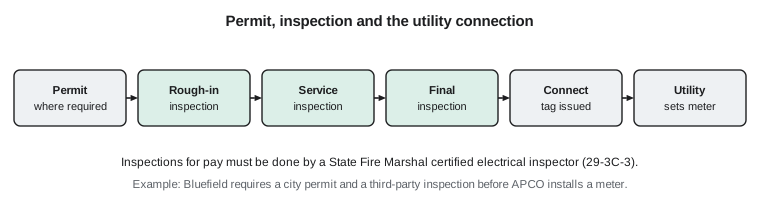
Electric utilities in West Virginia generally require proof of an electrical inspection before they energize a new service or reconnect one that has been disconnected. The City of Bluefield's posted procedure is a clear example. Both the city code and Appalachian Power require an electrical inspection before a meter is installed, whatever the reason the service was disconnected. The contractor or owner gets a city electrical permit, priced by job cost, and a third-party inspector performs the inspection for a fee of 100 dollars per meter. The inspection must be done before any covering is placed and before power is applied. If the system passes, the inspector places a connect tag and notifies the utility that the meter can be installed, and the tag must carry the city permit number and the utility's connect number.
Where there is no local building department, the same logic applies without the city permit. The contractor arranges an inspection by a State Fire Marshal certified electrical inspector, the inspector certifies the installation and notifies the utility, and the utility sets the meter. Renee's Lincoln County job worked that way: Kanawha Ridge scheduled a certified inspector, who checked the service, grounding and bonding and the panel, issued the release and sent it to Appalachian Power. Each utility publishes its own procedure and forms; follow the current one for the utility serving the job.
| Job location | Permit | Who inspects | Utility release |
|---|---|---|---|
| City with a building department (example: South Charleston) | City electrical permit | City inspector | After final or service inspection, per the city and utility |
| Bluefield (posted example) | City electrical permit, priced by job cost | Third-party certified inspector, 100 dollars per meter | Connect tag with the city permit number and APCO connect number |
| County without a building code program | Often none | State Fire Marshal certified electrical inspector | Inspector's release to the utility |
| State-owned buildings | Per the state agency's process | State Fire Marshal plans review and inspection, or the agency's inspectors | Per the agency and utility |
Inspection stages
Most electrical inspections follow the order of the work. An underground or slab inspection checks conduit and conductors before concrete is poured or a trench is backfilled. A rough-in inspection checks boxes, raceways, cables and grounding in walls and ceilings before they are closed. A service inspection checks the service equipment, grounding electrode system and bonding before the utility connects. A final inspection checks devices, fixtures, panel labeling and the completed installation. Small jobs may combine stages; large jobs may add inspections for each floor or phase.
The rule that matters most is simple: do not cover work that has not been inspected. An inspector who finds drywall over an uninspected rough-in can require it to be opened, at the contractor's cost. Kanawha Ridge schedules inspections two days ahead and tells the drywall contractor in writing when each area has passed. Renee keeps the inspection cards and reports in the job file, because they are often the only proof later that the work was accepted.
When work fails
An inspector who finds a violation issues a correction notice or report listing what must be fixed, citing the code section. The contractor makes the corrections and calls for a reinspection, which may carry a fee. If a contractor disagrees with a finding, the first step is to ask the inspector, politely and with the code book open, which rule applies and why. If the disagreement remains, the local building code has an appeal process, usually to a local board of appeals, and the State Building Code's administrative provisions describe it. For a third-party inspection, the contractor can ask the inspector's supervisor or the State Fire Marshal, which certifies and disciplines inspectors under Article 3C.
Failed inspections cost money and time, and they also tell a master something about the crew. Dale reviews every correction notice himself. If the same violation appears twice, he holds a short meeting with the crew to go through the rule. Renee will take over that habit, because under Lesson 7's duties the master is the person accountable for the work.
Worked problem
Planning the inspections for a small job
Kanawha Ridge is wiring a new 200-ampere, single-phase service and branch circuits for a small office in South Charleston. The slab is already poured. Which inspections should Renee expect, and in what order?
Show solution
- No underground or slab inspection is needed for the electrical work if no conduit is in the slab.
- Rough-in inspection after boxes, cables and raceways are installed and before walls are closed.
- Service inspection of the service equipment, grounding electrode system and bonding before the utility connects; the city may combine it with rough-in or final.
- Final inspection after devices, fixtures and labeling are complete.
- Confirm with the city's building department which inspections it requires and how to request them.
Answer: Rough-in, service and final, in that order, subject to the city's procedure.
Plans review and permit records
Larger jobs start with plans review. A local building department that has adopted the State Building Code reviews construction documents for code compliance before issuing a permit, and for many public and assembly buildings the State Fire Marshal's plans review office also reviews the fire protection and life safety features, including fire alarm and emergency lighting. A master's electrical drawings, panel schedules and load calculations are often part of that submission. A reviewer who finds a problem issues comments, and the designer answers them before the permit issues. For Renee, this will be new work: she has built from approved plans for years, but she has not been the person who answers a reviewer's comments.
Permits also create records that last. A closed permit with passed inspections is evidence that the work was accepted under the code in force at the time, which matters years later when an owner sells the building, an insurer investigates a fire or a new tenant wants to expand a service. An open permit, one that was issued but never finished or closed, can cause trouble at a property sale and can leave a contractor responsible for work it thought was done. Kanawha Ridge closes every permit at the end of each job, and voids permits for jobs that are canceled, so that its record with each building department stays clean.
The State Fire Marshal's role
The State Fire Marshal enforces the State Fire Code statewide, reviews plans for many buildings, and investigates fires and hazards. If an existing installation is unsafe, the Fire Marshal or a local fire official can order it corrected under the fire code whether or not a building permit was ever issued. The Fire Marshal also enforces Article 3B: an inspector or official who finds electrical work being done without the required license can refer it to the Fire Marshal, which can cite the violator or seek an injunction under section 29-3B-8. And under Article 3C, the Fire Marshal certifies electrical inspectors and can suspend or revoke a certification.
For an exam candidate, the key distinctions are these. Local building departments issue permits and inspect where the State Building Code is adopted. Certified electrical inspectors perform paid inspections, including third-party inspections for utility release. The State Fire Marshal licenses electricians, certifies inspectors and enforces the fire code. The Contractor Licensing Board licenses businesses and requires the license to be shown before a permit is issued.
# Inspection log for one job (illustrative)
log = [
    ("2026-10-05", "rough-in", "passed"),
    ("2026-10-19", "service", "correction: bonding jumper missing at water pipe"),
    ("2026-10-21", "service reinspection", "passed"),
    ("2026-11-02", "final", "passed"),
]
open_items = 0
for day, stage, result in log:
    if result.startswith("correction"):
        open_items += 1
    elif "reinspection" in stage:
        open_items -= 1
    print(f"{day}  {stage:22} {result}")
print("Open corrections:", open_items)2026-10-05 rough-in passed 2026-10-19 service correction: bonding jumper missing at water pipe 2026-10-21 service reinspection passed 2026-11-02 final passed Open corrections: 0
Common mistakes
MistakeAssuming no inspection is needed where there is no building department.
InsteadUtilities generally require an inspection by a certified electrical inspector before connecting a new service.
MistakeHiring any experienced electrician to do a paid third-party inspection.
InsteadSection 29-3C-3 requires State Fire Marshal certification for paid electrical inspections.
MistakeApplying for a permit without the contractor license.
InsteadSection 30-42-10 requires the applicant to show the license or file a sworn statement that none is required.
MistakeCovering work before it is inspected.
InsteadThe inspector can require the work to be opened, at the contractor's cost.
MistakeArguing a finding without the code book.
InsteadAsk which section applies, read it together, and use the appeal process if needed.
Summary and key terms
- Local building departments issue permits and inspect where the State Building Code is adopted.
- Paid electrical inspections require State Fire Marshal certification under 29-3C-3.
- Utilities generally require an inspection before setting a meter; Bluefield's procedure is a clear example.
- A permit applicant must show a contractor license or a sworn statement under 30-42-10.
- Inspections follow the order of the work: underground, rough-in, service, final.
- Failed work is corrected and reinspected; local appeal processes and the State Fire Marshal handle disputes.
- Certified electrical inspector
- A person certified by the State Fire Marshal to perform electrical inspections.
- Connect tag
- A tag or release showing that an inspection passed, allowing the utility to connect.
- Third-party inspector
- A certified inspector who is not a government employee, hired to inspect.
- Correction notice
- An inspector's list of violations to fix before reinspection.
- Sworn statement
- An affidavit under 30-42-10 that a contractor license is not required for the permitted work.
Practice problems
Work each problem on paper first, then reveal the answer to check.
Who may perform a paid inspection for a new service in Lincoln County?
Show answer
A State Fire Marshal certified electrical inspector.
What must the Bluefield connect tag show?
Show answer
The city permit number and the utility's connect number.
Can a city building inspector inspect without Article 3C certification?
Show answer
A government employee may inspect within normal duties under the exemption in 29-3C-3.
What must Cora show when applying for a permit?
Show answer
The company's contractor license under Article 42.
The inspector cites a missing bonding jumper. What next?
Show answer
Correct the work and request a reinspection; ask about the rule if unclear.
Lesson quiz · 5 questions
Score 60% or more to complete this lesson.
Create a free account to save your progress, take quizzes and earn a certificate.