
MELU-323 · Lesson 2 of 12 · 20 min
Eligibility for the Master Electrician License
▶ Video coming soon A video version of this lesson is on the way.
The first thing Renee did after Dale's request was ask a simple question: am I eligible? She had held a journeyman license for seven years and had worked in the trade for twelve, so she assumed the answer was yes. It was, but the State Fire Marshal does not take a candidate's word for it. The application asks for proof of hands-on experience, and the Fire Marshal's rule lets the office deny a license that rests on an application that misstates the applicant's qualifications or experience. So Renee spent two evenings in the company office with Cora Pauley, Kanawha Ridge's office manager, pulling payroll records, job lists and the letter Dale would sign. This lesson covers what she had to prove and why.
The rules for eligibility live in three places. Section 29-3B-2 defines a master electrician as a person with at least two years of experience covering all phases of wiring and installation. The State Fire Marshal's rule, 103 CSR 5, defines the classes again, sets the qualifications for each exam in section 4 and explains how experience is shown. The Fire Marshal's licensing page states the current requirements in plain terms. Where the three say the same thing, you can rely on it. Where they differ in wording, the rule and the current page control the application process, and the statute controls the law.
The master experience requirement
The State Fire Marshal's licensing page states the master requirement as two years, meaning 24 months, or 4,000 hours, of hands-on electrical work. Two points in that sentence matter. First, the hours must be hands-on. Time spent estimating, selling, managing a warehouse or teaching does not count, though the rule's definition of a master includes the ability to read plans and calculate loads, which a candidate learns on the job. Second, vocational training cannot count toward the master requirement. A candidate who used a 1,080-hour vocational course to qualify for the journeyman exam cannot use the same course again for the master.
The statute says two years of experience covering all phases of wiring and installation, and older summaries describe the expected mix as residential, commercial and industrial work. A candidate who has done nothing but one kind of work should expect questions. Renee's record is broad: houses as a helper, commercial tenant finishes and school additions as a journeyman, and two plant shutdowns where she worked on motor control centers and 480-volt feeders. She lists all three on her experience sheet, with job names and dates, because the master's scope is the whole code, not one corner of it.
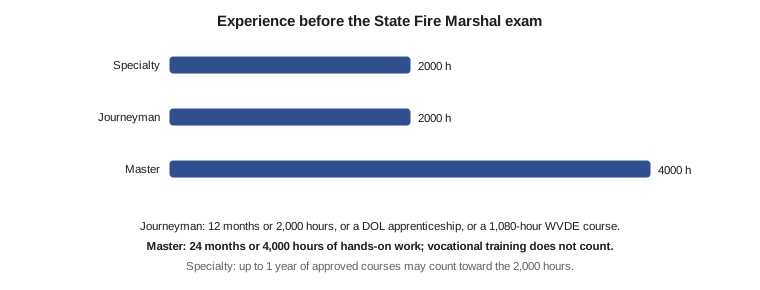
How the journeyman requirement differs
The journeyman requirement is lower and more flexible. The licensing page states it as one year, meaning 12 months, or 2,000 hours of hands-on work, limited to above-ground structural wiring. A candidate may instead qualify by completing a formal apprenticeship registered with the United States Department of Labor, or a 1,080-hour vocational course approved by the West Virginia Department of Education. The journeyman definition in the statute says at least one year of experience, and the rule adds that the journeyman knows the installation rules of the code and works under a master's supervision.
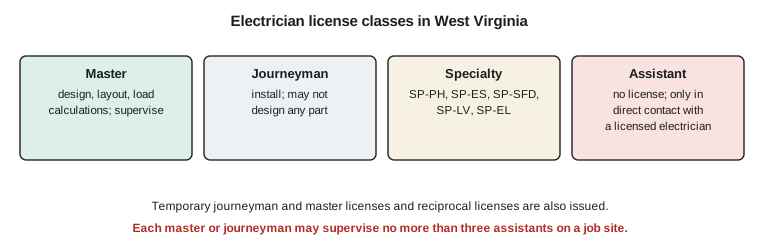
Look at the shape of the ladder. West Virginia does not require a candidate to hold a journeyman license before sitting the master exam; the requirement is stated as experience, not as time holding a lower license. In practice, almost every master candidate has held a journeyman license, because unlicensed paid work is illegal unless the person is an assistant working in direct contact with a licensed electrician, and hours as an assistant must be documented like any others. A candidate who is unsure whether assistant hours count toward the master should ask the State Fire Marshal's office before filing, and keep the answer in writing.
Proving the hours
The State Fire Marshal's exam application asks the candidate to document experience, and the application is signed. The rule gives the Fire Marshal power to deny or revoke a license obtained with a material misstatement of qualifications, and power to discipline a licensee who signs off on or vouches for another applicant's misstatement. That second ground is aimed at people like Dale. When he signs a statement that Renee worked for Kanawha Ridge for a given period doing hands-on electrical work, he puts his own license behind it.
Renee's file has four parts. The first is a summary sheet listing each employer, the start and end dates, average hours per week and the kinds of work. The second is payroll evidence: year-end wage statements or a payroll report Cora printed, showing hours by year. The third is a signed letter from Dale on company letterhead confirming the dates and describing the work. The fourth is a copy of her journeyman license. She does not need all of it for the application, but having it ready means she can answer any question from the Fire Marshal's office the same day. The application form names the required attachments; follow the current form, not this list.
Worked problem
Counting hours
Renee's records show 50 weeks a year at an average of 42 hours since she earned her journeyman license in 2019. How many years of that record would she need to show 4,000 hours?
Show solution
- Hours per year: 50 times 42 is 2,100 hours.
- Years needed: 4,000 divided by 2,100 is about 1.9 years.
- The licensing page states the requirement as 24 months or 4,000 hours, so either measure is satisfied after two years of full-time work.
Answer: About two years of her full-time record covers the requirement; her seven years are far more than enough.
Temporary and reciprocal licenses
Two other routes appear on the State Fire Marshal's page. A temporary license is offered for journeyman and master only. To qualify, the candidate must have completed a Department of Labor apprenticeship or a 1,080-hour Department of Education vocational program, with a certificate as proof, and must also meet the journeyman or master experience minimums. The page does not state how long a temporary license lasts, so a candidate who needs one should ask before relying on it.
Reciprocity is broad. Section 29-3B-4 directs the State Fire Marshal to grant the same or an equivalent class, without a written exam, to a person licensed in another jurisdiction that licenses electricians, if the person can show safe and competent work, is in good standing everywhere they are licensed and pays the fee. The Fire Marshal's page says the office recognizes reciprocity with all 50 states and with counties, cities and townships within them, and asks for a letter of good standing from the issuing agency and a copy of the license. The applicant must still meet West Virginia's experience minimums for the class requested. A separate provision in 29-3B-3 lets a former West Virginia licensee who returns as a permanent resident with an equivalent license from another state be licensed without the usual application or exam, where legislative rules allow it.
Background and identity
Section 29-3B-4 limits how a criminal record can affect eligibility. A conviction may bar initial licensure only if it relates directly and specifically to the duties of the license and, because the applicant has not been rehabilitated, creates a direct and substantial risk to the public. If five years have passed since the conviction or release, whichever is later, with no other crimes in that time, and the offense was not violent or sexual, the conviction may not disqualify the applicant. A person who has never held the license may ask the Fire Marshal in advance whether a record would disqualify them. Arrests that did not lead to a conviction may not be required to be disclosed. The statute also requires the application to include the applicant's Social Security number.
Section 29-3B-4a gives veterans a route to qualify for the exam based on military electrical training and experience. A veteran who served as an electrician should read that section and ask the Fire Marshal's office how military records are evaluated.
What eligibility is not
Eligibility to sit the exam is not the same as permission to work as a master. Until Renee passes, pays the activation fee and receives her license, she remains a journeyman: she may install under Dale's supervision, but she may not design or sign off on load calculations. Eligibility is also personal. It does not make Kanawha Ridge eligible for anything; the company's contractor license depends on the Contractor Licensing Board's rules, covered in Lesson 8.
Eligibility is also not a promise that the exam will be easy. The master exam tests the whole code, with calculations that carry real weight. Lessons 3 and 4 cover the application, the schedule and the exam itself.
Gaps, part-time work and self-employment
Real careers are rarely neat. Renee took eight weeks off in 2021 after a shoulder injury and worked a reduced schedule for a month afterward. She does not hide the gap; her summary sheet shows it, and the payroll report confirms the lower hours. Because the requirement is stated as 24 months or 4,000 hours, a candidate with gaps or part-time years can count hours instead of calendar time, and a candidate with long full-time years can count months. Either way, the record should show the work and add up.
Self-employed candidates face a harder proof problem, because no employer signs for them. A sole proprietor who has done paid electrical work under a valid license can show permits pulled, inspection records, invoices, tax records and letters from general contractors or customers. Work done without the required license is a different matter: it is not something to put on an application, and it can raise questions about compliance with 29-3B-2. Hours from out of state count only if they were hands-on electrical work and can be documented, and the candidate should expect the Fire Marshal's office to ask for the same kind of proof it would ask of a West Virginia employer.
The code itself is no help here. Experience rules are in the statute and the Fire Marshal's rule, not in the National Electrical Code, and no amount of code knowledge substitutes for a documented record. Renee's habit, which she now recommends to every apprentice at Kanawha Ridge, is to print a payroll hours report every January and file it with a one-page list of the year's major jobs. That record, kept for years, turns the eligibility question into a ten-minute task.
# Renee's hours by year since the journeyman license (from Cora's payroll report)
hours = {2019: 1150, 2020: 2080, 2021: 1610, 2022: 2120, 2023: 2160, 2024: 2090, 2025: 2140}
running = 0
for year, h in hours.items():
    running += h
    flag = "  <- 4,000 reached" if running - h < 4000 <= running else ""
print(f"{year}: {h} hours, running total {running}{flag}")2019: 1150 hours, running total 1150 2020: 2080 hours, running total 3230 2021: 1610 hours, running total 4840 <- 4,000 reached 2022: 2120 hours, running total 6960 2023: 2160 hours, running total 9120 2024: 2090 hours, running total 11210 2025: 2140 hours, running total 13350
The report shows that Renee passed 4,000 hours in 2021 even counting from her journeyman date, so the gap that worried her does not matter. She keeps the printout in her file in case the office asks.
| Question | Master | Journeyman |
|---|---|---|
| Experience on the licensing page | 24 months or 4,000 hours, hands-on | 12 months or 2,000 hours, or approved program |
| Does vocational training count? | No | Yes: a 1,080-hour WVDE course |
| Does an apprenticeship count? | Hours worked count as experience | Yes: a DOL registered apprenticeship |
| Statutory definition | At least two years, all phases | At least one year |
| May design? | Yes | No |
Common mistakes
MistakeCounting a vocational course toward the master requirement.
InsteadThe licensing page says vocational training cannot count toward the master's 4,000 hours.
MistakeAssuming a journeyman license must be held for two years first.
InsteadThe requirement is stated as experience; most candidates are journeymen, but check how the office counts each kind of hour.
MistakeTreating a supervisor's signature as a formality.
InsteadThe Fire Marshal may discipline a licensee who vouches for an applicant's material misstatement.
MistakeExpecting reciprocity to skip the experience minimums.
InsteadThe page says reciprocal applicants must meet West Virginia's minimums for the class.
MistakeAssuming any old conviction is disqualifying.
Instead29-3B-4 limits disqualification to convictions directly related to the license that create a substantial risk, with a five-year rule for most offenses.
Summary and key terms
- A master needs 24 months or 4,000 hours of hands-on work; vocational training does not count.
- A journeyman needs 12 months or 2,000 hours, or a DOL apprenticeship or a 1,080-hour WVDE course.
- The application is signed, and misstatements can lead to denial or revocation for the applicant and discipline for the person who vouches.
- Temporary licenses are offered for journeyman and master; ask the office about their term.
- Reciprocity is offered for licensees of other jurisdictions who meet West Virginia's minimums.
- 29-3B-4 limits how criminal records affect eligibility.
- Hands-on experience
- Time actually installing, altering or repairing electrical systems, as opposed to office or sales work.
- 1,080-hour course
- A West Virginia Department of Education approved vocational program that can qualify a journeyman candidate.
- Temporary license
- A journeyman or master license issued to a qualifying apprenticeship or vocational graduate who meets the experience minimums.
- Letter of good standing
- A statement from another licensing agency confirming a license, how it was obtained and any discipline.
- Material misstatement
- A false statement about qualifications or experience that matters to the licensing decision.
Practice problems
Work each problem on paper first, then reveal the answer to check.
Tyler, an assistant, finished a 1,080-hour WVDE course. Can he use it toward the master exam later?
Show answer
No; it can qualify him for the journeyman exam, but vocational training does not count toward the master.
How many hours does the master requirement state?
Show answer
4,000 hours, or 24 months, of hands-on work.
Dale signs an experience letter that overstates a former employee's hours. What is his risk?
Show answer
Discipline under 29-3B-7 for signing off on or vouching for a material misstatement.
A Virginia master moves to Charleston. What does reciprocity require?
Show answer
A letter of good standing, a copy of the license, West Virginia's experience minimums and the fee.
Renee is eligible. May she now design a service?
Show answer
Not until she passes, pays the activation fee and holds the master license.
Lesson quiz · 5 questions
Score 60% or more to complete this lesson.
Create a free account to save your progress, take quizzes and earn a certificate.